Updated July 5, 2026 · 8 min read
By Boise Bath — bathroom & shower remodeling in Boise & the Treasure Valley
The short answer
Labor typically runs 40–65% of a bathroom remodel budget, averaging close to half, per NerdWallet and Fixr (2026). By category, Fixr's data puts shower/tub work and vanity/shelving at roughly 25% each of total cost, with fixtures, tile, and utilities around 10% each — tile and plumbing carry more labor than materials cost per dollar spent.
Key takeaways
- NerdWallet (2026) puts labor at 40–65% of total bathroom remodel cost; Fixr's data centers that closer to 50%.
- By category, Fixr splits average project cost roughly: shower/tub 25%, vanity/shelving 25%, fixtures 10%, tile 10%, utilities 10%, countertops 6%, doors/windows 5%, permits 4%, contingency 5%.
- This Old House (2026) prices plumbing work at an average of $5,545 and shower installation at $8,044 — two of the largest single line items in a full remodel.
- Materials were cited by nearly 74% of homeowners as the largest contributor to cost overruns in This Old House's 2026 survey, even though labor is the larger baseline share.
- Tile and plumbing are labor-heavy relative to their material cost, while fixtures and countertops skew more toward the materials side.
How much of a bathroom remodel is labor vs. materials?
Homeowners often assume the bulk of a remodel budget goes to the things they can point to — tile, a vanity, a new tub. In reality, roughly half the total typically goes to labor: NerdWallet (2026) puts labor at 40–65% of total project cost, and Fixr's 2026 data centers that closer to 50%, averaging around $6,000 of a typical $12,000 project.
The range matters as much as the average. A bathroom that keeps its existing layout and uses prefab, standard-size components sits toward the 40% end, because most of the work is straightforward installation. A bathroom that moves plumbing, adds custom tile work, or reconfigures the layout pushes toward the 65% end, because those changes are measured in skilled hours rather than material cost. Knowing which end your project is likely to land on is a better planning tool than the single "50%" average by itself.
That split is not evenly spread across every category, though. Some parts of a remodel — tile, plumbing — lean heavily on skilled labor relative to their material cost, while others — a countertop, a faucet — are closer to a straight materials purchase with comparatively simple installation. Below is where the money actually lands, trade by trade.
The number that surprises people
This Old House's 2026 survey found materials were cited by nearly 74% of respondents as the largest contributor to their remodel's final cost — even though labor is typically the larger baseline share of the budget. The two are not in conflict: labor is the bigger fixed percentage, but material choices are what most often push a project over its original estimate.
The category breakdown, by share of total cost
Fixr's 2026 cost data breaks a typical bathroom remodel down by category as a share of total project cost — a useful map of where a budget actually lands, combining both labor and materials for each category.
| Category | Share of total cost | Typical dollar range |
|---|---|---|
| Shower / tub | ~25% | $1,500–$4,500 |
| Vanity & shelving | ~25% | $1,500–$4,500 |
| Fixtures | ~10% | $1,200–$3,600 |
| Tile work | ~10% | $600–$1,800 |
| Utilities (plumbing/electrical work) | ~10% | Varies by scope |
| Countertops | ~6% | $360–$1,100 |
| Doors / windows | ~5% | $240–$720 |
| Contingency | ~5% | ~$600 |
| Permits | ~4% | ~$500 |
Source: Fixr (2026). Percentages and dollar ranges are illustrative of a typical $12,000 project; larger or higher-finish remodels scale proportionally but not identically.
1. Shower and tub work: the single biggest line item
Shower and tub work is the largest category in Fixr's breakdown at roughly a quarter of total cost, and This Old House (2026) separately prices average shower installation at $8,044 — one of the largest single figures in a full remodel. That number reflects both materials (glass, tile, pan, fixtures) and the labor to waterproof and plumb it correctly, which is why a shower or tub swap moves the budget more than almost any other single decision.
2. Vanity and shelving: materials-heavy, labor-light
Tied with shower/tub work at roughly 25% of total cost, vanity and shelving spending is more heavily weighted toward the purchase price of the piece itself — a prefab vanity installs in a fraction of the time a custom tile shower takes to build. This is one of the categories where choosing a mid-tier, standard-size product over a fully custom one saves real money without touching the labor side much at all.
3. Plumbing: where labor quietly dominates
This Old House (2026) prices average plumbing work at $5,545 for a full bathroom remodel — a number that swings heavily based on labor, not materials, because moving or extending supply and drain lines is measured in hours of skilled work, not in the cost of the pipe itself. This is the category most affected by a layout change: keeping fixtures in their existing locations keeps this number close to its low end; relocating them pushes it up regardless of how modest the fixtures themselves are.
4. Tile work: the most labor-intensive dollar-for-dollar
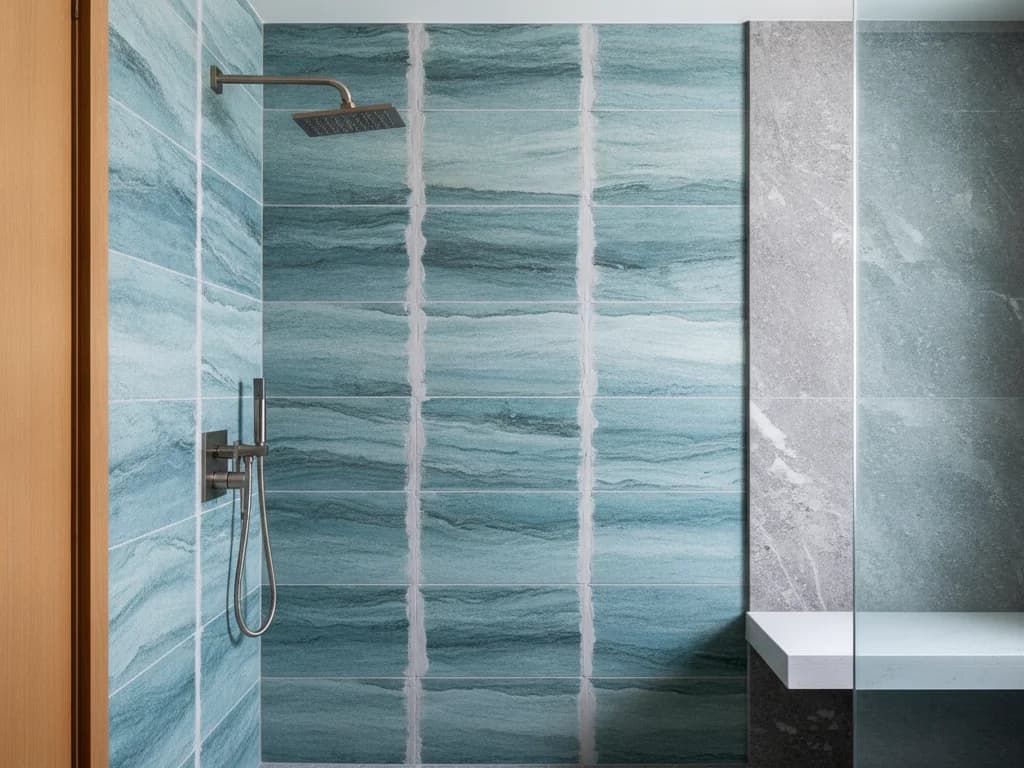
Tile sits at roughly 10% of total cost in Fixr's breakdown, but it is one of the more labor-intensive categories relative to its material price — setting tile correctly (especially in a wet, waterproofed shower) takes precision time that a straight materials cost does not capture. Large-format tile reduces this somewhat by cutting down the number of pieces and grout lines to set, which is why it is a common budget tactic even at a similar per-square-foot material cost.
5. Fixtures: a real but smaller share
Fixtures — faucets, showerheads, the toilet — run roughly 10% of total cost per Fixr, in a $1,200–$3,600 typical range. Installation labor here is comparatively quick per fixture, so this category tracks closer to the sticker price of what you choose than the categories above, making it one of the more predictable line items to budget.
6–7. Countertops, doors, and windows: the smaller material-driven slices
Countertops run about 6% of total cost ($360–$1,100 typical) and, like vanities, skew toward material cost with comparatively simple installation once templated. Doors and windows, at about 5% ($240–$720 typical), are usually a smaller, more contained line item unless the remodel changes an opening's size or location, which pulls in framing and trim labor beyond a straight swap.
8. Permits and contingency: the categories with no materials at all
Permits (about 4%, roughly $500 typical) and a budget contingency (about 5%, roughly $600 typical) are pure overhead — no materials involved at all, and the labor they represent is administrative rather than hands-on. They are easy to overlook when comparing bids, but a quote missing either one is a quote missing real cost, not a lower price.
How to use this breakdown when comparing bids
When two contractors quote the same project at different totals, this breakdown is a useful diagnostic. If the gap is concentrated in shower/tub, plumbing, or tile line items, the difference is most likely labor — different crews, different timelines, or different waterproofing methods. If the gap is concentrated in vanity, countertop, or fixture line items, it is most likely a materials-grade difference — one bid specs a mid-tier vanity, the other a custom one.
Ask for the bid broken out by category rather than as a single number. A contractor who can show you roughly where their number lands relative to the shares above — even informally — is pricing the job the same way the underlying cost data is structured, which is a reasonable proxy for a bid that has been thought through rather than estimated from the outside.
What this means for your budget
The practical takeaway is that cutting materials cost has a ceiling — vanities, countertops, and fixtures only save so much before quality suffers — while the labor-heavy categories (shower/tub, plumbing, tile) respond more to layout and scope decisions than to shopping choices. Keeping the existing layout, choosing large-format tile, and picking a standard-size shower or tub all reduce the labor side of the budget, which is where roughly half the money goes.
For the sourcing and material-side tactics that pair with this, see our bathroom remodel budget tips, and for the full local cost picture, our Boise bathroom remodel cost guide. When you are ready for numbers specific to your bathroom rather than category averages, request a free, itemized estimate.
Ready to plan your Boise bathroom?
Licensed & insured · 3-year workmanship warranty
Frequently asked questions
- Is labor or materials the bigger cost in a bathroom remodel?
- Labor is typically the larger share — NerdWallet (2026) puts it at 40–65% of total cost, and Fixr's data centers that closer to 50%. Materials, however, were cited by nearly 74% of homeowners in This Old House's 2026 survey as the biggest contributor to cost overruns, since material choices are the easiest place for a budget to creep upward.
- What is the most expensive category in a bathroom remodel?
- Shower or tub work is typically the largest single category, at roughly 25% of total cost per Fixr (2026), with This Old House separately pricing average shower installation at $8,044. Vanity and shelving ties it at roughly 25% of total cost.
- Why does plumbing cost so much if the pipe itself is cheap?
- Plumbing cost is driven by labor hours, not material cost — This Old House (2026) prices average plumbing work at $5,545 for a full remodel. Relocating supply or drain lines takes skilled time regardless of how inexpensive the pipe and fittings are, which is why moving fixtures raises cost even when the fixtures themselves are modest.
Sources
- NerdWallet — Bathroom Remodel Cost (2026)
- Fixr — Bathroom Remodel Cost (2026)
- This Old House — Bathroom Remodel Cost (2026)
Claims and figures are drawn from the sources above and provided for general guidance; your project may vary. Photography is illustrative of design concepts. For a fixed price on your specific bathroom, request a free estimate.