
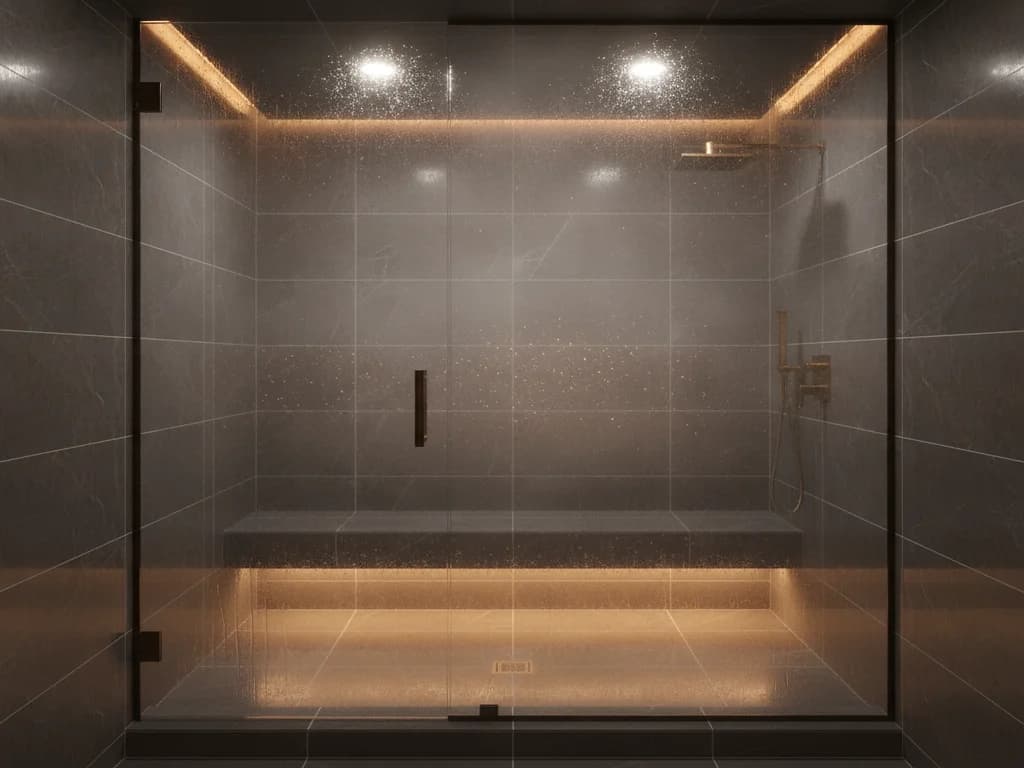
Steam Shower Installation
A steam shower turns an ordinary enclosure into a private spa — a vapor-sealed room that holds steam the way a commercial steam room does. Building one correctly is unforgiving work: every surface must be waterproofed and vapor-tight, sloped ceilings keep condensation off your shoulders, and the generator has to be sized to the cubic volume of the room. That is precisely the kind of detail work we do.
What's included
Steam Shower Installation
- Steam generators sized to the enclosure and plumbed for service access
- Vapor-tight membranes behind every tiled surface, ceiling included
- Sloped ceiling design so condensation sheets to the walls, not on you
- Tight-sealing glass with transom for controlled ventilation
- Bench seating, aroma and lighting controls placed where you reach them
How it works
Our steam shower installation process
The right choice for homeowners who want a genuine at-home steam room and are willing to invest in the vapor-tight construction it takes to hold steam properly, not just a shower with a generator bolted on.
- 1
Design & Sizing
We measure the enclosure's exact cubic volume to size the steam generator correctly, plan the sloped ceiling that keeps condensation from dripping on you, and lay out bench, control, and lighting placement together.
- 2
Vapor-Proofing
Every surface — walls, ceiling included — gets a vapor-tight membrane behind it before any tile goes up. This is the step that decides whether the room actually holds steam or leaks it into the walls over time.
- 3
Tile & Controls
Tile is set over the sealed shell, and the generator, steam head, and control panel are plumbed and wired for reliable service access. Bench seating goes in at this stage too.
- 4
Glass & Commissioning
A tight-sealing glass enclosure with a transom is fitted to hold steam in while allowing controlled ventilation. We run the system through a full steam cycle with you before calling it finished.
What actually makes a shower a steam shower
A steam shower looks like a tiled walk-in shower with one added control on the wall, but the difference is in the parts you never see. A dedicated generator, usually tucked into a nearby closet, vanity cavity, or heated crawlspace, boils water and pipes low-pressure vapor to a head inside the enclosure. A digital control sets temperature and run time, and the whole room is built to trap that vapor instead of letting it drift into the walls.
The pieces have to work as a system. Undersize the generator and the room never reaches a satisfying temperature; skip the vapor barrier and moisture migrates into framing you can't inspect. The table below breaks down what each component does so you can picture how a steam enclosure differs from the shower you already know.
| Component | What it does |
|---|---|
| Steam generator | Boils water and produces the vapor; sized to the enclosure's cubic volume and wired to its own circuit |
| Steam head | Releases vapor low in the enclosure, positioned away from feet and seating |
| Digital control | Sets temperature and session length; often adds lighting, audio, or aromatherapy |
| Vapor barrier | A continuous membrane behind every tiled surface — walls and ceiling — that keeps moisture out of the structure |
| Sloped ceiling | Pitched a few degrees so condensation runs to the walls instead of dripping straight down on you |
| Sealed enclosure | Full-height glass with a transom or vent that holds steam in while allowing controlled airflow |
| Built-in seating | A tiled bench, since a steam session is something you sit through rather than stand under |
Why it can't just be a regular shower with a generator added
The instinct is to treat steam as an accessory — buy a unit, plumb it in, done. In practice the enclosure itself is the hard part. A standard shower is designed to shed water that lands on tile and drain it away; a steam shower has to contain a warm, pressurized vapor that seeks out every unsealed gap. That changes how the room is built from the studs out.
Three things separate the two builds. First, the waterproofing wraps the ceiling as well as the walls, because vapor rises and condenses overhead. Second, that ceiling is deliberately sloped so the condensation it collects runs off to the sides rather than raining back down. Third, the enclosure is fully sealed to the top with a tight door and a transom or vent, instead of the open gap a normal shower leaves for airflow. Leave any of those out and you get a shower that makes steam but never holds it — moisture ends up in the walls instead of on your skin.
What you actually get out of it
The appeal of a steam shower is the experience, not the fixture. Warm, high-humidity air surrounds you at a lower temperature than a sauna's dry heat, which many people find easier to sit in for longer. It turns an everyday shower stall into a room you linger in — a few quiet minutes that double as a warm, moist environment before or after the actual washing.
Because it starts from a shower you were likely building anyway, a steam upgrade rides on top of an enclosure that still functions as a normal walk-in shower the rest of the time. You are not giving up floor space to a separate sauna room or a fixture that only earns its keep occasionally. If you're weighing steam against a dry sauna, our steam shower vs. sauna comparison lays the two side by side, and the honest pros and cons of a steam shower covers where it does and doesn't make sense before you commit to the vapor-tight build.
Living with it: ventilation and upkeep
A well-built steam shower asks for less maintenance than people expect, but it isn't zero. The generator needs periodic descaling — mineral scale builds up wherever water is boiled, and hard water shortens the interval between cleanings — and the tile gets the same care as any other shower. Most of the long-term reliability, though, comes from the build behind the tile rather than anything you do afterward.
The part homeowners most often overlook is what happens after the steam shuts off. A steam-tight enclosure holds moisture on purpose, so the room needs a real plan for clearing that humidity once the session ends — an appropriately sized exhaust fan, run long enough to dry the space, keeps moisture from lingering in grout and adjoining surfaces. Our bathroom exhaust fan and venting guide covers sizing and duct routing so a sealed steam room still dries out properly between uses.
Sizing the enclosure before you size the generator
Generator capacity is driven by the enclosure's adjusted cubic volume, so the footprint and ceiling height you choose decide how large — and how expensive — a unit the room needs. A bigger stall with a stone finish and a tall ceiling asks for far more capacity than a compact tiled enclosure, which is why settling the dimensions early keeps the rest of the build honest. Deciding on the footprint first also lets us plan bench placement and the steam head location around how you'll actually use the room.
If you're still working out the size, our guide to walk-in shower dimensions and sizes walks through comfortable footprints, and it's worth setting those numbers before pricing a generator to them. A stall that's a little too large isn't just harder to heat — it commits you to a bigger, costlier unit for the life of the room.
What drives the cost
Two variables move a steam shower's price more than anything else: whether the enclosure is prefab or fully custom, and the surface material lining it. A prefab acrylic unit is the least expensive path; a custom stone-and-tile enclosure sits at the top, both because of the finish and because stone demands roughly double the generator capacity of ceramic tile for the same room volume. Ceiling height, the number of exterior walls, and add-ons like lighting or aromatherapy nudge the figure from there.
Because we offer steam as an upgrade to a walk-in shower build rather than a standalone product, the honest way to budget is the base shower cost plus what the steam system adds on top. Our steam shower cost guide for Boise pulls together cited national ranges for the generator, the installation tiers, and how the upgrade prices out over a standard shower — the clearest starting point before you request a firm number. When you're ready for a figure specific to your space, a free estimate puts real dimensions and finishes behind it.
Getting the design and sizing right
A steam shower rewards planning that starts with how you'll use the room, not with the fixture catalog. The bench is the anchor: a steam session is something you sit through, so its height, depth, and placement relative to the steam head decide whether the experience is comfortable or awkward. From there we position the digital control within easy reach of the seat, keep the steam head low and clear of feet and legs, and set the door and any transom to seal cleanly while still allowing controlled venting when the session ends.
Ceiling height and finish quietly drive the whole design. A taller ceiling and a stone surface both demand more generator capacity for the same footprint, so the dimensions you settle on ripple straight through to equipment cost and heat-up time. That's why we lock the enclosure size before specifying a unit rather than the reverse. If you're still weighing footprints, our guide to walk-in shower dimensions and sizes covers comfortable proportions to work from — a sound starting point for a room you'll want to linger in.
Steam vs. a regular shower — is it worth it?
The honest answer is that a steam shower is a comfort feature, not a necessity, and whether it earns its place depends on how you'll actually use it. If a warm, high-humidity soak at the start or end of the day is something you'll reach for regularly, the vapor-tight build pays you back every time you use it — and the enclosure still works as an ordinary walk-in shower the rest of the week, so it isn't space or plumbing spent on a single-purpose fixture. If steam is more of a someday-nice-to-have, the extra sealing, sloped ceiling, and generator may be budget better spent elsewhere in the room.
It's worth setting expectations against the alternatives too. Our honest pros and cons of a steam shower lays out where it delivers and where it disappoints, and if what you're really after is heat therapy rather than the shower itself, our steam shower vs. sauna comparison weighs wet heat against dry across cost, space, and upkeep so you choose the feature that fits how you'll live with it.
Good to know
Steam Shower Installation questions
- What electrical does a steam shower need?
- A steam generator needs a dedicated circuit sized to the unit, plus a location that gives a service technician real access for maintenance. We plan that circuit and generator placement early so it's built in rather than retrofitted.
- How much maintenance does a steam shower require?
- Beyond periodic descaling of the generator and the same tile care as any shower, a properly vapor-sealed steam room doesn't ask for much. Most of the long-term reliability comes from the vapor-tight build behind the tile, not from upkeep afterward.
- Will steam escape into the rest of the bathroom or house?
- A correctly built steam shower is sealed with a vapor-tight membrane and a tight-fitting enclosure with a controlled transom, so steam stays where it belongs. That containment is the whole point of building it as vapor-proof construction rather than a standard shower with a generator added.
- Where does the steam generator actually go?
- The generator lives outside the enclosure, not inside it — commonly in an adjacent closet, a vanity cavity, or an insulated space within roughly 25 feet of the steam head, on its own dedicated circuit. We plan that location during design so a technician can reach it for descaling later, rather than sealing it behind finished tile where service means demolition.
- Does a steam shower use a lot of water?
- Less than you'd think, and the numbers are not close. Mr. Steam puts a typical 20-minute steam session at about two gallons. A showerhead running for the same 20 minutes uses 40 to 50 gallons — the federal maximum flow rate is 2.5 gallons per minute, and a WaterSense-labelled head is capped at 2.0 (EPA). The real operating cost is the electricity the generator draws to heat that water, which is why the unit is sized to the room rather than oversized.
- Can a steam shower be added to an existing bathroom, or does it need a full remodel?
- It effectively rebuilds the shower. Because the enclosure has to be vapor-sealed on every surface including the ceiling, and the ceiling has to be sloped, retrofitting steam into an existing tiled shower means opening it back up to install the membrane and generator plumbing correctly. It's most practical to build steam in as part of a walk-in shower or larger bathroom project rather than as a bolt-on to a finished room.
Steam Shower Installation by city
Serving Boise & the Treasure Valley
Guides & ideas
Planning your steam shower installation project
Request a free estimate
Ready to start your steam shower installation bathroom project?
Tell us a little about your space and we'll follow up to schedule a free, no-obligation design consultation with clear, fixed pricing.
Prefer to talk? Call (208) 775-8999

Ready to Transform Your Bathroom?
A fixed-price quote, a 3-year workmanship warranty, and a project manager who answers the phone. Let's build a space you'll love for years.
No obligation · Licensed & insured (RCE-6681702) · 3-year workmanship warranty