
Accessible Bathrooms
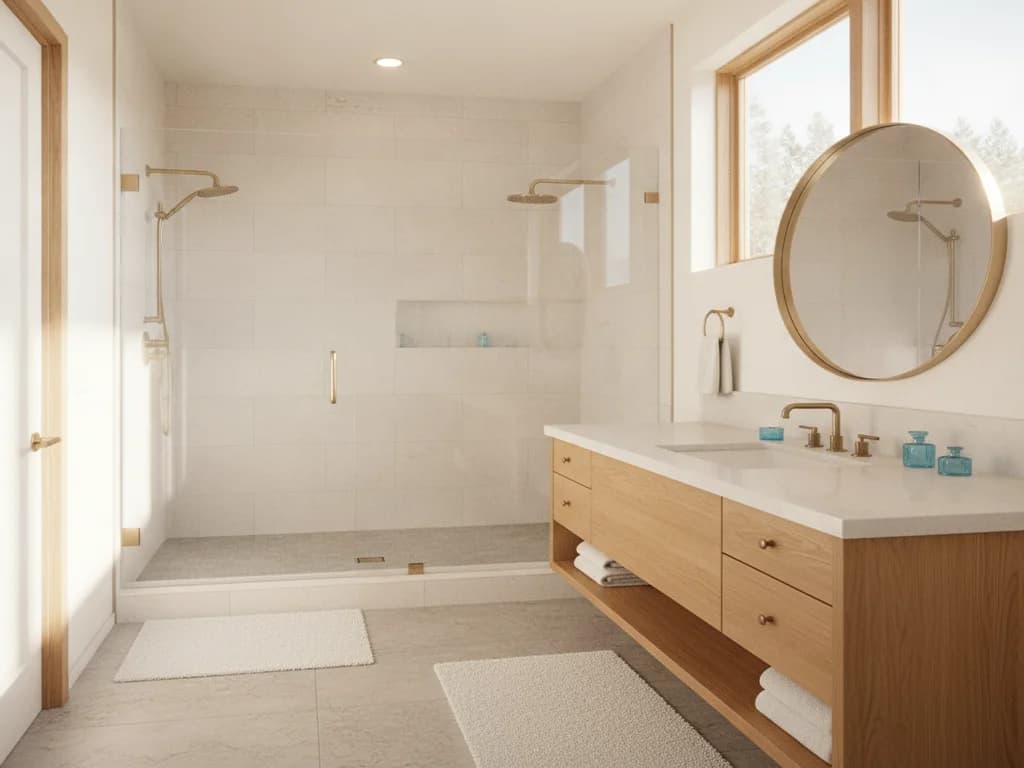
Safety and style are not mutually exclusive. We design barrier-free, age-in-place bathrooms with curbless entries, grab bars, and built-in seating that look intentional rather than institutional — so the room is comfortable now and ready for the years ahead.
What's included
Accessible Bathrooms
- Curbless, zero-threshold shower entries
- Reinforced walls and discreet grab bars
- Built-in shower seating and handheld sprays
- Comfort-height fixtures and slip-resistant flooring
- Wider clearances for easier movement
How it works
Our accessible bathrooms process
The right choice for anyone planning to age in place, living with limited mobility, or wanting a barrier-free bathroom that's safe today and ready for the years ahead without looking institutional.
- 1
Assess Needs
We start with how the room will actually be used — reach, transfers, seating, and any mobility aids — to define clearances and fixture heights. This drives every later decision rather than fitting a person to a stock layout.
- 2
Reinforce & Plan
We open the walls to add solid blocking so grab bars can be mounted securely and discreetly wherever they're needed. The layout is widened for easier movement and approach.
- 3
Curbless Pan
We build a zero-threshold shower pan that drains properly with no curb to step over, fully waterproofed beneath slip-resistant flooring. Built-in seating and a handheld spray are set within easy reach.
- 4
Comfort Finishes
Comfort-height fixtures, accessible controls, and the grab bars go in, finished to look intentional rather than clinical. We confirm every element is reachable and secure before completion.
The features that make a bathroom truly accessible
A barrier-free bathroom is a system of parts working together, not a single fixture. The foundation is a curbless, zero-threshold entry so a walker, rollator, or wheelchair rolls straight in with no lip to catch a toe or a wheel — the same flush floor detailed in what a roll-in shower is. On top of that sit the pieces that let a person use the room independently.
Grab bars give something solid to hold for balance and for transfers on and off a seat or toilet, and they only work when they are anchored into blocking behind the wall and placed where a hand actually reaches — the placement logic is laid out in the grab bar placement guide. A built-in or wall-folding shower seat lets a person bathe seated, and a handheld sprayer on a vertical slide bar brings the water to them at any height.
The smaller details finish the picture: lever or single-handle faucets that work without a tight grip, comfort-height toilets and a vanity with open knee space for a seated user, and controls positioned near the entry rather than under the spray. Each element does one job, and together they turn a hazard-filled room into one a person can use safely on their own terms.
ADA and universal-design dimensions worth building to
The Americans with Disabilities Act accessibility standards, published by the U.S. Access Board and available at ADA.gov, are written for public buildings — a private home is not legally bound by them. What they give a homeowner is a trusted, field-tested blueprint for dimensions that genuinely work for mobility, rather than guesswork. Building an accessible bathroom to these figures means it will still serve a wheelchair or walker years from now.
The clearances below are the ones that shape a floor plan the most. Getting them right early is nearly free; discovering a doorway or turning space is too tight after the walls close is expensive. Fuller tables live in the bathroom ADA dimensions reference, the bathroom door sizes and clearances guide, and the accessory placement heights guide.
| Element | ADA-referenced dimension |
|---|---|
| Clear doorway width | 32" minimum clear opening |
| Turning space (circle) | 60" diameter for a wheelchair to turn |
| Turning space (T-turn) | 60" x 60" T-shaped alternative |
| Standard roll-in shower | 30" deep x 60" wide, full-width entry |
| Transfer shower | 36" x 36" with a folding seat |
| Grab bar mounting height | 33"–36" above the finished floor |
| Comfort-height toilet seat | 17"–19" above the finished floor |
Figures reflect the 2010 ADA Standards / U.S. Access Board guidelines (ADA.gov). The ADA legally governs public and commercial spaces; in a home these are best-practice targets, not a code you must meet. Verify current requirements with the Access Board for your project.
Walk-in tub or roll-in shower: which fits the need
The two most common accessible bathing choices solve different problems, and picking the wrong one is a costly mistake to undo. A walk-in tub is a deep tub with a watertight door you step through over a several-inch threshold and sit in to soak. It suits someone who loves a bath and can still step over a low door, but you cannot roll a wheelchair into it, and the bather has to wait for it to fill and drain while seated in the tub.
A roll-in or curbless shower is the opposite: a flush, seated-or-standing shower a person rolls or walks straight into, with grab bars and a handheld within reach. For anyone using a wheelchair, or for households planning around progressive mobility loss, the roll-in shower is almost always the more flexible long-term answer. The full head-to-head is in walk-in tub vs. walk-in shower, and tub pricing considerations are in walk-in tub cost.
Neither is automatically "the accessible option." The right call comes from who will use the room, how their mobility is likely to change, and whether soaking or step-free rolling access matters more — a conversation we have before any pan is built.
Designing falls out of the room: floors and lighting
Accessibility and safety overlap most sharply in one statistic: the CDC reports that about one in four adults aged 65 and older falls each year, that falls are the leading cause of injury in that age group, and that the bathroom — wet, hard-surfaced, and full of things to grab at — is one of the highest-risk rooms in the home. A well-designed accessible bathroom is, in large part, a bathroom engineered to prevent those falls.
Flooring is the first line of defense. A slip-resistant floor and shower surface keep footing secure when everything is wet; the trade-offs between materials and finishes are covered in best non-slip bathroom flooring, and fixes for an existing slick floor are in slippery bathroom floor solutions. Smaller tile and textured surfaces in the wet zone add grip where it counts.
Lighting does quieter work. Even, layered light with no dark corners, plus low-level or motion-activated night lighting on the path from bed to bathroom, removes the shadows and squinting that cause missteps. Contrast helps too — a toilet seat, grab bar, or counter edge that stands out visually from its background is easier to locate and use for anyone with declining vision.
What drives the cost of an accessible bathroom
An accessible remodel spans a wide price range because "accessible" covers everything from adding grab bars and a comfort-height toilet to rebuilding the floor for a full roll-in shower. The single biggest cost driver is usually the curbless shower: creating a truly flush entry means recessing or building up the subfloor to bury the drain and slope the pan, which is structural work rather than a surface swap.
Other drivers include the scope of layout changes (widening a doorway or moving a wall to gain turning space costs more than working within the existing footprint), the fixtures chosen (a walk-in tub, a custom-tiled roll-in, or a high-end comfort-height vanity each move the number), and what is found once the walls open — outdated wiring, hidden water damage, or framing that needs reinforcing. Reinforced blocking for grab bars, by contrast, is inexpensive to add while the walls are already open.
For Idaho-specific ranges and the line items that move the total, see the accessible bathroom remodel cost guide for Boise. We give clear, fixed pricing before work begins so the scope is understood up front rather than drifting mid-project.
Accessible bathrooms in the Treasure Valley
Much of the Treasure Valley’s housing stock — from established Boise and Nampa neighborhoods to ranch homes across Meridian, Caldwell, and Eagle — was built with narrow bathroom doorways and compartmentalized layouts that predate any thought of wheelchair access. Widening a 24- or 28-inch door to a clear 32-inch opening is one of the most common first moves, and whether it is straightforward depends on what is in the wall; the trade-offs are in can you widen a bathroom doorway.
The region’s strong share of single-story homes is an advantage: a main-floor bathroom with no stairs to reach it is already halfway to letting someone live independently on one level. That makes a ground-floor accessible bathroom one of the highest-value changes a Treasure Valley homeowner can make for staying in a home long-term.
Because so many of these remodels are done ahead of an urgent need, it is worth designing with the future in view. The forward-looking approach — universal design that looks like any premium bathroom while quietly supporting changing mobility — is covered in aging-in-place bathroom ideas and what universal design is.
Good to know
Accessible Bathrooms questions
- Does an accessible bathroom have to look institutional?
- Not at all — modern accessible design integrates curbless entries, reinforced walls, and grab bars that read as finished hardware rather than medical equipment. The result is a room that's safe and comfortable while still matching the rest of the home.
- How does a curbless shower keep water off the floor?
- A curbless pan is built with a careful slope and a properly placed drain so water flows toward it instead of out the open entry. The whole area is waterproofed beneath the tile, and the layout positions the drain and fixtures to keep the rest of the floor dry.
- Can grab bars be added securely to any wall?
- Grab bars need solid backing behind the wall to hold real weight, which is why we add reinforced blocking during construction. Mounting to drywall anchors alone isn't safe for support, so planning the reinforcement before the walls close up is essential.
- What is the difference between an accessible bathroom and an aging-in-place bathroom?
- An accessible bathroom is usually built around a present mobility need — barrier-free features that someone relies on today, such as a roll-in shower, wider clearances, and grab bars in use now. An aging-in-place bathroom is planned ahead of need: it looks like any beautifully finished bathroom, with reinforcement and clearances built in quietly so it is ready whenever mobility changes. The construction overlaps heavily; the difference is timing and how visible the features are.
- How wide does a bathroom doorway need to be for a wheelchair?
- The ADA standards call for a clear opening of at least 32 inches, measured with the door open, which typically means a 34- to 36-inch door once the frame and hinge are accounted for. Many older Treasure Valley bathrooms have 24- to 28-inch doors that are too narrow for a wheelchair or walker, so widening the opening is a common part of an accessible remodel. Whether it is simple depends on what runs through that wall.
- Do I have to follow ADA rules in my own home?
- No. The ADA legally applies to public and commercial buildings, not private residences, so its dimensions are not a code you must meet at home. What they are is a proven blueprint for clearances and heights that genuinely work for wheelchairs, walkers, and transfers. Building to those figures — or adapting them to a specific person’s needs — is the reliable way to get real accessibility rather than guessing, per ADA.gov and the U.S. Access Board.
Accessible Bathrooms by city
Serving Boise & the Treasure Valley
Guides & ideas
Planning your accessible bathrooms project
Request a free estimate
Ready to start your accessible bathrooms bathroom project?
Tell us a little about your space and we'll follow up to schedule a free, no-obligation design consultation with clear, fixed pricing.
Prefer to talk? Call (208) 775-8999

Ready to Transform Your Bathroom?
A fixed-price quote, a 3-year workmanship warranty, and a project manager who answers the phone. Let's build a space you'll love for years.
No obligation · Licensed & insured (RCE-6681702) · 3-year workmanship warranty