Updated July 17, 2026 · 8 min read
By Boise Bath — bathroom & shower remodeling in Boise & the Treasure Valley
The short answer
Mount towel bars 42–48 inches above the floor, towel rings 48–52 inches, robe hooks 65–70 inches, and toilet paper holders 26 inches to center and 8–12 inches in front of the bowl. ADA-accessible heights differ: grab-bar and accessory reach ranges run 15–48 inches, with the towel bar no higher than 48 inches.
Key takeaways
- Standard towel bars mount 42–48 inches above the finished floor; a hand-towel ring sits a little higher at 48–52 inches near the sink.
- A toilet paper holder centers about 26 inches off the floor and 8–12 inches in front of the toilet bowl for an easy reach.
- Robe and towel hooks go high — 65–70 inches — so a hung towel or robe clears the floor and drains.
- ADA-accessible reach ranges cap accessory operable parts at 48 inches maximum and 15 inches minimum above the floor.
- Blocking behind the drywall matters as much as height: towel bars and hooks pull hard, and anchors alone strip out over time.
- These are accessory heights only — grab bars and heated towel bars follow their own placement rules covered in separate guides.
Why accessory height is worth getting right
Accessory placement is one of the last things installed in a remodel and one of the first things you notice every day. A towel bar mounted too low drags a bath towel on the floor; a paper holder set behind the toilet forces an awkward twist; a hook screwed into drywall with no blocking behind it tears loose the first time a wet robe hangs on it. None of these are structural failures, but all of them read as "builder-grade" the moment you live with them.
This reference gives you the standard mounting heights for every common bathroom accessory, plus the ADA-accessible ranges when the bathroom serves someone with limited mobility. It stays deliberately clear of two related jobs it borders. Safety grab bars — which carry body weight and follow strict placement math — live in grab bar placement guide. Heated towel bars and their electrical requirements live in towel warmers and heated features. This page is about the everyday hardware: bars, rings, hooks, holders, and shelves.
Standard bathroom accessory heights at a glance
Every number below is measured from the finished floor to the center of the accessory unless noted. Treat them as a starting point, not a rule — a household of tall adults may nudge bars up an inch or two, and a kids’ bath comes down. What matters is consistency: bars and rings that share a sight line should align, and hooks in a row should sit level with one another.
The single most useful habit is to mock everything up with painter’s tape before a hole is drilled. Hang a real towel over a taped line and step back; the "right" height is the one that keeps the towel off the floor and within a natural reach. The table sets the standard heights against the ADA-accessible figures so you can see where they diverge.
| Accessory | Standard height (to center) | ADA-accessible guidance |
|---|---|---|
| Towel bar (bath towels) | 42–48" above floor | No higher than 48"; within reach range |
| Towel ring (hand towel, at sink) | 48–52" above floor | Operable part 15–48" above floor |
| Robe / towel hook | 65–70" above floor | Operable part max 48" if used for reach |
| Toilet paper holder | 26" to center, 8–12" in front of bowl | 7–9" in front of bowl, 15–48" high |
| Wall shelf / niche accessory | 48–52" above floor | Within the 15–48" reach range |
| Recessed medicine cabinet (bottom) | Bottom ~48–52" above floor | Mirror bottom ≤ 40" for seated use |
| Double towel bar (over-under) | Upper bar ~48", lower ~24–30" | Upper bar ≤ 48" |
Standard heights reflect common trade practice; ADA-accessible figures follow the U.S. Access Board reach ranges (15–48 inches) and ADA Standards. Verify against local requirements for any accessible bathroom.
Towel bars and towel rings
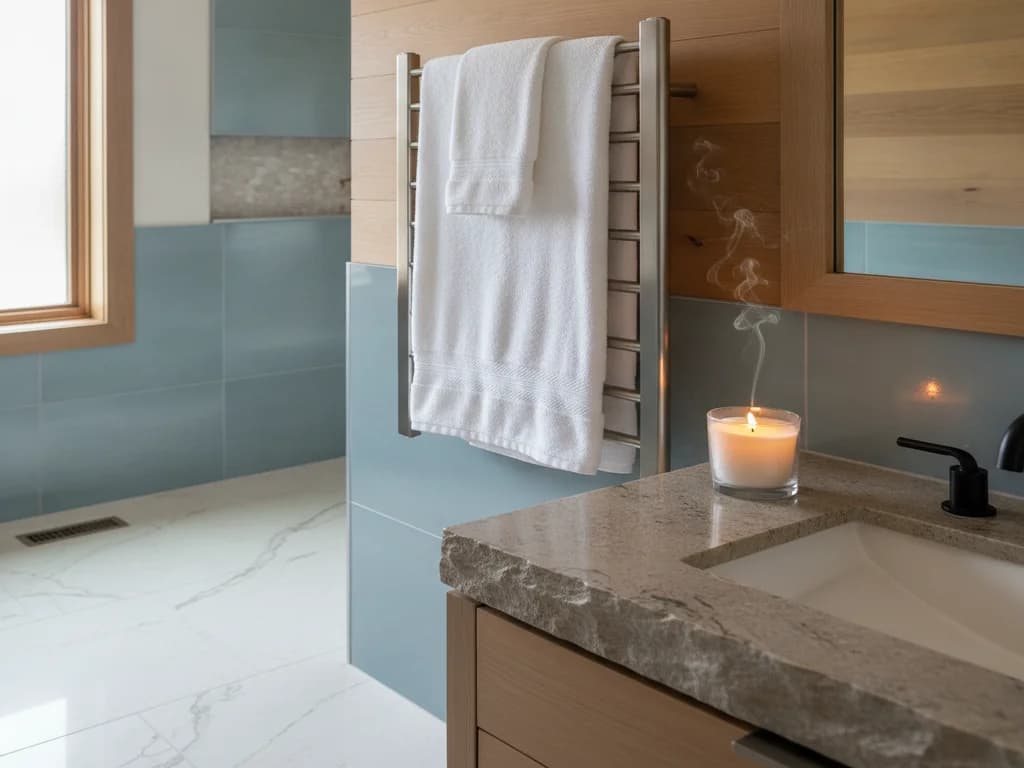
A bath towel bar is happiest 42 to 48 inches above the floor. Lower than 42 and a full-length towel brushes the floor or a baseboard; higher than 48 and shorter household members stretch for it. If you are stacking a double bar, the upper rail sits around 48 inches and the lower around 24 to 30, leaving enough gap for two towels to hang without overlapping and staying damp.
A towel ring is a different animal — it holds a hand towel at the sink, so it wants to be near the vanity and a touch higher, generally 48 to 52 inches off the floor and 4 to 8 inches to the side of the basin. Mount it where a wet hand can reach it without dripping across the counter. In a shared bathroom, give each sink its own ring rather than one in the middle; it eliminates the daily reach across a neighbor’s space.
Robe hooks and towel hooks
Hooks go high on purpose. A robe hook mounted 65 to 70 inches above the floor keeps a full robe or a large bath towel from puddling on the ground, and it clears a standard door swing. If you are installing a vertical row of hooks on a single board, space them 3 to 4 inches apart so two towels can hang side by side without matting together — matted towels stay wet and grow the mildew that Treasure Valley’s dry-then-steamy bathroom cycle already encourages.
Hooks take more abuse than any other accessory because people yank on them. That makes blocking non-negotiable: a hook screwed only into drywall with a plastic anchor will loosen, then spin, then pull out. During a remodel the wall is open and the fix is trivial — a horizontal 2x block between the studs at hook height. On a finished wall, hit a stud or use a heavy-duty toggle rated for the load.
Blocking beats anchors every time
Towel bars, hooks, and rings all pull outward and down. Drywall anchors alone strip out with repeated wet-towel loads. In a remodel, add solid blocking behind the wall at every accessory location before the tile or drywall goes up — it costs almost nothing and eliminates the loose-hardware call two years later.
Toilet paper holder placement
The toilet paper holder is the accessory most often placed by feel and most often placed wrong. The comfortable position is about 26 inches from the floor to the center of the roll and 8 to 12 inches in front of the toilet bowl’s leading edge. Set it behind the bowl and every reach becomes a twist; set it too low and the roll drags the floor.
If a vanity or a wall sits within arm’s reach, the holder can mount there instead of on open wall — often the cleaner look in a tight half bath layout. For an accessible bathroom, the ADA guidance moves the holder to 7 to 9 inches in front of the bowl and keeps the dispenser within the 15-to-48-inch reach range, positioned so it does not conflict with a side grab bar. Because that placement interacts directly with grab-bar geometry, coordinate the two together rather than mounting either in isolation.
Shelves, medicine cabinets, and mirrors
Wall shelves and open niche accessories sit comfortably in the 48-to-52-inch band — high enough to clear a vanity backsplash, low enough to reach without a stool. A recessed medicine cabinet typically lands with its bottom edge around 48 to 52 inches off the floor so the mirror centers on an average standing eye line, but the real driver is the mirror, not the cabinet box: center the reflective surface on the sink and the users, not on the wall.
For an accessible bathroom, drop the bottom edge of any mirror to no more than 40 inches above the floor so a seated user can see themselves, or choose a tilting mirror. The broader turning-space and reach-range rules that govern an accessible layout are collected in the bathroom ADA dimensions reference; accessory heights layer on top of that framework rather than replacing it.
How the heights work together as a system
Individually correct heights can still look wrong if they ignore each other. A towel bar at 46 inches and a ring at 46 inches on adjacent walls will read as misaligned even though both are "in range." The fix is to pick sight lines: decide which accessories a person sees together, then align those to a shared height. Bars that flank a mirror, hooks in a row, a bar and a ring on the same wall — each set should share a top or center line.
The other coordinating factor is the fixtures themselves. Accessory heights are keyed to a standard 30-to-36-inch vanity and a standard toilet; if you are installing comfort-height fixtures or an unusually tall vanity, nudge the related accessories up to match. When the whole bathroom is being planned, settling accessory blocking and heights on the same drawing as the standard bathroom dimensions is exactly what a professional does before the walls close up — it is far cheaper to move a taped line than a tiled anchor.
What the process looks like
- 1
Confirm fixture heights and users first
A professional starts from the installed vanity, toilet, and mirror heights and the household using the room. Accessory heights are relative to those fixtures and to reach, not to an abstract number, so the fixtures are settled before any accessory is located.
- 2
Add blocking while the wall is open
Solid horizontal blocking is set between studs at every planned bar, hook, ring, and holder location before tile or drywall goes up. This is the step that prevents loose hardware later and it can only be done cheaply while the wall is open.
- 3
Mock up placements with tape
Each accessory is taped to the finished wall and tested with a real towel or roll, then adjusted for reach and sight-line alignment. The homeowner is walked through it so the height matches how they actually use the room.
- 4
Align shared sight lines
Accessories that appear together — bars flanking a mirror, hooks in a row — are set to a common center or top line so the finished wall reads as intentional rather than scattered.
- 5
Verify accessible reach ranges where required
In an accessible bathroom, operable parts are checked against the 15-to-48-inch reach range and coordinated with grab-bar geometry so nothing conflicts. Paper holder and grab bar placement are resolved together, not separately.
- 6
Mount into blocking and check level
Hardware is fastened into the blocking or studs, never drywall anchors alone for load-bearing items, and each piece is leveled. A final pull-test on bars and hooks confirms they will hold a wet towel load.
Ready to plan your Boise bathroom?
Licensed & insured · 3-year workmanship warranty
Frequently asked questions
- How high should a towel bar be mounted?
- Mount a bath towel bar 42 to 48 inches above the finished floor, measured to the center of the bar. Lower than 42 inches and a full towel drags the floor; higher than 48 and shorter household members reach for it. A hand-towel ring at the sink sits a little higher, around 48 to 52 inches, and to the side of the basin.
- What height should a toilet paper holder be?
- Center a toilet paper holder about 26 inches above the floor and 8 to 12 inches in front of the toilet bowl’s leading edge. That keeps the roll within an easy forward reach instead of a twist behind the bowl. For an accessible bathroom, move it to 7 to 9 inches in front of the bowl and coordinate it with any side grab bar.
- How high do robe hooks go in a bathroom?
- Robe and towel hooks mount high — 65 to 70 inches above the floor — so a hung robe or bath towel clears the floor and drains freely. If you install a vertical row, space the hooks 3 to 4 inches apart so towels hang side by side without matting together and staying damp.
- What are the ADA heights for bathroom accessories?
- ADA-accessible accessories keep their operable parts within the U.S. Access Board reach range of 15 to 48 inches above the floor, with a 48-inch maximum for anything used from a reach. A mirror’s bottom edge should sit no higher than 40 inches for a seated user, or use a tilting mirror. Coordinate paper-holder placement with side grab bars.
- Do I need blocking behind towel bars and hooks?
- Yes for anything that pulls a load. Towel bars, rings, and especially hooks pull outward and down, and drywall anchors alone strip out over time with wet-towel loads. During a remodel, add solid blocking between the studs at every accessory location before the wall closes up; on a finished wall, hit a stud or use a heavy-duty toggle.
- Should all bathroom accessories be at the same height?
- No — different accessories have different ideal heights, but accessories a person sees together should share a sight line. Align bars flanking a mirror, hooks in a row, and a bar-and-ring pair on the same wall to a common center or top line. Coordination, not one uniform height, is what makes the finished wall look intentional.
Sources
- ADA.gov — U.S. Department of Justice
- U.S. Access Board — ADA Accessibility Standards
- National Kitchen & Bath Association (NKBA)
Claims and figures are drawn from the sources above and provided for general guidance; your project may vary. Photography is illustrative of design concepts. For a fixed price on your specific bathroom, request a free estimate.