Updated July 6, 2026 · 8 min read
By Boise Bath — bathroom & shower remodeling in Boise & the Treasure Valley
The short answer
Mixing bathroom hardware finishes works when one finish dominates — faucets, shower valve, and towel bars in a single metal — and a second finish appears only as an accent, on something like a light fixture or cabinet pull. Keep warm tones (brass, gold, bronze) and cool tones (chrome, nickel, stainless) in two groups, not three finishes competing at once.
Key takeaways
- Start with the faucet, not the accent piece: This Old House's guidance is direct that "the sink faucet...is the most visible hardware in many bathrooms, so start by choosing it."
- Once the faucet finish is set, coordinate outward from it — This Old House recommends you "match the shower set, toilet flush lever, towel bars, and other hardware to the faucet's styling and finish material."
- Group finishes by temperature before you group them by name: brass brings, per Bob Vila, "a warm, burnished glow," while chrome and nickel read cooler — mixing within one temperature group is safer than mixing across it.
- A second finish works best as a genuine accent — a light fixture, a cabinet pull, a mirror frame — not a third or fourth competing finish fighting the dominant one for attention.
- Mixed metals are a legitimate, current bathroom trend, not just a compromise: designer Eric Goranson tells Bob Vila that "mixed metals on faucets and hardware add eclectic flair" and "encourage personalization."
Mixing finishes is a rule set, not a free-for-all
Mixed metal finishes have become a genuinely popular bathroom look — Bob Vila's 2026 bathroom trends coverage quotes designer Eric Goranson noting that "mixed metals on faucets and hardware add eclectic flair" and that the approach "encourages personalization, allowing homeowners to infuse their spaces with personality and warmth." But there's a real difference between a bathroom that mixes finishes on purpose and one that just accumulated three different metals over several unrelated purchases. This guide is the how-to for the first version.
The rules below aren't complicated, but skipping any one of them is usually what makes mixed hardware read as accidental instead of intentional. If you've already read our bathroom fixture finishes survey of the finish options themselves — chrome, brushed nickel, matte black, brass, and how each holds up to hard water — this is the piece about how to combine them once you've picked favorites.
The one-sentence version
Pick one dominant finish for the pieces you touch and see most, add one accent finish elsewhere, and don't let a third finish sneak in.
Rule 1: start with the faucet, then coordinate outward
This Old House's bathroom guidance settles the starting point plainly: "the sink faucet — or in some cases the tub faucet — is the most visible hardware in many bathrooms, so start by choosing it." Everything else in the room should be decided in relation to that choice, not independently of it. Once the faucet finish is set, the same guidance is specific about what follows: "you can match the shower set, toilet flush lever, towel bars, and other hardware to the faucet's styling and finish material."
That sequence matters because it prevents the most common mixing mistake: choosing several individually nice pieces — a faucet here, a towel bar there — without ever deciding which one is actually setting the tone for the room. Pick the faucet finish first and treat it as the dominant finish everything else answers to.
Rule 2: group by warm and cool before you group by name
Metal finishes split naturally into two temperature groups, and that split matters more than any individual finish name. Brass, gold, and bronze read warm — Bob Vila's description of brass captures it well: it "brings a warm, burnished glow to household items," from switch plates to bathroom fixtures. Chrome, brushed nickel, and stainless steel read cool by comparison, with a more neutral, silvery cast.
Mixing within one temperature group — say, a brushed nickel faucet with chrome towel bars — reads as a subtle, almost accidental variation, which is a safe, low-risk way to start. Mixing across the temperature line — a warm brass faucet against cool chrome hardware everywhere else — is the version that needs the dominant-plus-accent rule below to avoid looking like two different bathrooms got combined into one.
Rule 3: one dominant finish, one accent — not three finishes competing
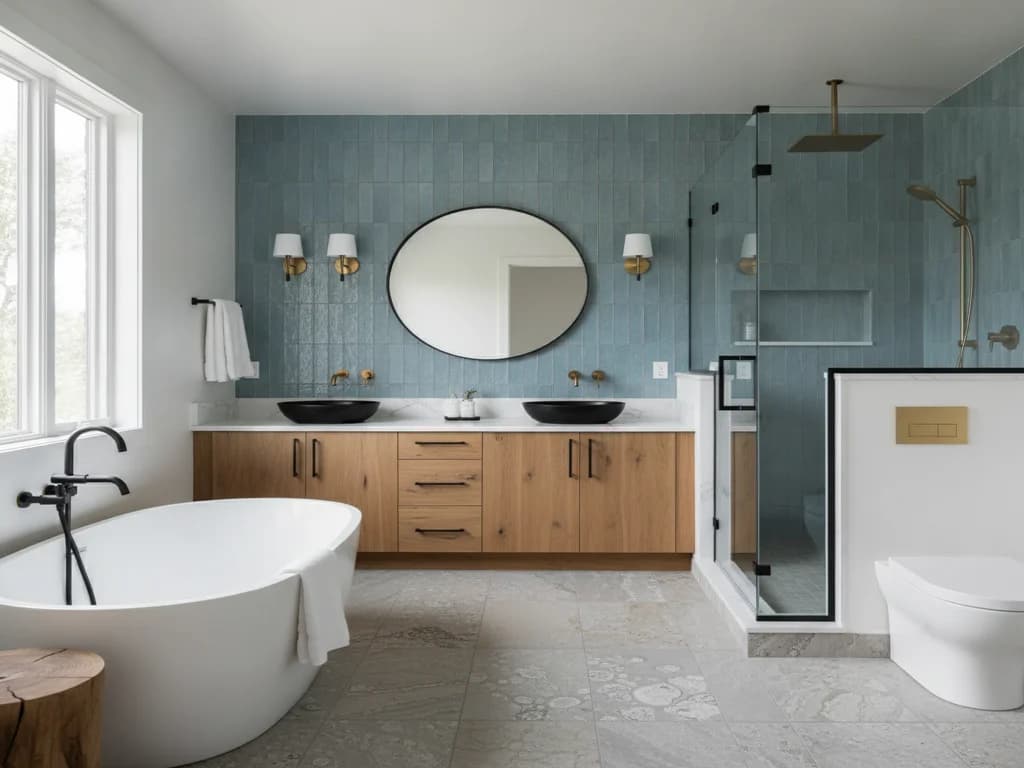
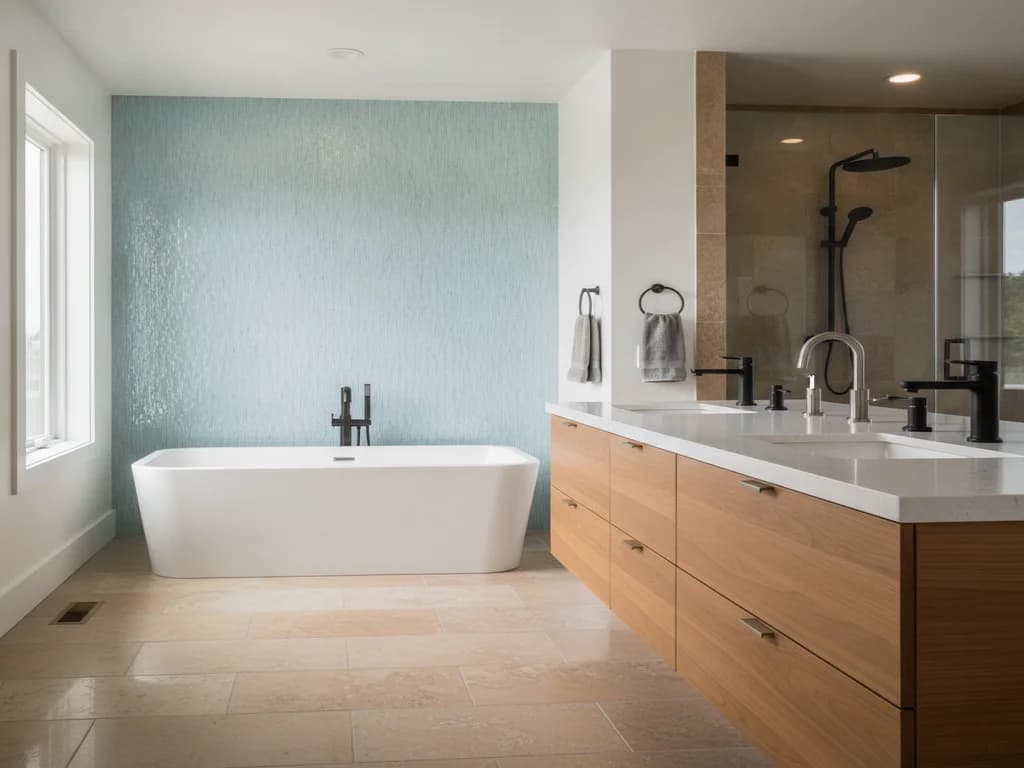
The mixing that reads as intentional almost always follows a ratio: one dominant finish covering the pieces you touch and see most — the faucets, the shower valve and head, the towel bars — and a second finish appearing only as a genuine accent, on something like a light fixture, a mirror frame, or cabinet pulls. That's a two-finish room with a clear hierarchy, not a three- or four-finish room where nothing is clearly in charge.
The failure mode is what happens without a plan: a satin-finish faucet on one side of a double vanity and a slightly more polished faucet on the other, purchased separately and never checked against each other, next to a shower system in yet a third finish. None of those choices is wrong in isolation, but without a dominant finish tying them together, the room reads as unplanned rather than eclectic.
What actually has to match exactly
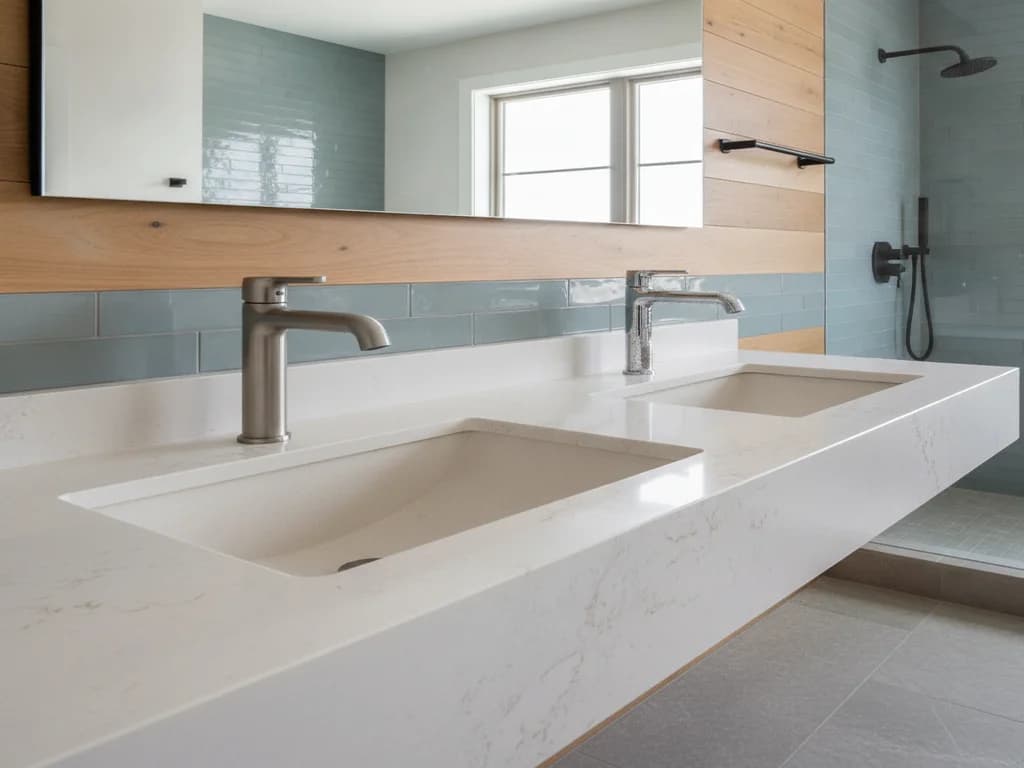
Some pairings are less about design preference and more about avoiding an obvious mismatch. The two faucets at a double vanity should match each other — a visible finish difference between them, even a subtle one, tends to look like a mistake rather than a choice, since they sit side by side in the same sightline. The shower valve trim and its showerhead or handheld should also match, since they're handled and viewed together every time the shower is used.
Beyond those two pairings, this guide's coordination rule (start with the faucet, match outward) is your working list for what else should follow the dominant finish: the shower set, the toilet flush lever, and the towel bars. Anything outside that list — a light fixture, cabinet hardware, a mirror frame — is where the accent finish has room to do its own thing.
Dominant-plus-accent combinations that work
These pairings follow the warm/cool grouping above while giving the accent finish a clear, limited role.
| Dominant finish | Accent finish | Where the accent shows up |
|---|---|---|
| Matte black (faucets, shower, towel bars) | Brass or brushed gold | Light fixture, mirror frame, or cabinet pulls |
| Brushed nickel (faucets, shower, towel bars) | Matte black | Light fixture or cabinet pulls |
| Polished chrome (faucets, shower, towel bars) | Brushed nickel | Light fixture (a subtle, same-temperature variation) |
| Brass or brushed gold (faucets, shower, towel bars) | Matte black | Light fixture, mirror frame, or hardware |
When to just pick one finish and stop
Mixing isn't mandatory. A single consistent finish across every fixture in the room is a legitimate, lower-risk choice, and it's often the right one in a smaller bathroom where fewer distinct surfaces make a second finish feel like clutter rather than an accent. If you're not confident about which finishes read as warm versus cool, or you don't have an obvious accent piece in mind, a single dominant finish carried through the whole room is never going to look like a mistake — which is more than can be said for an unplanned three-finish mix.
For the underlying facts about each individual finish — how chrome, brushed nickel, matte black, and brass differ in hard-water spot resistance and coating durability — see our bathroom fixture finishes survey. And if the mechanical side of your fixtures (valve types, cartridge sizes, PVD coating durability) is still an open question, our bathroom fixtures & hardware guide covers that ground.
Bringing it together
Mixed finishes look intentional when they follow a hierarchy: the faucet chosen first, a dominant finish carried through everything you touch and see most, one accent finish grouped by warm or cool temperature, and the double-vanity and shower-valve pairings matched exactly. Skip the hierarchy and the same finishes that would have looked eclectic on purpose tend to read as leftover choices from separate trips to the hardware aisle.
A full bathroom remodel is where finish decisions get made against the whole fixture list at once, rather than one faucet at a time after the fact.
Ready to plan your Boise bathroom?
Licensed & insured · 3-year workmanship warranty
Frequently asked questions
- How many metal finishes should a bathroom have?
- Two, in most cases: one dominant finish covering the faucets, shower valve, and towel bars, and one accent finish on something like a light fixture or cabinet pulls. A third finish competing for attention is usually what makes a mix read as unplanned rather than intentional.
- Can you mix warm and cool metal finishes in a bathroom?
- Yes, but it needs the dominant-plus-accent structure to work — one warm or cool finish dominant throughout the room, with the other temperature appearing only as a limited accent. Mixing within one temperature group (two cool finishes, or two warm finishes) is the lower-risk version if you're not confident about the pairing.
- Do both vanity faucets need to match at a double sink?
- Yes — the two faucets sit side by side in the same sightline, so a visible finish difference between them tends to read as a mismatch rather than an intentional accent. The shower valve trim and its showerhead should match each other for the same reason.
Sources
- This Old House — Redoing Your Bathroom? Read This!
- Bob Vila — 6 Bathroom Trends Making a Splash in 2026
- Bob Vila — How to Clean Brass and Restore Its Lustrous Shine
Claims and figures are drawn from the sources above and provided for general guidance; your project may vary. Photography is illustrative of design concepts. For a fixed price on your specific bathroom, request a free estimate.