Updated July 17, 2026 · 8 min read
By Boise Bath — bathroom & shower remodeling in Boise & the Treasure Valley
The short answer
Bathroom faucets are sorted by how they mount: single-hole needs one hole, centerset spans three holes on 4-inch centers, and widespread uses three separated holes on 8-to-16-inch centers. Wall-mount faucets skip the deck entirely, while vessel faucets rise tall to clear an above-counter bowl. The sink you own dictates which will fit.
Key takeaways
- Faucet type is defined by mounting configuration and hole spacing, not by finish or brand — the sink or countertop drilling decides which styles will physically fit.
- Single-hole and centerset faucets are the compact, budget-friendly standard for most vanities; centerset spans three holes on 4-inch centers, single-hole needs just one.
- Widespread faucets separate the spout and two handles across 8-to-16-inch centers for a high-end look, and mini-widespread compresses that same split layout to about 4 inches for tight sinks.
- Wall-mount faucets clear the deck for easy cleaning and pair with vessel or trough sinks, but the valve and spout must be roughed into the wall before tile goes up.
- Vessel faucets are simply tall single-hole faucets sized to clear the rim of an above-counter bowl — spout height and reach matter more than hole count.
- Match the faucet to the sink first: count the pre-drilled holes and measure their center-to-center spacing before you shop, or plan the drilling to match the faucet you want.
What actually separates one faucet "type" from another
When people say "faucet type," they usually mean one of two very different things: how the faucet mounts to the sink or wall, or what it is finished in. This guide is about the first — the mounting configuration and the hole pattern it requires — because that is the decision that determines whether a faucet will physically fit your sink at all. The color and metal are a separate choice covered in our bathroom fixture finishes guide.
Every deck-mounted faucet lands in one of a handful of families defined by two numbers: how many holes it needs, and how far apart those holes sit (measured center-to-center). A sink or countertop is drilled for a specific pattern — one hole, three holes on 4-inch centers, or three holes spread 8 inches apart — and the faucet has to match. Get this wrong and you are either buying an escutcheon plate to hide extra holes or drilling a solid-surface top after the fact.
The families below cover the styles you will actually see for sale. Read them as a shopping filter: identify what your sink is drilled for, then shop only the faucets that fit. If you are choosing a sink and faucet together in a remodel, you have the freedom to pick the look first and drill to suit — see how the two decisions connect in our bathroom sink types guide.
Single-hole faucets
A single-hole faucet does everything through one opening: the spout and the mixing handle share a single body, so the sink or counter needs just one drilling. The handle is usually a single lever that swings for both temperature and volume, though some designs stack a small handle on the spout body. This is the most forgiving type to install and the easiest to clean around because there is only one base to wipe.
Single-hole faucets suit modern and minimalist vanities, small powder rooms, and any sink drilled for one hole. Many ship with an optional deck plate (an escutcheon) so the same faucet can also cover a three-hole sink — handy if you are upgrading from a centerset without changing the sink. If your sink has three holes and you want the clean single-hole look, confirm the faucet includes that plate or buy one separately.
Centerset faucets
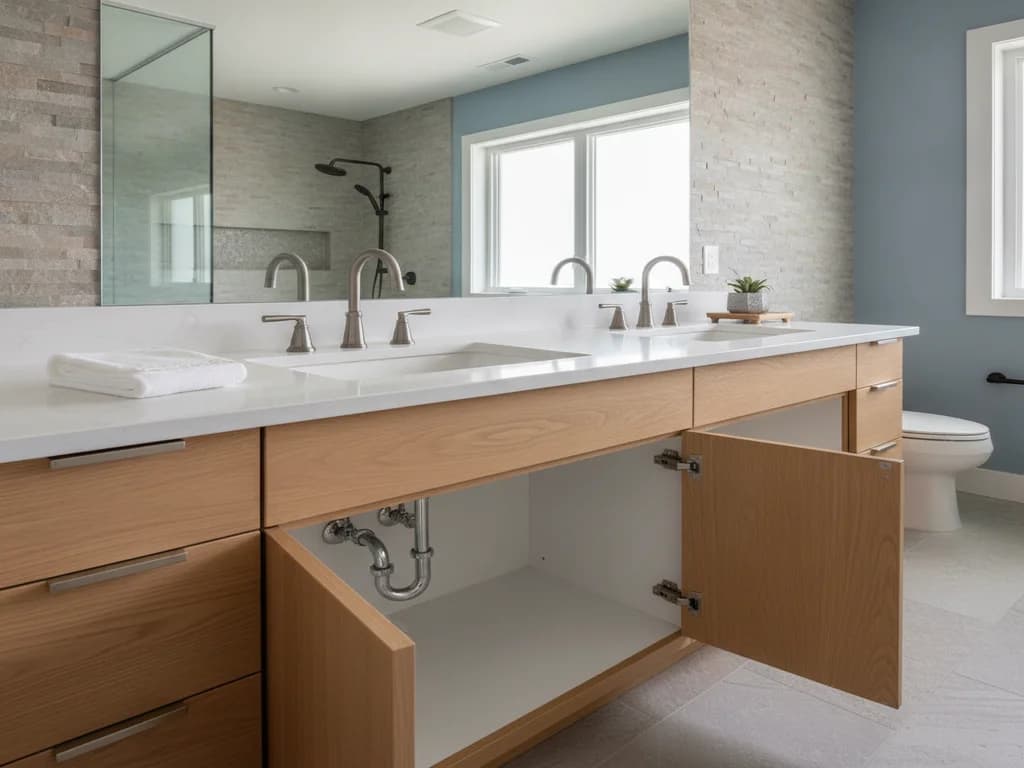
Centerset is the workhorse of American bathrooms. The spout and two handles sit on a single base plate that spans three holes drilled on 4-inch centers — meaning the outer holes are 4 inches apart, center to center. Because everything is joined on one unit, a centerset installs almost as simply as a single-hole faucet while still giving you separate hot and cold handles.
This is the configuration most builder-grade and mid-range vanity sinks come drilled for, which is exactly why it is so common across Treasure Valley homes built in the 2000s. If you are doing a like-for-like faucet swap on an existing three-hole sink, a 4-inch centerset is almost always the drop-in answer. It reads as traditional-to-transitional and keeps the plumbing tidy under a compact base.
Widespread and mini-widespread faucets
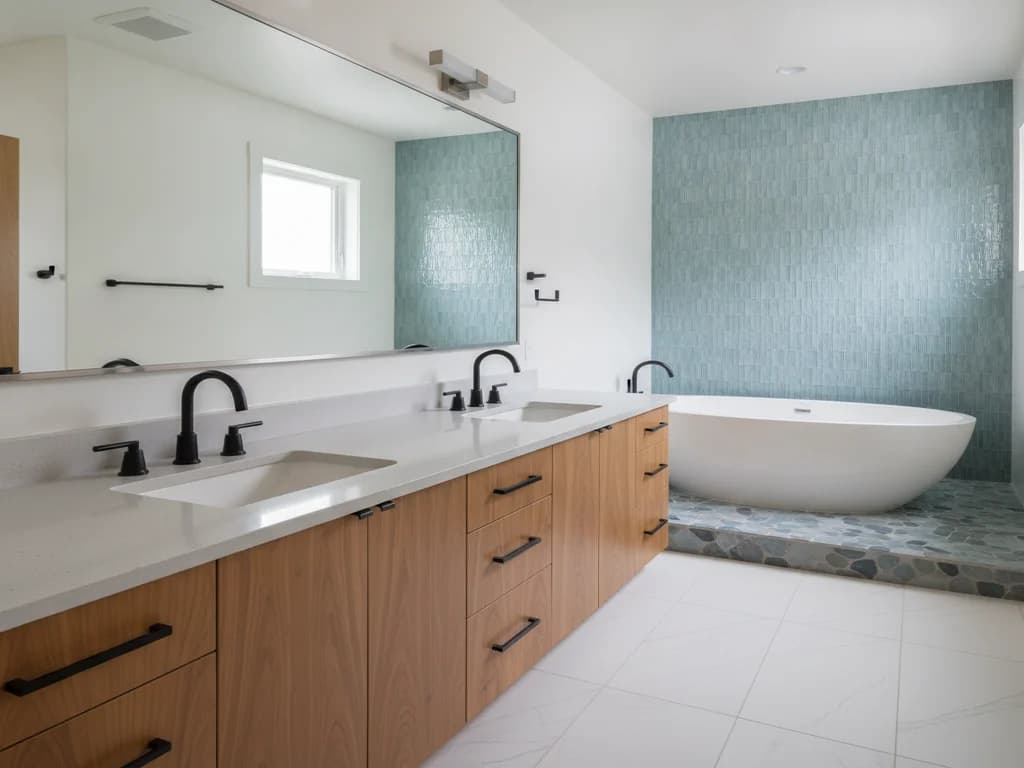
A widespread faucet splits the fixture into three separate pieces — the spout in the middle and a hot and a cold handle on each side — each mounted in its own hole and connected by concealed tubing under the deck. The holes sit on 8-to-16-inch centers, though 8 inches is the common standard. The separated layout looks more custom and high-end, and the wide spacing gives your hands room at the handles.
Widespread faucets need a sink or counter drilled (or drillable) for three spread-out holes, so they are a natural choice when you are building the vanity from scratch or working with a countertop you can drill. Mini-widespread is the same three-piece split compressed onto about 4-inch centers, which lets you get the separated, upscale look on a sink originally drilled for a centerset. If your sink has 4-inch centers but you want the widespread aesthetic, mini-widespread is the workaround.
Wall-mount faucets
A wall-mount faucet skips the sink deck entirely: the spout and handles come out of the wall above the basin, with the valve body and supply lines roughed into the wall framing. That frees the counter and sink rim of any holes, which makes cleaning simple and pairs beautifully with vessel bowls, trough sinks, and floating vanities where you want to see the full countertop.
The catch is that a wall-mount faucet is a construction decision, not a shopping decision — the rough-in valve has to be set at the right height and reach before the wall is closed and tiled, and the spout must project far enough to land water in the center of the basin. Because it lives inside a wet wall, this is firmly professional territory; getting the height and projection right relative to a specific sink is the whole game. If a wall-mount is on your wish list, it belongs in the plan from the start, not as a late substitution.
Wall-mount and vessel faucets must be planned before the wall closes
A wall-mount valve is roughed into the framing, and a vessel faucet has to be tall enough to clear a specific bowl. Both decisions have to be locked before tile and countertop go in — swapping to either one late means opening a finished wall or re-drilling a counter. Choose the sink and faucet as a pair up front.
Vessel faucets
A vessel faucet is not a separate mounting family so much as a height class. Because a vessel sink sits on top of the counter rather than dropping into it, a standard faucet would pour into the counter, not the bowl. Vessel faucets solve this by rising tall — often 10 to 16 inches — on a single-hole deck mount so the spout clears the rim and the reach lands water in the basin.
The two numbers that matter are spout height (tall enough to clear your specific bowl with room to wash your hands) and spout reach (far enough that water hits the drain area, not the front rim). A wall-mount faucet can serve the same role for a vessel bowl. Because the bowl height varies from sink to sink, a vessel faucet is another case where you choose the faucet and sink together — the tradeoffs between vessel and recessed bowls are laid out in our vessel vs. undermount sink comparison.
The faucet configuration table
The table below is the shopping filter in one place. "Holes" is how many the sink or counter must have; "spacing" is the center-to-center distance the drilling has to match. Read across to see the sinks each faucet type suits, then match against what you own or plan to drill.
| Faucet type | Holes | Hole spacing | Best fit |
|---|---|---|---|
| Single-hole | 1 | One hole | Modern vanities, small baths, single-hole sinks (deck plate covers 3-hole) |
| Centerset | 3 (often 1 unit) | 4 in centers | Standard builder-grade three-hole sinks; like-for-like swaps |
| Widespread | 3 separate | 8–16 in centers | New or drillable sinks/counters; upscale, custom look |
| Mini-widespread | 3 separate | ~4 in centers | Sinks drilled for centerset that want the split look |
| Wall-mount | 0 in deck | Roughed into wall | Vessel, trough, floating vanities; open-counter look |
| Vessel (tall) | 1 | One hole | Above-counter vessel bowls; needs tall spout + reach |
Spacing is measured center-to-center between outer holes. Faucet dimensions per manufacturer specifications; flow rate is a separate spec — see the WaterSense note below.
Flow rate, valves, and what else to check
Beyond mounting, two specs are worth a glance. Flow rate is how much water the faucet delivers: the federal maximum for bathroom faucets is 2.2 gallons per minute, and EPA WaterSense–labeled models cap at 1.5 gpm or less while still performing well, which matters on Boise’s municipal water. A lower flow rate is a quiet way to trim water use without giving up feel.
Inside the faucet, the valve is what controls the water; ceramic-disc cartridges are the durable modern standard and shrug off Treasure Valley’s hard water better than older rubber-washer designs, which are the usual culprit behind a drip. Hard water also scales up aerators and spouts over time, so a finish and cartridge rated for it will age better. If your existing faucet drips or the handle has gone stiff, that is often a cartridge or a mounting issue — our faucet replacement guide walks through when a swap is the fix and what the job involves.
What the process looks like
- 1
Identify the sink’s existing drilling
A professional starts by counting the holes in the sink or counter and measuring their center-to-center spacing — one hole, 4-inch centers, or 8-inch-plus centers. That single fact rules most faucet types in or out before any shopping begins.
- 2
Match the faucet family to the drilling
One hole takes a single-hole or vessel faucet; three holes on 4-inch centers take a centerset or mini-widespread; three spread holes take a widespread. A deck plate can bridge a single-hole faucet onto a three-hole sink where needed.
- 3
Confirm spout height and reach for the sink
For a vessel bowl, the spout must clear the rim and reach the drain area; for any sink, the reach should land water near the center. A pro checks these against the specific basin, not a generic assumption.
- 4
Plan wall-mount rough-ins before closing the wall
If the design calls for a wall-mount faucet, the valve and spout are roughed into the framing at the correct height and projection before tile — a step that cannot be added after the wall is finished.
- 5
Check flow rate and valve type
A professional confirms the flow rate suits the household — often a WaterSense 1.5 gpm model — and that the faucet uses a durable ceramic-disc cartridge suited to hard water, which reduces future drips and stiffness.
- 6
Verify supply and drain compatibility
Finally, the supply-line connections and pop-up drain assembly are matched to the faucet and sink so the parts arrive compatible and the install goes in clean rather than needing adapters on the spot.
Ready to plan your Boise bathroom?
Licensed & insured · 3-year workmanship warranty
Frequently asked questions
- What is the difference between a centerset and a widespread faucet?
- A centerset joins the spout and both handles on one base spanning three holes on 4-inch centers, so it installs as a single unit. A widespread separates the spout and two handles into three individual pieces mounted 8 to 16 inches apart and connected by hidden tubing. Centerset is compact and common; widespread looks more custom and needs wider drilling.
- Can I put a single-hole faucet on a three-hole sink?
- Yes. Most single-hole faucets ship with an optional deck plate, or escutcheon, that covers the two outer holes of a standard three-hole sink drilled on 4-inch centers. This lets you get the clean single-hole look without replacing the sink. Confirm the faucet includes the plate, or buy a matching one separately before installing.
- What faucet do I need for a vessel sink?
- A vessel sink needs a tall single-hole faucet — usually 10 to 16 inches high — or a wall-mount faucet, because the bowl sits above the counter. The spout must clear the rim with room to wash your hands and reach far enough to land water near the drain. Match the spout height to your specific bowl before buying.
- How far apart are widespread faucet holes?
- Widespread faucet holes sit on 8-to-16-inch centers, meaning the two outer holes are 8 to 16 inches apart center-to-center, with 8 inches being the common standard. Mini-widespread faucets use the same three-piece layout but compress the spacing to about 4 inches, letting them fit a sink originally drilled for a centerset faucet.
- Are wall-mount bathroom faucets hard to install?
- Wall-mount faucets are more involved than deck-mounted ones because the valve body and supply lines are roughed into the wall framing before tile goes up, and the height and projection must suit the specific sink. Because it lives in a wet wall, it is professional work planned from the start — not a fixture you swap in after the wall is finished.
- Does the faucet finish affect which type I can buy?
- No. Finish — chrome, brushed nickel, matte black, and so on — is independent of mounting type, so most faucet styles come in most finishes. Choose the mounting configuration first based on your sink’s hole pattern, then pick the finish. Our fixture finishes guide covers durability and coordination across a bathroom’s metals.
Sources
Claims and figures are drawn from the sources above and provided for general guidance; your project may vary. Photography is illustrative of design concepts. For a fixed price on your specific bathroom, request a free estimate.