Updated July 17, 2026 · 9 min read
By Boise Bath — bathroom & shower remodeling in Boise & the Treasure Valley
The short answer
Bathroom sinks split into seven installation styles: drop-in and undermount mount into a vanity top, vessel sits on top of it, and pedestal, wall-mount, console, and integrated sinks either skip the vanity or fuse the bowl and counter into one piece. Counter space, cleaning, and storage needs decide which fits your bathroom.
Key takeaways
- Bathroom sinks are classified by how they install, not by material — the same porcelain or stone can appear as a drop-in, undermount, vessel, or integrated bowl.
- Drop-in sinks are the easiest and cheapest to install because the rim rests on the counter; undermount sinks mount below for a seamless, wipe-clean edge at higher cost.
- Vessel sinks sit on top of the counter as a design statement but raise the effective basin height and need a tall or wall-mount faucet to clear the rim.
- Pedestal, wall-mount, and console sinks skip the vanity cabinet to save space and suit small or period bathrooms, trading away nearly all under-sink storage.
- Integrated sinks fuse the bowl and countertop into one seamless piece with no rim or seam, making them the easiest to clean but the costliest to replace if damaged.
- The right choice balances four things: counter and storage space, ease of cleaning, faucet type, and budget — measure the vanity and clearances before committing.
How bathroom sinks are actually categorized
Bathroom sinks are sorted by how they install, not by what they are made of. A single porcelain bowl can be a drop-in in one bathroom and an undermount in the next; the material is a separate decision covered in our best bathroom sink materials guide. What changes the look, the cleaning, and the plumbing is the mounting style — and that is what this taxonomy covers.
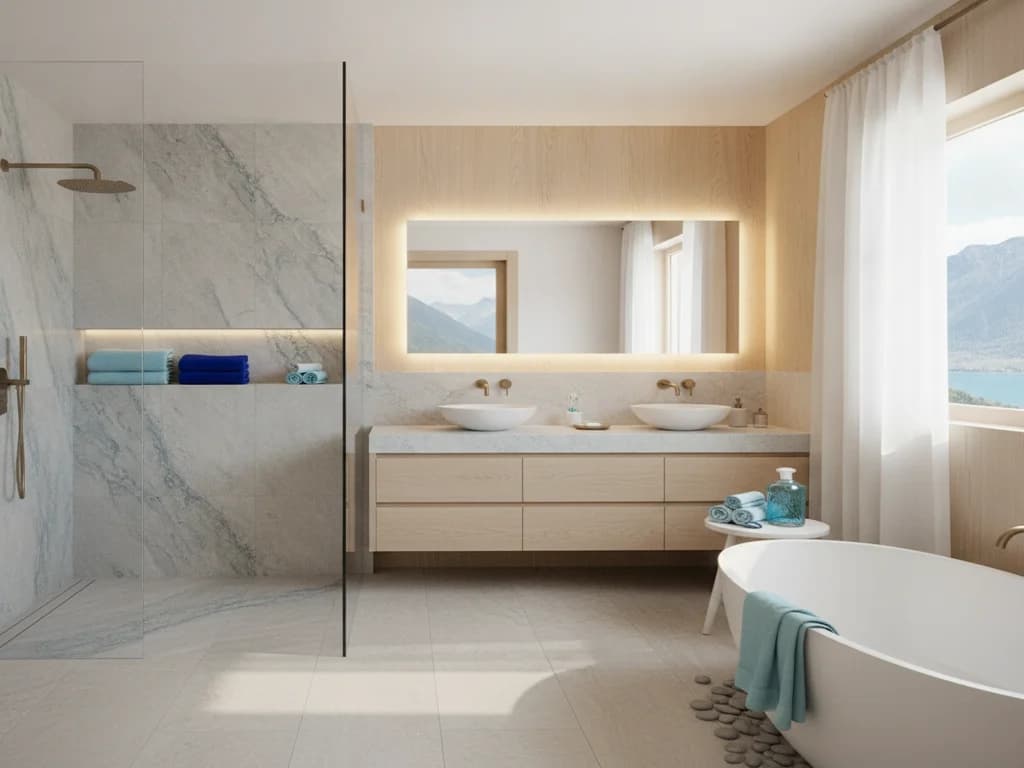
There are seven styles you will actually shop for. The first three — drop-in, undermount, and vessel — all live on a vanity top and differ by whether the bowl sits in, under, or on the counter. The next three — pedestal, wall-mount, and console — do away with the cabinet to free up floor space. The seventh, integrated, fuses bowl and counter into a single piece. Each carries its own tradeoffs in cost, cleaning, storage, and which faucet it needs.
Read this as a fit-finder. Decide how much counter and storage you need, how much you care about wipe-down cleaning, and whether the room is tight, and the field narrows fast. If you are choosing a faucet alongside the sink, the two decisions are linked — a vessel or wall-mount sink changes what faucet will work, as our bathroom faucet types guide lays out.
Drop-in (self-rimming) sinks
A drop-in sink — also called a top-mount or self-rimming sink — sets into a cutout in the vanity top so its rolled rim rests on the counter surface. That rim is the whole story: it makes the sink the easiest and least expensive to install because the counter carries the weight and the cutout does not need precise edge finishing. It is the reason drop-ins dominate builder-grade bathrooms across the Treasure Valley.
The tradeoff is the rim itself. Because it sits proud of the counter, it collects a line of grime where the rim meets the surface, and you cannot sweep water and toothpaste straight into the bowl — you wipe up to the rim and stop. Drop-ins work with almost any countertop, including laminate, and are the natural pick for a budget refresh or a like-for-like swap. The full comparison against undermounts is in our drop-in vs. undermount sink breakdown.
Undermount sinks
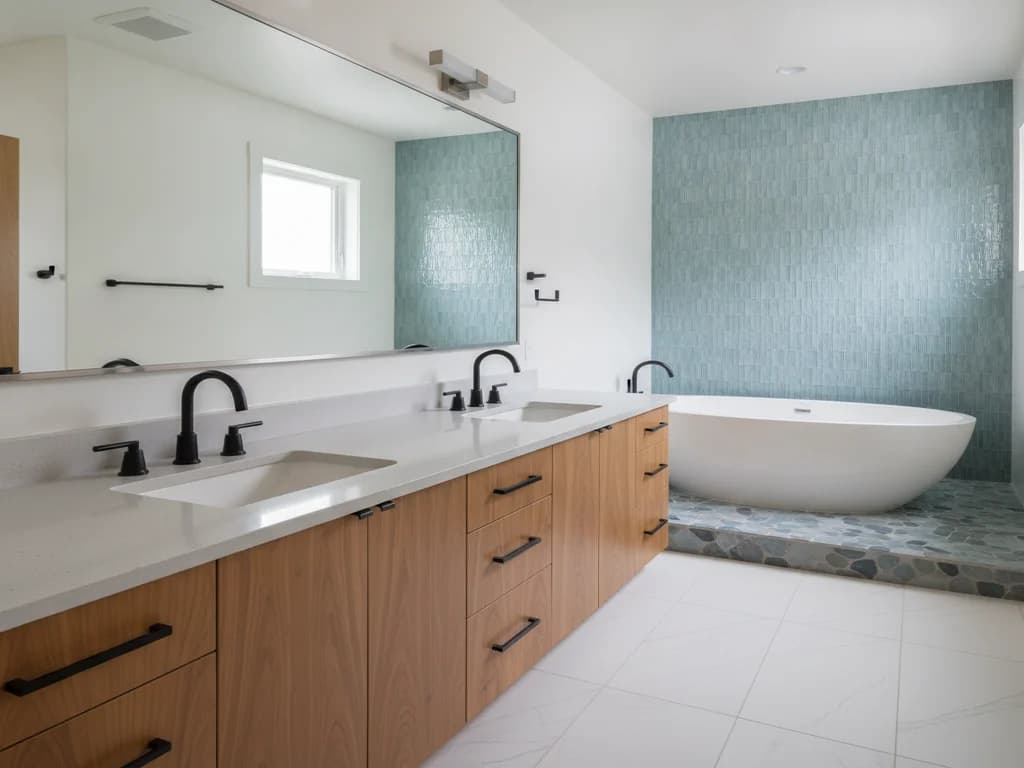
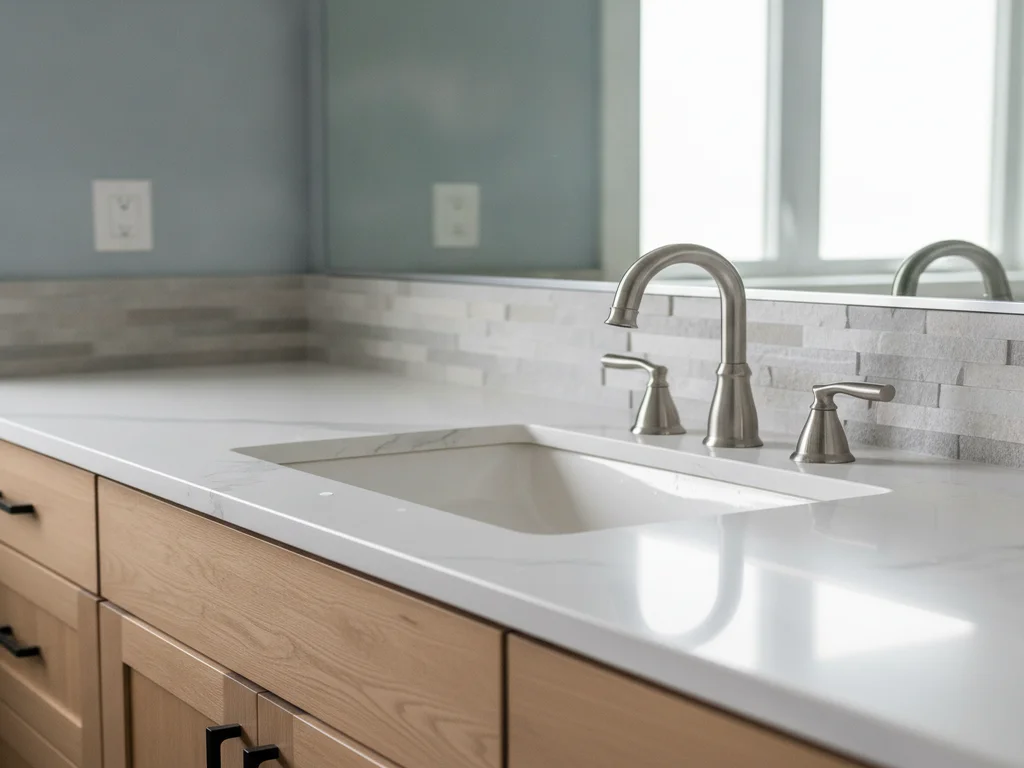
An undermount sink mounts underneath the countertop, so the counter’s edge forms the rim of the basin and there is no lip sitting on the surface. That single detail is why undermounts read as more finished and why they are so much easier to keep clean: you wipe water and debris straight off the counter into the bowl with nothing in the way.
The cost is in the counter, not just the sink. Because the exposed edge of the cutout becomes a visible finished edge, undermounts require a solid, water-resistant countertop — quartz, granite, or solid surface — professionally cut and polished, not laminate. They also need secure clips or adhesive to carry the bowl from below. For a mid-to-high-end vanity with a stone top, an undermount is usually the default; the vessel vs. undermount comparison covers where each wins.
Vessel sinks
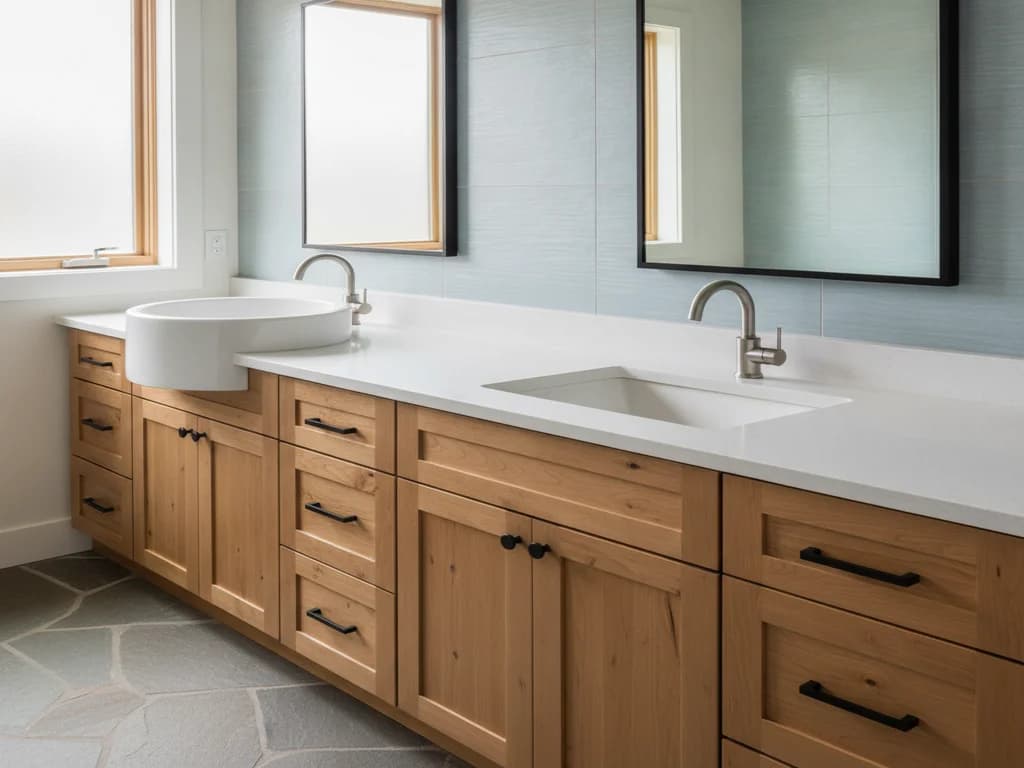
A vessel sink sits entirely on top of the counter like a bowl on a table, connected through a single hole for the drain. It is the most sculptural option — the sink becomes the focal point — and it is popular in powder rooms where a homeowner wants a statement. Installation is straightforward because the counter needs only a drain hole, not a large basin cutout.
The catch is height and practicality. A vessel adds its full bowl height on top of the counter, so on a standard 34-to-36-inch vanity the rim can land uncomfortably high; some builders drop the cabinet a few inches to compensate. Because the bowl sits above the deck, a vessel needs a tall single-hole faucet or a wall-mount faucet to clear the rim, and the exposed exterior of the bowl shows water spots. Vessels shine as a design accent, less so as a heavily used daily sink.
Pedestal, wall-mount, and console sinks
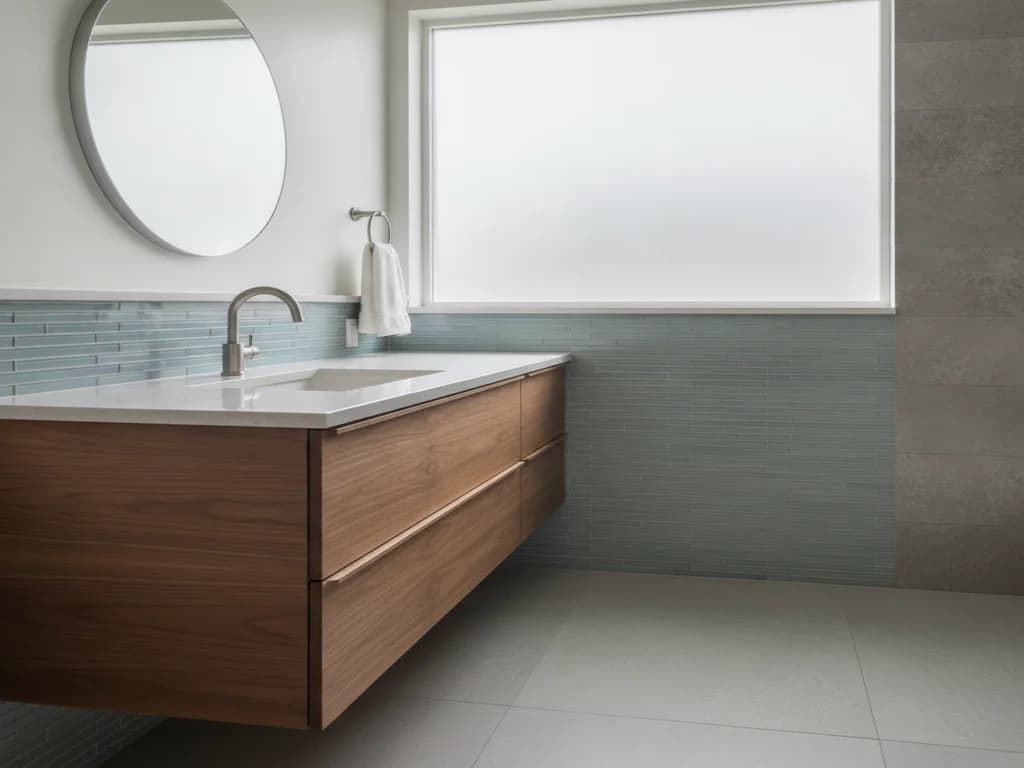
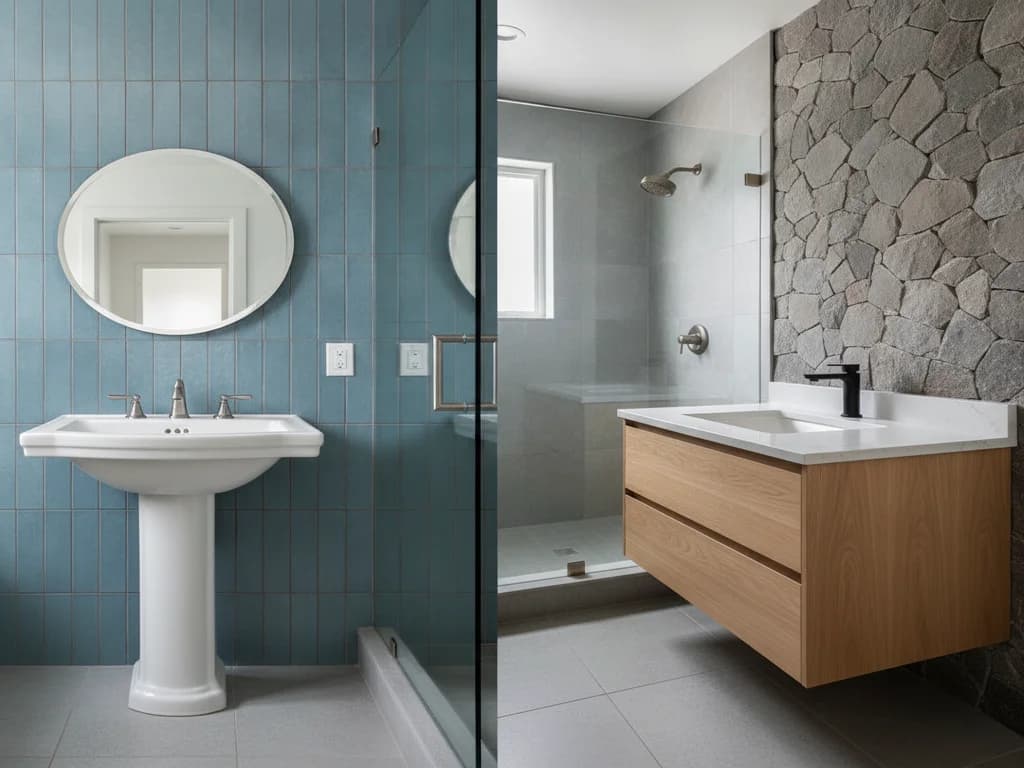
These three share a mission: skip the vanity cabinet to reclaim floor space and visual openness. A pedestal sink is a basin on a slender column that hides the drain and rough plumbing, a classic look in older and period-style homes and a lifesaver in a tiny powder room. A wall-mount sink hangs off the wall with the plumbing exposed or half-concealed, giving the most open floor and the easiest mopping underneath — and, with the right height, real accessibility benefits for a wheelchair user. A console sink splits the difference: a basin held on two or four legs, often with a towel bar, for a light, furniture-like presence.
The universal tradeoff is storage. All three give up the cabinet, so there is nowhere under the sink to hide toiletries or plumbing — you make it up with a mirror cabinet, shelving, or a nearby linen closet. They also demand solid in-wall support: a wall-mount or heavy console basin needs blocking added inside the wall to carry the load, which is why these are best planned into a remodel rather than hung on existing drywall. In a compact Boise bath where floor space reads as breathing room, the space they buy back is often worth the lost storage.
Pedestal and wall-mount sinks need in-wall support
A cabinet carries a vanity sink, but a pedestal, console, or wall-mount basin transfers its weight to the wall — which means solid blocking has to be added inside the framing to bolt to. That is a plan-ahead item: bolting a heavy basin to bare drywall is a failure waiting to happen, so this support goes in before the wall is closed.
Integrated sinks
An integrated sink is molded from the same material as the countertop so the bowl and the counter are one continuous piece — no rim, no seam, no caulk line where sink meets top. Common in solid-surface, quartz, and cast materials, it is the easiest surface in any bathroom to clean because there is simply nothing to catch grime. It also gives a crisp, modern, all-one-material look that suits contemporary and floating vanities.
The downsides are cost and repairability. An integrated top is a fabricated unit, so it costs more upfront, and if the basin cracks or stains badly you often replace the whole countertop rather than just a sink. It also locks you into the counter material as your sink material. For a homeowner who prioritizes seamless cleaning and a unified look and plans to keep the bathroom a long time, an integrated sink is a strong pick; for anyone who might want to change the sink independently later, a separate undermount is more flexible.
The sink types comparison table
The table below lines up all seven styles against the factors that decide a bathroom sink: where it mounts, how it cleans, whether it offers storage, and roughly where it sits on cost. Use it to shortlist, then confirm the vanity size, faucet type, and clearances before you buy.
| Sink type | Mounting | Storage | Cleaning | Relative cost |
|---|---|---|---|---|
| Drop-in | Rim rests on counter | Full vanity | Rim catches grime | Lowest |
| Undermount | Below the counter | Full vanity | Wipe straight in | Mid–high |
| Vessel | On top of counter | Full vanity | Bowl exterior shows spots | Mid |
| Pedestal | Column, no cabinet | None | Easy bowl, exposed base | Low–mid |
| Wall-mount | Hung on wall | None | Open floor beneath | Low–mid |
| Console | Legs, open base | Minimal (shelf/bar) | Open, furniture-like | Mid |
| Integrated | One piece with top | Full vanity | Seamless, easiest | Highest |
Relative cost reflects the sink-and-installation combination, not the sink alone; undermount and integrated styles also require a solid, fabricated countertop.
Clearances and how to choose
Whatever style you pick, the sink lives inside a set of clearances that decide whether the bathroom feels usable. NKBA planning guidelines call for at least 15 inches from the sink centerline to any side wall (20 is comfortable) and a clear space in front of the sink so a person can stand and lean in — the same numbers that govern the vanity itself, detailed in our standard bathroom dimensions guide. A pedestal or wall-mount sink can ease a tight layout precisely because it takes up less visual and floor space than a full cabinet.
To choose, work through four questions in order. How much storage do you need — cabinet styles for a busy family bath, cabinet-free styles for a powder room or space-starved layout? How much does effortless cleaning matter — undermount and integrated win, drop-in and vessel lag? What faucet do you want, since vessel and wall-mount sinks constrain the faucet type? And what is the budget, remembering that undermount and integrated styles also require a fabricated stone or solid-surface top. Answer those four and usually one or two styles are left standing. When it is time to swap an existing basin, our sink replacement guide covers what the job involves and when it is worth folding into a larger remodel.
What the process looks like
- 1
Decide storage vs. openness
A professional first asks whether the room needs the storage of a vanity cabinet or the open floor of a pedestal, wall-mount, or console sink. In a small Boise powder room, the space a cabinet-free sink buys back often outweighs the lost storage.
- 2
Match the sink to the countertop plan
Undermount and integrated sinks require a solid fabricated top — quartz, granite, or solid surface — while drop-ins work with almost anything including laminate. The counter decision and the sink decision are made together, not separately.
- 3
Confirm the faucet pairing
Vessel and wall-mount sinks constrain the faucet: a vessel needs a tall or wall-mount faucet to clear the rim. A pro confirms the faucet type and hole drilling suit the chosen sink before ordering either.
- 4
Verify clearances on the layout
The plan is checked for at least 15 inches from the sink centerline to any side wall and adequate clear floor in front, so the finished sink is comfortable to stand at rather than jammed into a corner.
- 5
Add in-wall support where needed
For a wall-mount, console, or heavy pedestal basin, solid blocking is added inside the wall framing to carry the load — a step done before the wall is closed, never bolted to bare drywall after.
- 6
Coordinate drain and supply rough-in
Finally, the drain and supply-line locations are set to match the chosen sink style and height, so the plumbing lands where the basin needs it and the parts arrive compatible on install day.
Ready to plan your Boise bathroom?
Licensed & insured · 3-year workmanship warranty
Frequently asked questions
- What is the difference between a drop-in and an undermount sink?
- A drop-in sink sets into the counter with its rim resting on top, making it cheap and easy to install but leaving a lip that catches grime. An undermount mounts below the counter so the counter edge forms the rim, giving a seamless, wipe-clean surface. Undermounts cost more and require a solid stone or solid-surface top, not laminate.
- Do vessel sinks need a special faucet?
- Yes. Because a vessel sink sits on top of the counter, a standard faucet would pour onto the deck rather than into the bowl. Vessel sinks need a tall single-hole faucet — usually 10 to 16 inches high — or a wall-mount faucet, sized so the spout clears the rim and reaches the drain area. Match the faucet height to your specific bowl.
- Which bathroom sink is best for a small bathroom?
- Pedestal and wall-mount sinks suit small bathrooms best because they skip the vanity cabinet, freeing floor space and making the room feel more open. A wall-mount also leaves clear floor beneath for easy cleaning and accessibility. The tradeoff is storage — you lose the under-sink cabinet — so pair it with a mirror cabinet or nearby shelving.
- What is an integrated sink?
- An integrated sink is molded as one continuous piece with the countertop, so there is no rim, seam, or caulk line where the bowl meets the counter. It is the easiest sink to clean and gives a seamless modern look, but it costs more upfront and usually means replacing the whole countertop if the basin is ever damaged.
- Do pedestal and wall-mount sinks have storage?
- No — both skip the vanity cabinet, so there is no built-in storage or place to conceal plumbing under the sink. You make up the difference with a medicine or mirror cabinet, open shelving, or a nearby linen closet. The upside is the reclaimed floor space, which is why these styles suit small powder rooms and open layouts.
- Which bathroom sink is easiest to clean?
- Integrated sinks are the easiest to clean because the bowl and counter are one seamless piece with nothing to catch grime. Undermount sinks are next, since you can wipe debris straight off the counter into the bowl with no rim in the way. Drop-in and vessel sinks are harder — the drop-in rim and the vessel’s exposed exterior both collect residue.
Sources
Claims and figures are drawn from the sources above and provided for general guidance; your project may vary. Photography is illustrative of design concepts. For a fixed price on your specific bathroom, request a free estimate.