Updated July 16, 2026 · 6 min read
By Boise Bath — bathroom & shower remodeling in Boise & the Treasure Valley
The short answer
A bathroom sink can be replaced on its own when it is a separate piece from the countertop — drop-in, undermount, and vessel sinks all qualify. The swap means disconnecting the trap and faucet, cutting the old sink free, and sealing in a new one that fits the existing cutout. Integrated sink-tops, like cultured marble, must be replaced as one piece with the counter.
Key takeaways
- Whether a sink-only swap is possible comes down to one question: is the sink a separate piece from the countertop, or molded into it?
- Drop-in and vessel sinks are the easiest swaps; undermounts are doable but demand careful support and sealing from below.
- Integrated sink-countertops — the cultured marble tops in most 1990s Treasure Valley bathrooms — cannot be swapped sink-only; the whole top comes off.
- The replacement sink must match the existing countertop cutout, which limits your options more than style preferences do.
- Cracks that reach the drain or hold water are replacement triggers; surface stains and dull finishes sometimes are not.
Does your sink actually need replacing?
Sinks fail in two different ways, and only one of them demands replacement. Structural failure — a crack that reaches the drain, a chip that has gone through the glaze into the body, a basin that weeps water into the cabinet below — means the sink is done. A crack you can catch a fingernail in will only grow, and porcelain cannot be reliably patched in a wet, daily-use environment.
Cosmetic failure is more forgiving. Hard-water staining, which the USGS notes comes with the dissolved calcium and magnesium common in Treasure Valley water, often responds to proper cleaning before it justifies a new sink. A dated color — the almond and seafoam basins of the 1990s — is a legitimate reason too; just know you are choosing an upgrade, not fixing a defect.
The one question that decides everything: how is your sink mounted?
A sink-only replacement is possible when the sink is a discrete component the countertop can live without. That is a function of mounting style, and it is worth identifying yours before pricing anything.
| Mounting style | How to recognize it | Sink-only swap? |
|---|---|---|
| Drop-in (self-rimming) | Rim sits on top of the counter with a caulk line | Yes — the easiest swap |
| Undermount | Basin hangs below the counter; no rim on top | Yes, with careful support and sealing |
| Vessel | Bowl sits on the counter surface | Yes — simplest of all |
| Integrated sink-top | Sink and counter are one molded piece | No — the whole top is replaced |
| Pedestal / wall-hung | No vanity; sink is the fixture | Yes, but it is a fixture swap |
Integrated cultured marble tops are covered in their own guide — see replacing a cultured marble vanity top.
The cutout problem: why your options are narrower than the showroom
The new sink has to work with the hole already in your countertop. A drop-in replacement must cover the existing cutout completely — the same size or slightly larger — and its faucet holes must align with the ones drilled in the counter or the sink deck. An undermount replacement needs to match the polished cutout closely, because the counter edge is visible and cannot be recut without refinishing.
This is why sink-only swaps favor standard oval and rectangular sizes, and why an unusual old sink sometimes forces the decision up a level: if nothing on the market fits the hole, the countertop is coming off anyway, and the project becomes replacing the vanity countertop with a new sink included.
If you are weighing a style change while you are at it, the practical trade-offs between the two most popular styles — cleaning, splash, counter space, height — are covered in vessel vs. undermount sinks.
What the swap involves behind the scenes
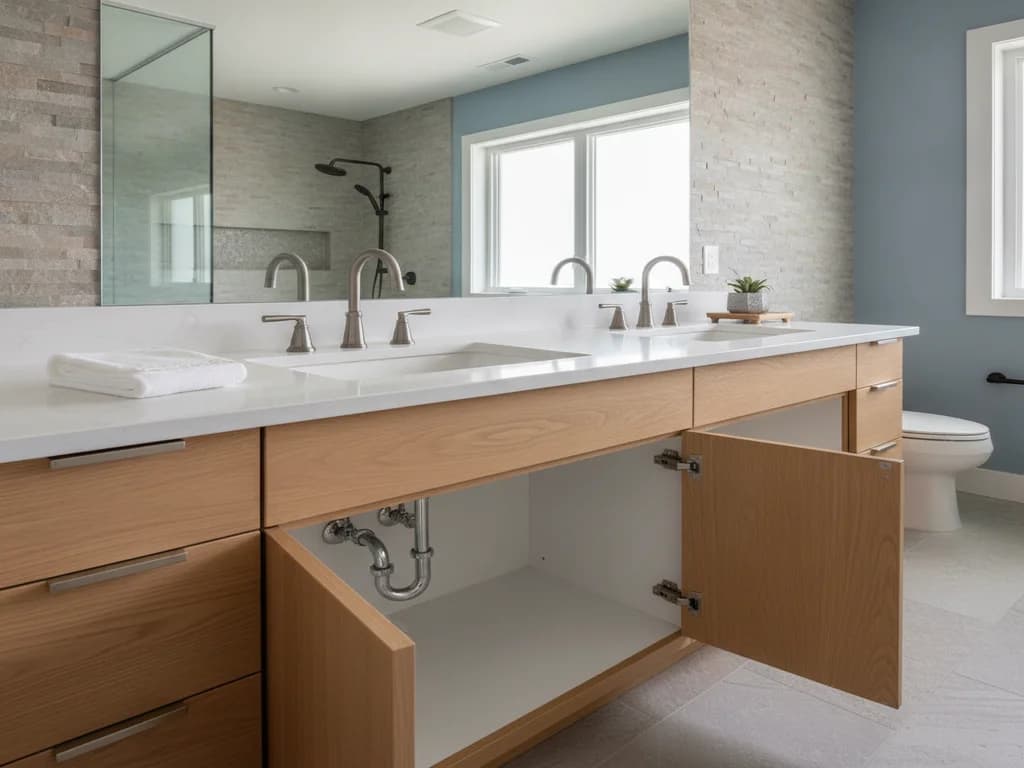
Every sink replacement is a small plumbing job. The supply valves are shut off, the P-trap is disconnected and drained, and the faucet and drain assembly come off. The old sink is then cut free of its sealant — drop-ins lift out from above; undermounts are supported, released from their clips and adhesive, and lowered from below.
The new sink goes in with fresh sealant and, for undermounts, proper mechanical support — adhesive alone is not how a water-filled basin should hang from stone. Then the drain, faucet, and trap are reconnected and everything is leak-tested. Old tubular trap parts and a corroded pop-up assembly are usually renewed rather than reused; they seldom seal again once disturbed.
Seized shutoff valves are the most common surprise
Builder-grade supply valves that have not been turned in 20 years frequently fail to reseal once touched, turning a sink swap into a small valve-replacement job. It is a modest add-on when planned — and a soaked cabinet when discovered the hard way. Any quote for sink work should account for the possibility.
Replace the faucet at the same time — here is why
A sink swap already disconnects everything a faucet replacement requires, so the incremental labor to install a new faucet mid-project is minimal — a fraction of what the same job costs later as a standalone service call under a finished sink. If your faucet is dated, drips, or has corroded supply lines, this is the moment.
It is also the cheap moment to upgrade efficiency: EPA WaterSense-labeled bathroom faucets and aerators cut faucet water use meaningfully versus older standard fixtures without a noticeable difference at the handle. The full decision — finishes, mounting configurations, valve quality — lives in replacing a bathroom faucet.
When a sink-only swap is the wrong call
A new basin in a failing setting is money spent twice. Skip the sink-only swap and scope up when:
- The sink is integrated with the countertop — cultured marble and solid-surface one-piece tops replace as a unit.
- The countertop itself is damaged, burned, or delaminating — pair the new sink with a new top in one visit.
- The cabinet below is swollen or water-damaged — that is a vanity replacement, and the sink comes with it.
- You are replacing a pedestal because you need storage — see replacing a pedestal sink with a vanity.
- No available sink matches your countertop cutout — forcing a mismatched fit invites leaks at the seal.
Cost and timeline for a sink-only replacement
A straightforward drop-in or vessel swap is a couple of hours of labor; an undermount takes longer for the support and cure time. National cost guides such as HomeAdvisor and Angi put bathroom sink replacement roughly in the $200–$1,000 installed range for common styles, with the sink itself and any faucet or valve work driving the spread — premium basins and stone-related undermount labor push higher.
That makes the sink swap one of the most affordable bathroom updates available — provided the setting around it is genuinely sound. When it is not, the honest math usually favors doing the counter or vanity at the same time rather than paying for overlapping labor twice.
What the process looks like
- 1
Identify the mounting style and measure the cutout
The contractor confirms whether the sink is drop-in, undermount, vessel, or integrated, measures the existing cutout and faucet-hole spacing, and verifies a replacement sink exists that fits — the go/no-go for a sink-only swap.
- 2
Shut off water and disconnect
Supply valves are closed and checked for seizing, lines are drained, and the trap, supply lines, and drain assembly are disconnected with the cabinet below protected.
- 3
Cut the old sink free
Sealant is cut and the sink is removed — drop-ins and vessels lift from above, while undermounts are supported from below before their clips and adhesive are released.
- 4
Prep the counter and dry-fit
Old sealant is scraped clean, the cutout edge is inspected, and the new sink is dry-fitted to confirm coverage, faucet-hole alignment, and drain position before anything is sealed.
- 5
Mount the faucet and drain to the new sink
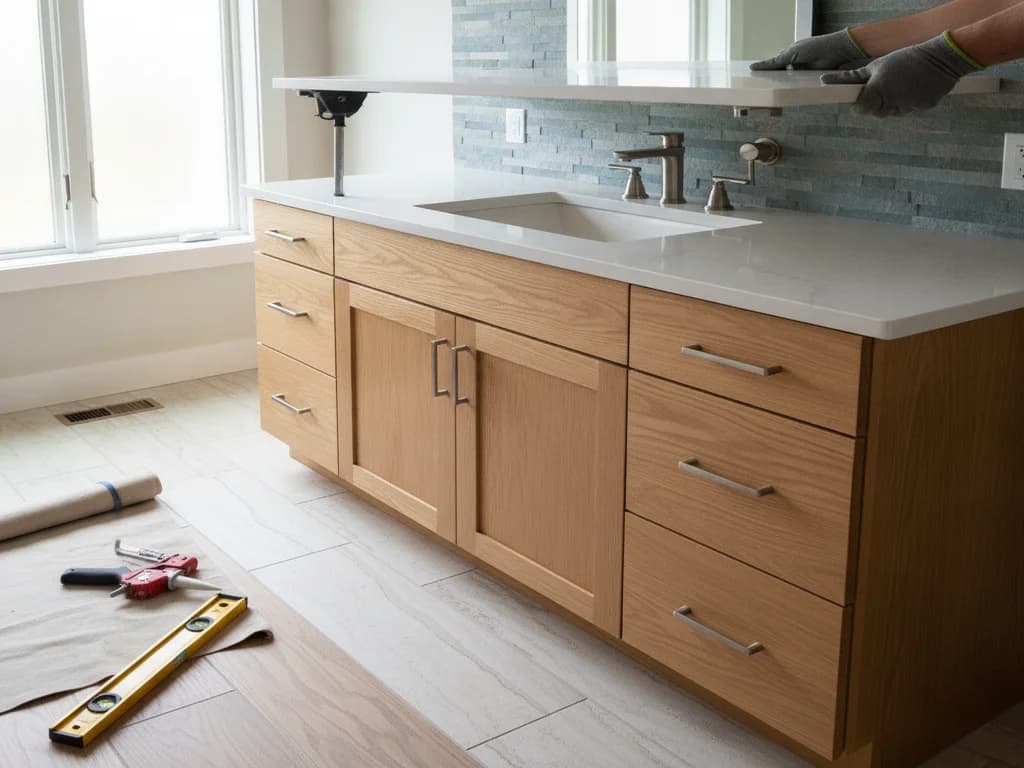
Where the sink deck carries the faucet, the faucet and pop-up drain go on before the sink is set — easier and cleaner than working overhead inside the cabinet afterward.
- 6
Set, seal, and support the sink
The sink is bedded in fresh sealant; undermounts get mechanical clips or brackets in addition to adhesive so the basin never relies on glue alone to carry water weight.
- 7
Reconnect and leak-test
The trap and supplies are reconnected — with new tubular parts where the old ones are corroded — then the sink is filled, drained, and every joint checked dry before the job is closed out.
Ready to plan your Boise bathroom?
Licensed & insured · 3-year workmanship warranty
Frequently asked questions
- Can you replace a bathroom sink without replacing the countertop?
- Yes, when the sink is a separate piece — drop-in, undermount, or vessel — and a replacement exists that fits the existing cutout and faucet holes. Integrated sink-countertops, where the basin is molded into the top, cannot be split; those replace as one piece. Identifying your mounting style is the first step in pricing the job.
- Can you replace a bathroom sink without replacing the vanity?
- Almost always, provided the cabinet below is sound. The sink connects to the vanity only through the countertop, so a swap leaves the cabinet untouched. The exception is water damage: if a leaking sink has already swollen the cabinet floor or sides, replacing just the basin ignores the real failure — that project is a vanity replacement.
- Is a cracked bathroom sink worth repairing instead of replacing?
- Rarely. Hairline surface crazing in old porcelain can be cosmetic, but a crack you can catch a fingernail on — especially one reaching the drain or holding water — will grow, and patch products do not hold up to daily hot-and-cold cycling. Given that common replacement sinks are inexpensive relative to the labor already involved, replacement is usually the honest recommendation.
- How long does it take to replace a bathroom sink?
- A drop-in or vessel swap typically takes two to three hours including disconnection, sealing, and leak-testing. Undermounts run longer because the basin must be supported and the adhesive needs cure time before the plumbing is reconnected. Add time if the shutoff valves need replacing — a common finding on sinks that have not been touched in decades.
- Should I replace the faucet when I replace the sink?
- If the faucet is more than a few years old, yes. The swap already disconnects everything the faucet job requires, so the added labor is minimal — versus a full-price standalone job later, working overhead under a finished sink. It is also the natural moment to move to a WaterSense-labeled faucet, which the EPA rates to cut faucet water use without sacrificing pressure.
Sources
- HomeAdvisor — True Cost Guide
- Angi — Cost Guides
- EPA WaterSense
- USGS Water Science School — Hardness of Water
Claims and figures are drawn from the sources above and provided for general guidance; your project may vary. Photography is illustrative of design concepts. For a fixed price on your specific bathroom, request a free estimate.