Updated July 16, 2026 · 7 min read
By Boise Bath — bathroom & shower remodeling in Boise & the Treasure Valley
The short answer
Replacing a bathroom faucet means shutting off the stop valves, disconnecting the supply lines and pop-up drain, unbolting the old faucet, and installing a new one that matches the countertop’s hole pattern. The swap itself takes an hour or two — but seized shutoff valves or corroded supply lines routinely turn it into a small plumbing job.
Key takeaways
- The new faucet must match the countertop’s existing hole pattern — single-hole, 4-inch centerset, or 8-inch widespread — or the counter has to change with it.
- Shutoff valves are the real risk: decades-old multi-turn stops often will not close or start weeping the moment they are touched, and replacing them is the smart move while everything is apart.
- The pop-up drain assembly comes with a new faucet and should be replaced with it — reusing an old corroded drain under a new faucet is a false economy.
- Hard Treasure Valley water shortens faucet life: mineral crust that has etched the finish or repeated cartridge failures are honest replacement signals.
- A WaterSense-labeled faucet uses at most 1.5 gallons per minute — about 30% less than the standard maximum — with no real difference in feel, per the EPA.
Why a one-hour job sometimes isn’t
On paper, a faucet swap is the simplest plumbing task in the house: two supply connections, a drain linkage, and a couple of mounting nuts. And when the house is newer and the shutoff valves work, that is exactly how it goes.
The trouble is that faucets get replaced at 15 to 25 years old — and everything around them is the same age. The shutoff valves under the sink have not been turned since installation, the supply lines may be original, and the drain flange is welded in place by two decades of mineral scale. The faucet is rarely the hard part. Its neighbors are.
That is why this guide is framed around what a professional checks before touching the faucet — the same checks that decide whether your project is an hour or an afternoon.
How do you know the faucet actually needs replacing?
A drip alone is not a verdict — on a decent faucet, a worn cartridge is a cheap, replaceable part, and manufacturers like Delta, Moen, and Kohler back their cartridges with long warranties and available parts. Replacement earns its keep when the problems go past the cartridge:
- Corrosion or pitting on the body — the finish is failing from the inside, not just the surface
- Drips that come back after a cartridge swap, meaning the valve seats in the body are worn
- Mineral crust that has permanently etched the finish — a familiar sight with the Treasure Valley’s hard water (more in hard water and your Boise bathroom)
- Leaking around the base or from under the handles onto the countertop
- A discontinued builder-grade model with no available parts
- You are replacing the countertop anyway — the faucet comes off regardless, and old ones rarely reinstall cleanly
The shutoff valves decide the job
Before anything else, a pro tests the stop valves under the sink. Old multi-turn valves frequently refuse to close fully, or start weeping at the stem the first time they are turned in 20 years. If they fail, the water gets shut off at the house, the valves get replaced, and the "faucet swap" is now a plumbing job — which is exactly why it is worth having someone who can handle that standing at your sink.
Match the holes: centerset, widespread, or single-hole?
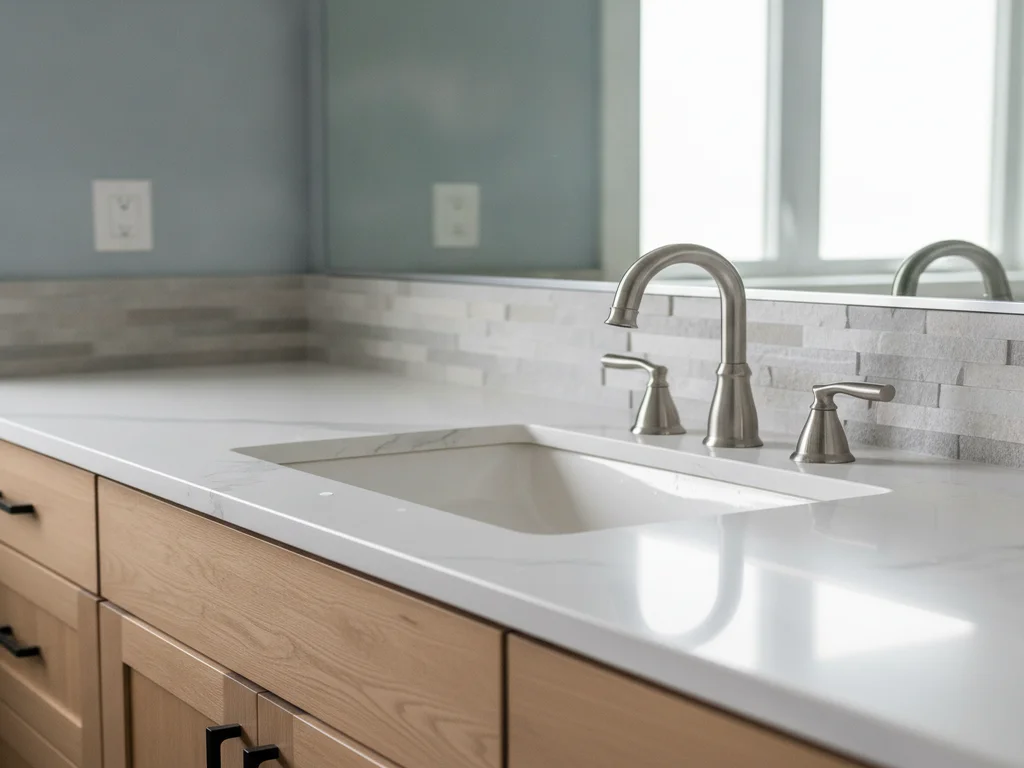
Your countertop already voted on which faucets you can buy. The drilled hole pattern in the counter or sink has to match the new faucet’s configuration, and changing patterns means modifying or replacing the top.
| Configuration | Hole pattern | Where you find it |
|---|---|---|
| Centerset | Three holes, 4" between outer holes | Builder-grade baths from the 80s–2000s; smaller vanities |
| Widespread | Three holes, 8"–16" spread, separate handles | Larger vanities and most upgrades; covers old centerset holes with deck plates in some cases |
| Single-hole | One hole | Modern vanities and vessel-sink setups |
| Vessel / tall spout | One hole, extended height | Vessel sinks only — see [vessel vs. undermount sinks](/guides/vessel-vs-undermount-sink) |
| Wall-mounted | No deck holes; plumbing in the wall | A remodel-level change, not a swap |
Many single-hole faucets include an escutcheon plate to cover an old 4" centerset pattern — a common upgrade path.
What about the drain? It comes along
New bathroom faucets ship with a matching pop-up drain assembly, and it should be installed — not skipped. The old drain flange is the same age as the old faucet, its gasket is compression-set, and a corroded chrome drain sitting under a new matte-black faucet defeats the point.
Swapping the drain means disturbing the P-trap, and this is the second place a quick job grows: a crusted trap or corroded tailpiece that crumbles on contact gets replaced on the spot. If the drain has been leaking a long time, check the cabinet floor while it is open — chronic drips are how vanity bases rot, and sometimes the honest answer is a bigger vanity project.
Choosing the new faucet: what actually matters
Inside the faucet, the part that determines lifespan is the valve. Ceramic-disc cartridges are the current standard on quality faucets and shrug off grit and hard water far better than old compression or ball designs. Brand matters mostly for parts: Delta, Moen, and Kohler keep cartridges available for decades, which is what makes a faucet repairable at year 15 instead of disposable.
Flow rate is worth a look too. The EPA’s WaterSense label caps bathroom faucets at 1.5 gallons per minute — about 30% below the standard maximum — with independent performance testing behind it, so the savings do not come with a weak stream.
On looks: finish is the decision people agonize over, and it deserves better than a paragraph here. Our bathroom fixture finishes guide covers how chrome, brushed nickel, matte black, and brass actually wear — and how to keep finishes coherent across the room. For keeping whatever you choose looking new, see bathroom fixture care.
When a faucet swap should wait for a bigger project
Two situations argue for holding off. First, if the countertop is on its way out — a yellowed cultured marble top, for instance — the faucet comes off during that replacement anyway, and buying it as part of the top-sink-faucet package gets the hole pattern right by design instead of by constraint.
Second, if the shutoff valves, supply lines, and drain are all original and tired, and the vanity itself is dated, the incremental cost of doing it all at once is much lower than three separate service visits. A faucet is a one-hour highlight in a one-day vanity refresh.
On cost: national guides such as HomeAdvisor and Angi put professional bathroom faucet replacement roughly in the $150–$400 range for labor plus the faucet’s own price, which runs from well under $100 for builder-grade to several hundred for quality widespread sets — with valve or supply-line repairs added when they surface.
What the process looks like
- 1
Test the shutoff valves first
The stop valves under the sink get closed and checked for full shutoff and stem leaks before anything is disconnected. Failed valves are replaced now, with the house water off — the single most common scope change in this job.
- 2
Confirm the hole pattern and fit
The counter’s drilled configuration — single-hole, 4-inch centerset, or widespread — is verified against the new faucet, along with spout reach over the bowl, so nothing gets discovered mid-install.
- 3
Disconnect supplies and drain
Supply lines come off the stops, the pop-up linkage is unclipped, and the P-trap is loosened to free the old drain assembly. Original supply lines are retired regardless of condition; new braided stainless lines go in.
- 4
Remove the old faucet and clean the deck
The mounting nuts come off from below — often seized and needing a basin wrench or cutting — and the old faucet lifts out. Decades of caulk, putty, and mineral ring get scraped and cleaned from the counter.
- 5
Set the new faucet and drain
The new faucet is gasketed and tightened to the deck, and the new pop-up drain is installed with fresh plumber’s putty or the manufacturer’s gasket at the flange, with the trap reconnected.
- 6
Connect, flush, and test
Supplies are connected, aerator removed, and the lines flushed to clear debris that would clog the new cartridge. Everything gets checked under pressure — stops, connections, drain, and pop-up action — before the cabinet is closed up.
Ready to plan your Boise bathroom?
Licensed & insured · 3-year workmanship warranty
Frequently asked questions
- How hard is it to replace a bathroom faucet?
- The faucet itself is straightforward — the difficulty hides in what is around it. Seized mounting nuts, shutoff valves that will not close or start leaking when turned, and corroded drains routinely turn an hour-long swap into real plumbing work. If your valves are original multi-turn stops from decades ago, plan for the bigger version of the job.
- Can I replace a centerset faucet with a widespread one?
- Sometimes. A widespread faucet needs an 8-inch or wider three-hole pattern, so it does not fit a 4-inch centerset drilling directly. Going the other way is easier: many single-hole and centerset faucets include deck plates that cover the old holes. If your heart is set on widespread, the realistic path is often a new top drilled to match.
- Should I replace the shutoff valves when replacing a faucet?
- If they are old multi-turn valves, yes. They are cheap parts, they are the thing standing between a future leak and your cabinet, and this is the one moment everything is already disconnected. Modern quarter-turn ball valves close reliably for decades. A valve that weeps or will not fully close is not optional — it gets replaced.
- How much does it cost to have a bathroom faucet replaced?
- National cost guides like HomeAdvisor and Angi put professional installation roughly at $150–$400 in labor, plus the faucet — anywhere from under $100 for basic models to several hundred dollars for quality widespread sets. Add more if shutoff valves, supply lines, or drain parts need replacement, which is common on faucets old enough to be worth replacing.
- Do WaterSense faucets feel weaker?
- No — that is the point of the label. WaterSense caps bathroom faucets at 1.5 gallons per minute versus the 2.2 gpm standard maximum, and the EPA requires independent performance testing, so certified faucets meet user-satisfaction criteria rather than just flow limits. In a bathroom sink, where you are washing hands and faces, the difference is unnoticeable.
- Why does my new faucet already have low pressure?
- Almost always debris. Installation dislodges scale and grit in the lines, and it collects in the aerator or the cartridge — which is why a proper install flushes the lines with the aerator off before finishing. In hard-water areas like the Treasure Valley, a slowly clogging aerator is also routine maintenance, not a defect: unscrew, soak in vinegar, reinstall.
Sources
Claims and figures are drawn from the sources above and provided for general guidance; your project may vary. Photography is illustrative of design concepts. For a fixed price on your specific bathroom, request a free estimate.