Updated September 12, 2026 · 8 min read
By Boise Bath — bathroom & shower remodeling in Boise & the Treasure Valley
The short answer
Treasure Valley city water can run hard — the City of Kuna reports an average of 8.05 grains per gallon, which it classifies as hard, and Nampa’s 2025 report gives a range of none to 7.08 — and those minerals leave spots on shower glass, dull fixture finishes, and stain grout. A remodel fights back with low-iron coated glass, spot-hiding finishes like matte black or brushed nickel, sealed grout, and, if your own water tests hard, a whole-house softener.
Key takeaways
- Hardness depends on your water system: Kuna reports an average of 8.05 grains per gallon (hard by its own classification), Nampa reports none to 7.08, and we could not find a current published figure for Boise — test before assuming your number.
- Hard water is a cosmetic and maintenance problem, not a safety one: it spots glass, dulls finishes, and leaves scale, but the water itself is safe to drink.
- Low-iron coated glass, spot-hiding fixture finishes, and sealed or epoxy grout are remodel choices that specifically resist local mineral content.
- A whole-house softener is worth evaluating at remodel time, but test your actual supply first, since hardness differs from one water system or private well to the next.
- Daily habits (squeegeeing glass, drying fixtures) still matter after the remodel — the right materials just make those habits easier to keep up.
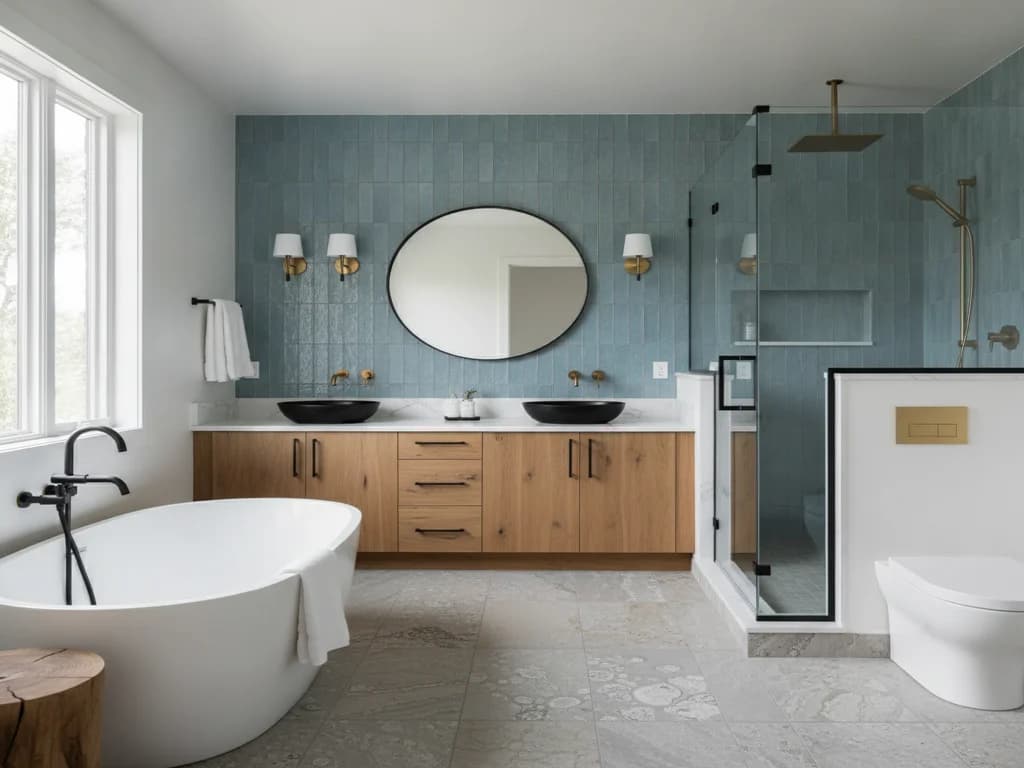
Why does hard water matter for a Boise bathroom remodel?
A bathroom in the Treasure Valley ages differently than one in a soft-water city, and the difference is not subtle. The same shower glass, faucet finish, and grout line that would look nearly new after five years elsewhere can look tired here — not because the materials are worse, but because the water is harder. Hard water carries dissolved calcium and magnesium, and every time water evaporates on a surface, those minerals stay behind.
None of this is a safety issue. Hard water is safe to drink and safe to shower in; the cost shows up as cosmetic wear and extra maintenance, not health risk. This article covers what that wear actually looks like on glass, fixtures, and tile, and — more usefully — which material and finish choices in a remodel specifically resist it.
The honest number: it depends on your water system
You will not know your exact hardness without testing your own water, so every recommendation below is built to hold up even if your water tests hard.
Is Boise's water actually hard? The honest answer
It depends on which system supplies your home, and for Boise itself we could not find a current published figure. Veolia Water Idaho’s public water-quality pages did not list a hardness value when we checked in September 2026, and the City of Eagle’s 2025 water quality reports do not include one either.
The nearby cities that do publish a number show why it is worth checking. The City of Kuna reports average hardness of 137.73 mg/L, about 8.05 grains per gallon, which it classifies as hard. The City of Nampa, which draws on 17 groundwater wells, states in its 2025 water quality report that hardness ranges from none to 7.08 grains per gallon. For scale, the USGS classifies 61–120 mg/L as "moderately hard," 121–180 mg/L as "hard," and above 180 mg/L as "very hard" — so Kuna’s average is hard, and a home test is the only way to know where your own tap falls.
What does hard water do to shower glass?
1. White spotting as water evaporates. Every droplet that dries on glass leaves its dissolved minerals behind. Over weeks, that becomes the cloudy, spotted look on an otherwise clean shower door — an evaporation problem more than a cleaning problem.
2. Soap scum that bonds with minerals. Hard-water minerals react with soap residue to form a filmy scum that is harder to remove than soap alone, and that film is what makes spotted glass feel gritty rather than just cloudy.
3. Permanent etching, if buildup goes untreated for years. Left long enough, mineral deposits can etch into uncoated glass, at which point no cleaner brings back the original clarity — the glass itself needs replacing. This is the outcome the choices below are meant to prevent.
What does hard water do to fixtures and finishes?
4. Scale on faucets, showerheads, and handles. The same mineral evaporation that spots glass leaves crusty white scale on fixtures, especially around aerators and showerhead nozzles where water sits and dries repeatedly.
5. Finish dulling on polished chrome. A mirror-polish chrome finish shows every dried droplet, so it is the finish that reads as neglected the fastest in a hard-water home — even with regular cleaning.
6. Slower internal scale buildup. Over the long term, the same minerals that spot visible surfaces also scale up inside valves and supply lines, gradually restricting flow — a background effect rather than a dramatic one.
What does hard water do to tile and grout?
7. Grout discoloration and buildup. Porous grout absorbs mineral-laden water and soap film over time, dulling its color even when the tile itself stays clean.
8. Faster wear on unsealed or lower-quality grout. Combined with the Treasure Valley's dry, high-desert swings in humidity and temperature, grout that is not sealed or that uses a lower-quality mix tends to show cracking and staining sooner here than in milder, more humid climates.
Which shower glass choices resist Treasure Valley hard water?
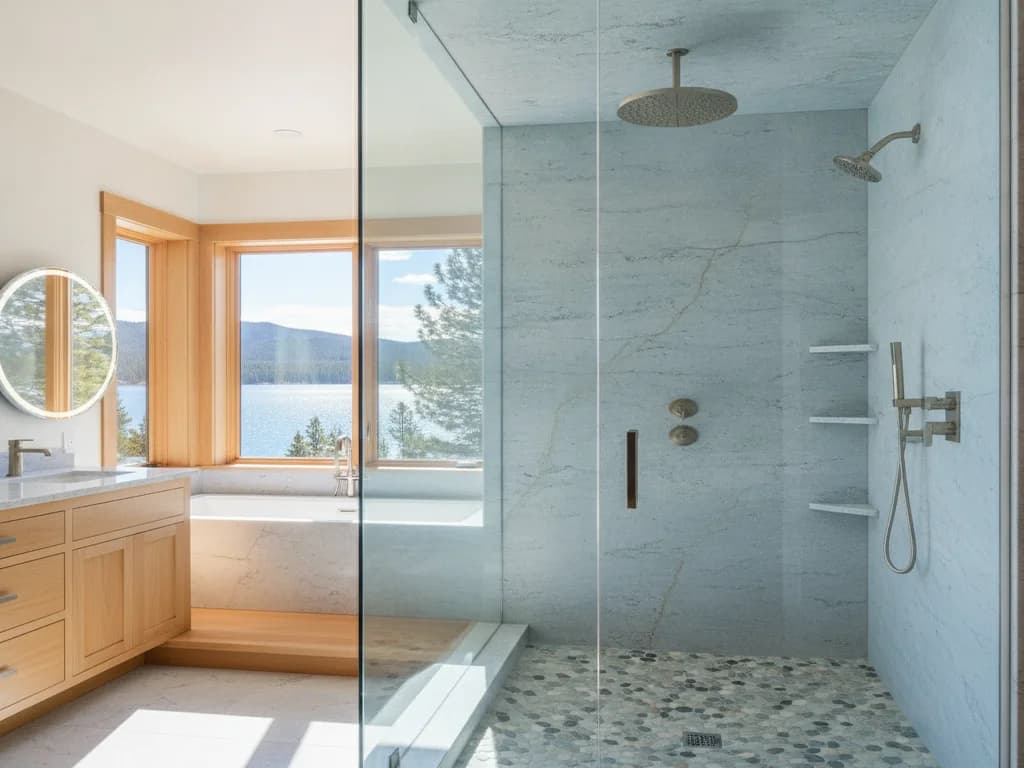
9. Low-iron, coated glass. "Ultra-clear" low-iron glass paired with a factory or applied hydrophobic coating sheds water faster, giving minerals less time to dry and bond to the surface — the single most effective material upgrade for hard-water spotting. Coated glass still needs care to keep the coating intact; our shower glass care guide covers the cleaners that are safe on a coating and the ones that strip it.
Which fixture finishes hide hard-water spots best?
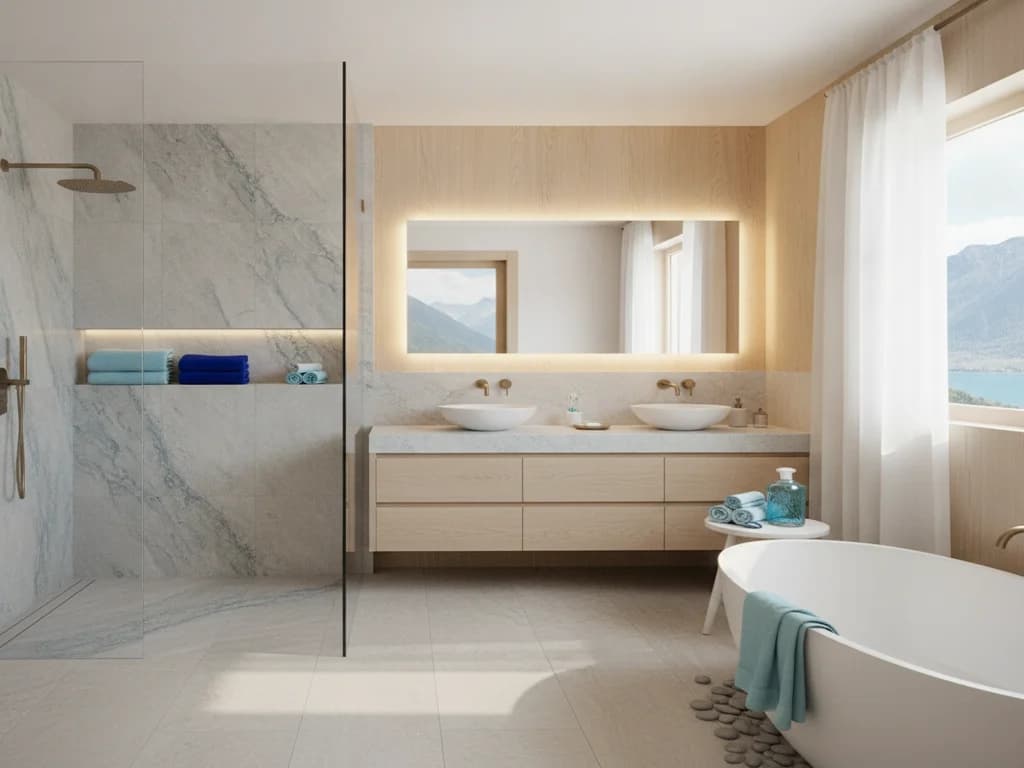
10. Brushed or satin nickel, matte black, and brushed gold. These textured, non-reflective finishes break up light and hide mineral droplets far better than polished chrome, which shows every spot. Choosing one of these finishes at remodel time is a low-cost, high-payoff decision specifically because of the local water. Once installed, the manufacturer-approved cleaning routine matters as much as the finish choice itself — our bathroom fixture care guide walks through what Moen and Delta actually recommend, including safe hard-water-spot removal that will not void a warranty.
How do you protect grout and tile from local water and climate?
11. Sealed high-quality or epoxy grout, with flexible caulk at movement joints. Epoxy grout in particular resists staining and does not need repeat sealing the way cementitious grout does — a meaningful advantage where hard water and dry-climate shrinkage both work against a grout line. Flexible silicone at the joints where tile meets tub, glass, or the floor absorbs the movement that rigid grout cannot.
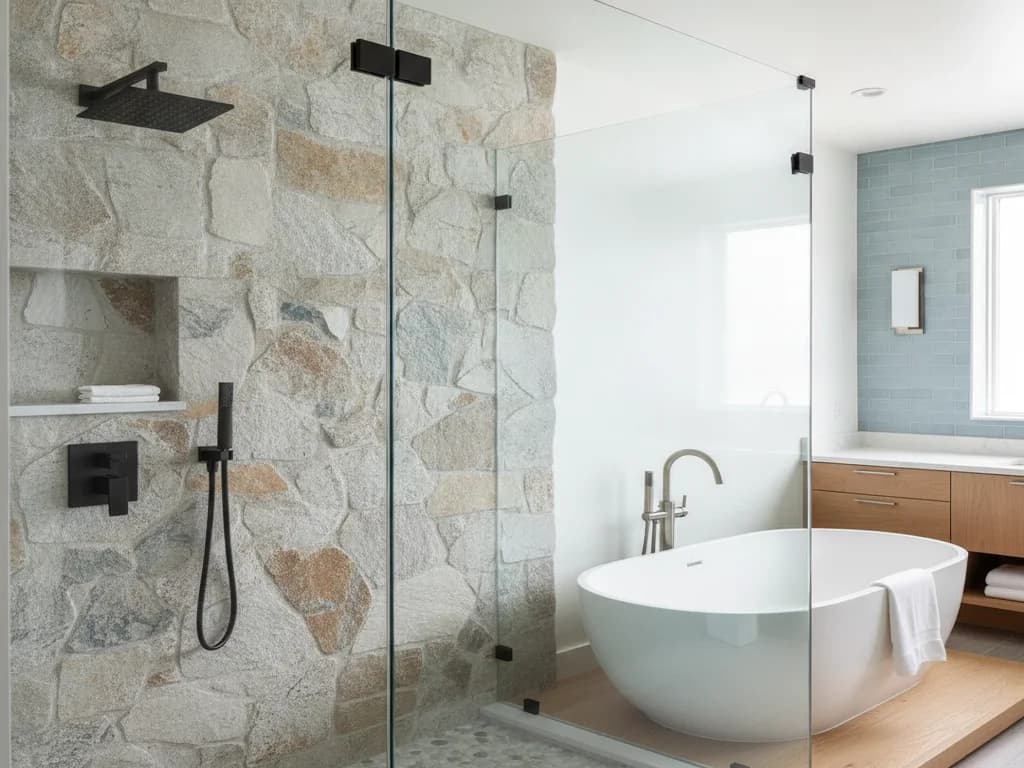
Is a water softener worth adding during a remodel?
12. Consider whole-house conditioning — but test first. Where water tests hard, a softener or conditioner reduces scale on fixtures and spotting on glass throughout the house, not just in one bathroom. Because hardness differs between water systems and private wells, the right move before sizing any system is testing your specific supply rather than borrowing a nearby city’s number. A remodel — when supply lines are already exposed — is a practical time to have that conversation and route for a softener if you decide it is worth it.
| Where it shows up | Remodel choice that helps |
|---|---|
| Spotted, cloudy shower glass | Low-iron glass with a hydrophobic coating |
| Dulled, scaled faucet and showerhead finishes | Brushed nickel, matte black, or brushed gold over polished chrome |
| Stained or cracking grout | Sealed high-quality or epoxy grout, flexible caulk at joints |
| Whole-house scale and spotting | Softener or conditioner, sized after testing your actual supply |
Conditions are drawn from the cited city water reports and the USGS hardness classification; the responses are standard material choices, not guarantees for any specific home.
What should you actually do with this?
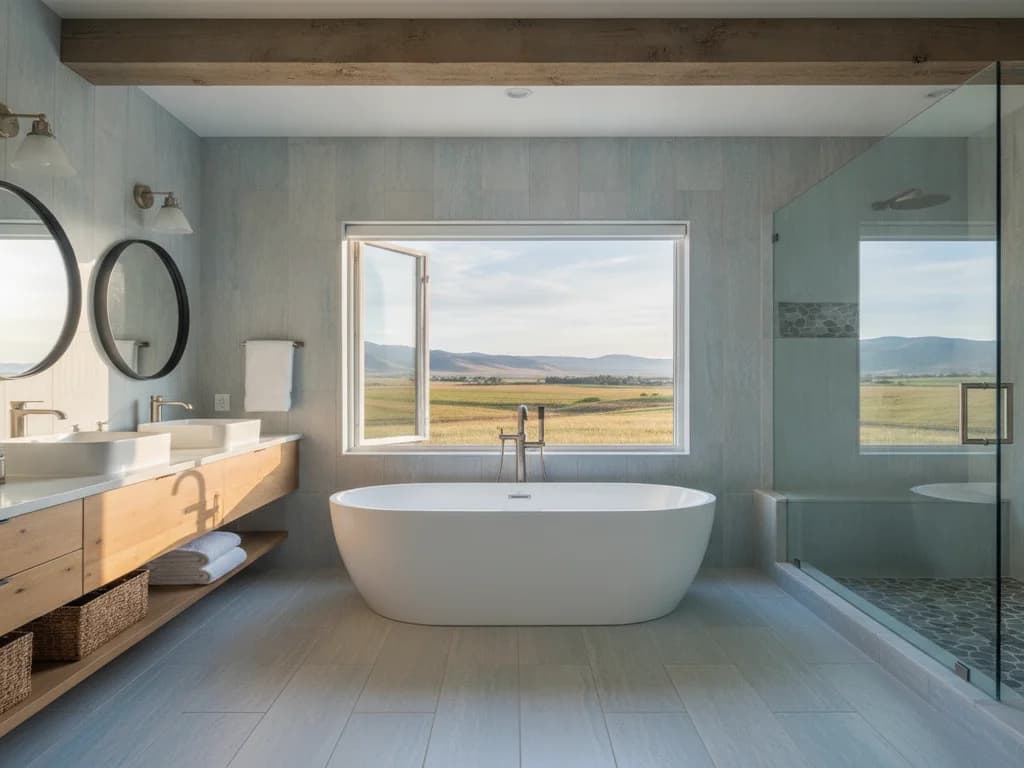
None of these choices are exotic or expensive relative to the rest of a remodel — a coated low-iron enclosure, a spot-hiding finish, and quality grout are decisions you make once, during selection, that then work in the background for years. If you are already planning a shower conversion, this is the moment to build those choices in rather than retrofit around them later; see our walk-in shower options for how enclosure glass and finish choices come together in a full project.
Ready to plan your Boise bathroom?
Licensed & insured · 3-year workmanship warranty
Frequently asked questions
- How hard is Boise water, exactly?
- We could not find a current published hardness figure for Boise: Veolia Water Idaho’s public water-quality pages did not list one when we checked in September 2026. Nearby cities that do publish a number include Kuna, which reports an average of 8.05 grains per gallon (137.73 mg/L, classified as hard), and Nampa, which reports none to 7.08 grains per gallon. Testing your own water is the only way to know your exact number.
- What is the best shower glass for hard water?
- Low-iron ("ultra-clear") glass with a factory or applied hydrophobic coating is the most forgiving choice. The coating helps water sheet off before minerals have time to dry and bond, which cuts down on spotting significantly compared to uncoated glass.
- Should I install a water softener when I remodel my Boise bathroom?
- It is worth evaluating if your water tests hard, since a softener reduces scale and spotting throughout the house, not just one room. Test your specific supply before sizing a system — hardness differs enough between water systems and wells that a nearby city’s figure will not tell you what you actually have.
Sources
- City of Kuna — Water Reports (average hardness 137.73 mg/L, 8.05 gpg)
- City of Nampa — 2025 Water Quality Report (PWS ID3140080)
- City of Eagle — 2025 Consumer Confidence Reports
- Veolia Water Idaho — Water Quality Reports
- USGS — Water Science School: Hardness of Water
Claims and figures are drawn from the sources above and provided for general guidance; your project may vary. Photography is illustrative of design concepts. For a fixed price on your specific bathroom, request a free estimate.