Updated July 6, 2026 · 8 min read
By Boise Bath — bathroom & shower remodeling in Boise & the Treasure Valley
The short answer
Bathroom tile installation cost is driven by substrate prep, tile format and size, pattern complexity, and waterproofing — not just the tile itself. Fixr (2026) prices shower tiling labor at $4–$15 per square foot depending on material, and patterns like herringbone or diagonal add roughly 10–30% on top of a straight layout.
Key takeaways
- Fixr (2026) prices a full shower tiling project at $1,800–$5,000, with labor alone running $4–$15 per square foot depending on tile type.
- Pattern complexity is a direct cost adder: Fixr prices diagonal and herringbone layouts at roughly +20%, accent walls at +20–30%, and decorative borders at +10–30% over a straight layout.
- Substrate prep is not optional in a wet room — This Old House notes damaged or inadequate subflooring adds about $2 per square foot, and Bob Vila prices structural subfloor repair separately at $40–$65 per square foot when framing needs work.
- Tile format changes labor time in both directions: This Old House notes large tiles install faster per square foot, while small mosaic and paper-faced sheets take longer because of the sheer number of pieces and extra finishing steps.
- A waterproofing membrane runs about $10 a roll per Fixr, or $450–$750 as a line item per Bob Vila — a small fraction of the project that is not negotiable in a shower.
Why does bathroom tile installation cost vary so much?
Two bathrooms with a similar amount of tile can come back from bid at very different prices, and the tile itself is rarely why. Fixr (2026) prices a full shower tiling project at $1,800–$5,000 with a $2,700 average, but notes a builder-grade ceramic shower can run as low as $900 while a pebble-and-marble shower can reach $10,000 — a gap that is almost entirely labor and complexity, not material cost per tile.
Below are the factors that actually set the labor number: how much substrate prep the room needs, what format and pattern you choose, what the tile is made of, and how the wet areas get waterproofed.
The pattern behind all of it
Labor cost tracks precision time, not material cost. A pattern with more cuts, a substrate that needs more prep, or a tile that needs extra handling all add installer hours — which is why the same square footage of tile can price very differently depending on how it is laid out and where it is going.
1. Substrate prep: the work nobody sees in the finished photo
Before a single tile goes down, the surface underneath has to be sound, flat, and (in a shower) waterproofed. This Old House notes that damaged or inadequate subflooring adds about $2 per square foot to a tile floor installation — a comparatively small underlayment upcharge. Bob Vila prices actual structural subfloor repair — replacing rotted or damaged plywood, not just leveling — separately, at $40–$65 per square foot, which is a much bigger number when a bathroom floor has water damage behind the surface.
Old tile removal is its own line item on top of that: Fixr prices removing existing tile at $2–$5 per square foot, and Bob Vila's range runs $2–$7 per square foot. Backer board installation — the cement or fiber-cement panel tile is set onto in wet areas — adds another $5–$8 per square foot per Bob Vila. None of this shows up in a finished bathroom photo, which is exactly why it is easy to underestimate.
2. Tile format and size
Format changes labor time in both directions. This Old House notes large tiles "take less time and effort to install," since fewer pieces cover the same area with fewer grout lines to set. Small mosaic tile and paper-faced mosaic sheets go the other way — Fixr prices mosaic installation labor at $10–$25 per square foot, roughly double the $3–$10 rate for standard ceramic, because "paper-faced mosaic tiles need to have key marks smoothed, and then the paper soaked off the sheets," on top of simply setting far more individual pieces per square foot.
Large-format tile is a common budget tactic for exactly this reason — Fixr prices large-format labor at $14–$20 per square foot, but it covers ground faster and needs fewer grout lines, which is part of why it has become a default choice in modern bathroom design even before considering the aesthetic.
3. Pattern complexity
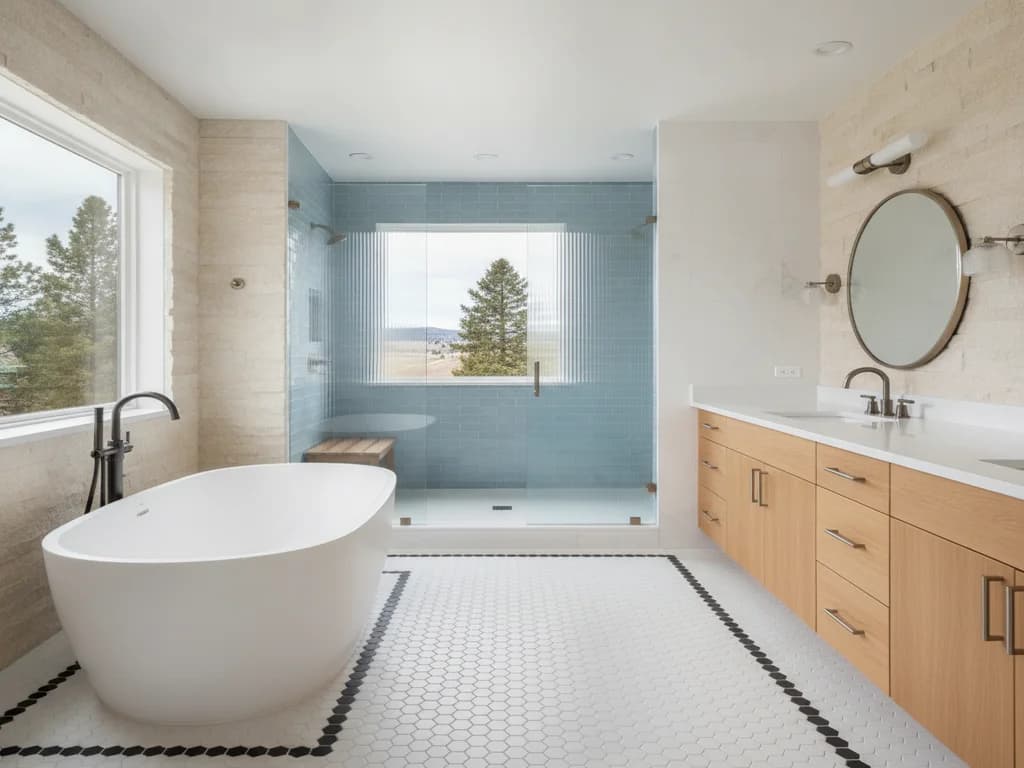
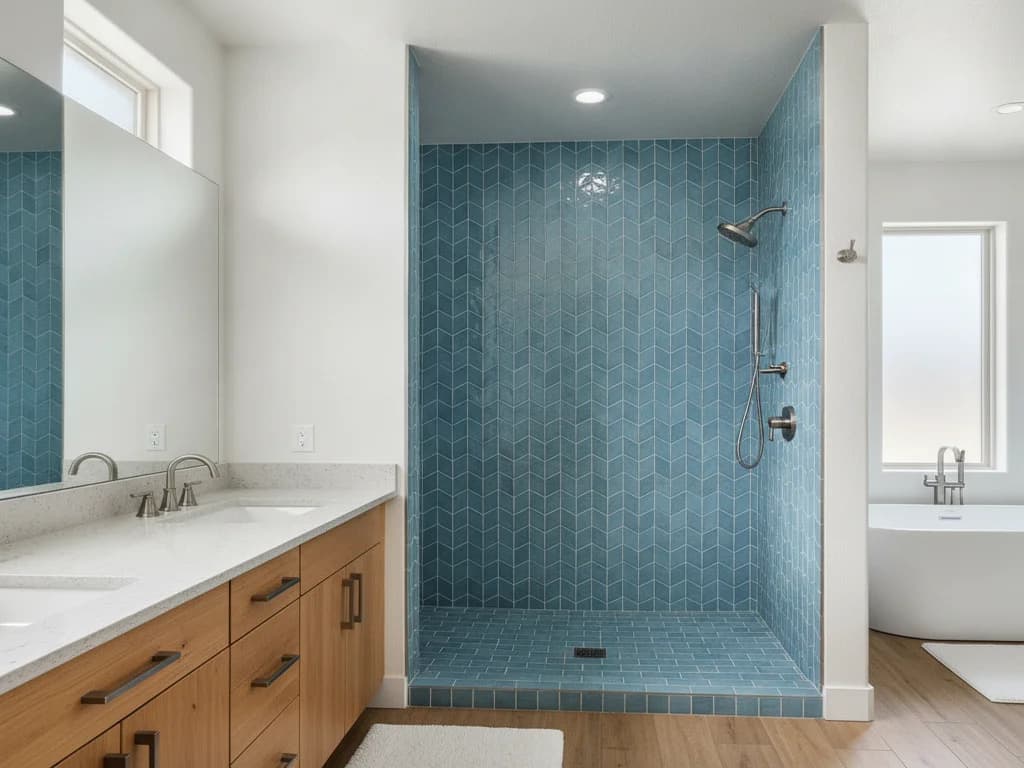
A straight (stacked or running-bond-light) layout is the labor baseline; everything else adds a percentage on top. Fixr prices a diagonal layout and a herringbone layout at roughly +20% each over a straight layout, a running bond pattern at +10–15%, a full accent wall at +20–30%, and decorative borders at +10–30% depending on the material and size involved. These add up: a herringbone accent wall with a border can easily stack two or three of these adders on the same square footage.
| Pattern / feature | Typical cost adder |
|---|---|
| Running bond | +10–15% |
| Diagonal | +20% |
| Herringbone | +20% |
| Accent wall | +20–30% |
| Decorative borders | +10–30% |
Source: Fixr (2026). Percentages are additive on top of the base per-square-foot labor rate for the material chosen.
4. Material type
Different tile materials require different handling, which shows up directly in the labor rate. Fixr's per-square-foot labor figures range from $3–$10 for ceramic, quarry, and terracotta, up to $7–$15 for granite, $9–$15 for glass, $10–$12 for slate, $10–$15 for marble and limestone, and $12–$30 for pebble tile. Glass tile is a good example of why: Fixr notes it "need[s] a very smooth mortar or the key marks in the mortar may show through the tile," which means extra prep time that a standard ceramic install skips entirely. Porous natural stone and terracotta add their own step — they "must be sealed before being grouted," per Fixr.
5. Waterproofing
In a shower or other wet area, waterproofing is not an upsell — it is the difference between a tile job that lasts and one that fails behind the wall within a few years. Fixr prices a waterproofing membrane at around $10 a roll, while Bob Vila prices waterproofing as a line item at $450–$750, noting it is "typically included in professional estimates." Relative to the total project cost, it is one of the smallest line items on this list and one of the least negotiable — skipping or underspeccing it is how a tile job turns into a much larger repair later.
The bathroom-specific numbers
For scale, This Old House prices the average bathroom retiling project around $2,000, with a standard 150-square-foot room running $2,422–$2,984 total, and bathroom floors specifically at $1,100–$3,000. Bob Vila's bathroom-specific figures land in a similar range: $2,400 average for a bathroom floor and $780–$2,600 for a bathroom wall — with the gap between those two driven by exactly the factors above, not by the room itself.
How to use this when comparing tile bids
When two tile quotes for a similar room come back far apart, walk through this list: is one bid accounting for subfloor repair the other is not? Is the pattern more complex? Is the tile format smaller and more labor-intensive? Most of the gap traces back to one or two of these factors rather than a materials difference alone.
For pattern inspiration once your budget range is clear, see our bathroom tile pattern ideas, and for what keeps a finished tile installation looking good for the long run, our tile and grout care guide. When you are ready to spec tile for your own bathroom, a custom tile and stonework project prices these factors against your actual space rather than a category average.
Ready to plan your Boise bathroom?
Licensed & insured · 3-year workmanship warranty
Frequently asked questions
- Why is bathroom tile installation labor so much more than the tile itself?
- Because labor tracks precision time, not material cost. Fixr (2026) prices tile installation labor at $4–$15 per square foot depending on material, and that rate climbs further with substrate prep, pattern complexity, and smaller tile formats — all of which take more installer hours regardless of what the tile itself costs per square foot.
- How much does a tile pattern like herringbone add to the cost?
- Fixr (2026) prices a herringbone or diagonal layout at roughly +20% over a straight layout, a running bond pattern at +10–15%, and a full accent wall at +20–30%. These adders stack, so a herringbone accent wall with a decorative border can add well over 30% versus a straight, unbordered layout of the same tile.
- Is waterproofing included in a bathroom tile quote?
- It should be. Bob Vila prices waterproofing at $450–$750 as a line item that is "typically included in professional estimates," while Fixr prices the membrane material itself at around $10 a roll. It is one of the smallest costs in a tile project and one of the most important — skipping it risks failure behind the wall.
Sources
- Fixr — Shower Tiling Cost (2026)
- This Old House — Tile Floor Installation Cost (2026)
- Bob Vila — Tile Installation Cost
- Tile Council of North America — Handbook for Ceramic, Glass & Stone Tile Installation
- Natural Stone Institute — Standards
Claims and figures are drawn from the sources above and provided for general guidance; your project may vary. Photography is illustrative of design concepts. For a fixed price on your specific bathroom, request a free estimate.