Updated July 6, 2026 · 8 min read
By Boise Bath — bathroom & shower remodeling in Boise & the Treasure Valley
The short answer
For showers, tank heaters deliver a large but finite supply that eventually needs to recover, while tankless units heat on demand with no capacity limit but a flow-rate ceiling — commonly 5–6 gpm, up to 11 gpm on high-output models. One shower head fits either easily; a multi-head shower or several at once can exceed a tankless unit's flow rate.
Key takeaways
- A tank water heater's "first hour rating" (stored capacity plus recovery) determines how long hot water lasts — Bob Vila's testing found well-specified gas tank models delivering 77–81 gallons in the first hour, with gas units recovering faster than electric ones after that.
- A tankless unit does not run out of hot water, but it does have a maximum flow rate — commonly 5–6 gpm per This Old House's testing, or up to 11 gpm on higher-output residential models like Rinnai's RU199iN.
- A single shower head uses roughly 1.25–2.5 gpm, so one shower rarely challenges either system — the constraint shows up with multi-head showers, body sprays, or several showers running at once.
- This Old House and Bob Vila both note that large households with simultaneous hot-water demand may need a bigger tank or, for tankless, a properly sized unit or multiple units working together.
- This is a shower-performance comparison, not a full HVAC or whole-house sizing guide — pair it with your plumber's flow calculation for the specific shower you are designing.
The question this article actually answers
Tankless vs. tank is usually framed as a whole-house efficiency debate, but if what you are actually deciding is "will this water heater keep my shower hot," the efficiency numbers are beside the point. What matters is two things: how much hot water is available before it runs out (tank) or before it hits a flow-rate ceiling (tankless), and how much flow your shower actually demands.
This is deliberately narrow. It does not cover whole-home BTU sizing, venting, or fuel-type economics — it stays on the bathroom side of the question: recovery vs. endless supply, and gpm limits against a real shower head or multi-head setup.
The one-line version
A tank gives you a large but finite supply that eventually needs to recover; a tankless unit never runs out but has a flow-rate ceiling it cannot exceed. One shower head rarely challenges either — multiple heads or multiple showers at once is where the difference actually shows up.
How a tank water heater behaves during a shower
A storage tank heats and holds a set volume of water, so the first constraint is simply how much hot water is sitting in the tank when you start. Bob Vila's water heater testing gives a sense of scale for a well-specified 50-gallon-class gas tank: the A.O. Smith Signature model it reviewed "provides 81 gallons of water in the first hour," and the Rheem Performance Platinum "can deliver a staggering 77 gallons of hot water in the first hour" — both well above the tank's own rated capacity, because the burner keeps reheating water as it is drawn out.
Once that first-hour capacity is used up, the unit has to draw in cold water and reheat it — the recovery rate — before more hot water is available, and This Old House's water heater coverage notes gas-fired tank models recover meaningfully faster than electric ones, which is part of why gas tanks are more common in households with heavier simultaneous demand.
Practically, this means a tank water heater is excellent for a single long shower — the tank simply needs enough stored capacity for the household's typical routine — but it is the recovery time, not raw capacity, that determines whether a second or third shower run back-to-back still comes out hot.
How a tankless water heater behaves during a shower
A tankless (demand-type) unit has no storage volume at all — it heats water as it passes through a heat exchanger, which is why it does not "run out" the way a tank does. The trade-off is a maximum flow rate it can heat at once: This Old House's testing found most tested units "produce about 5 or 6 gallons of hot water per minute," while higher-output residential models go further — Rinnai's RU199iN, for example, lists a maximum domestic hot water flow rate of 11 GPM on its own product specification.
Below that ceiling, performance is genuinely constant — no fading, no waiting to reheat. Above it, the unit cannot simply push more hot water through; it either falls behind on temperature or, on some models, automatically throttles flow to keep the output hot. Bob Vila's water heater guide describes exactly this behavior in a tested Stiebel Eltron tankless unit, which "makes slight reductions to flow to ensure the warm water keeps on coming" once demand exceeds its rated capacity.
Manufacturer marketing vs. the flow-rate math
Rinnai's own consumer messaging promotes "multiple showers, a load of laundry and the dishwasher running simultaneously" on a single unit — which is true within a correctly sized unit's rated flow rate. The company's FAQ page also flags the failure mode directly: a unit can be "output challenged if maximum usage was calculated incorrectly," and recommends professional sizing before you commit to a multi-fixture plan.
Where the shower head itself fits into the math
A single shower head is a modest draw either way. This Old House's reporting puts typical showerhead flow at roughly 1.25–2.5 gpm — well inside both a tank's recovery capacity and a tankless unit's minimum flow rate. That is why a straightforward single-head shower rarely exposes the difference between the two water heater types in daily use.
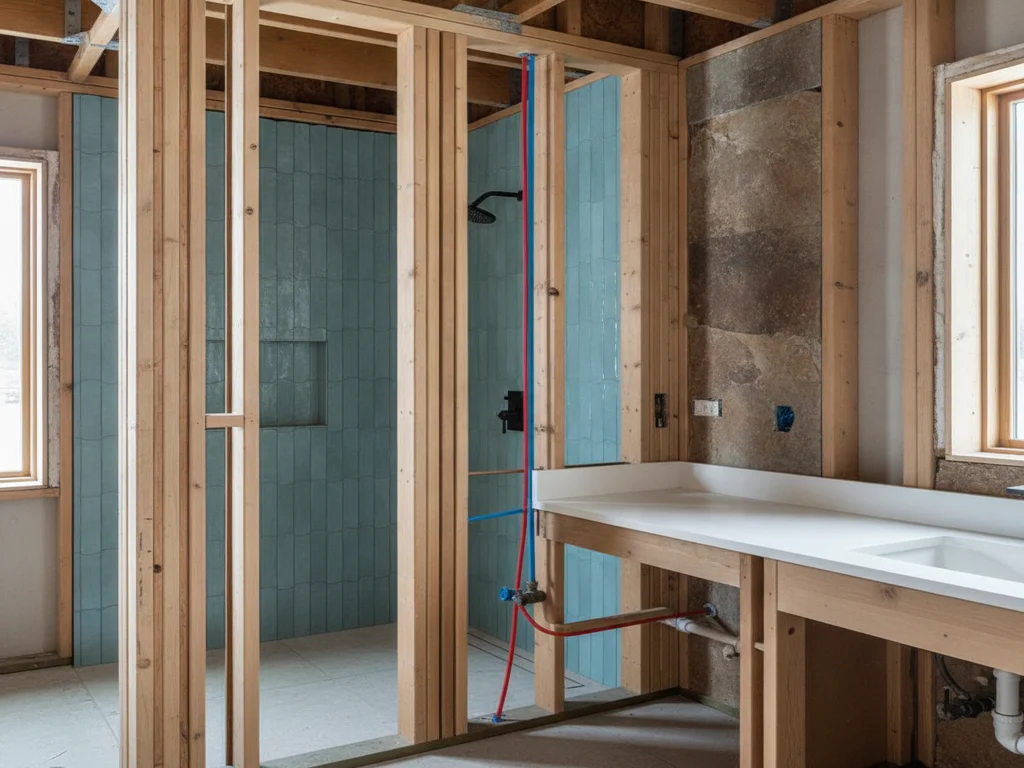
The math changes with a multi-head shower. A rain head plus a handheld, or a rain head plus body sprays, can each draw in that same 1.25–2.5 gpm range — and running two or three of them together stacks those draws on top of each other. A two-head shower alone can approach or exceed the low end of a tankless unit's flow-rate ceiling, and a three- or four-outlet setup can get close to even a high-output model's maximum, especially if another fixture (a second bathroom, a washing machine) is running hot water at the same time.
Quick comparison for shower performance
The practical differences, focused specifically on shower use.
| Tank | Tankless | |
|---|---|---|
| Hot water limit | Finite — stored volume, then recovery time | None — but capped by max flow rate (gpm) |
| Typical recovery / flow | Gas recovers faster than electric (This Old House) | ~5–6 gpm typical; up to 11 gpm on high-output models (Rinnai) |
| Best fit | One long shower, or a household with predictable, sequential use | Steady single-head use; multi-head use if unit is sized correctly |
| Risk point | Back-to-back showers outpacing recovery | Simultaneous multi-head or multi-fixture demand exceeding max flow |
Sizing a water heater for a multi-head or luxury shower
If you are designing (or already have) a shower with more than one outlet — a rain head and handheld, body sprays, or a digital system running several heads at once — the sizing conversation is not optional. Rinnai's own guidance is to have flow demand professionally calculated rather than assumed, precisely because a unit that handles a single shower comfortably can fall short the moment a second head, or a second bathroom, draws from it at the same time.
For a tank system, that conversation is about first-hour capacity and recovery rate matched to how many showers run back-to-back in your household's morning routine. For tankless, it is about total simultaneous gpm demand versus the unit's rated maximum — with the option of pairing multiple tankless units, which Bob Vila's coverage notes "can work in tandem to improve the total hot water capacity" for larger or higher-demand homes.
Get the shower design and the water heater sized together
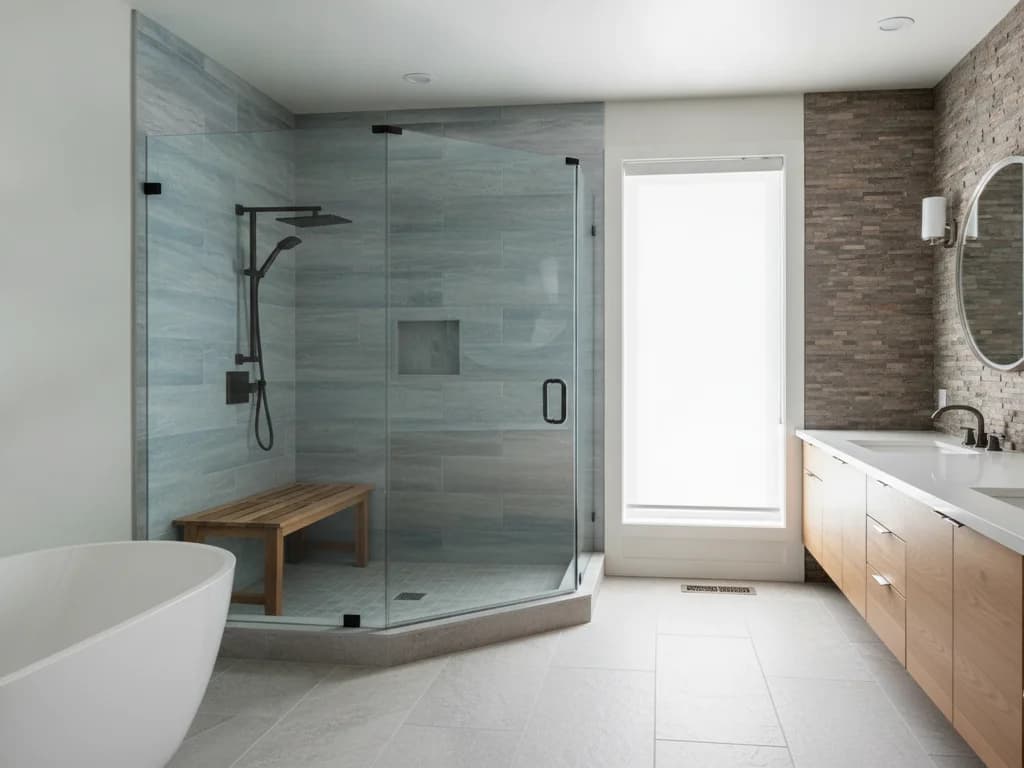
The flow rate a multi-head shower actually needs should be confirmed before the water heater (or its replacement) is chosen — not after tile goes up and the new shower feels underpowered.
The bottom line for a bathroom remodel
A single, standard shower head performs well on either a tank or a tankless system, so this decision alone should not be the deciding factor for a simple shower refresh. It becomes a real design constraint the moment you add a second shower outlet, plan simultaneous showers for a busy household, or want a luxury multi-head experience — at that point, matching your water heater's recovery or flow-rate capacity to the actual shower you are designing is the difference between a shower that performs as promised and one that quietly falls short.
Our shower head types compared guide covers what each additional head or body spray actually adds in flow demand, and when you are ready to design the shower itself, see how we build master bathroom retreats — sizing the water supply is part of that conversation from the start, not an afterthought.
Ready to plan your Boise bathroom?
Licensed & insured · 3-year workmanship warranty
Frequently asked questions
- Can a tankless water heater run a multi-head shower?
- Yes, if it is sized for the flow rate the shower demands. Tankless units commonly max out around 5–6 gpm, with higher-output residential models reaching up to 11 gpm (Rinnai). A rain head plus a handheld or body sprays can stack enough simultaneous flow to approach or exceed a smaller unit's ceiling, so Rinnai recommends professional flow-demand calculation before committing to a multi-outlet shower design.
- Does a tank water heater ever run out of hot water during a shower?
- It can, once the stored volume plus what the unit can reheat during use (its recovery rate) is exceeded. This Old House notes gas tank units recover meaningfully faster than electric ones. A single shower rarely exhausts a properly sized tank, but back-to-back showers in the same household can outpace recovery, especially on electric models.
- What is the actual flow rate difference between tankless and tank for showers?
- A standard shower head uses roughly 1.25–2.5 gpm, per This Old House, which either system handles comfortably. The difference shows up in simultaneous, multi-fixture demand: a tank is limited by stored capacity and recovery speed, while a tankless unit is limited by a fixed maximum flow rate — commonly 5–6 gpm, up to 11 gpm on higher-output models.
Sources
- This Old House — The Best Tankless Water Heaters
- This Old House — Tankless Water Heaters: A Buyer's Guide
- Bob Vila — 9 Best Water Heaters for Efficiency and Performance
- Bob Vila — Solved! Storage Tank vs. Tankless Water Heaters
- Rinnai — Residential FAQ (manufacturer)
- Rinnai — RU199iN Product Specifications (manufacturer)
- ENERGY STAR — Water Heater Key Product Criteria
- DOE — Purchasing Energy-Efficient Residential Water Heaters
Claims and figures are drawn from the sources above and provided for general guidance; your project may vary. Photography is illustrative of design concepts. For a fixed price on your specific bathroom, request a free estimate.