Updated July 17, 2026 · 8 min read
By Boise Bath — bathroom & shower remodeling in Boise & the Treasure Valley
The short answer
The standard shower head height is about 80 inches (6 feet 8 inches) from the floor to the outlet, which clears most adults. Rain heads mount overhead on the ceiling or a long arm; handheld slide bars run roughly 48 to 72 inches so the holder adjusts for any user. Set height to the tallest regular user, not code minimums.
Key takeaways
- The standard fixed shower head height is about 80 inches (6 feet 8 inches) to the outlet — high enough that spray clears the head of most adults instead of hitting them in the neck.
- Rain heads point straight down, so they mount overhead on the ceiling or a long shower arm, typically leaving about 84 inches or more of clearance so the spray falls over you, not in front of you.
- A handheld on a slide bar mounts the bar so its range spans roughly 48 to 72 inches, letting the holder slide to suit a tall adult, a child, or a seated user.
- Height should be set to the tallest person who uses the shower regularly; the plumbing rough-in for the drop-ear elbow is placed a few inches above the finished head height.
- For dual-head and multi-user showers, each head gets its own height and the controls are reachable from outside the spray so you can start the water without getting blasted.
- For accessible showers, a handheld on a bar plus a fixed head, an ADA-range slide bar, and controls within reach of a seat make the shower usable seated or standing.
Standard shower head height
The default height for a fixed, wall-mounted shower head is about 80 inches — 6 feet 8 inches — from the shower floor to the outlet where the water leaves the head. That number exists because it clears the top of most adults, so the spray arcs down over you instead of hitting you in the face or neck. Many builder-grade showers were plumbed lower, around 72 to 78 inches, which is why so many tall homeowners duck under their own shower head.
Eighty inches is a starting point, not a rule. The right height is the one that clears the tallest person who uses the shower regularly, and it is one of the easiest things to improve in a remodel because the plumbing is opened up anyway. This guide is the reference for those heights across every type of head — fixed, rain, handheld, and dual. If you are still deciding which kind of head to install, our shower head types compared breakdown covers the trade-offs; here we focus purely on how high and where each one goes.
How to set the right height for your household
The single best rule is to set the head so its outlet sits several inches above the top of the head of the tallest regular user. For a household topping out around 6 feet, that often lands the head near or a little above the 80-inch standard; for a taller user, going to 82 or 84 inches is reasonable. Going too low is the common mistake — a head at 76 inches feels fine for an average-height person and cramped for anyone taller.
The plumbing detail behind this: the drop-ear elbow (the fitting the shower arm threads into, buried in the wall) is roughed in a few inches above the intended finished head height, because the arm angles the head down and forward. That rough-in height is set before the wall is closed and tiled, so the time to decide is during planning, not after. A professional sets it to your household rather than to a generic default, which is exactly the kind of small dimension that makes a remodeled shower feel custom.
Height is set before the wall closes
The shower-arm rough-in is fixed inside the wall before tile goes up. Raising a fixed head later means opening finished, waterproofed tile — so head height, and every head in a multi-head layout, is decided during planning. Tell your remodeler the height of the tallest regular user before the walls are closed.
Rain shower head placement
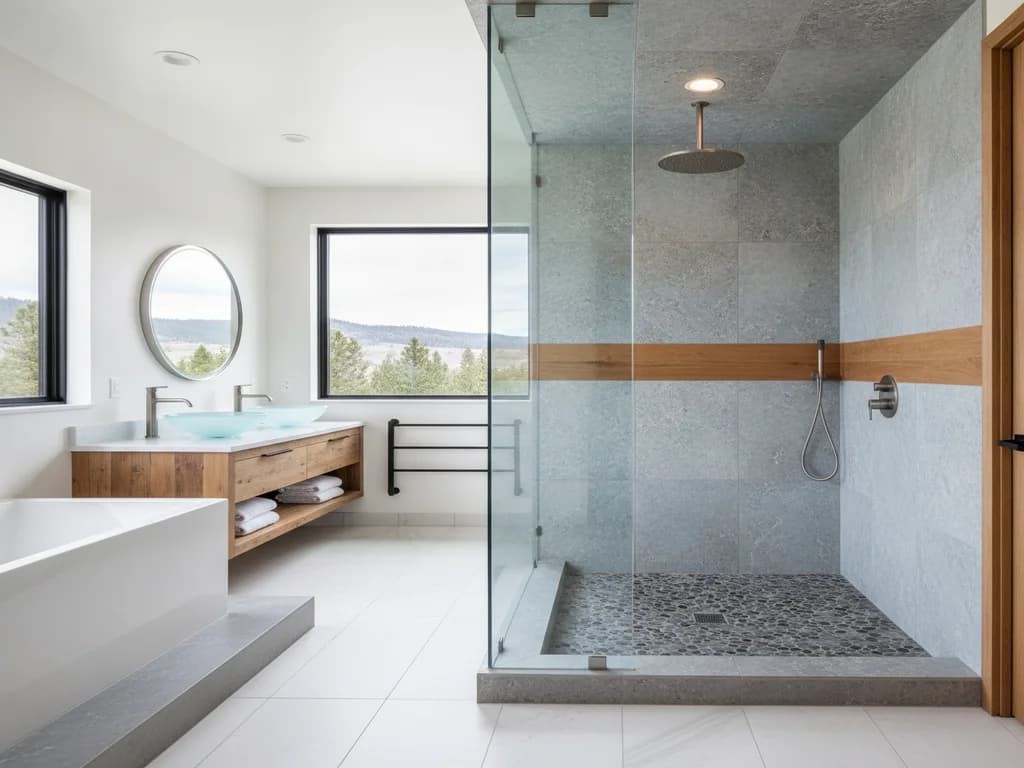
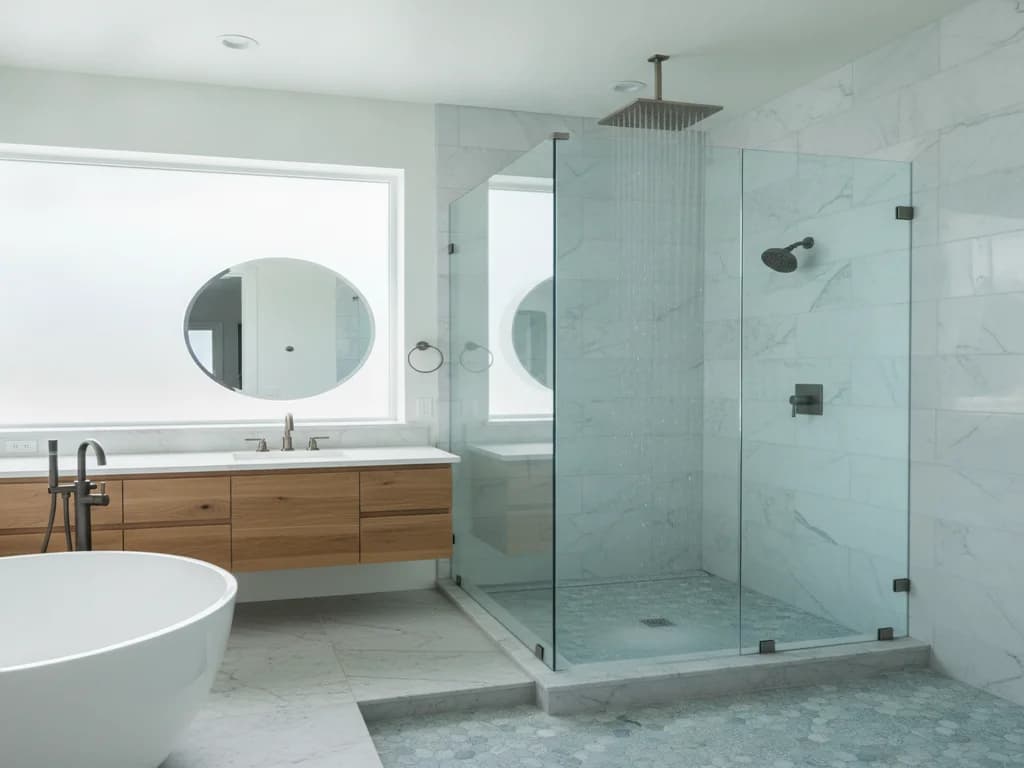
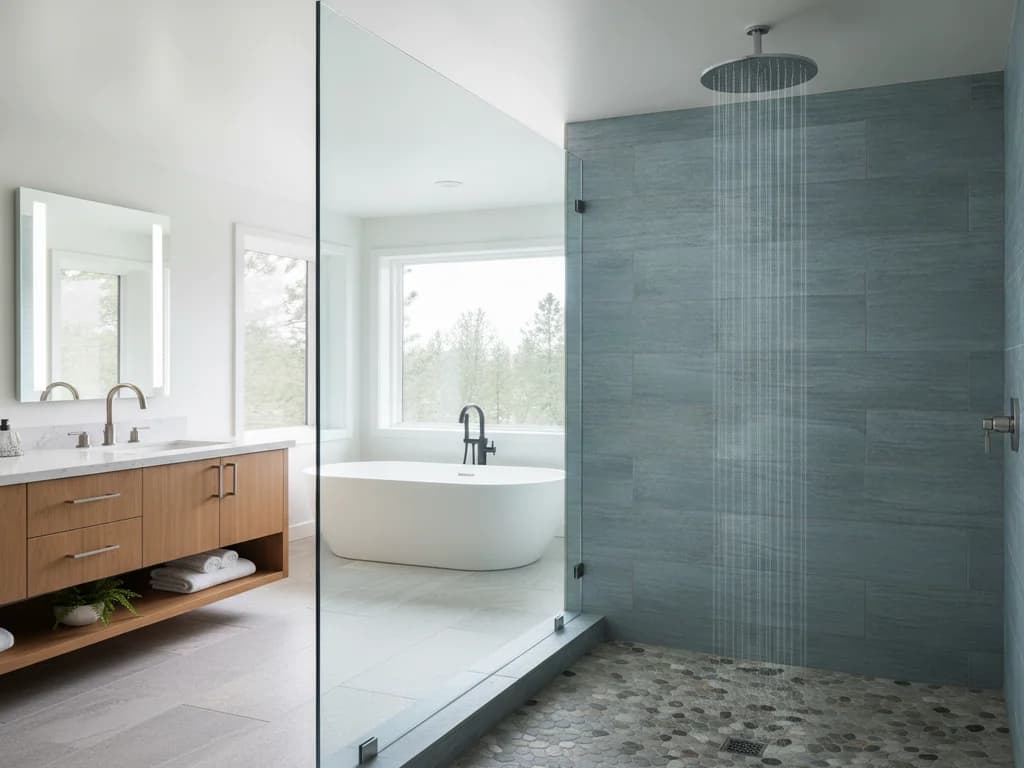
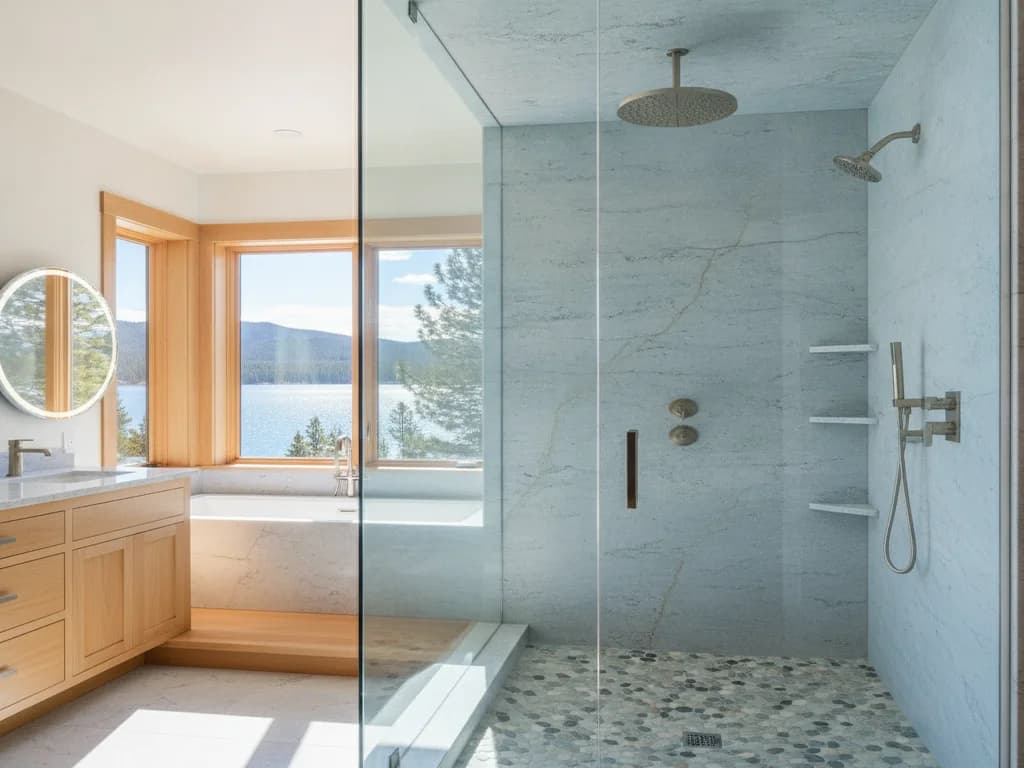
A rain head is a different geometry problem. Because it points straight down instead of angling out from the wall, it has to be positioned over where you actually stand, and high enough that the water falls onto you rather than in front of you. That usually means mounting it on the ceiling or on a long, near-horizontal shower arm, with the outlet around 84 inches or higher so a tall user still stands under the spray with room to spare.
The catch is that a rain head loses perceived pressure the higher it goes, because the water has farther to fall and spreads out — so placement balances clearance against feel, and it often pairs with a valve sized for the head's flow. Retrofitting one into an existing shower is not always a simple swap; ceiling-mounted rain heads in particular need a supply line run up into the ceiling. Our guide on whether you can upgrade to a rain shower head covers when it is a straightforward change and when it becomes a bigger project.
Handheld and slide-bar height
A handheld shower on a slide bar is the most flexible fixture in the shower, because its whole point is that the height adjusts. The bar is mounted so the holder's travel spans roughly 48 to 72 inches off the floor — low enough for a child or a seated user to reach and aim, high enough to act as a fixed overhead head when parked at the top. Mounting the bar itself usually means its bracket screws land somewhere around 40 to 48 inches at the bottom and 72 to 78 inches at the top.
The hose gives you reach for rinsing, cleaning the shower, or bathing a child or pet, and the slide range is what makes one fixture work for a whole household of different heights. In an accessible or aging-in-place shower, a handheld on a bar is close to mandatory — it is the fixture that lets someone shower seated. When a handheld and a fixed head share a wall, both heights are planned together so the hose reaches and the two do not crowd each other.
Dual-head and multi-user layouts
When two people share a shower or you want a fixed head plus a handheld, layout is about giving each head its own height and keeping the controls sane. A common pairing is a fixed head at standard height on one wall and a handheld on a slide bar beside or below it. A his-and-hers layout with two fixed heads sets each to its user's height, often on opposite or adjacent walls so the sprays do not collide.
The rule that saves you a cold-water surprise: the shower valve and controls go where you can reach them from outside the spray zone, typically toward the entry side of the shower, so you can turn the water on and let it warm up before stepping in. In a larger shower this may mean the controls sit well away from the heads themselves. Bigger multi-head layouts also draw more water, which affects valve and supply sizing — a coordination question that ties into how our walk-in shower dimensions reference sizes the enclosure around the fixtures.
ADA and accessible placement
An accessible shower is designed so it works seated as well as standing, and the fixture heights follow from that. The core move is a handheld shower on a vertical slide bar, which the ADA Standards recognize as a way to serve a seated user — with a hose long enough (commonly at least 59 inches) to reach a bench. Pairing the handheld with a fixed head lets the same shower serve someone standing and someone seated without a compromise for either.
Controls and the valve are placed within reach of the seat, not up at standing height, and grab bars are mounted at their own accessible heights (a separate dimension from the shower head). The goal is a shower a person can use independently and safely, which is central to any aging-in-place remodel — our how to choose shower fixtures guide covers selecting a handheld, bar, and valve as a coordinated set. For public or code-required accessible installations, the exact figures come from the ADA Standards and the applicable plumbing code, confirmed for the project.
The shower head height reference table
This table gathers the working heights in one place. Treat the fixed-head standard as a floor to raise for taller users, the rain-head clearance as the number that keeps spray falling on you, and the handheld range as the flexibility that serves a whole household.
| Fixture | Typical height / placement | Notes |
|---|---|---|
| Fixed wall head (standard) | ~80 in (6 ft 8 in) to outlet | Clears most adults; raise for taller regular users |
| Fixed wall head (tall users) | ~82–84 in to outlet | Set several inches above the tallest regular user |
| Rain head (ceiling/long arm) | ~84 in or higher | Points straight down; higher = softer perceived pressure |
| Handheld slide bar (range) | ~48–72 in of travel | Adjusts for tall, short, seated, and child users |
| Handheld hose length (accessible) | ≥59 in | Long enough to reach a shower bench (per ADA) |
| Shower controls/valve | Reachable from outside spray | On the entry side; within reach of a seat if accessible |
| Arm rough-in (in wall) | A few inches above finished head height | Set before tile; not adjustable afterward |
Standard heights are typical ranges. Accessible dimensions follow the ADA Standards and the applicable plumbing code; local Treasure Valley requirements are confirmed at permit for code-required installations.
What the process looks like
- 1
Identify the tallest regular user
A professional starts from who actually uses the shower and sets the fixed-head target several inches above the tallest regular user, rather than defaulting to a low builder-grade height.
- 2
Choose the head types and count
The layout is decided first — a single fixed head, a fixed head plus handheld, dual fixed heads, or a rain head — because each type has its own height and rough-in, and adding heads affects valve and supply sizing.
- 3
Set each rough-in height in the wall
The drop-ear elbow for each fixed head and the mounting backing for a slide bar are located at the planned heights before the wall is closed and waterproofed, since these are fixed once the tile goes up.
- 4
Place the valve and controls for reach
The shower valve and controls are set on the entry side, reachable from outside the spray so the water can warm up before you step in — and within reach of a seat in an accessible shower.
- 5
Coordinate accessible fixtures
For an aging-in-place or accessible shower, a handheld on a bar with a long hose, a fixed head, and seat-height controls are placed together so the shower works seated or standing.
- 6
Install, test, and confirm clearances
After tile, the heads and handheld are installed and run to confirm the spray clears the tallest user, the handheld reaches where it needs to, and the controls operate from outside the spray.
Ready to plan your Boise bathroom?
Licensed & insured · 3-year workmanship warranty
Frequently asked questions
- What is the standard shower head height?
- The standard fixed shower head height is about 80 inches — 6 feet 8 inches — from the floor to the outlet. That clears the top of most adults so the spray falls over you rather than hitting your face. Many older showers were plumbed lower, around 72 to 78 inches, which is why taller people often want the head raised in a remodel.
- How high should a rain shower head be mounted?
- A rain head points straight down, so it mounts overhead — on the ceiling or a long shower arm — usually with the outlet around 84 inches or higher, so a tall person stands fully under the falling water. The higher it goes, the softer the perceived pressure feels, so placement balances clearance against the feel you want.
- What height should a handheld shower slide bar be?
- A handheld slide bar is mounted so the holder can travel roughly 48 to 72 inches off the floor. That range lets the same fixture serve a tall adult parked high, a child lower down, and a seated user. The bar bracket itself typically lands around 40 to 48 inches at the bottom and 72 to 78 inches at the top.
- Can I raise my shower head height without a remodel?
- A simple raise is sometimes possible with an S-shaped extension arm or a slide bar that adds height without opening the wall. Moving the actual in-wall rough-in higher, though, means opening finished, waterproofed tile — a bigger job usually folded into a remodel. Which path applies depends on how much extra height you need and the fixture you choose.
- What is the ADA shower head requirement?
- Accessible showers use a handheld shower on a slide bar so it works for a seated user, with a hose long enough — commonly at least 59 inches — to reach a bench, plus controls within reach of the seat. Pairing the handheld with a fixed head serves both seated and standing users. Exact figures follow the ADA Standards for code-required installations.
- Where should shower controls be placed?
- Put the shower valve and controls on the entry side of the shower, reachable from outside the spray, so you can turn the water on and let it warm up before stepping in. In an accessible shower the controls also need to be within reach of the seat. In a large or multi-head shower this often means the controls sit well away from the heads.
Sources
- ADA.gov — U.S. Department of Justice
- U.S. Access Board — ADA Accessibility Standards
- National Kitchen & Bath Association (NKBA)
- Moen
Claims and figures are drawn from the sources above and provided for general guidance; your project may vary. Photography is illustrative of design concepts. For a fixed price on your specific bathroom, request a free estimate.