Updated July 6, 2026 · 8 min read
By Boise Bath — bathroom & shower remodeling in Boise & the Treasure Valley
The short answer
An anti-scald valve is a shower or tub-shower control valve — pressure-balancing, thermostatic, or a combination of both — that keeps water from suddenly spiking hot when another fixture pulls water. The CPSC notes 150°F water can cause a third-degree burn in 2 seconds and recommends setting water heaters no higher than 120°F.
Key takeaways
- The CPSC reports most adults suffer third-degree burns from 150°F water in just 2 seconds — and even 120°F water can burn after a 5-minute exposure.
- The CPSC urges households to set water heaters no higher than 120°F, which also conserves energy.
- Pressure-balancing valves react to water-pressure changes; thermostatic valves react to actual water temperature; combination valves do both, per ASSE International.
- These valve types provide two kinds of protection — scald protection and thermal-shock protection — a distinction the plumbing industry's own standards body draws explicitly.
- A temperature-control valve is not just a code checkbox — it is one of the least expensive, highest-value safety upgrades in any shower or tub remodel.
What is an anti-scald valve, and why does it matter?
"Anti-scald valve" is the everyday name for a shower or tub-shower control valve built to keep the water temperature from suddenly spiking. The most common trigger is another fixture in the house — a toilet flushing, a washing machine filling, a kitchen tap running — briefly pulling cold water away from the supply line and letting the shower run hotter than intended, sometimes in less than a second.
This is not a minor inconvenience. The ASSE International Scald Awareness Task Group, the plumbing-industry group behind the performance standards for these valves, notes that hot tap water accounts for more than 25 percent of all scald burns in children, with the elderly and physically impaired also at increased risk. The U.S. Consumer Product Safety Commission (CPSC) is even more direct about who is affected: "the majority of injuries and deaths involving tap water scalds are to the elderly and children under the age of five."
A shower valve that includes this protection is not solving a rare, freak-accident problem. It is addressing the single most common and most preventable way a bathroom fixture actually hurts someone — and it does so automatically, every time, without the household having to remember to test the water first.
CPSC recommendation
The CPSC urges all households to lower their water heaters to 120°F. In addition to reducing scald risk, it conserves energy and lowers utility costs.
How fast can hot water actually burn you?
The numbers below are the reason anti-scald valves exist. A few degrees make an enormous difference in how much time a person has to react.
| Water temperature | Time to third-degree burn (most adults) |
|---|---|
| 150°F | 2 seconds |
| 140°F | 6 seconds |
| 130°F | 30 seconds |
| 120°F | Roughly 5 minutes of continuous exposure |
Source: U.S. Consumer Product Safety Commission, "Avoiding Tap Water Scalds" (Publication 5098).
Why 120°F is the CPSC's recommended ceiling
The gap between 120°F and 130°F looks small on a dial, but it is the difference between a five-minute margin for error and a thirty-second one. The CPSC frames the 120°F recommendation as the point where an accidental exposure — a child turning a single-handle faucet too far, an adult stepping into a shower before checking it — is far less likely to cause a serious burn before someone can react.
Pressure-balancing vs. thermostatic valves — what is the difference?
ASSE International, the standards body whose ASSE 1016 performance standard governs these devices, defines three valve types that meet the standard for individual showers and tub-shower combinations: pressure balancing, thermostatic (mechanical or electronic), and a combination of the two.
A pressure-balancing valve reacts to changes in water pressure between the hot and cold supply lines. If cold pressure drops because another fixture opened elsewhere in the house, the valve automatically reduces the hot side to keep the mix ratio — and therefore the output temperature — roughly constant. A thermostatic valve works differently: it senses the actual temperature of the mixed water and adjusts flow to hold that temperature steady, regardless of what is causing the fluctuation, including changes in the incoming supply temperature itself, which a pressure-balancing valve alone cannot fully correct for. A combination valve uses both mechanisms together.
Per ASSE's own application guidance, all three types share a few requirements: the user retains access to flow and/or final temperature controls, no further mixing happens downstream of the device, and the temperature-limit stop must be set at installation and may need periodic adjustment as supply conditions change.
In practice, most homeowners never choose between these types by name — the valve behind a given shower fixture is typically whatever the manufacturer paired with that trim kit. What matters more day to day is simply knowing the valve exists and that it has a limit stop, since that stop is what an installer or plumber actually adjusts if a household wants the maximum shower temperature capped lower than the factory default.
Why plumbing codes require these valves
These are not optional showroom upgrades. ASSE International's guidance states plainly that shower and tub-shower combination valves "shall be automatic temperature and/or pressure compensating valves," built and installed to comply with the ASSE 1016 standard, with a temperature-limit stop set at the time of installation. Model plumbing codes widely reference this same ASSE 1016 standard for individual shower and tub-shower valves, which is why a modern shower valve — even a plain, inexpensive one — almost always includes this protection built in, whether or not the homeowner ever thinks about it.
ASSE also draws a sharp distinction worth remembering: a device that only regulates temperature at a central point, like a water heater or a whole-house mixing valve, is not the same as a point-of-use anti-scald valve at the shower itself. Its own guidance is explicit that a mixing valve installed at the water heater "will not be able to provide the required scald protection" for individual fixtures — the point-of-use valve at the shower or tub is still required.
Thermal shock: the second hazard these valves prevent
Scalding is not the only risk. ASSE International defines a second, related hazard called thermal shock: "a significant sudden change in temperature from hot to cold or cold to hot, or hot to hotter, that causes a bather to violently react, which can lead to a slip and fall injury." In other words, a sudden blast of cold water can be just as dangerous as a blast of hot water, simply because of how a startled person reacts on a wet, slippery surface.
This is why ASSE 1016-compliant valves are described as providing "both scald and thermal shock protection" — the same mechanism that prevents a dangerous temperature spike also prevents a dangerous temperature drop.
This second protection is easy to overlook because it never gets described in terms of burns or degrees. But a slip caused by someone jerking away from an unexpected cold blast can be just as serious as a scald, particularly for an older adult on a wet, hard shower floor — which is one more reason this cluster of posts pairs anti-scald valves with the slip-resistant flooring and grab bar placement covered elsewhere in our safety-and-accessibility guides.
Choosing and finishing an anti-scald valve
Because ASSE 1016 compliance is now standard on nearly all shower and tub-shower valves sold for residential use, choosing one is less about finding scald protection and more about matching the valve's trim, handle style, and finish to the rest of the room. Our guide to choosing shower fixtures and our bathroom fixtures and hardware guide both cover that side — finish coordination, single-handle versus two-handle designs, and how to match a valve trim to your shower head and hardware.
Building anti-scald protection into a shower remodel
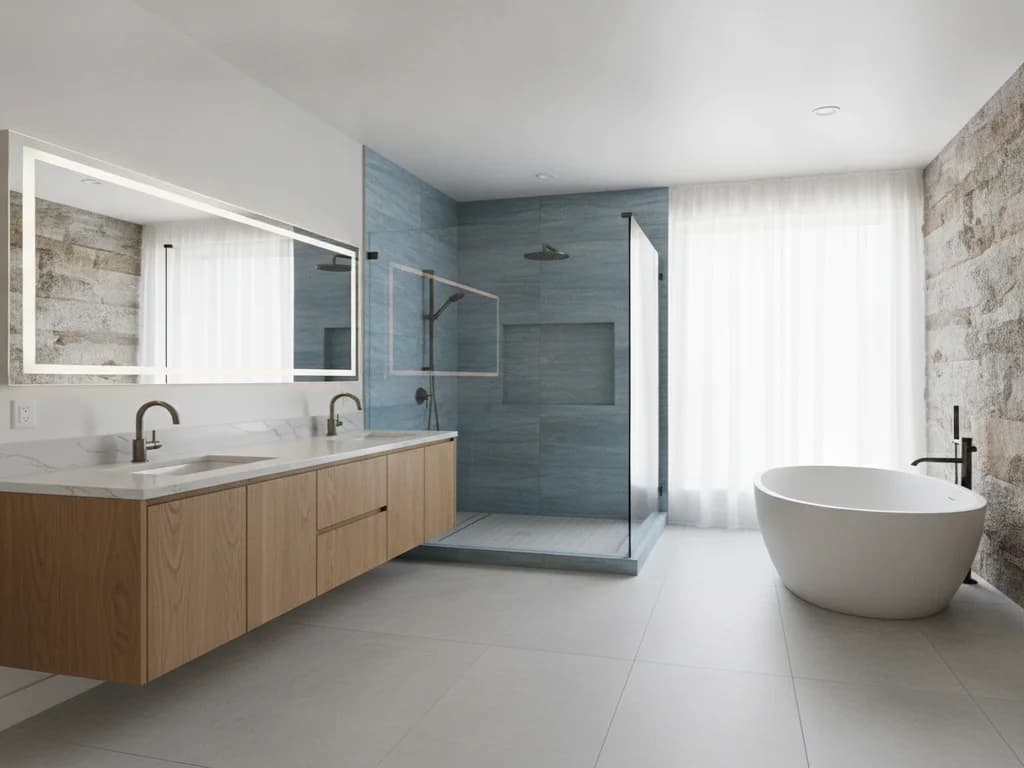
A remodel is the easiest time to make sure this protection is actually in place, since the valve is being installed either way. If you are planning a new walk-in shower, explore our walk-in shower services — every valve we install meets this same ASSE 1016 standard, and we can also help set the temperature-limit stop to whatever ceiling makes sense for your household, particularly if young children or older adults use the space.
Ready to plan your Boise bathroom?
Licensed & insured · 3-year workmanship warranty
Frequently asked questions
- What temperature should I set my water heater to prevent scalds?
- The CPSC recommends setting residential water heaters no higher than 120°F. At 150°F, most adults suffer a third-degree burn in about 2 seconds; even at 120°F, roughly 5 minutes of continuous exposure could cause a third-degree burn, so a properly working anti-scald shower valve remains important even at a lowered water-heater setting.
- What is the difference between a pressure-balancing and a thermostatic shower valve?
- A pressure-balancing valve reacts to pressure changes between the hot and cold supply lines to hold the mix ratio steady. A thermostatic valve senses the actual output temperature directly and adjusts to hold it steady, regardless of the cause of the fluctuation. Both are covered by the ASSE 1016 standard, and a combination valve uses both mechanisms.
- Are anti-scald valves required by code?
- Yes, for individual showers and tub-shower combinations. ASSE International's guidance states these valves must be automatic temperature and/or pressure-compensating types that comply with the ASSE 1016 standard, with a temperature-limit stop set at installation — a requirement that model plumbing codes widely reference for residential shower and tub-shower valves.
Sources
- U.S. Consumer Product Safety Commission — Avoiding Tap Water Scalds (Publication 5098)
- ASSE International — Guidelines for Temperature Control Devices in Domestic Hot Water Systems (manufacturer/institute white paper)
- International Code Council — International Residential Code (IRC)
Claims and figures are drawn from the sources above and provided for general guidance; your project may vary. Photography is illustrative of design concepts. For a fixed price on your specific bathroom, request a free estimate.