Updated July 6, 2026 · 9 min read
By Boise Bath — bathroom & shower remodeling in Boise & the Treasure Valley
The short answer
The best bathroom ceiling ideas balance look with moisture exposure: a bathroom-rated satin or semi-gloss paint works almost anywhere, tongue-and-groove or shiplap needs solid wood or PVC (never MDF) and belongs outside direct spray, tile-to-ceiling suits a fully waterproofed shower, and cove lighting adds a soft perimeter glow to any of them.
Key takeaways
- Bathroom-rated paint in a satin or semi-gloss sheen is the lowest-risk ceiling upgrade — This Old House recommends these sheens because they "repel water and hold up well to frequent cleaning."
- Wood ceilings need the right material: Bob Vila's guidance is blunt that "MDF can swell or warp when exposed to moisture," so a bathroom tongue-and-groove or shiplap ceiling should use solid wood or PVC instead, kept clear of direct shower spray.
- A tiled shower ceiling should be sloped slightly — This Old House's steam-shower guidance notes that without a slight slope, "any steam that condenses there will drip down onto your shoulders."
- Cove lighting recessed along a ceiling perimeter is an accent layer, not a replacement for ambient light — This Old House describes it as "rope lights behind a crown molding" that add "a soft, warm glow around the room's perimeter."
- Any ceiling fixture within about six feet of a tub or shower needs a wet-rated (not just damp-rated) listing, since damp-rated fixtures handle humidity but not direct water contact.
Why the ceiling is the most overlooked surface in a bathroom
Most bathroom remodels spend their design energy on the floor, the walls, and the vanity, and treat the ceiling as whatever's left over — flat, white, done. That's a missed opportunity, because a bathroom ceiling sits directly over the room's highest-humidity zone and gets seen constantly, whether you're looking up from the tub or catching it in a mirror's reflection. It's also one of the few surfaces in the house where moisture rises to meet it rather than running down and away, which makes material choice more consequential here than almost anywhere else in the room.
The ideas below are organized the same way any bathroom material decision should be: by how much direct moisture and steam the ceiling in question actually sees, since that answer decides which of these treatments is safe to use and which isn't.
Start here
Is this ceiling over a shower or tub that generates real steam, or is it over a dry part of the room? That answer narrows this list fast.
Painted ceilings: the lowest-risk upgrade
Paint is the simplest ceiling change and, done right, one of the safest. Sherwin-Williams' Duration Home line is built specifically around this use case, offering "moisture resistant technology offering quick return to service (as little as two hours) & durability in moist environments like bathrooms," with anti-microbial agents that "inhibit the growth of mold and mildew." Benjamin Moore's Aura Bath & Spa line makes the same case from a different angle, positioned as "our premium, matte finish bathroom paint offering unparalleled beauty in high humidity environments."
Sheen matters as much as the formula. This Old House's guidance for bathroom paint recommends "satin or semi-gloss finishes" because they "repel water and hold up well to frequent cleaning" — the same logic applies overhead as it does on the walls. A flat finish will show water spotting and is harder to wipe clean if condensation drips and pools on the ceiling surface.
Tongue-and-groove and shiplap ceilings: where wood works
Wood ceilings bring warmth a flat painted plane can't, and tongue-and-groove in particular has a long history as a ceiling material — Bob Vila's guidance on the difference between shiplap and tongue-and-groove notes it's "a classic ceiling choice for porches," and that homeowners going for a modern farmhouse or coastal look "might even choose to use shiplap or tongue and groove on the ceiling." The look works just as well over a bathroom vanity or tub deck as it does on a porch — the material decision is what changes.
The caveat is the same one that applies to wood on bathroom walls: material matters more than style. Bob Vila is direct that "MDF can swell or warp when exposed to moisture," so a bathroom ceiling in tongue-and-groove or shiplap should use solid wood or PVC boards instead, properly sealed, and — per the same guidance — kept out of direct water contact, "say, in a shower enclosure." A wood ceiling over a vanity or a soaking tub, away from direct spray, is a reasonable use; a wood ceiling directly inside a shower stall is not, regardless of material.
Tile-to-ceiling showers: full coverage inside the wet zone
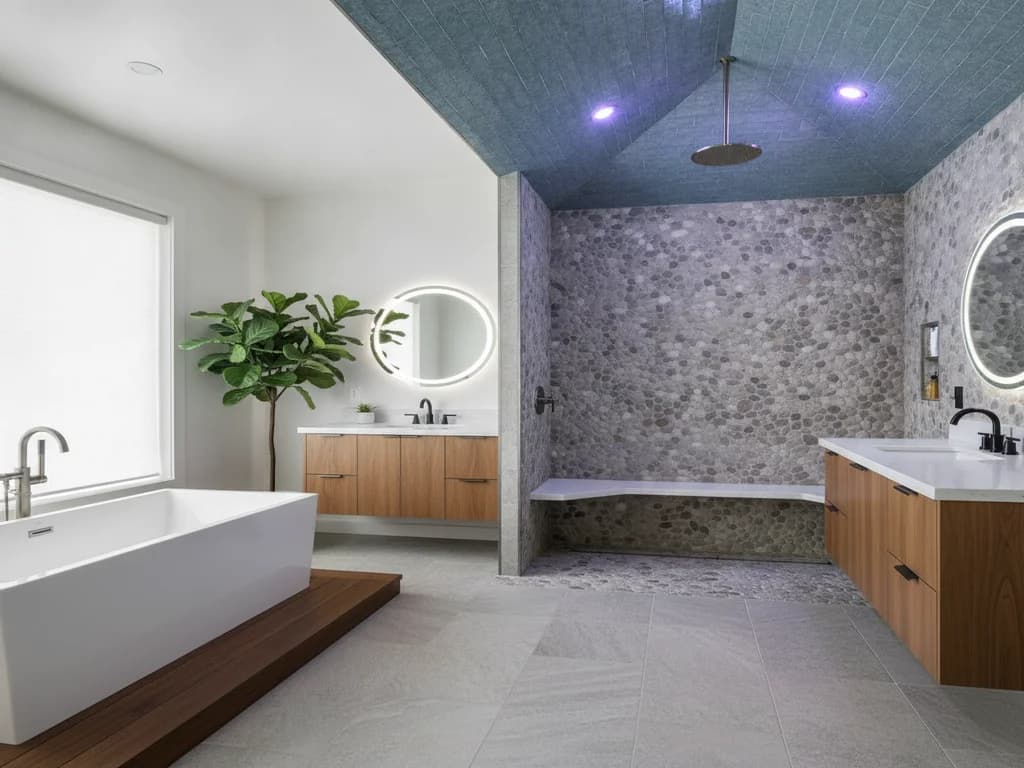
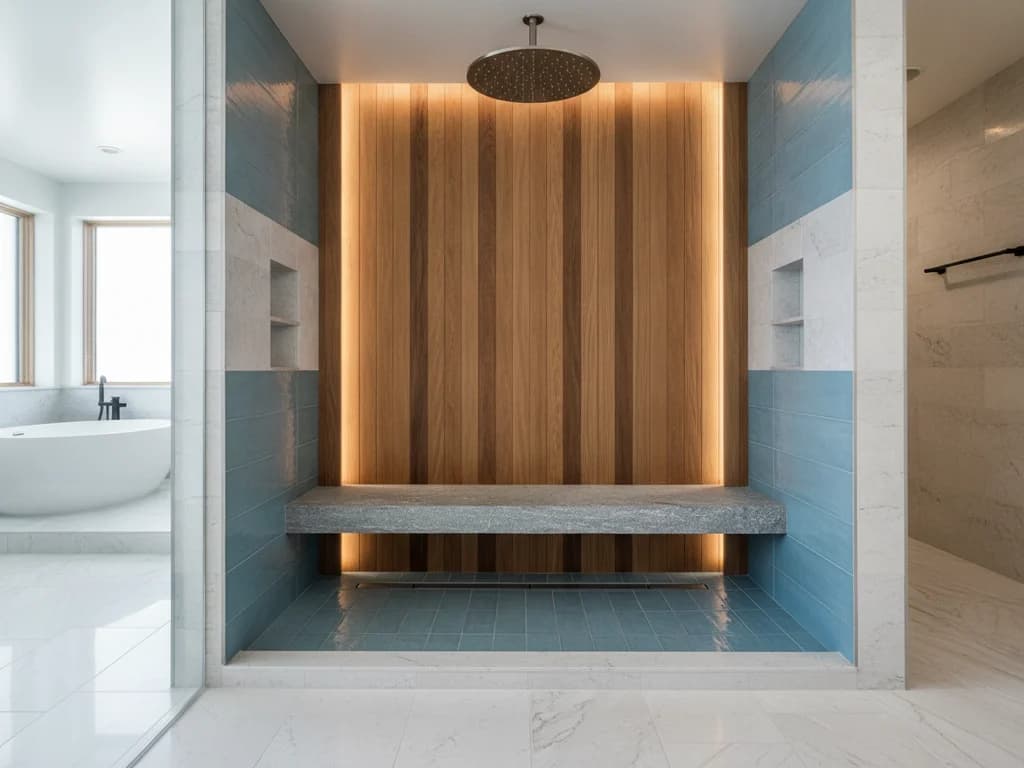
Running tile all the way up a shower's walls and across its ceiling is the highest-moisture-tolerance option on this list, because it's built the same way a shower wall is: waterproofed first, tiled second. It also solves a problem paint and wood can't touch — a shower generates real steam, and that steam has to condense somewhere. This Old House's steam-shower guidance is specific about the fix: "slope the ceiling slightly. If you don't, any steam that condenses there will drip down onto your shoulders." A tiled ceiling on a slight slope sheds that condensation the same way a shower wall sheds direct spray.
That slope, plus a full waterproofing membrane behind the tile — the same backer-board-and-membrane system used on shower walls — is what makes a tiled ceiling durable rather than a maintenance problem. It's a shower-specific idea, not a whole-room one: outside the wet zone, tile-to-ceiling is expensive overkill compared with paint or wood.
Bathroom ceiling treatments at a glance
Match the treatment to how much direct moisture that specific ceiling actually sees.
| Treatment | Moisture tolerance | Best for |
|---|---|---|
| Bathroom-rated paint (satin/semi-gloss) | High — formulated for humidity, per Sherwin-Williams and Benjamin Moore | Any bathroom ceiling; the default choice |
| Tongue-and-groove / shiplap (solid wood or PVC) | Moderate — needs sealing and no direct spray | Over a vanity, tub deck, or dry part of the room |
| Tile-to-ceiling (waterproofed, sloped) | Highest — built like a shower wall | Directly inside a shower or wet-room enclosure |
| Cove lighting (any material) | Depends on the fixture rating | Accent layer added to any of the above |
Cove lighting: the ceiling as a light source
Cove lighting treats the ceiling perimeter as a light fixture rather than just a surface, and it's one of the more understated upgrades on this list. This Old House's bathroom lighting guidance describes the classic version directly: "consider installing cove lighting by concealing rope lights behind a crown molding. The effect adds a soft, warm glow around the room's perimeter." It's an accent layer — mood and depth, not the room's main light source — so it works best paired with the vanity task lighting and ambient ceiling cans a bathroom actually needs to function.
Fixture rating matters here too. This Old House's guidance is specific that "any lighting fixtures installed within a certain distance of the tub or shower (usually six feet, but check local codes) must be wet-rated or shower-location-rated," and cautions not to "confuse wet-rated fixtures with damp-location-rated fixtures, which are suitable for humid environments but not direct water exposure." Cove lighting mounted well outside that six-foot zone can typically use a standard damp-rated fixture; anything closer, or inside a tiled shower ceiling, needs the fully wet-rated version.
Putting it together with the rest of the room
A ceiling choice rarely stands alone — it either continues a wall treatment upward or deliberately breaks from it, and it always interacts with how the room is lit. If you're also deciding on the walls themselves, our bathroom wall treatment ideas roundup covers wainscoting, board-and-batten, and tile options with the same moisture-first framing used here. And if lighting is the piece you haven't settled yet, our bathroom lighting layers guide covers how task, ambient, and accent light — including cove lighting — work together across the whole room, not just the ceiling.
How the ideas come together
Simple and safe: a bathroom-rated satin or semi-gloss paint on every ceiling in the room, including over the tub.
Warm and textural: sealed solid-wood or PVC tongue-and-groove over the vanity and tub deck, painted ceiling everywhere closer to the shower.
Full wet-zone coverage: tile carried up the shower walls and across a slightly sloped ceiling, waterproofed the same way the walls are.
Finishing touch: cove lighting added around the room's perimeter, wet- or damp-rated depending on its distance from the shower.
A full bathroom remodel is where the ceiling, wall treatment, and lighting plan get decided together, rather than the ceiling getting whatever's left in the paint can.
Ready to plan your Boise bathroom?
Licensed & insured · 3-year workmanship warranty
Frequently asked questions
- Can you put shiplap or tongue-and-groove on a bathroom ceiling?
- Yes, but the material matters more than the style. Bob Vila's guidance warns that "MDF can swell or warp when exposed to moisture," so a bathroom ceiling should use solid wood or PVC boards, properly sealed, and kept out of direct water contact — over a vanity or tub deck rather than inside a shower stall.
- What paint should you use on a bathroom ceiling?
- A bathroom-rated paint in a satin or semi-gloss sheen, per This Old House's guidance that these sheens "repel water and hold up well to frequent cleaning." Sherwin-Williams' Duration Home and Benjamin Moore's Aura Bath & Spa are both formulated specifically for high-humidity rooms like bathrooms.
- Should a shower ceiling be tiled?
- It can be, as long as it's waterproofed the same way the shower walls are and given a slight slope. This Old House's steam-shower guidance notes that without that slope, "any steam that condenses there will drip down onto your shoulders" — the slope sheds condensation instead of collecting it overhead.
Sources
- This Old House — 6 Great Looks for Your Ceiling
- Bob Vila — Shiplap vs. Tongue and Groove Paneling: What's the Difference?
- This Old House — All About Steam Showers
- This Old House — A Lesson in Bathroom Lighting
- Sherwin-Williams — Duration Home Interior Acrylic Latex (manufacturer)
- Benjamin Moore — Aura Bath & Spa Interior Paint (manufacturer)
Claims and figures are drawn from the sources above and provided for general guidance; your project may vary. Photography is illustrative of design concepts. For a fixed price on your specific bathroom, request a free estimate.