Updated July 6, 2026 · 8 min read
By Boise Bath — bathroom & shower remodeling in Boise & the Treasure Valley
The short answer
Bathroom mold needs moisture, not bad luck — the EPA is direct that "the key to mold control is moisture control." A remodel prevents it through four choices: correctly sized exhaust ventilation, a real waterproofing membrane behind tile, low-porosity grout like epoxy, and a mildew-resistant paint formula on the walls that stay dry.
Key takeaways
- The EPA states plainly that moisture control, not cleaning products, is the key to mold control — remove the moisture and mold has nothing to grow on.
- The EPA recommends keeping indoor relative humidity below 60 percent, ideally between 30 and 50 percent, which exhaust ventilation is the primary tool for achieving.
- A sheet waterproofing membrane behind tile stops water from ever reaching the wood framing and drywall where mold actually takes hold.
- Epoxy grout is non-porous and does not absorb water the way cementitious grout does, per the Tile Council of North America.
- Moisture-resistant, mildew-inhibiting paint formulas exist specifically for bathroom walls, per manufacturer product data.
Why moisture control is the whole story
Mold is not a mystery or a hygiene failure — it is a biological process that needs moisture to happen at all. The EPA states this as plainly as an agency can: "The Key to Mold Control is Moisture Control." Remove the standing moisture, and mold has nothing to grow on, no matter how much a bathroom gets used.
That reframes what a "mold-resistant remodel" actually is. It is not one special product; it is four ordinary remodel decisions — ventilation, waterproofing, grout, and paint — each aimed at the same target: getting water out of the room, and keeping it out of the materials behind the tile.
None of these four decisions is exotic or expensive relative to the rest of a remodel budget. What actually determines whether a bathroom stays mold-free for years is whether they are specified correctly and installed together, rather than treating any single one — a good exhaust fan, say — as the whole solution on its own.
The EPA's core guidance
The EPA also advises drying any water-damaged area or item within 24–48 hours and promptly fixing leaky plumbing or other water sources — both are as relevant to a finished remodel as to the demolition phase.
Ventilation: getting moist air out of the room before it settles
A shower can put more water vapor into the air in ten minutes than the rest of the house sees all day, and where that vapor goes next determines whether it becomes a problem. The EPA recommends keeping indoor relative humidity below 60 percent, ideally between 30 and 50 percent — a range that a correctly sized, correctly vented exhaust fan is the primary tool for reaching in a bathroom.
We cover the actual CFM sizing formula, duct routing, and humidity-sensor options in full in our bathroom ventilation tips guide — the short version for this post is that ventilation is not optional trim on a remodel; it is the mechanism that keeps humidity in the range the EPA describes rather than letting it linger on cool tile and drywall.
An undersized fan, a duct that terminates in the attic instead of outdoors, or a fan nobody actually turns on all produce the same outcome: humidity stays elevated well past the shower itself, giving mold hours instead of minutes of favorable conditions on a cool surface. Sizing and routing the ventilation correctly during a remodel is a one-time decision that keeps paying off every single day afterward.
Waterproofing systems: stopping water before it reaches framing
Grout and caulk slow water down, but they are not the layer actually responsible for keeping a shower dry behind the tile — a waterproofing membrane is. Manufacturer Schluter, whose KERDI membrane is one of the standard sheet-applied systems used in tiled showers, describes its product's purpose directly: it "eliminates water damage which can lead to mold and mildew" by fully sealing the wall and floor assembly beneath the tile, rather than relying on the tile and grout joints to do that job.
This is the real difference between a remodel that merely looks new and one that actually resists mold for years: a modern shower gets a continuous waterproofing layer bonded directly beneath the tile, not just a coat of thin-set and a hope that the grout holds.
This matters most at the seams — where wall meets floor, where a niche is cut into the wall, where a shower valve or drain penetrates the membrane — because those are exactly the spots an older, tar-paper-and-mesh approach was most likely to leave a gap. A properly detailed sheet membrane is built to be continuous across every one of those transitions, not just across the flat field of tile.
Grout choice: porous vs. sealed surfaces
Standard cementitious grout is porous by nature — the Tile Council of North America notes plainly that it "can absorb a stain," which is another way of saying it can absorb water, soap film, and the organic residue mold feeds on. That is why cementitious grout needs a sealer and periodic resealing to perform well in a wet shower.
Epoxy grout works differently. Per the same source, "if epoxy grout is used, it is virtually as stain proof as the tile" — because it is non-porous, it does not need sealing and gives mold far less to hold onto in the grout lines themselves. It costs more and installs differently, but in a genuinely wet zone, it is the lower-maintenance, more mold-resistant choice.
Caulk: the joint that needs its own mildew resistance
Grout handles the tile field; caulk handles the corners, the tub-to-tile joint, and anywhere two different materials meet. These joints move slightly with temperature and settling, which is exactly why they are sealed with flexible caulk rather than rigid grout — and why that caulk needs to be a mildew-resistant formula built for the job. Our bathroom caulking guide covers the silicone-versus-latex trade-offs and how to tell when a joint is due for replacement, since even a mildewcide-rated caulk eventually needs to be redone.
Paint choice for the walls that stay damp
Outside the direct splash zone, bathroom walls still see more ambient humidity than any other room, and ordinary interior paint is not built for it. Manufacturer Sherwin-Williams describes its Duration Home line as offering "moisture resistant technology... in moist environments like bathrooms," with "anti-microbial agents [that] inhibit the growth of mold and mildew on the paint surface" — a formulation difference from standard wall paint, not just a marketing label.
Choosing a bathroom-rated paint for the dry and low-splash walls, alongside tile in the true wet zones, closes the last gap in a moisture-control plan: every surface in the room, not just the shower, is working against the same humidity.
Catching a problem before it becomes a bigger one
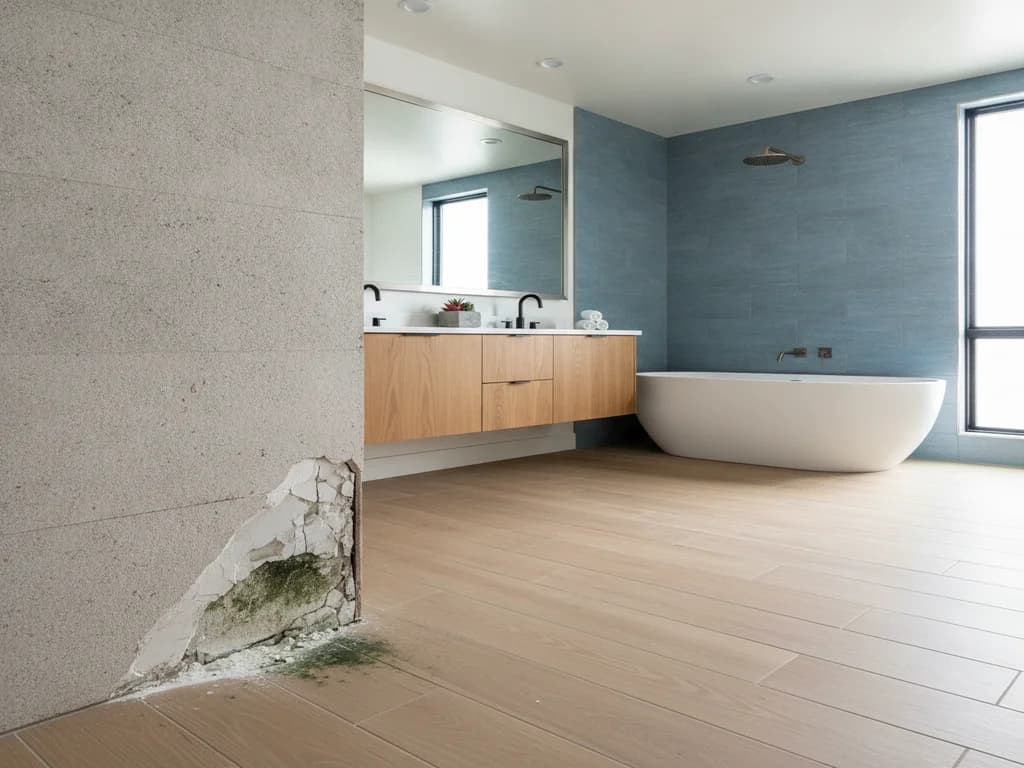
Even a well-built moisture-control system can develop a leak or a failed seal years later, and catching it early is what keeps a small issue from becoming a wall-opening repair. Our signs of bathroom water damage guide covers what to watch for — soft flooring, staining, and the other early tells that moisture is getting somewhere it should not.
It is also worth noting what this post is not: a health scare. The EPA notes that mold can produce allergens and irritants that affect sensitive individuals, which is simply one more reason moisture control matters — not a reason to panic over a bathroom that is properly ventilated and waterproofed.
Building mold prevention into a full remodel
None of these four choices — ventilation, waterproofing, grout, and paint — is expensive to specify correctly during a remodel, and each one is far more expensive to retrofit after the fact. If you are planning a full bathroom remodel and want moisture control built in from the studs out, explore our full bathroom remodeling services — we treat ventilation sizing and waterproofing as standard scope, not an upsell.
Ready to plan your Boise bathroom?
Licensed & insured · 3-year workmanship warranty
Frequently asked questions
- What is the single most important thing to prevent bathroom mold?
- Moisture control. The EPA states that "the key to mold control is moisture control" — mold cannot grow without sustained moisture, so correctly sized exhaust ventilation and a real waterproofing membrane behind the tile do more to prevent mold than any cleaning product or surface treatment.
- What humidity level should a bathroom stay under to prevent mold?
- The EPA recommends keeping indoor relative humidity below 60 percent, ideally between 30 and 50 percent. A properly sized bathroom exhaust fan, ideally with a humidity sensor or timer, is the main tool for keeping a bathroom in that range after a shower.
- Does epoxy grout resist mold better than regular grout?
- Yes, indirectly. The Tile Council of North America notes that standard cementitious grout is porous and can absorb stains and moisture, while epoxy grout is non-porous and "virtually as stain proof as the tile." Because it does not absorb water the way cementitious grout does, epoxy grout gives mold much less to grow on in the grout lines.
Sources
- EPA — Mold (moisture control guidance)
- EPA — Mold and Health
- EPA — Mold Course, Chapter 2 (indoor relative humidity guidance)
- Tile Council of North America — Cleaning Grout (FAQ)
- Schluter — KERDI Waterproofing Membrane (manufacturer)
- Sherwin-Williams — Duration Home Interior Acrylic Latex (manufacturer)
Claims and figures are drawn from the sources above and provided for general guidance; your project may vary. Photography is illustrative of design concepts. For a fixed price on your specific bathroom, request a free estimate.