Updated July 16, 2026 · 8 min read
By Boise Bath — bathroom & shower remodeling in Boise & the Treasure Valley
The short answer
Adding a bathroom costs roughly $6,000–$25,000 nationally when you convert existing space — a basement, closet, or garage corner — and roughly $20,000–$50,000 or more for a new-footprint addition, per HomeAdvisor and Angi. In Boise, the work is permitted through the city, and plumbing distance drives most of the spread.
Key takeaways
- Converting existing space to a bathroom runs roughly $6,000–$25,000 nationally; building new footprint runs roughly $20,000–$50,000 or more (HomeAdvisor, Angi).
- Zonda’s Cost vs. Value Report has benchmarked a midrange national bathroom addition well above $50,000 in recent editions, recouping roughly a third at resale.
- The cheapest new bathroom is the one closest to existing plumbing — distance to the drain stack sets the budget more than finishes do.
- Basements are the most common donor space in Boise’s older neighborhoods; below-grade plumbing has its own rules and sometimes needs an ejector pump.
- A new-footprint addition pays for foundation, framing, roof, and exterior before a single bathroom fixture goes in.
- Every version of this project is permitted, inspected work in Boise — plan the timeline around plan review and inspections, not just construction.
The short answer: national ranges
HomeAdvisor and Angi both split this project the same way. Converting space the house already has — a basement corner, a big closet, the end of a hallway, part of a garage — runs roughly $6,000–$25,000 nationally depending on plumbing distance and finish level. Building a bathroom as new square footage, on a new foundation with new roof and walls, runs roughly $20,000–$50,000 and climbs from there.
For the addition route, Zonda’s Cost vs. Value Report is the sober benchmark: its midrange national bathroom-addition figure has sat well above $50,000 in recent editions, with roughly a third of the cost recouped at resale. Those are national numbers, not Boise quotes — but the structure of the spread holds everywhere: conversions are a plumbing project, additions are a construction project with a bathroom at the end.
Whether the project makes sense for your household at all is a separate question — should I add a second bathroom walks through that decision. This page assumes the answer is yes and prices the paths.
Conversion vs. addition: the fork that sets the budget
Every add-a-bathroom project takes one of four common routes, and the route matters more than any finish decision you’ll make afterward.
| Route | Typical national range | What drives it |
|---|---|---|
| Basement conversion | $10,000–$25,000 | Existing rough-ins vs. cutting the slab; ejector pump if below the sewer line |
| Closet / hallway conversion (half bath) | $6,000–$15,000 | Distance to the drain stack; usually no bathing fixture |
| Garage-corner conversion | $8,000–$25,000 | Slab cutting for drains, insulation and heating, wall framing |
| New-footprint addition | $20,000–$50,000+ | Foundation, framing, roof tie-in, and exterior before any plumbing |
National planning ranges per HomeAdvisor and Angi cost guides; Zonda’s Cost vs. Value Report puts a midrange addition higher still. Finish level moves totals within each band.
What decides a conversion budget: plumbing distance
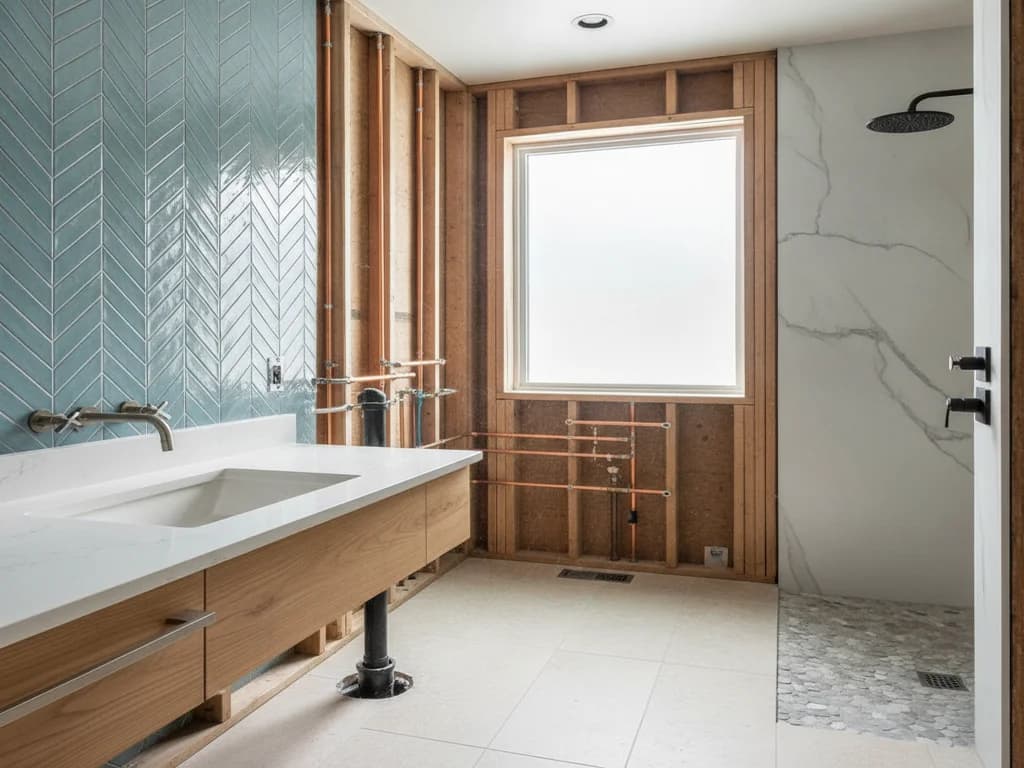
Two identical-looking conversions can differ by ten thousand dollars, and the difference is almost never the tile. It is how far the new fixtures sit from the existing drain stack and water lines, and what stands between them — a crawlspace you can run pipe through in an afternoon, or a concrete slab that gets cut and patched along every drain route.
A new bathroom needs drains with continuous slope to the stack, vent connections within code distance, and hot and cold supply, all built to the International Residential Code as adopted in Idaho. Over a crawlspace — the common case in Treasure Valley homes — that work is accessible and routine. On a slab, every foot of drain line is concrete work first and plumbing second. Our plumbing relocation cost breakdown covers how distance and floor construction drive the number in detail.
Basements deserve their own note. Boise’s Bench and North End housing stock has full-height basements that make ideal donor space, and some were built with capped rough-ins that cut the plumbing budget dramatically. Without rough-ins, the slab gets cut — and if the new fixtures sit below the sewer line, a sewage ejector pump lifts the waste. Our basement bathroom guide covers that route end to end, so we won’t re-plumb it here.
Why additions cost multiples more
A new-footprint addition buys the entire shell before the bathroom starts: excavation and foundation, framing, a roof tied into the existing structure, siding, windows, insulation, and heating. Only then do the plumber and electrician begin the part that resembles a bathroom project.
That is why the addition route only tends to make sense when the house genuinely has no donor space — no basement, no oversized closet or laundry, no garage corner — or when the addition solves more than one problem at once, like a primary-suite expansion. If any interior space can host the bathroom, the conversion math nearly always wins.
Find the stack before you fall for a location
The single best budget move in this project happens before design: locate your existing drain stack and water heater, and favor bathroom locations that back up to them. A bathroom placed against existing plumbing shares walls and shortens every pipe run; one placed across the house pays for that distance in demolition, pipe, and patching.
Permits and inspections in Boise
Every version of this project is permitted work. A new bathroom adds fixtures, extends the drain-waste-vent system, adds circuits, and creates a new wet area — in Boise that means a building permit through the city’s Planning & Development Services plus plumbing and electrical trade permits, with inspections at rough-in and final. A licensed contractor handles the filings and scheduling as part of the job.
Budget the timeline, not just the dollars: plan review and inspection scheduling add calendar time that a purely cosmetic remodel never sees. We cover the full process — what triggers permits, typical steps, and how it affects scheduling — in our Boise bathroom permit guide, so tease your timeline against that rather than assuming construction-only weeks.
Half bath or full bath: sizing the project to the need
The fixtures you add set both the footprint and the plumbing scope. A half bath — toilet and sink — fits in roughly 18 square feet and needs no bathing waterproofing, which is why closet and hallway conversions usually land as powder rooms. Once the space exists, finishing it is priced like any small bath; our powder room remodel cost guide covers those numbers.
A three-quarter bath — toilet, sink, and shower — roughly doubles the footprint and adds a 2-inch drain, waterproofing, and ventilation. If you already have a half bath somewhere useful, upgrading it is often cheaper than building new: can you add a shower to a half bath covers that feasibility test. Match the fixture count to the actual bottleneck — a family that fights over showers needs a bathing bathroom, while a main floor that just needs guest access is served by a powder room at a fraction of the cost.
The resale math, briefly
Bathroom additions recoup roughly a third of their cost at resale, per Zonda’s Cost vs. Value Report — so the project pencils on daily function first, marketability second. The exception worth knowing: the jump from one bathroom to two changes which buyers see the house at all, because listings filter at "2+ baths." That first added bathroom carries far more weight than a third.
If your motivation is mostly resale, run the numbers against your neighborhood before committing to the spend — a fixed local quote makes that comparison honest.
Getting a Boise-specific number
National ranges bracket this project, but nothing about it is average: your drain stack location, your floor construction, and your donor space determine whether you’re at $8,000 or $40,000. Those answers come from a walkthrough with a tape measure and a look at the crawlspace or slab — not a calculator.
A free estimate gets you a fixed price for your actual floor plan, including the plumbing route, permit scope, and finish choices, so you can decide with a real number instead of a national band.
Ready to plan your Boise bathroom?
Licensed & insured · 3-year workmanship warranty
Frequently asked questions
- How much does it cost to add a bathroom to an existing house?
- Roughly $6,000–$25,000 nationally if you convert existing space — a basement, closet, or garage corner — and roughly $20,000–$50,000 or more for a new-footprint addition, per HomeAdvisor and Angi. Plumbing distance is the biggest variable in conversions; the shell (foundation, framing, roof) is what drives additions.
- What is the cheapest way to add a bathroom?
- Convert space that sits close to existing plumbing. A closet or hallway corner backing up to the current bathroom shares a wet wall and keeps pipe runs short, and a basement with existing rough-ins is nearly as economical. Cheapest of all is often upgrading an existing half bath with a shower, since the toilet, sink, drain, and vent are already in place.
- How much does it cost to add a basement bathroom in Boise?
- Nationally, basement bathroom conversions run roughly $10,000–$25,000, per HomeAdvisor — with the low end reflecting basements that were pre-plumbed with rough-ins and the high end reflecting slab cutting and a sewage ejector pump. Many older Boise homes have full-height basements that suit this well; our basement bathroom guide covers the specifics.
- Do I need a permit to add a bathroom in Boise?
- Yes. Adding a bathroom means new fixtures, extended drain-waste-vent lines, new circuits, and a new wet area — all permitted, inspected work through Boise Planning & Development Services, with plumbing and electrical trade permits and inspections at rough-in and final. A licensed contractor files and schedules all of it; budget calendar time for plan review.
- Does adding a bathroom increase home value?
- Yes, but not dollar for dollar — Zonda’s Cost vs. Value Report puts recouped cost at roughly a third for bathroom additions. The bigger effect is marketability: going from one bathroom to two moves a house into "2+ bath" search filters it was excluded from. Treat resale as a bonus on top of daily function, not the reason to build.
- How long does adding a bathroom take?
- Longer than a same-footprint remodel, because it adds permit plan review, rough-in inspections, and often structural or concrete work before finishes start. Conversions commonly run several weeks of construction plus permitting time on either end; a new-footprint addition runs months. The permit and inspection cadence, not fixture installation, usually sets the calendar.
Sources
- HomeAdvisor — True Cost Guide
- Angi — Cost Guides
- Zonda — Cost vs. Value Report
- International Code Council (IRC/IBC)
- City of Boise — Planning & Development Services
Claims and figures are drawn from the sources above and provided for general guidance; your project may vary. Photography is illustrative of design concepts. For a fixed price on your specific bathroom, request a free estimate.