Updated July 5, 2026 · 8 min read
By Boise Bath — bathroom & shower remodeling in Boise & the Treasure Valley
The short answer
Quartz costs less installed than most granite, never needs sealing, and resists stains without upkeep — the lower-maintenance pick for most bathroom vanities. Granite offers unique natural veining and matches quartz on hardness, but needs resealing every 6–12 months. Quartz is the practical default for a busy bathroom; granite wins if you want a one-of-a-kind natural stone look.
Key takeaways
- Bob Vila prices granite at $60–$270 per square foot installed versus quartz at $70–$100 — quartz is typically the cheaper choice except at the very low end of granite.
- Cambria confirms both materials rank about 7/10 on the Mohs hardness scale, so day-to-day scratch resistance is essentially a tie.
- Quartz is non-porous and never needs sealing; granite needs resealing on a roughly 6–12 month cycle, per Bob Vila and Cambria.
- Granite’s natural veining gives every slab a unique look; quartz holds a consistent, engineered pattern that hides seams more easily.
- This is a different question than "which countertop material is best overall" — see our broader material survey if marble, quartzite, or solid surface are also on the table.
This is a two-way decision, not a survey
If you have already narrowed your vanity countertop down to quartz or granite and just need to decide between the two, this article is built for you — a direct head-to-head on cost, maintenance, durability, and look. If you are still weighing marble, quartzite, solid surface, or porcelain against these two, start instead with our broader bathroom countertop materials guide, which surveys all of the common options side by side. This page picks up from there and goes deep on just these two.
Quick take
Quartz is the lower-maintenance, typically lower-cost default for most bathrooms. Granite is worth the extra sealing routine if you specifically want the one-of-a-kind look of natural stone.
Quick comparison
A side-by-side on the four factors that actually decide this choice for most homeowners.
| Factor | Quartz | Granite |
|---|---|---|
| Installed cost | $70–$100 / sq ft (Bob Vila) | $60–$270 / sq ft (Bob Vila) |
| Hardness (Mohs) | ~7/10 (Cambria) | ~7/10 (Cambria) |
| Sealing | Never — non-porous | Every ~6–12 months (Cambria; Bob Vila) |
| Stain resistance | High, without sealing | Good, if resealed on schedule |
| Look | Consistent, engineered pattern | Unique natural veining per slab |
| Heat resistance | Good, but avoid direct hot tools | Slightly better tolerance per Cambria |
What are quartz and granite countertops actually made of?
Granite is a natural stone — quarried, cut into slabs, and installed largely as it comes out of the ground. Bob Vila describes it as an interlocking mix of quartz, feldspar, and mica that gives every slab its own striations and swirls. Quartz, despite the name, is engineered: Bob Vila notes it is roughly 90–94% naturally occurring ground quartz bound with 6–10% polymer resins and pigments, manufactured to a consistent pattern rather than quarried whole.
That manufacturing difference is the root cause of almost every other difference on this page — quartz’s consistency and non-porous surface both come from the resin binder; granite’s uniqueness and sealing requirement both come from being unaltered natural stone.
Cost: which one is actually cheaper?
Bob Vila prices granite at $60–$270 per square foot installed and quartz at $70–$100 per square foot installed. For a typical 30-square-foot vanity top, that puts granite anywhere from $1,800 to $8,100 and quartz at a tighter $2,100–$3,000 — meaning quartz is usually the more predictable, and often the cheaper, choice unless you are shopping the entry-level end of granite.
The wide granite range comes down to slab rarity: common granite colors sit near the bottom of that range, while rarer patterns and colors push toward the top. Quartz’s engineered consistency keeps its price band much narrower.
Maintenance: sealing is the whole story
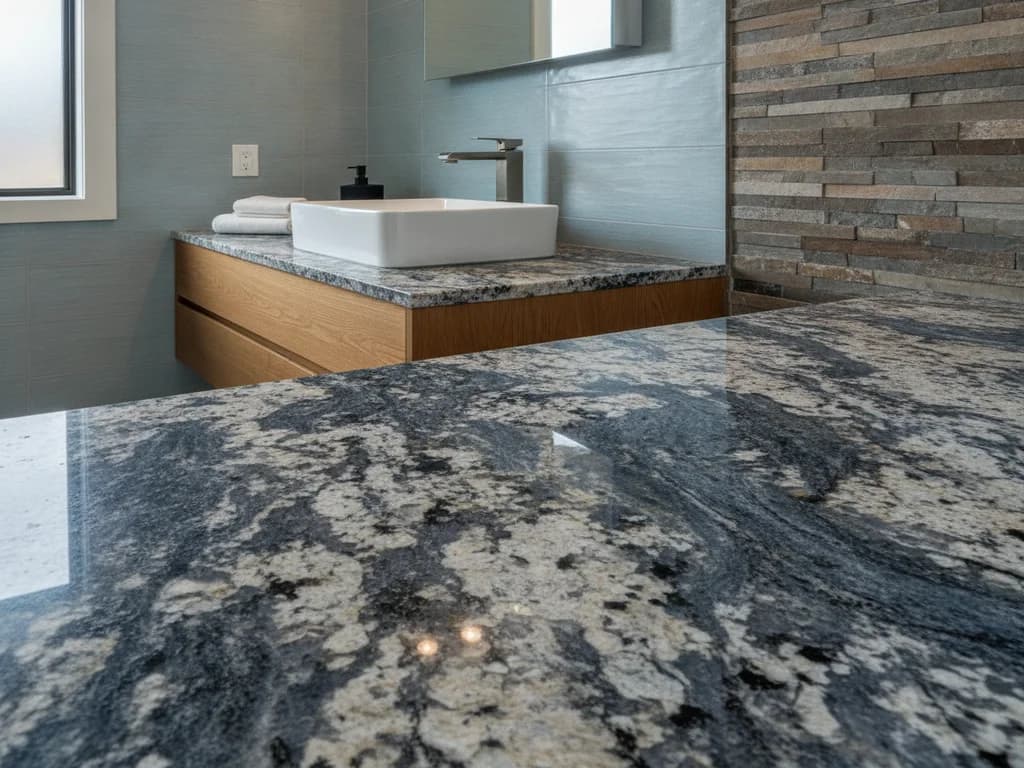
This is where the two materials genuinely part ways. Cambria describes quartz as maintenance-free and stain-resistant without sealing, cleaned with just warm water, a soft cloth, and mild soap. Because it is non-porous, there is no pore structure for water, soap, or bacteria to work into — so there is no sealing schedule to track, ever.
Granite is porous, and both Cambria and Bob Vila note it needs regular sealing to stay stain-resistant. Bob Vila puts the modern resealing cadence at roughly once a year — most granite now ships pre-sealed, so it is an annual task rather than a monthly one, but it is still a recurring job (and cost) that quartz simply does not have.
Durability: hardness, heat, and everyday wear
On raw hardness, this one is close to a tie: Cambria and Bob Vila both put quartz and granite at roughly 7 out of 10 on the Mohs scale, meaning both resist everyday scratching from keys, jewelry, or grooming tools about equally well.
Heat is a narrower edge for granite — Cambria notes granite "excel[s]" at heat and impact resistance, while quartz's resin binder means it is not fully heatproof (a hot curling iron or flat iron left directly on the surface can damage it). In a bathroom this matters more than in a kitchen: styling tools are a daily reality at a vanity, so if you tend to set hot tools straight down, granite has a slight practical edge — though a $10 silicone trivet closes that gap for either material.
Look: consistency vs. uniqueness
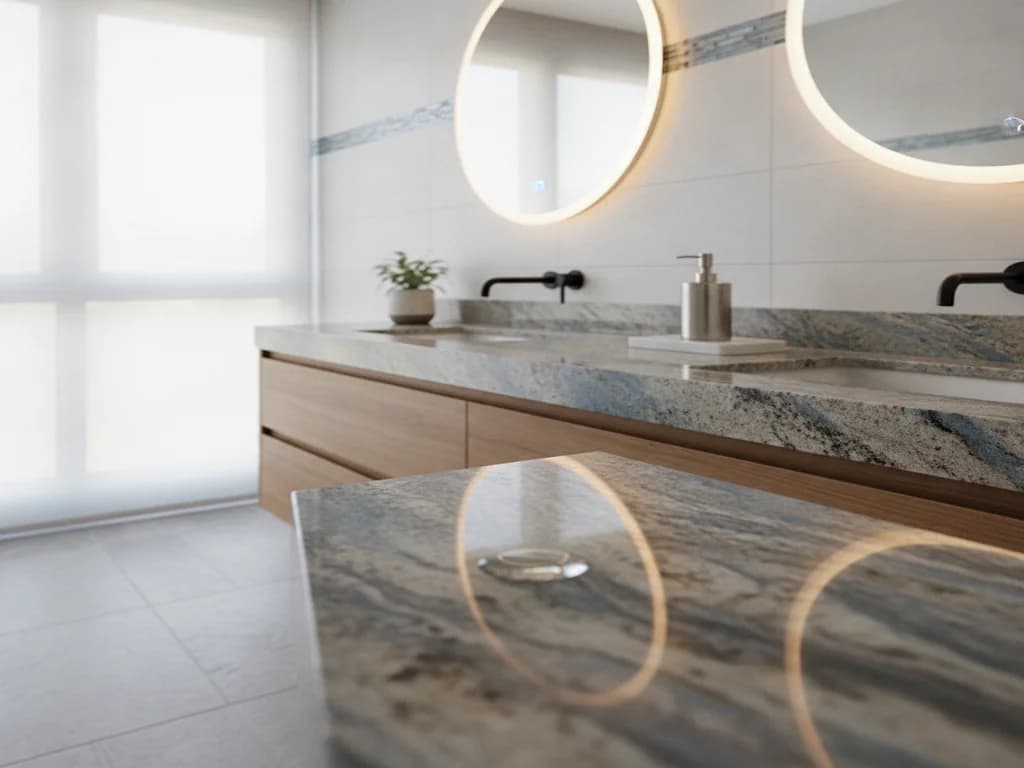
Bob Vila frames this as the clearest style difference: granite’s natural striations and swirls vary from one point on the slab to another, giving every installation a one-of-a-kind, focal-point look. Quartz keeps a consistent, engineered pattern across the whole slab, which Bob Vila notes makes seams easier to hide and suits a cleaner, more minimalist design.
Neither is objectively better here — it is a style call. If you want a vanity that reads as a natural, never-repeated material, granite delivers that in a way manufactured quartz cannot fully replicate. If you want a clean, uniform surface (especially across a longer double-vanity run with a seam), quartz’s consistency is the more forgiving choice.
Which one should you choose?
For most bathroom vanities, quartz is the practical default: it costs about the same or less installed, needs zero sealing, and shrugs off the daily splashes, cosmetics, and cleaning products a vanity sees. It is also the lower-risk pick if you are not the type to keep a resealing schedule.
Choose granite instead if the natural, one-of-a-kind look is genuinely important to you and you are comfortable with an annual sealing routine — or if you are matching an existing granite surface elsewhere in the home. Both materials hold up well structurally; the decision mostly comes down to how much maintenance you want to sign up for versus how much you value natural variation.
A vanity countertop swap is often part of a larger full bathroom remodel — happy to talk through both options against your layout and budget.
Ready to plan your Boise bathroom?
Licensed & insured · 3-year workmanship warranty
Frequently asked questions
- Is quartz or granite better for a bathroom vanity?
- Quartz is the better default for most bathrooms — it never needs sealing and resists stains without upkeep, and Bob Vila prices it at $70–$100 per square foot installed versus granite’s wider $60–$270 range. Granite is worth choosing if you specifically want natural stone’s unique veining and are willing to reseal it roughly once a year.
- Does granite need to be sealed in a bathroom?
- Yes. Granite is porous, and Bob Vila and Cambria both note it needs resealing to resist stains — modern pre-sealed slabs typically need this about once a year rather than monthly, but it is a recurring task quartz does not require at all.
- Is quartz as durable as granite?
- For everyday scratch resistance, essentially yes — Cambria rates both at roughly 7/10 on the Mohs hardness scale. Granite has a slight edge on heat resistance per Cambria, so a hot styling tool set directly on quartz is more risky than on granite, though a trivet solves that for either material.
Sources
- Cambria — Quartz vs. Granite Countertops
- Bob Vila — Granite vs. Quartz: Choosing Between Two Popular Countertops
- Natural Stone Institute — Standards
Claims and figures are drawn from the sources above and provided for general guidance; your project may vary. Photography is illustrative of design concepts. For a fixed price on your specific bathroom, request a free estimate.