Updated July 16, 2026 · 7 min read
By Boise Bath — bathroom & shower remodeling in Boise & the Treasure Valley
The short answer
Quartz is the better bathroom countertop for most homes: non-porous, stain-resistant, never needs sealing, and marble-look patterns are now genuinely convincing. Real marble is softer and etches on contact with acids like toners and mouthwash — choose it only if you will seal it, use pH-neutral cleaners, and welcome the patina it develops.
Key takeaways
- Quartz counters are roughly 90 percent ground natural quartz bound in resin — non-porous, so they never need sealing and shrug off cosmetics and toothpaste.
- Marble is calcite: acids common on a vanity (toner, mouthwash, citrus, some cleaners) etch its polish on contact, and per the Natural Stone Institute, sealer prevents staining but not etching.
- Quartz’s honest weakness is heat — the resin can scorch under a hot curling iron, so a heat-safe tray belongs on every quartz vanity.
- Marble asks for sealing, gentle cleaners, and tolerance for wear; quartz asks for soap and water.
- Marble’s cost overlaps quartz — commodity Carrara can undercut premium quartz, while rarer marbles cost far more.
- The decision is really about aging: quartz looks the same for decades, marble keeps a diary.
The verdict: quartz for how bathrooms are used, marble for how they age
A bathroom vanity top is a chemistry bench. Toothpaste, mouthwash, facial acids, nail polish remover, hair products, and hot tools all land on it daily — and that specific gauntlet is why quartz wins this comparison for most households. It is non-porous, it does not etch, and it never asks for a sealer.
Marble loses the practicality contest and still gets chosen every day, because nothing engineered fully matches real stone’s depth and one-of-a-kind veining — and because a vanity is a small, low-abuse surface compared to a kitchen counter. If you will ever own marble, a bathroom vanity is the most forgiving place to do it.
This article covers countertops only. If you are weighing quartz against granite instead, that matchup has its own guide, and the full countertop materials roundup puts every option side by side.
What each material actually is
Quartz countertops are engineered stone: roughly 90 percent ground natural quartz bound with polymer resins and pigments, cured into slabs. The resin is the trick — it makes the slab non-porous, uniform, and consistent from sample to install. It is also the material’s one vulnerability, since resin scorches under high heat where natural stone would not.
Marble is metamorphosed limestone — calcium carbonate, or calcite. Calcite is soft enough to scratch under everyday grit and reactive enough that acids dissolve its polished surface on contact. Those two facts, straight from the stone’s chemistry, drive every maintenance line in this comparison.
The design story explains the market: quartz manufacturers spend their effort imitating marble, not the other way around. The better marble-look quartz lines now carry veining through the slab body with movement that reads as natural at conversational distance.
Marble vs. quartz: the side-by-side
Here is the full comparison for a bathroom vanity specifically — a kitchen version of this table would score heat and cutting differently.
| Factor | Marble | Quartz |
|---|---|---|
| Water & staining | Porous; needs periodic sealing to resist water rings, oils, and cosmetics | Non-porous; stains wipe off, no sealer ever |
| Etching | Acids dull the polish on contact — sealer does not prevent it, per the Natural Stone Institute | Does not etch |
| Scratching & chips | Soft calcite; scratches and edge chips accumulate with use | Harder surface; highly scratch-resistant in normal vanity use |
| Heat | Tolerates a hot tool briefly without scorching (thermal shock still possible) | Resin can scorch or discolor under curling irons and flat irons — use a tray |
| Maintenance | pH-neutral cleaners, resealing on schedule, professional honing to reset wear | Soap and water |
| Looks & aging | Genuine depth, unique veining; develops patina — softened polish, small marks | Consistent pattern, ages essentially unchanged; best lines convincingly marble-like |
| Cost direction | Roughly $40–$150/sq ft installed depending on the stone, per HomeAdvisor | Roughly $50–$120/sq ft installed, per HomeAdvisor |
Cost ranges are national figures from HomeAdvisor’s True Cost Guide; slab grade, edge profile, and sink cutouts drive the spread.
Etching: the vanity-specific problem
Etching deserves its own section because vanities concentrate exactly the substances that cause it. Facial toners and exfoliants are formulated acids. Mouthwash splatters. A lemon-scented cleaner grabbed from under the sink can dull a polished marble top in one wipe-down. Each contact leaves a flat, lighter mark where the acid dissolved the calcite shine.
The Natural Stone Institute draws the line clearly: sealers slow absorption, which prevents stains — but etching is a surface chemical reaction, so no sealer stops it. The practical mitigations are choosing a honed (matte) finish that hides etch marks, keeping products on a tray, and treating the top to professional re-honing when the accumulated wear bothers you.
Quartz simply opts out of this problem. The resin binder does not react with cosmetic acids, which — more than stain resistance, more than sealing — is the single biggest reason quartz took over the vanity market.
Quartz’s own honesty issue: hot tools
Quartz is not invincible — its resin can scorch, discolor, or crack under a curling iron or flat iron parked directly on the surface, and heat damage is not repairable the way stone can be refinished. Every quartz vanity in a household with hot tools should have a heat-safe tray or trivet living on it. Marble tolerates brief heat contact better; it just etches instead.
Maintenance and how each top ages
Quartz maintenance is a short paragraph: clean it with soap and water, avoid harsh solvents, keep hot tools on a tray. There is no sealing schedule, no special cleaner to stock, and no refinishing appointment in its future. Consumer Reports’ countertop testing consistently ranks quartz at or near the top for overall durability among vanity-appropriate surfaces.
Marble maintenance is a routine: pH-neutral stone cleaner only, resealing when a water drop starts darkening the surface, coasters and trays under anything acidic or pigmented, and — eventually — a decision about whether to have the top professionally honed and repolished or to embrace the patina. In hard-water country like the Treasure Valley, mineral spotting adds one more chore, because acidic hard-water removers are off the table on calcite.
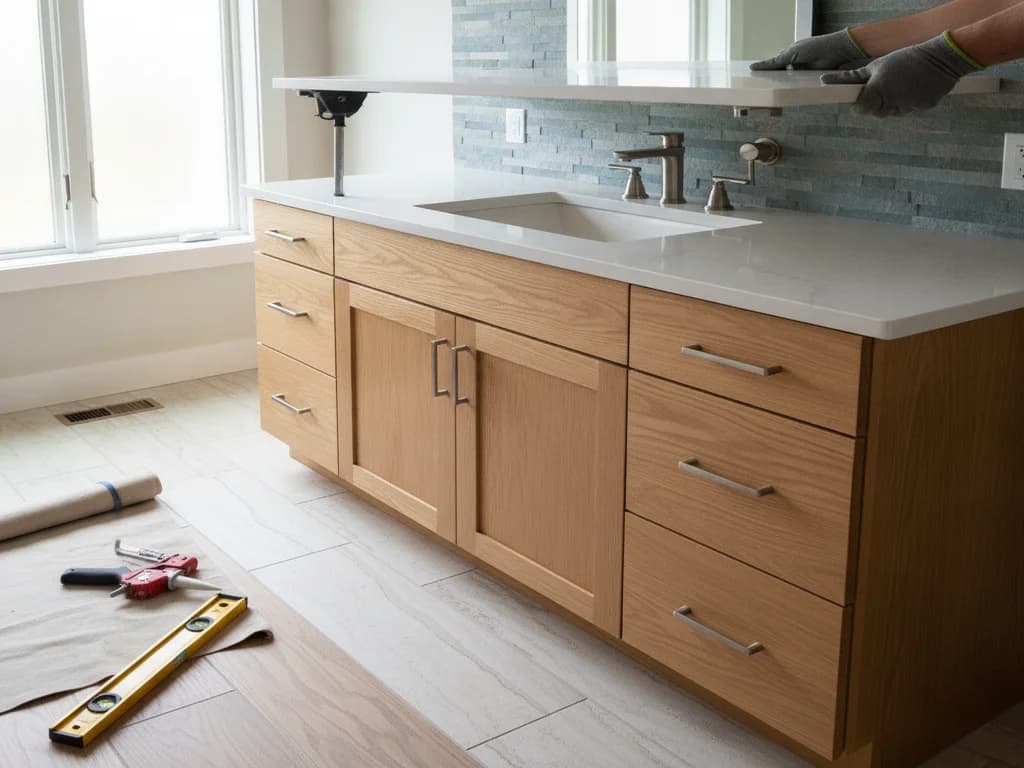
Neither routine is unreasonable. The question is which one matches your household. If the answer involves teenagers and a shared bathroom, that is usually the whole answer. When an existing top has aged past rescue, replacing a vanity countertop covers what the swap involves — and it is often possible to replace just the top without touching the cabinet.
Cost: closer than most people expect
The clean assumption — marble is the luxury price, quartz is the value price — does not survive contact with a slab yard. HomeAdvisor’s cost guides put installed quartz roughly at $50 to $120 per square foot and marble roughly at $40 to $150, and the overlap is real: commodity Carrara marble often costs less than premium designer quartz, while rare marbles like Calacatta run past the top of any quartz line.
For a bathroom vanity, the total square footage is small — which cuts both ways. The absolute dollar difference between materials shrinks, making the marble splurge more affordable here than in a kitchen; and fabrication minimums mean a tiny top does not get proportionally cheap. Sink cutouts, edge profiles, and backsplash pieces move the number more than material grade does at this scale.
The lifetime picture still favors quartz: marble carries ongoing sealing and eventual refinishing costs, while quartz’s lifetime cost is its install. The countertop cost-by-material breakdown runs these numbers across every surface if budget is the deciding factor.
Which should you choose?
Match the top to the bathroom’s users, not the showroom lighting:
- Shared, kids’, or high-traffic bathroom: quartz — the etch-proof, seal-free surface is built for exactly this abuse.
- Primary bath for owners who want real stone and accept the care routine: honed marble — the matte finish hides etching, and a vanity is marble’s most forgiving home.
- You want the marble look with zero relationship: a vein-through marble-look quartz in a honed finish — the convincing middle path most of our clients land on.
- Daily hot-tool household: either material works with a heat tray; without one, marble actually tolerates the curling iron better than quartz resin does.
- Selling within a few years: quartz — buyers recognize it, inspectors have nothing to note, and it will look new at listing time.
- Comparing against granite instead: read the quartz vs. granite comparison — granite changes the durability math.
Ready to plan your Boise bathroom?
Licensed & insured · 3-year workmanship warranty
Frequently asked questions
- Does marble etch in a bathroom even if you seal it?
- Yes. Sealing slows liquids from absorbing into the stone, which prevents stains — but etching is acid chemically dissolving the polished calcite surface on contact, and no sealer stops that, per the Natural Stone Institute. Toners, mouthwash, and acidic cleaners will all leave dull marks on polished marble. A honed finish hides etching far better than a polished one.
- Will a curling iron damage a quartz countertop?
- It can. Quartz slabs are bound with polymer resin, and sustained direct heat from a curling iron or flat iron can scorch, discolor, or even crack the surface — and unlike stone, heat-damaged quartz cannot be honed back to health. The fix is cheap and permanent: keep a heat-safe tray or trivet on the vanity and park hot tools there.
- Is marble or quartz more expensive for a bathroom vanity?
- They overlap. HomeAdvisor puts installed quartz roughly at $50–$120 per square foot and marble roughly at $40–$150 — common Carrara often undercuts premium quartz, while rare marbles far exceed it. On a small vanity, fabrication details like sink cutouts and edge profiles move the price as much as the material choice. Quartz wins on lifetime cost since it needs no sealing or refinishing.
- How often does a marble vanity top need sealing?
- It depends on the sealer and the use, so test rather than guess: drip a little water on the surface, and if it darkens the stone within a few minutes, it is time to reseal. For many bathroom vanities that works out to roughly once a year. Use a stone-specific sealer and pH-neutral cleaners between applications — acidic cleaners undo the whole effort.
- Does marble-look quartz actually look like real marble?
- The better lines are genuinely convincing — printed and vein-through patterns with natural movement, honed or polished finishes, and full-slab veining for waterfall edges. The tells are pattern repetition across large runs and a uniformity real stone never has. On a vanity-sized top viewed at arm’s length, most people cannot make the call without touching it.
- Can you replace just the countertop and keep the vanity cabinet?
- Usually, yes — if the cabinet is sound, level, and a standard depth, a new quartz or marble top can go on with a new sink and faucet in a day’s work. It is one of the highest-impact small upgrades in a bathroom. The catch is cabinet condition: water-swollen or out-of-square cabinets should be replaced first, or the new top telegraphs the old problem.
Sources
Claims and figures are drawn from the sources above and provided for general guidance; your project may vary. Photography is illustrative of design concepts. For a fixed price on your specific bathroom, request a free estimate.