Updated July 16, 2026 · 6 min read
By Boise Bath — bathroom & shower remodeling in Boise & the Treasure Valley
The short answer
Yes — the vanity top is a separate part by design, and replacing just the top is one of the easiest bathroom upgrades. Tops come in standard widths from 24 to 72 inches, so a stock or custom top drops onto an existing cabinet. The test is the cabinet: solid box, right layout, and worth the new top’s cost.
Key takeaways
- A vanity top sits on the cabinet held by brackets and adhesive — it was always meant to come off, which makes top-only replacement routine work.
- Standard vanity widths (24, 30, 36, 48, 60, and 72 inches) mean stock tops fit most cabinets; anything else is a custom template, not a dead end.
- The keep-cabinet test: a solid box with working drawers and a layout you like justifies a new top; a swollen, delaminating, or wrong-sized cabinet doesn’t.
- Sink and faucet almost always ride along — most tops come with integrated or pre-mounted bowls, and old faucets rarely justify reinstalling on a new top.
- A new stone top on a failing builder-grade cabinet is the classic false economy: the top outlives its base and rarely transfers cleanly.
- Top-only swaps cost a fraction of full vanity replacement, per national cost guides — when the cabinet passes, it’s the highest-visibility dollar in the room.
Why the top was always a separate part
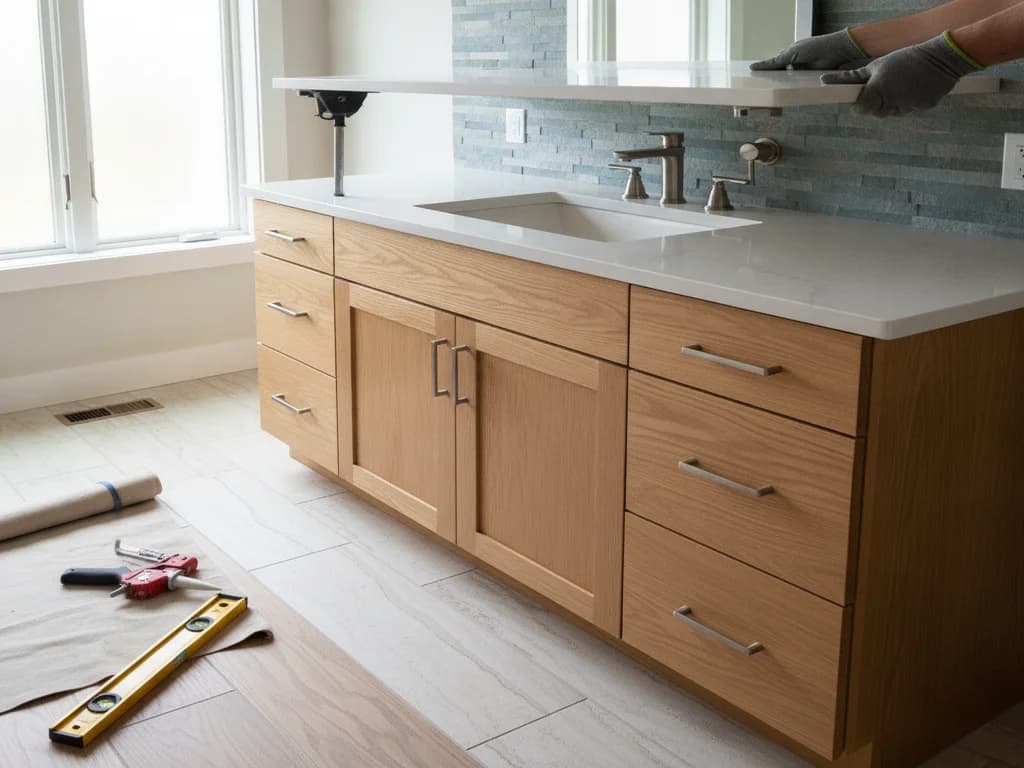
Unlike a tub trapped behind wall tile, a vanity top has no structural entanglement with the room. It rests on the cabinet box, secured by a few brackets or dabs of adhesive, with a caulk line at the wall. Disconnect the faucet supply lines and the drain trap, cut the caulk, and the top lifts off. Manufacturers build them this way on purpose — tops and cabinets sell as separate SKUs in coordinated sizes.
That makes a top-only swap the rare bathroom project with almost no discovery risk. There’s no waterproofing behind it, no flange under it, and the plumbing involved is the friendliest in the house — a P-trap and two supply lines under the sink, all serviceable from a cabinet door.
The full step-by-step — templating, removal, setting, and the plumbing reconnect — is covered in replacing a vanity countertop. This article is about the decision in front of it: whether your cabinet deserves a new top at all.
Standard sizes: why your cabinet probably fits a stock top
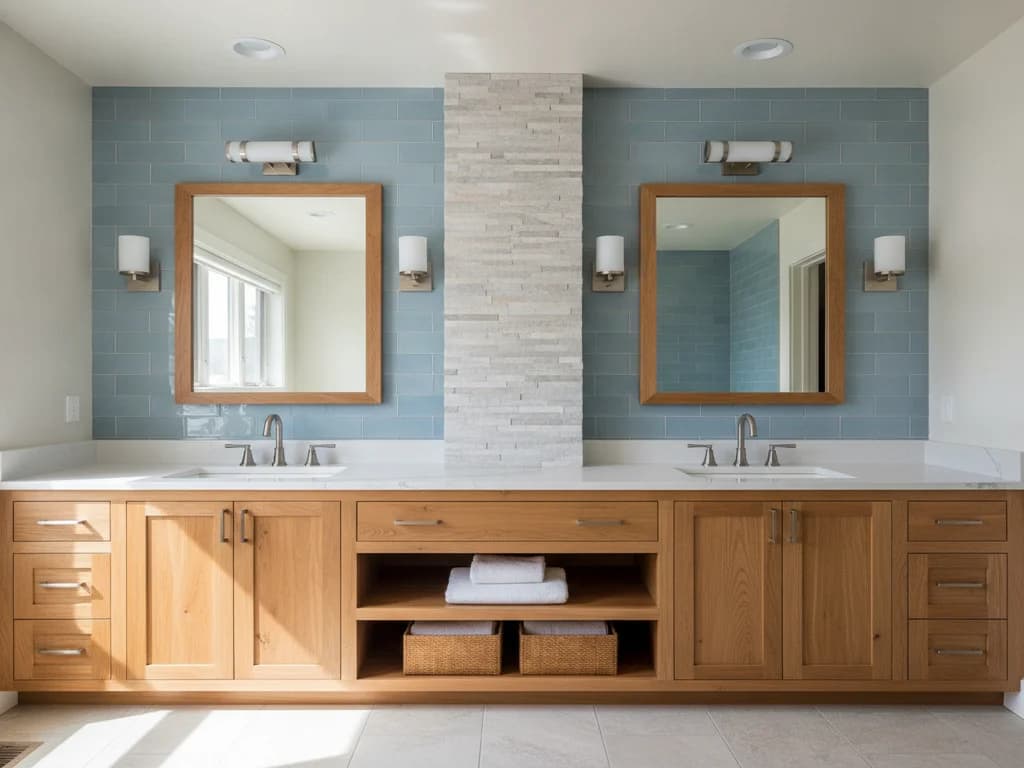
Vanity cabinets have been built to standard widths for decades: 24, 30, 36, 48, 60, and 72 inches, at a standard depth of about 21 inches (tops run roughly 22 inches deep to overhang the box). If a tape measure across your cabinet lands on one of those numbers, stock tops in cultured marble, quartz, granite, and solid surface are sitting in local supply right now.
Odd widths — from a custom build, a trimmed cabinet, or an older home — don’t kill the project; they move it from stock to custom. A fabricator templates the exact footprint and cuts quartz or stone to fit, which adds cost and a week or two of lead time but fits anything, including offset sink positions and angled walls.
Measure three things before shopping: width wall-to-edge, depth from the wall, and the faucet drilling on your existing top (single-hole, 4-inch centerset, or 8-inch widespread). New tops come pre-drilled, and the drilling has to match the faucet you intend to put on it — which, on most top swaps, should be a new faucet anyway; see replacing a bathroom faucet for why old valves rarely justify reinstalling.
The keep-cabinet test
A new top commits you to the cabinet under it for the top’s lifespan — and a quartz top is effectively permanent. So the cabinet has to earn it. Run four checks.
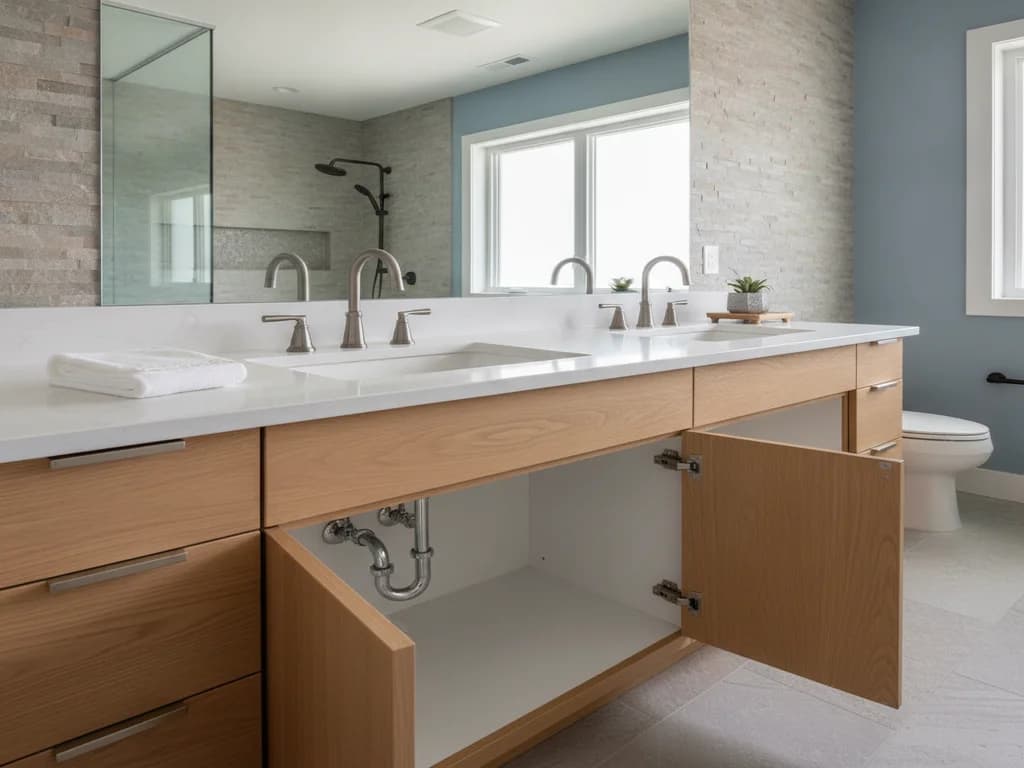
Structure: open the doors and look at the bottom shelf and the back panel. Water damage shows as swelling, delamination, or a wavy bottom deck — common in builder-grade particleboard cabinets after years of small under-sink leaks. A swollen box fails; it will keep degrading under a brand-new top.
Function: drawers that track, doors that close, hinges that hold adjustment. Hardware is replaceable; racked or sagging boxes are not. Layout: right width for the space, right height for the household — older 30-to-32-inch-tall vanities are noticeably lower than the 36-inch comfort height that’s now standard, and no top fixes a height you resent daily. Finish: a solid box with tired paint passes — painting a cabinet under a new top is a legitimate combination.
| Check | Keep the cabinet | Replace the vanity |
|---|---|---|
| Box condition | Solid deck, no swelling or delamination | Water-swollen particleboard, soft bottom shelf |
| Doors & drawers | Track and close; hardware adjustable | Racked box, sagging or broken drawer slides |
| Width & layout | Fits the space and your storage needs | Wrong size, or you want single-to-double |
| Height | Comfortable as-is | Old low height you already resent |
| Finish | Good, or paintable | Peeling thermofoil, failing veneer |
What rides along with the top: sink and faucet
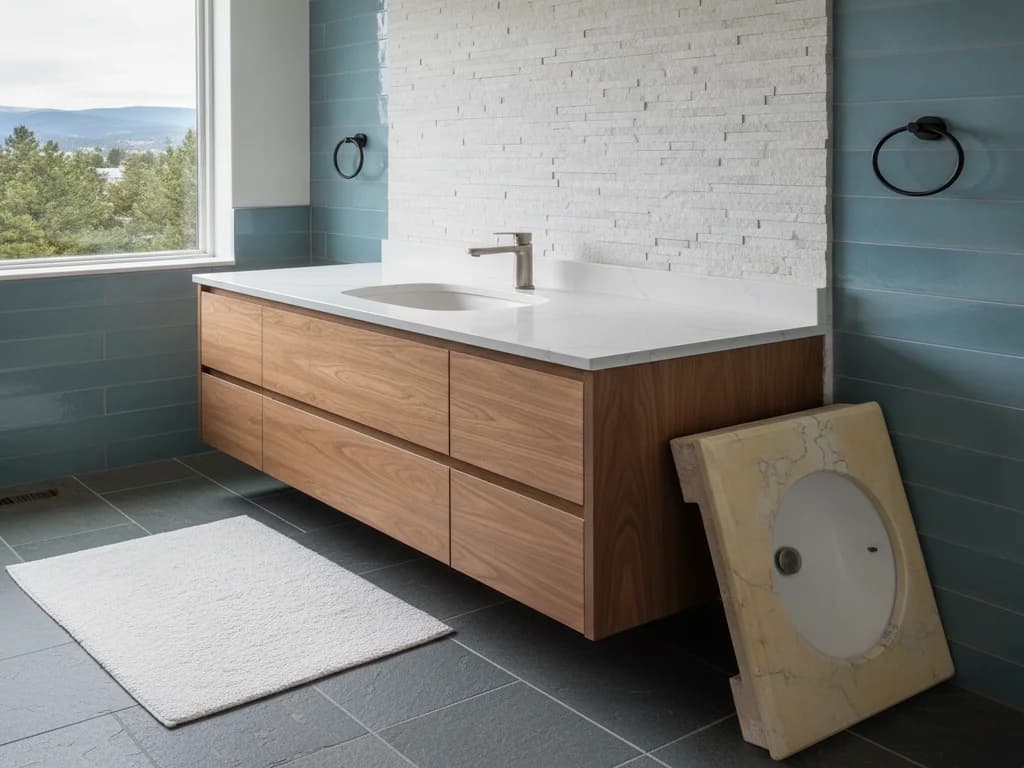
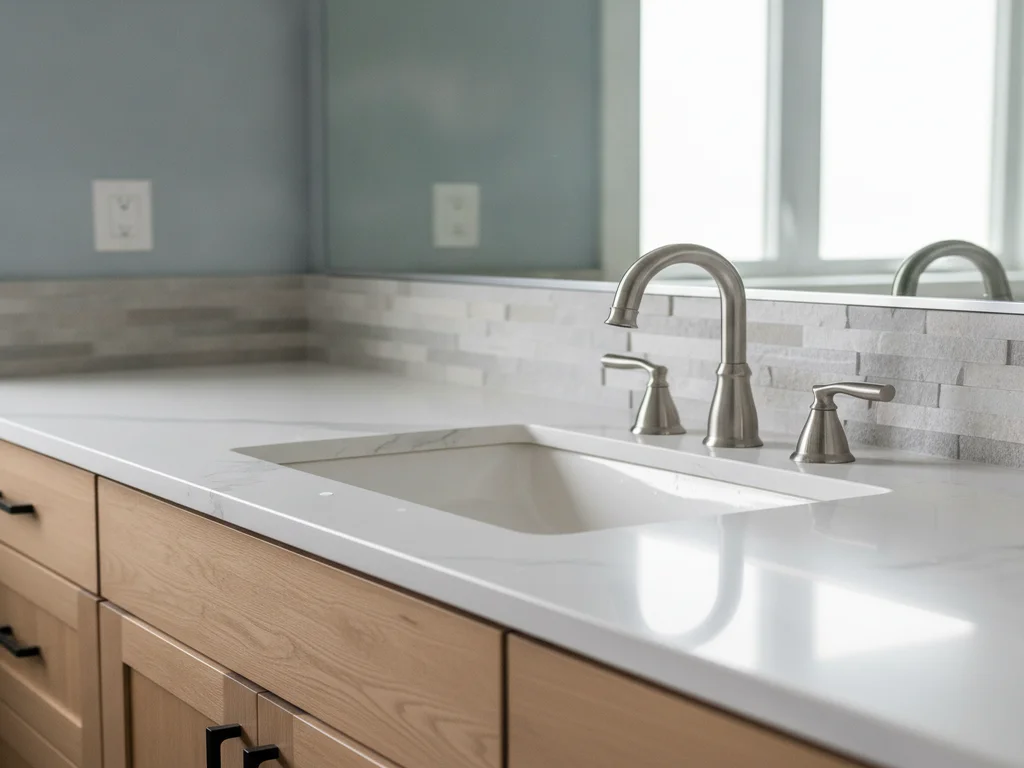
A top swap is almost never just the slab. Most stock vanity tops come as a unit with the bowl — integrated in cultured marble and solid surface, or pre-mounted undermount in quartz and granite — so the sink is usually included whether you were shopping for one or not. That’s a feature: the sink-to-top seal is factory-made, and undermount bowls on a used top rarely survive transfer. The bowl options are covered in replacing a bathroom sink.
The faucet is a judgment call that usually lands the same way. Reinstalling a ten-year-old faucet on a new top saves a modest amount now and puts the oldest part of the assembly on the newest surface. In hard-water areas like the Treasure Valley, a decade of scale on a faucet body and valves is normal — most homeowners pair the new top with a new faucet and start the whole surface at year zero.
The drain assembly nearly always gets replaced regardless: pop-up assemblies are cheap, and old ones seldom match a new bowl’s drain geometry cleanly.
Don’t put a permanent top on a temporary cabinet
The classic false economy: a new quartz top on a swollen builder-grade box. The top will outlive the cabinet by decades, and when the cabinet fails, a used top rarely transfers — undermount sinks, cutout positions, and adhesive make clean removal unlikely. If the cabinet is marginal, replace the vanity as a unit; the math is closer than it looks.
When a full vanity replacement is the better spend
The cabinet test fails more often than homeowners expect, and when it does, the arithmetic shifts. National cost guides such as HomeAdvisor put installed vanity tops broadly in the few-hundred-to-over-a-thousand-dollar range depending on material and size — but complete vanity units with tops included start low enough that a marginal cabinet plus a custom top can cost more than a decent new unit.
Layout ambitions settle it too. Converting a single vanity to a double, changing widths, or moving from furniture-style to wall-hung are all cabinet projects that happen to include a top — the decision framework for the whole unit is in replacing a bathroom vanity.
And if the top failing is cultured marble with worn gelcoat — the standard 1990s and 2000s builder top around the Treasure Valley — its specific quirks and replacement options have their own writeup in replacing a cultured marble vanity top.
What the top-only project actually looks like
For a stock-size top, the sequence is one visit: shut off the supplies, disconnect the trap and lines, cut the caulk, lift the old top, check the cabinet’s top edge is level and sound, set and secure the new top, mount the faucet, connect the drain, and caulk the wall line. Custom stone adds a templating visit and fabrication lead time up front, but installation day looks the same.
The material decision deserves more thought than the labor: cultured marble, quartz, granite, and solid surface behave differently against hard water spotting, chips, and heat, and the full comparison is in our bathroom countertop materials guide.
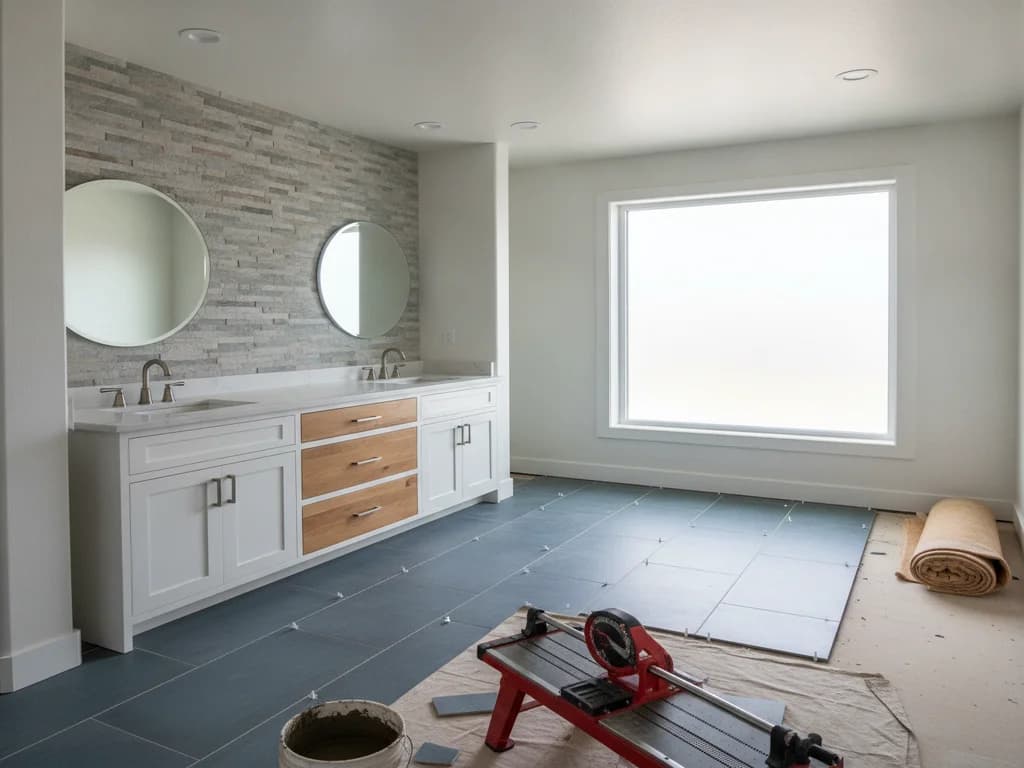
Where this project fits the bigger picture: a top swap is the highest-visibility single-day upgrade a bathroom can get, and it’s genuinely worth doing standalone on a good cabinet. But if the flooring, tub, or shower are on the same replacement clock, roll the vanity into a full bathroom remodel — the vanity top becomes a line item instead of a mobilization.
Ready to plan your Boise bathroom?
Licensed & insured · 3-year workmanship warranty
Frequently asked questions
- How do I know what size vanity top to buy?
- Measure the cabinet’s width wall-to-edge and its depth from the wall. Cabinets are typically 24, 30, 36, 48, 60, or 72 inches wide and about 21 inches deep; tops run roughly an inch wider and deeper to overhang. If your measurements land on a standard, stock tops fit. If not, a fabricator templates and cuts a custom top to the exact footprint.
- Can I put a new top on the cabinet without replacing the sink?
- Usually the sink comes with the top, not separate from it. Cultured marble and solid-surface tops have the bowl molded in; quartz and granite stock tops arrive with the undermount bowl already mounted. Transferring your old sink onto a new top is rarely practical — undermount removal tends to damage the bowl or its mounting, and the factory seal is better anyway.
- Should I reuse my old faucet on a new vanity top?
- You can if the top’s pre-drilled holes match its configuration, but most people shouldn’t. A faucet with years of Treasure Valley hard water on its valves is the most failure-prone part of the assembly, and swapping it later means working under a set top. Pair the new surface with a new faucet and the whole assembly starts at year zero.
- How much does replacing just a vanity top cost?
- National guides like HomeAdvisor put it broadly from a few hundred dollars for a stock cultured marble top to over a thousand installed for custom quartz or granite, driven by material and size. That’s a fraction of a full vanity replacement — which is exactly why the cabinet test matters: the savings are only real if the cabinet deserves the top.
- Can I paint the cabinet and just replace the top?
- Yes — it’s one of the best-value combinations in bathroom updating. A structurally sound box with dated finish gets sanded and painted (or gets new doors and hardware), then the new top goes on. The order matters: paint first, set the top after curing, caulk last. What can’t be painted away is swelling, delamination, or racked framing — those fail the test regardless of color.
- Will a new top fit if my walls are out of square?
- A stock top can leave a visible taper at the back wall if the corner is badly out of square — standard practice hides small gaps with the backsplash and caulk line. Larger deviations are a reason to go custom: the fabricator scribes the template to the actual wall, and the top lands tight. This is common in older homes and a routine thing installers check while measuring.
Sources
- HomeAdvisor — True Cost Guide
- National Kitchen & Bath Association (NKBA)
- Natural Stone Institute
- This Old House — Bathrooms
Claims and figures are drawn from the sources above and provided for general guidance; your project may vary. Photography is illustrative of design concepts. For a fixed price on your specific bathroom, request a free estimate.