Updated July 16, 2026 · 7 min read
By Boise Bath — bathroom & shower remodeling in Boise & the Treasure Valley
The short answer
Porcelain wins for most bathrooms: it is harder, denser, stain-proof, and maintenance-free, and marble-look porcelain now imitates the stone convincingly. Real marble wins on depth and authenticity but etches on contact with acids, needs periodic sealing, and develops a patina. Choose marble only if you will maintain it and can love how it ages.
Key takeaways
- Porcelain absorbs under 0.5 percent of its weight in water per TCNA standards; marble is porous natural stone that depends on sealer for stain resistance.
- Etching is marble’s defining honesty issue: acids dull the polish on contact, and — per the Natural Stone Institute — no sealer prevents it, because etching is a chemical reaction, not absorption.
- Marble is soft enough to scratch under grit and traffic; porcelain is among the hardest floor surfaces made.
- Maintenance is the real divider — porcelain asks for cleaning, marble asks for pH-neutral cleaners, resealing, and tolerance for wear patterns.
- Marble-look porcelain has closed most of the visual gap at normal viewing distance, at a lower installed cost than real stone.
- For shower interiors the calculus shifts further — that decision has its own guide.
The verdict: porcelain for practicality, marble for patina
If you want a bathroom floor or wall that looks the same in year ten as it did on day one, choose porcelain. It is denser, harder, and less porous than the natural stone it imitates, and it asks nothing of you but cleaning. That is the short version, and for most households it is the right version.
Marble earns its place differently. It is a real metamorphic stone with depth, translucence, and veining no printer fully reproduces — and it changes with use. Polish softens in traffic lanes, edges wear, and the surface picks up the small marks of a lived-in room. Owners who love marble call that patina. Owners who expected permanence call it damage. Which camp you fall in is the actual decision.
One scope note: this comparison covers bathroom floors and walls generally. Inside the shower, water exposure changes the math enough that we wrote it up separately — see natural stone vs. porcelain in showers for that decision.
What each material actually is
Marble is metamorphosed limestone — calcium carbonate recrystallized under heat and pressure. That chemistry is the key to everything that follows: calcite is relatively soft (it scratches with ordinary grit) and it reacts with acids, which is where etching comes from. Every slab and tile is genuinely unique, which is the appeal.
Porcelain is a manufactured product: refined clay fired at high temperature until it vitrifies into a dense, glass-like body. The Tile Council of North America classifies porcelain as impervious — under 0.5 percent water absorption — which is why it tolerates wet rooms so casually. Modern inkjet glazing prints marble veining onto that body with enough resolution that the better marble-look lines survive close inspection.
The practical summary: marble is a beautiful material with a chemistry problem in bathrooms; porcelain is a bathroom-proof material wearing marble’s portrait. Our porcelain vs. ceramic guide covers how porcelain also outclasses its own clay-tile sibling.
Marble vs. porcelain: the side-by-side
The table below is the whole argument in one place. Notice that marble’s column reads like a relationship and porcelain’s reads like an appliance — that framing genuinely helps people choose.
| Factor | Marble | Porcelain |
|---|---|---|
| Water behavior | Porous stone; relies on sealer to resist staining from water and products | Impervious body — <0.5% absorption per TCNA standards |
| Etching | Acids (toner, mouthwash, citrus, some cleaners) dull the finish on contact; sealer does not prevent it, per the Natural Stone Institute | Does not etch |
| Scratch resistance | Soft calcite — grit and traffic scratch and dull polish over time | Among the hardest flooring surfaces available |
| Maintenance | pH-neutral cleaners only; reseal periodically; occasional professional honing/polishing to reset wear | Ordinary cleaning; grout is the only maintenance item |
| Looks | Genuine depth, translucence, one-of-a-kind veining; develops patina | Excellent marble-look prints; consistent, repeatable, ages without change |
| Cost direction | Roughly $15–$40/sq ft installed for natural stone tile, per HomeAdvisor | Roughly $10–$25/sq ft installed, per HomeAdvisor |
Cost ranges are national figures from HomeAdvisor’s True Cost Guide; stone grade, tile format, and layout complexity drive the spread.
Etching and sealing: the honesty section
This is where marble decisions go wrong, so it deserves plain language. Sealing protects marble against staining — it slows liquids from soaking into the pores. Sealing does not protect against etching, because etching is not absorption: it is acid chemically dissolving the calcite surface on contact. The Natural Stone Institute is direct about this distinction, and any seller who implies a sealer makes marble worry-proof is overselling.
Bathrooms are quietly full of acids: facial toners, vitamin C serums, mouthwash, urine around a toilet, and — the classic — acidic cleaners someone grabs without reading the label. Each contact leaves a dull spot on polished marble. Honed (matte) marble hides etching far better, which is why honed finishes are the standard recommendation for marble in working bathrooms.
None of this makes marble a mistake. It makes marble a maintenance relationship: pH-neutral cleaners, resealing on schedule, and either acceptance of patina or a budget for periodic professional re-honing. When a marble floor has aged past what refinishing can reset, replacing a marble bathroom floor covers that project.
The one-week test before you commit to marble
Get a polished sample of the marble you are considering and live with it on the vanity for a week: set a wet glass on it, drip toner on a corner, wipe it with your current bathroom cleaner. If the marks you see read as character, buy the marble. If they read as damage, buy the marble-look porcelain and never think about it again.
Durability and water in daily use
On floors, the difference compounds over years. Porcelain shrugs off tracked grit, dropped bottles, and standing water. Marble’s polish dulls along the traffic lane between the door and the vanity, and scratches accumulate wherever grit gets ground underfoot — slower in a low-traffic ensuite, faster in a busy family bath.
Water itself is manageable on sealed marble floors and walls in the general bathroom — splash zones near the vanity and tub surround are fine with sensible sealing. The material’s real water problems belong to shower interiors, where constant saturation raises the stakes; again, the shower-specific comparison handles that terrain.
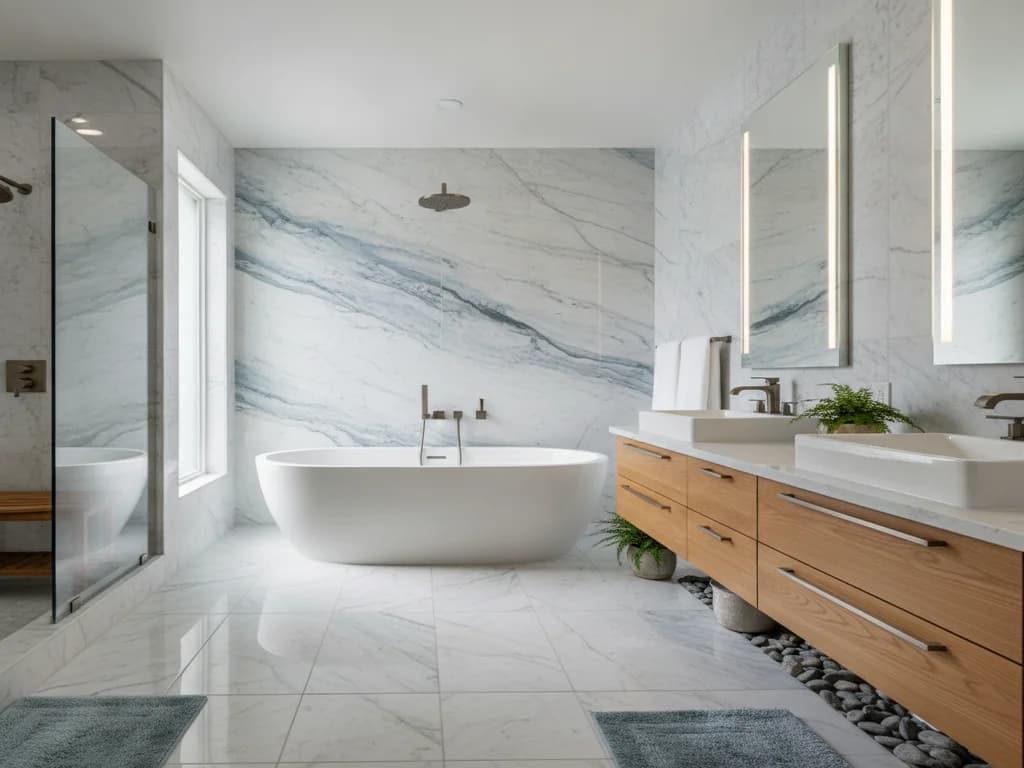
On walls, both materials are long-haul performers, since walls take no traffic and little standing water. Wall applications are where marble’s risk profile is lowest and its visual payoff highest — a marble feature wall behind a tub is a much easier yes than a marble floor in a kids’ bathroom.
The look: real stone vs. the print
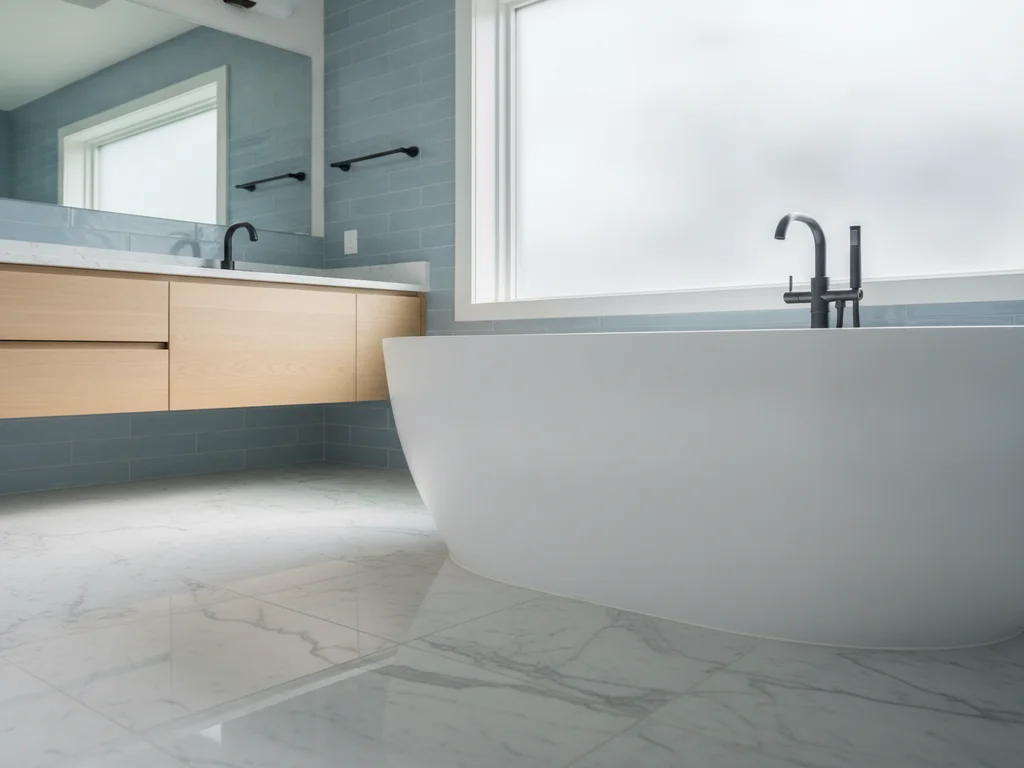
Five years ago this section would have declared real marble the easy visual winner. The gap has narrowed. Large-format marble-look porcelain with rectified edges, matte and polished finishes, and vein-through bodies reads as stone to most eyes at most distances. Where the print still loses: repeating patterns across a large floor, edge profiles where a cut reveals the body, and the subtle translucence of real calcite under raking light.
Real marble still owns the moments porcelain cannot manufacture — bookmatched veining, the cold genuine feel under a hand, and the knowledge (which matters to some owners and not at all to others) that the surface is actual stone. In a design-forward primary bath, those moments can justify the premium and the upkeep.
A practical middle path we often build: marble on the low-risk, high-visibility surface — a feature wall, a vanity backsplash — with marble-look porcelain on the floor doing the daily work. You get the genuine article at eye level and the appliance underfoot. A matte finish choice on that floor also adds slip resistance where it counts.
Which should you choose?
Let the room’s traffic and your maintenance appetite decide:
- Family or kids’ bathroom floor: porcelain, no hesitation — the etching-and-grit environment is exactly what marble hates.
- Primary bath where you want real stone and will maintain it: honed marble on floors or walls, sealed on schedule, cleaned pH-neutral.
- You love the marble look but not the relationship: marble-look porcelain in a large format — most of the beauty, none of the chemistry.
- Feature wall or tub surround (outside the shower): real marble here is the low-risk splurge — no foot traffic, maximum visual return.
- Rental, flip, or sell-soon home: porcelain — buyers get the look, you skip the maintenance disclosure conversation.
- Shower walls or floor: neither answer from this page — read the stone vs. porcelain shower comparison before deciding.
Ready to plan your Boise bathroom?
Licensed & insured · 3-year workmanship warranty
Frequently asked questions
- Does marble tile really need to be sealed in a bathroom?
- Yes — marble is porous, and sealer is what keeps water, oils, and products from soaking in and staining. Plan on resealing periodically; frequency depends on the sealer and the traffic, and a simple water-drop test (if it darkens the stone, reseal) tells you when. Remember the limit: sealing prevents staining, not etching, per the Natural Stone Institute.
- What does etched marble look like, and can it be fixed?
- Etching shows as dull, slightly lighter spots or rings on polished marble — the acid has eaten the shine off the surface. Light etching on honed marble often disappears into the matte finish; on polished stone, restoring the gloss takes professional honing and repolishing. It is fixable, but it is a recurring cost in a bathroom full of acidic products.
- Is marble-look porcelain convincing compared to real marble?
- At normal viewing distance, the better lines are genuinely convincing — high-resolution printed veining, honed and polished finishes, and large formats that mimic slab looks. The tells are pattern repeats across big floors and cut edges that reveal the porcelain body. On a bathroom-sized floor with tight grout lines, most people read it as stone.
- Which costs more, marble or porcelain tile?
- Marble runs higher both up front and over time. HomeAdvisor’s cost guides put natural stone tile roughly at $15–$40 per square foot installed versus roughly $10–$25 for porcelain, and marble adds sealing, special cleaners, and eventual professional refinishing. Porcelain’s lifetime cost is essentially its install cost plus grout care.
- Can you use marble tile on a bathroom floor with hard water?
- You can, but Treasure Valley hard water leaves mineral spotting that shows plainly on dark or polished marble, and the tempting fix — an acidic hard-water cleaner — will etch the stone. On marble, mineral deposits have to come off with stone-safe methods. If your household will not keep that straight, a honed light-toned marble hides it best, and porcelain sidesteps it entirely.
- Is marble or porcelain better for bathroom walls?
- Walls are the friendliest place for marble — no foot traffic, no grinding grit, minimal standing water — so the choice there is mostly aesthetic and budgetary. Porcelain still wins on zero maintenance and lower cost; marble wins on depth and uniqueness. Inside a shower, water exposure changes the decision, and our shower-specific stone comparison covers that.
Sources
- Natural Stone Institute
- Tile Council of North America (TCNA)
- HomeAdvisor — True Cost Guide
- This Old House — Bathrooms
Claims and figures are drawn from the sources above and provided for general guidance; your project may vary. Photography is illustrative of design concepts. For a fixed price on your specific bathroom, request a free estimate.