Updated July 16, 2026 · 7 min read
By Boise Bath — bathroom & shower remodeling in Boise & the Treasure Valley
The short answer
Light etching and dullness in a marble bathroom floor can often be honed and repolished in place. Cracked tiles, deep staining, or hollow spots point to full replacement: the marble comes up, the substrate gets corrected, and a new floor goes down. Many homeowners switch to marble-look porcelain, which resists etching and never needs sealing.
Key takeaways
- Etching is chemical damage to the stone’s surface — acidic cleaners and toiletries dissolve marble on contact, and no sealer fully prevents it.
- Surface-level etching and dullness can usually be honed and repolished; cracks that cross multiple tiles signal a substrate problem that honing cannot fix.
- Marble-look porcelain delivers the veined look without sealing, etching, or staining, typically at a lower installed cost than real stone.
- Replacing a marble floor is a demolition-and-rebuild job — the substrate underneath must be inspected and corrected before anything new goes down.
- If the rest of the bathroom is dated, replacing the floor alone rarely makes sense; folding it into a broader remodel avoids paying for demolition twice.
Why do marble bathroom floors fail?
Marble is calcium carbonate — beautiful, but chemically reactive. Acidic things that live in every bathroom (vinegar-based cleaners, many tile sprays, even some shampoos and toothpaste splatter) dissolve the polished surface on contact, leaving the dull, lighter-colored marks known as etching. The Natural Stone Institute is blunt about this: etching is damage to the stone itself, not a stain sitting on top, and sealers do not prevent it.
The other common failures are staining (marble is porous, so oils and dyes soak in), cracking (usually from movement or deflection in the floor beneath the tile), and general traffic wear that slowly grinds the polish off the walking path between the door and the vanity.
Which failure you have determines everything about the fix. Etching and wear are surface problems. Cracks and widespread hollow-sounding tiles are structural ones — and structural problems mean the floor is coming up.
Can the marble be restored instead of replaced?
Often, yes — and it is worth ruling out first, because restoration is far less disruptive than replacement. A stone restoration professional can hone the floor (grinding off a thin surface layer with progressively finer abrasives) to remove etching, light scratches, and traffic dullness, then repolish to the sheen you want. Deep-set stains can sometimes be drawn out with poultices.
Restoration stops making sense when the damage goes deeper than the surface: tiles that are cracked through, lippage from tiles that have shifted, grout lines that keep failing, or stains that have penetrated too far to lift. Honing also removes real material, so a floor that has been restored several times already may not have much left to give.
Day-to-day care for the marble you keep is simple in principle — pH-neutral cleaner, prompt wipe-ups, periodic resealing per the Natural Stone Institute’s guidance — and we’ll cover stone care in depth in a dedicated guide.
What are the signs it’s time for full replacement?
A few symptoms take restoration off the table. Cracks that track across multiple tiles in a line almost always mean the substrate is moving — a flexing subfloor, a missing uncoupling layer, or an installation that skipped crack-isolation. New marble laid over the same problem will crack the same way.
Hollow-sounding tiles when tapped mean the bond between tile and substrate has failed; those tiles are loose whether they look it or not. And staining or spalling concentrated around the toilet or tub often points to water getting beneath the stone, which raises subfloor questions no polish can answer — if the floor feels soft anywhere, that is a subfloor problem first and a flooring decision second.
Cracks are a message from below
A cracked marble tile is rarely a tile problem. It is usually the floor structure underneath telling you it moves more than rigid stone can tolerate. Diagnose and fix that before installing anything new, or the new floor inherits the same fate.
What should replace a marble floor?
You have three honest paths: new marble installed correctly, marble-look porcelain, or a different material entirely. New marble makes sense if you love the real thing and accept its care requirements — this time over a properly prepared substrate with an uncoupling membrane, which the Tile Council of North America’s installation standards address directly.
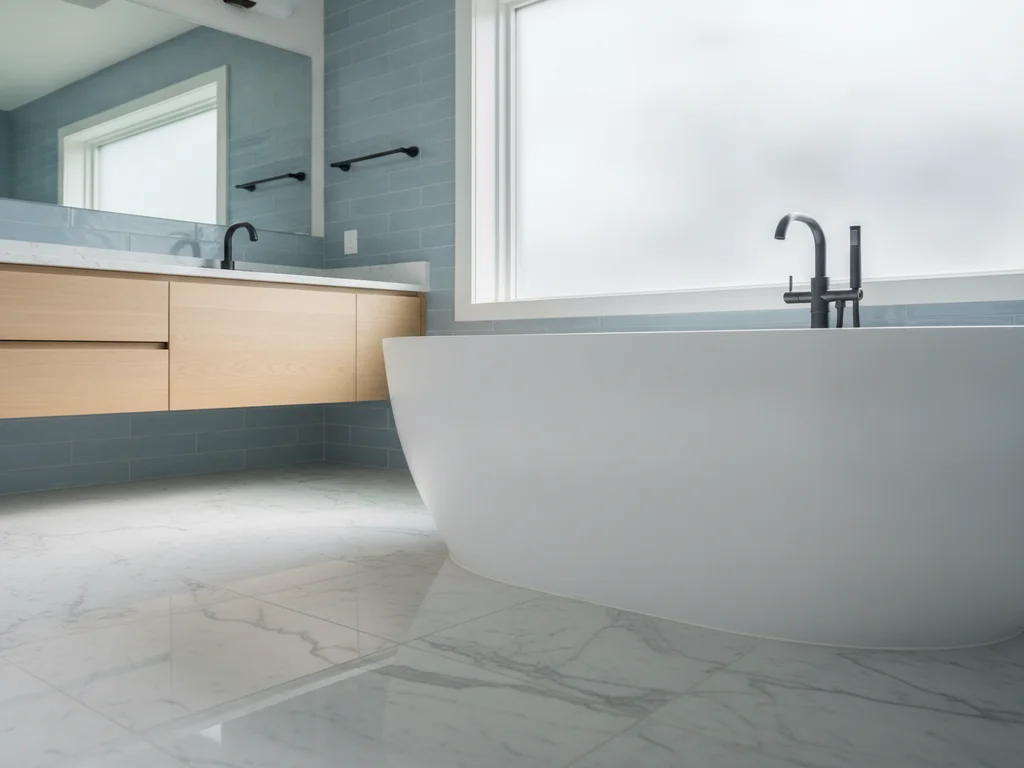
Marble-look porcelain has become the default recommendation for busy bathrooms, and not as a consolation prize. Modern printing puts convincing veining on large-format tile that never etches, never needs sealing, and shrugs off the hard-water spotting common across the Treasure Valley. We compare the two materials in depth in our natural stone vs. porcelain guide.
If the marble experiment soured you on stone altogether, the field is wide open — see the best bathroom flooring options for how tile, luxury vinyl, and others stack up.
| Option | Look | Maintenance | Etching/stain risk | Best for |
|---|---|---|---|---|
| New marble | The real thing — depth and variation | Sealing, pH-neutral cleaners | Etches and stains; it’s inherent to the stone | Owners committed to stone care |
| Marble-look porcelain | Very convincing at normal viewing distance | Essentially none | None — impervious surface | Busy family baths, low upkeep |
| Other flooring (tile, LVP) | Different aesthetic direction | Varies by material | None to low | A fresh start with the whole design |
What does replacing a marble floor cost?
Marble is on the expensive end of flooring. Per HomeAdvisor’s cost guides, marble tile flooring generally runs roughly $10–$20 per square foot installed for common varieties, with rarer stones climbing well past that. Porcelain tile typically installs for roughly $8–$15 per square foot, per Angi’s cost data — and marble-look porcelain sits inside that range, not above it.
For a typical 40–60 square foot Boise bathroom floor, the tile itself is only part of the bill. Demolition of the old marble, substrate repair, and any subfloor correction add labor that varies with what demo uncovers. That is why quotes for the same square footage can differ widely — the honest ones price the unknowns.
For how flooring fits into a whole-room budget, see our Boise bathroom remodel cost guide.
Should you fold the floor into a larger remodel?
If the marble floor is failing, look hard at what surrounds it. A floor replacement already involves pulling the toilet, cutting in at the tub or shower, and disturbing baseboards — much of the disruptive groundwork of a full remodel. Doing the floor alone this year and the shower two years from now means paying for mobilization, demolition, and finish work twice.
This is exactly the conversation a good contractor should have with you before quoting. Our custom tile and stonework projects often start as a single failing surface and become a smarter scope once the numbers are side by side.
What the process looks like
- 1
Assess the damage and the structure
A pro starts by distinguishing surface damage (etching, wear, shallow stains) from structural symptoms (cracks, hollow tiles, soft spots), tapping the field for delamination and checking floor flatness and deflection. This determines whether restoration is viable or replacement is the honest recommendation.
- 2
Protect the room and remove the marble
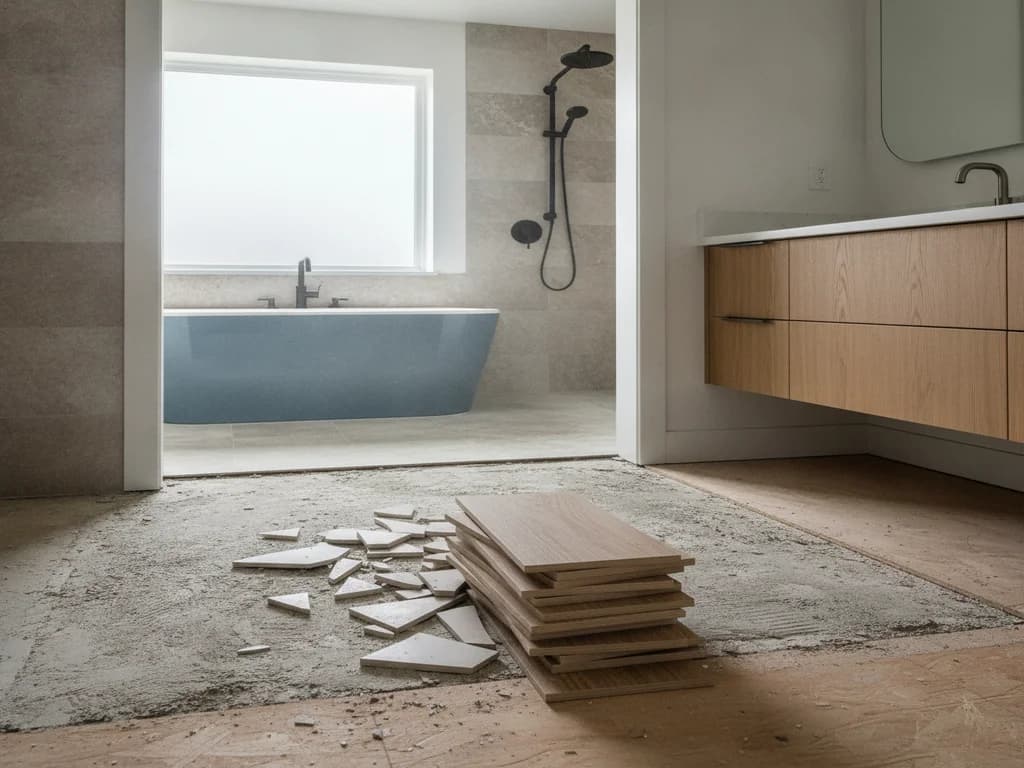
Fixtures are protected or pulled — the toilet always comes out — and the marble and its setting bed are demolished. Stone demo is dusty, heavy work; a professional crew contains the dust and hauls the debris rather than letting it migrate through the house.
- 3
Inspect and correct the substrate
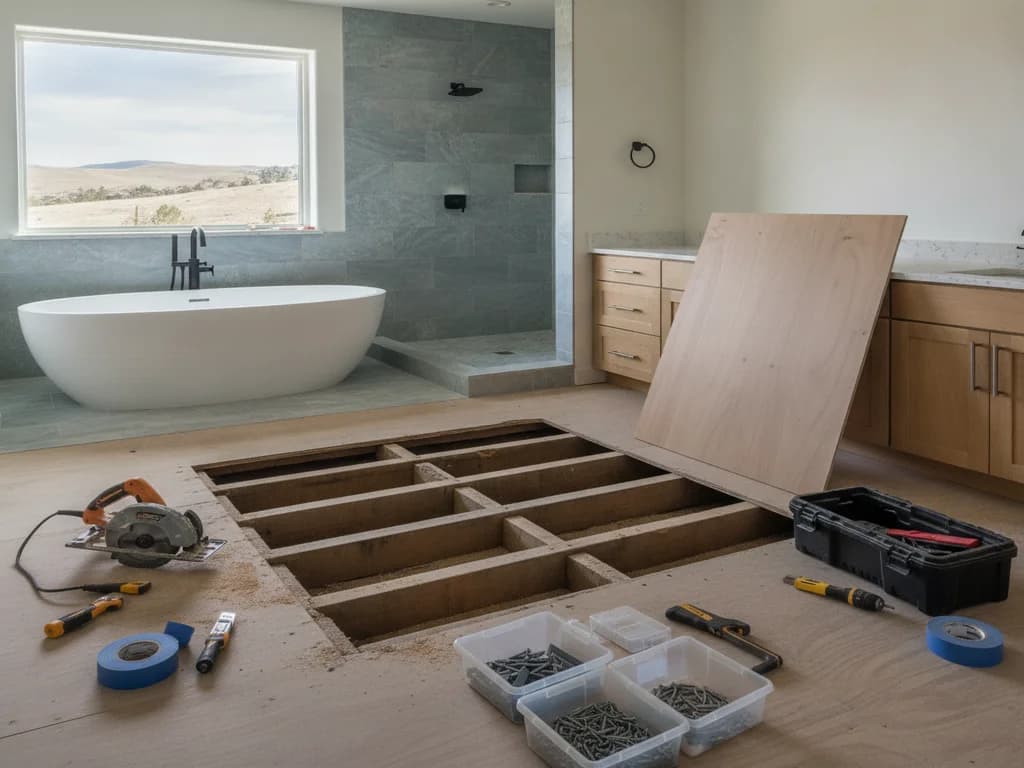
With the floor open, the installer inspects the subfloor for water damage, checks stiffness against tile-industry deflection requirements, and corrects anything that contributed to the old floor’s failure. Skipping this step is how the new floor cracks like the old one did.
- 4
Install underlayment or an uncoupling membrane
Over a sound structure, an uncoupling membrane or appropriate backer goes down per TCNA-recognized methods. This layer absorbs the small movements of the wood structure below so the rigid tile above never feels them.
- 5
Set the new floor
Tile is laid out dry first so cuts land symmetrically and veining flows the right direction — this matters double with marble-look porcelain, where repeating patterns need spreading across the room. Then it is set with the correct thinset and trowel size for the tile format.
- 6
Grout, seal, and reset fixtures
Grout is chosen to complement the stone look, movement joints are honored at the room’s perimeter, the toilet is reset on a new wax ring or seal, and thresholds and baseboards are reinstalled. Real marble gets its initial sealer coat; porcelain needs none.
Ready to plan your Boise bathroom?
Licensed & insured · 3-year workmanship warranty
Frequently asked questions
- Can etching be polished out of a marble floor?
- Usually, yes. Etching is shallow chemical damage to the polished surface, and a stone restoration pro can hone the floor with fine abrasives and repolish it to remove etch marks and traffic dullness. What honing cannot fix is cracking, loose tiles, or stains that have penetrated deep into the stone — those point toward replacement.
- Why did my marble bathroom floor crack?
- Almost always because of movement below the tile, not a defect in the stone. A flexing subfloor, a skipped uncoupling membrane, or voids in the setting bed let the structure move more than rigid marble can tolerate. That is why cracks that line up across several tiles mean the substrate must be diagnosed and corrected before any new floor is installed.
- Is marble-look porcelain cheaper than real marble?
- Generally, yes. Per HomeAdvisor and Angi cost data, marble commonly installs at roughly $10–$20 per square foot while porcelain typically runs roughly $8–$15 — and porcelain also skips the ongoing sealing and the risk of etch damage. At normal viewing distance, quality marble-look porcelain is convincing enough that most visitors never question it.
- Can you replace just one cracked marble tile?
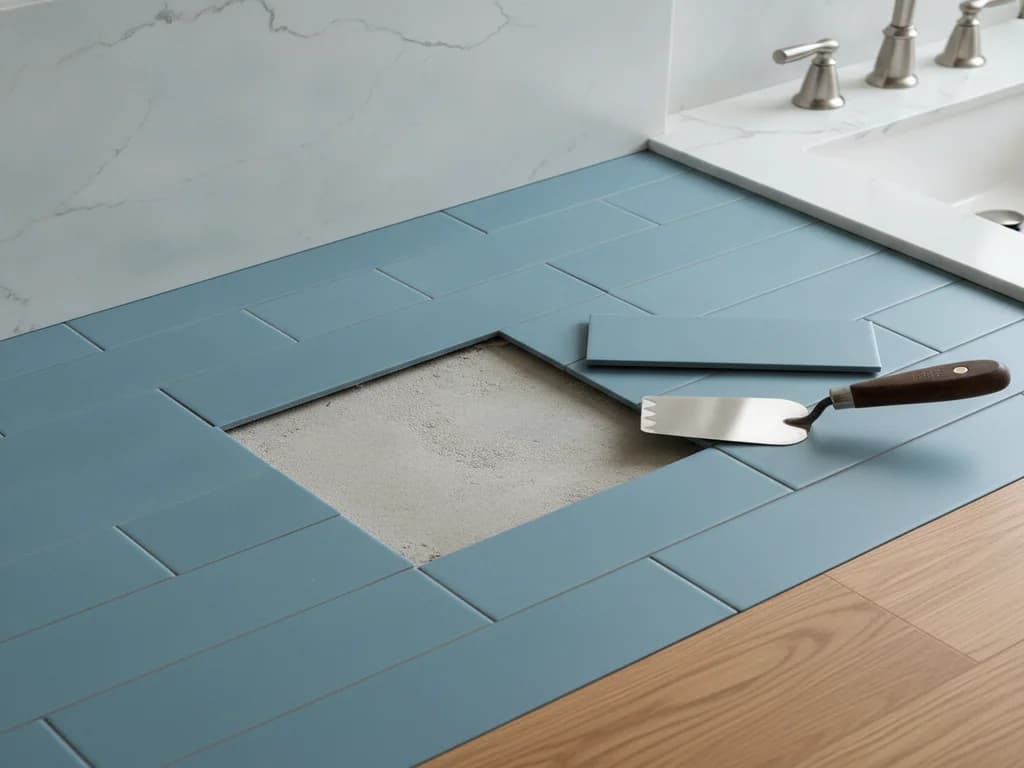
- Mechanically, yes — a pro can cut out and replace a single tile. The catch is matching: marble varies lot to lot, so the replacement rarely blends invisibly, and a crack usually signals substrate movement that will claim neighboring tiles next. Single-tile swaps make sense for impact damage; pattern cracking calls for a bigger conversation.
- Is marble a bad choice for bathroom floors?
- Not bad — demanding. Marble etches on contact with acids, stains through its pores, and needs periodic sealing and pH-neutral cleaning, per Natural Stone Institute care guidance. Owners who accept that upkeep love it for decades. If you want the look without the contract, marble-look porcelain is the low-maintenance route.
Sources
- Natural Stone Institute
- Tile Council of North America (TCNA)
- HomeAdvisor — True Cost Guide
- Angi — Cost Guides
Claims and figures are drawn from the sources above and provided for general guidance; your project may vary. Photography is illustrative of design concepts. For a fixed price on your specific bathroom, request a free estimate.