Updated July 16, 2026 · 7 min read
By Boise Bath — bathroom & shower remodeling in Boise & the Treasure Valley
The short answer
Tile is the better bathroom floor for almost every home. Porcelain and ceramic are effectively waterproof and indifferent to humidity; hardwood — even engineered — survives only as long as its finish seal and your cleanup speed. Reserve real wood for half baths without a tub or shower, and use wood-look porcelain everywhere else.
Key takeaways
- Porcelain tile absorbs less than 0.5 percent of its weight in water under TCNA standards; wood is hygroscopic and moves with every humidity swing.
- The classic hardwood bathroom failure is not a flood — it is slow water around the toilet and tub edge showing up as cupped boards and black staining.
- Engineered hardwood handles bathroom humidity better than solid wood, but its plywood core still swells once water reaches seams and edges.
- Tile asks for grout upkeep; hardwood asks for vigilance — wiped-up water, intact finish, and re-coating on schedule. Only one of those failure modes ruins the subfloor.
- Wood-look porcelain planks deliver the hardwood aesthetic with tile physics, which is why they have become the default answer in full bathrooms.
- A half bath with no bathing fixture is the one bathroom where hardwood is a defensible choice.
The verdict: tile, unless the room has no water
This comparison has a short honest answer. A bathroom floor lives with standing water, shower steam, toilet condensation, and the occasional overflow — and tile is the only one of these two materials that does not care about any of it. Porcelain in particular is fired so dense that it absorbs less than half a percent of its weight in water, per the Tile Council of North America’s standards for impervious tile.
Wood is the opposite by nature. It is hygroscopic — it takes on and releases moisture constantly, swelling and shrinking as it does. A finish coat slows that exchange; nothing stops it. That is not a knock on hardwood as a material. It is a mismatch between the material and the room.
So the real question is rarely "which is better" — it is whether your specific bathroom has enough water exposure to rule wood out, and whether wood-look porcelain gets you the look you actually wanted. Both of those get honest treatment below.
How hardwood actually fails in a bathroom
The failure mode homeowners picture is a burst pipe. The failure mode that actually claims hardwood bathroom floors is slow water: the ring of moisture around a toilet base with a tired wax seal, the drip line where wet feet exit a tub, splash-out that seeps into board seams before anyone wipes it.
The evidence shows up in a predictable sequence. Boards cup — edges rise higher than centers — as the underside takes on moisture. Black staining appears at seams and nail holes where water has oxidized the tannins in the wood. Finish peels or clouds in the traffic path between the door and the tub. By the time any of that is visible, the moisture has usually been at work for months, and publications like Fine Homebuilding have documented for decades that wood flooring in wet rooms fails at the seams and edges long before the face of the board shows it.
Boise adds its own twist: our dry winters pull indoor humidity down hard, so a bathroom hardwood floor cycles between shower-steam swelling and winter shrinkage. That seasonal movement opens the very gaps that let the next splash reach the subfloor. When a wood floor has already reached the cupping-and-staining stage, replacing hardwood in a bathroom covers what the fix involves.
Tile vs. hardwood: the side-by-side
Here is the whole comparison in one table. The pattern to notice: hardwood’s wins are all about feel and aesthetics, and tile’s wins are all about physics.
| Factor | Porcelain / ceramic tile | Hardwood (solid or engineered) |
|---|---|---|
| Water resistance | Effectively waterproof; porcelain absorbs <0.5% per TCNA standards | Depends entirely on finish seal; standing water reaches seams and swells the wood |
| Durability | Decades of service; grout is the maintenance item, not the tile | Wears well in dry rooms; in bathrooms, moisture — not traffic — sets the lifespan |
| Maintenance | Routine cleaning; periodic grout sealing and re-caulking at wet edges | Immediate wipe-ups, finish re-coats on schedule, vigilance at toilet and tub |
| Failure cost | A cracked tile is a spot repair | Cupping and black staining usually mean sanding or full replacement, plus subfloor checks |
| Comfort underfoot | Hard and cool — pairs well with in-floor heating | Warmer and softer feel; the main reason people want it |
| Looks | Any format; wood-look planks are convincingly realistic | The genuine article — until water damage says otherwise |
| Cost direction | Roughly $10–$25/sq ft installed, per HomeAdvisor cost guides | Roughly $8–$22/sq ft installed per HomeAdvisor — plus real replacement risk after leaks |
Cost ranges are national figures from HomeAdvisor’s True Cost Guide; format, species, and demo scope drive the spread.
Does engineered hardwood change the answer?
Somewhat — but less than the sales pitch suggests. Engineered hardwood is a real-wood veneer over a plywood core, and that cross-laminated core is genuinely more dimensionally stable than solid wood. It handles humidity swings better, which is why engineered is the standard recommendation over slabs and in basements.
What it does not change is what happens with liquid water. The seams between planks are still wood, the core is still plywood, and a toilet-seal leak still finds its way in. Engineered buys you better behavior in a steamy room; it does not buy you a waterproof floor. In a full bathroom, that distinction is the whole game.
The honest framing: engineered hardwood is the right wood for a bathroom, and wood is still the wrong material for most bathrooms. If the room has a tub or shower that gets daily use, engineered narrows the gap with tile without closing it.
Maintenance and the real cost picture
Tile’s upkeep is concentrated in the grout: routine cleaning, sealing on a reasonable schedule, and re-caulking the joint at the tub or shower when it ages. None of it is urgent in the way water on wood is urgent, and none of it threatens the floor structure. A matte or polished finish choice affects cleaning habits more than durability.
Hardwood’s upkeep is behavioral. Bath mats at every splash zone, water wiped up promptly, the finish re-coated before it wears through, and the toilet seal watched. Households that live that way can keep a wood bathroom floor presentable for years. Households with kids splashing in the tub generally cannot, and it only takes one unnoticed leak to move from maintenance to replacement.
On price, the up-front ranges overlap — HomeAdvisor’s cost guides put installed tile roughly at $10 to $25 per square foot and hardwood roughly $8 to $22, depending on species, format, and demo. The divergence is downstream: tile’s worst case is a regrout, while hardwood’s worst case is tearing out the floor and possibly the subfloor. Our best bathroom flooring guide puts these numbers alongside vinyl and laminate for the full picture.
Warmth, feel, and the case people are really making for wood
When homeowners push for hardwood in a bathroom, the actual argument is usually about feel: wood is warmer underfoot, softer to stand on, and continuous with the flooring in the rest of the house. Those are legitimate wants, and tile’s honest weakness is that it is hard and cool on a January morning in Boise.
But tile has an answer wood cannot match: electric in-floor heating turns the coldest floor in the house into the warmest room in it, and tile conducts that heat beautifully. Wood, by contrast, insulates against radiant heat and has manufacturer temperature limits that cap how warm the system can run.
Continuity with adjacent hardwood is solvable too — a clean threshold transition at the bathroom door is standard practice, and plank-format tile laid in the same direction as the hall floor makes the change read as intentional rather than abrupt.
Wood-look porcelain is the bridge that ends most of these debates
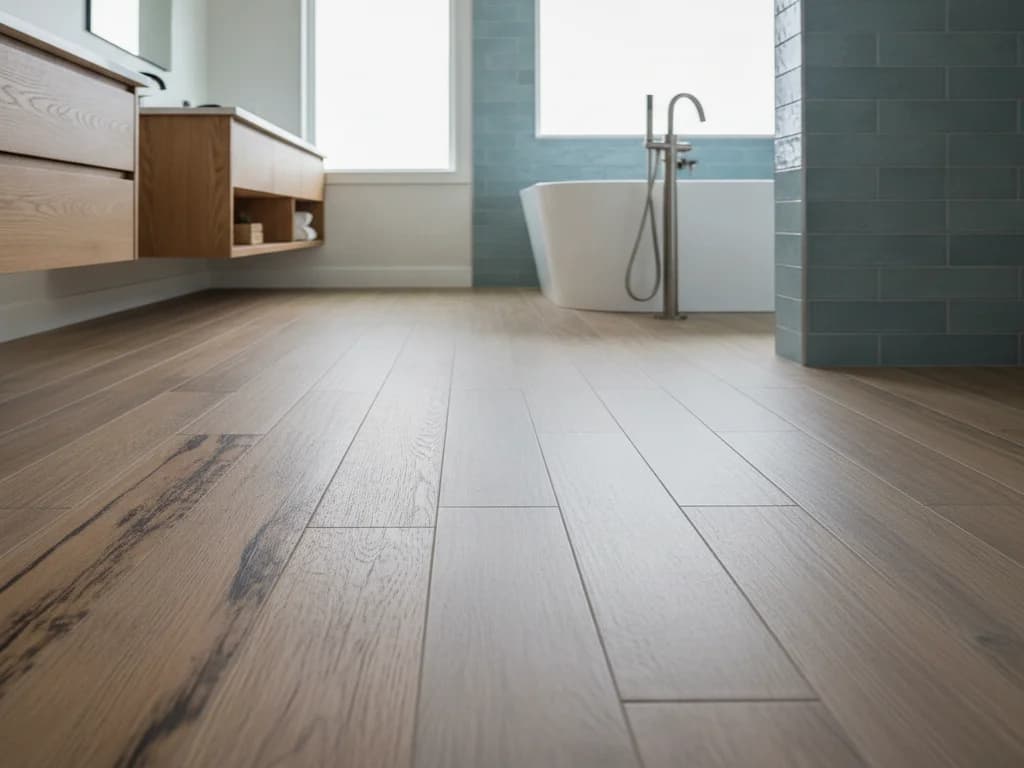
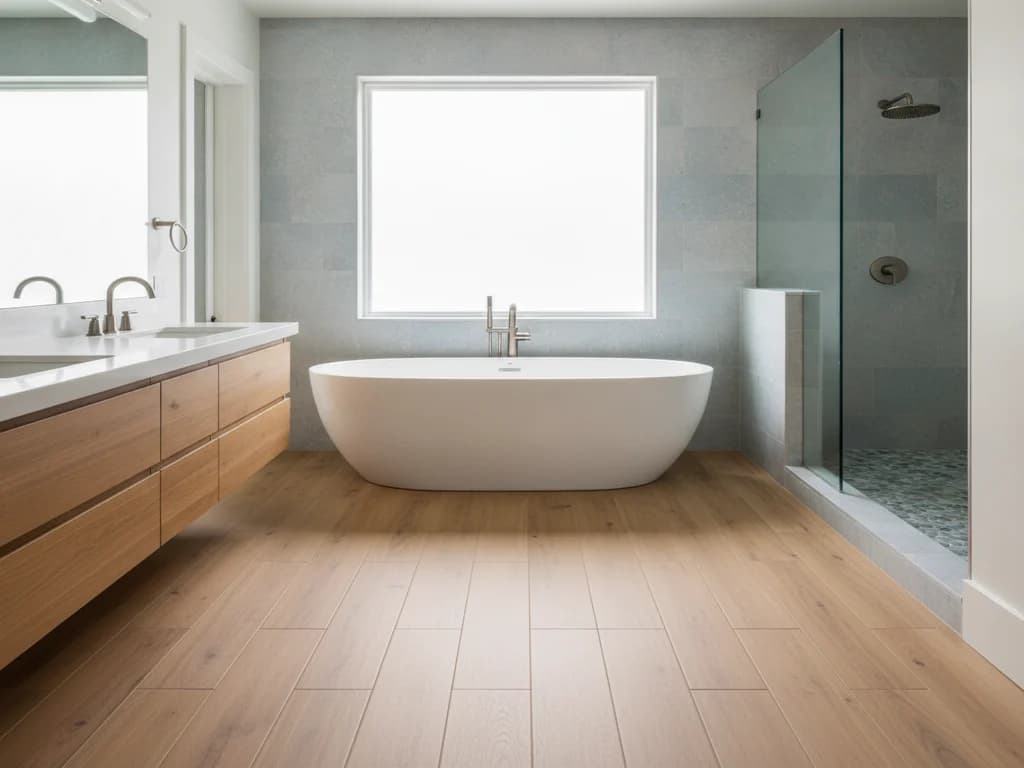
Porcelain plank tile now comes in wood grains, board widths, and matte textures convincing enough that most visitors will not clock the difference at a glance. You get the warmth of the look, compatibility with heated floors, and a surface that shrugs off a toddler’s bath-time tsunami. For full bathrooms, it is the recommendation we make most often.
Which should you choose?
Match the material to the room’s actual water exposure, not to the mood board:
- Full bathroom with a daily-use tub or shower: tile, full stop — porcelain for the density, wood-look plank format if you want the hardwood aesthetic.
- Kids’ bathroom: tile, and consider a textured matte finish for slip resistance where splash-out is a daily event.
- Primary bath where cold floors are the objection: tile over an electric heated-floor system — warmer than hardwood ever gets, and the heated floor system is a modest add during a remodel.
- Half bath or powder room with no bathing fixture: hardwood is defensible here — engineered preferred, with a watchful eye on the toilet seal.
- Whole-house hardwood continuity as the goal: run wood-look porcelain in the bathrooms and let a clean threshold handle the transition.
- Existing hardwood bathroom that still looks good: no urgency to rip it out — maintain the finish, mind the wet zones, and plan the tile conversion into your next remodel.
Ready to plan your Boise bathroom?
Licensed & insured · 3-year workmanship warranty
Frequently asked questions
- Is engineered hardwood OK in a full bathroom?
- It is better than solid hardwood — the plywood core resists humidity-driven movement — but it is still not waterproof. The seams and core swell when liquid water gets past the finish, and in a bathroom with a daily-use tub or shower, it eventually will. Engineered wood is a reasonable choice for half baths and a risk-tolerant choice anywhere with bathing fixtures.
- Can you put real hardwood in a half bath?
- Yes — this is the one bathroom where wood is defensible. With no tub or shower, the water exposure drops to sink splashes and the toilet, both manageable with an intact finish and prompt wipe-ups. Use engineered wood for stability, keep the toilet’s wax seal in good shape, and the floor can run continuously with a hardwood hallway.
- What actually happens when a toilet leaks onto a hardwood floor?
- A failing wax ring seeps slowly, and the wood hides it: moisture wicks into board undersides and seams, boards cup, and black tannin stains bloom around the toilet base. By the time discoloration is visible, the subfloor is often wet too. The repair typically means pulling the toilet, replacing the damaged boards or the floor, and verifying the subfloor is sound and dry.
- Does tile or hardwood add more value in a bathroom?
- In bathrooms specifically, tile reads as correct to buyers and inspectors, while hardwood reads as a question mark — inspectors flag wood in wet rooms and buyers price in the risk. Hardwood adds value in living spaces; bathrooms are the exception where the premium material is the one engineered for water. Wood-look porcelain captures the aesthetic without the flag.
- Is wood-look tile obvious once it is installed?
- Less than most people expect. Current porcelain planks carry printed grain that varies board to board, textured matte surfaces, and realistic formats up to 48 inches long. The tells are grout lines and the sound underfoot, and tight rectified-edge installs minimize the first. In a bathroom-sized room viewed at a glance, most visitors read it as wood.
- Can heated floors go under both tile and hardwood?
- Electric radiant systems pair naturally with tile — porcelain conducts and holds the heat well, and it is the standard assembly. Under wood, manufacturers cap surface temperatures to protect the material and finish, so the floor never gets as warm, and wood’s insulating nature blunts the effect further. If a warm floor is the goal, tile is the better partner.
Sources
- Tile Council of North America (TCNA)
- Fine Homebuilding
- HomeAdvisor — True Cost Guide
- This Old House — Bathrooms
Claims and figures are drawn from the sources above and provided for general guidance; your project may vary. Photography is illustrative of design concepts. For a fixed price on your specific bathroom, request a free estimate.