Updated July 16, 2026 · 7 min read
By Boise Bath — bathroom & shower remodeling in Boise & the Treasure Valley
The short answer
Solid hardwood fails in full bathrooms because repeated moisture swings make boards cup, gap, and stain, especially around the tub and toilet. The proven replacement is porcelain tile — including wood-look planks that keep the warmth of wood — or a waterproof luxury vinyl. Expect a two-to-four-day professional replacement for a typical bathroom.
Key takeaways
- Wood moves with moisture; a bathroom cycles between steam-room humidity and dry Idaho winter air, and boards eventually cup, gap, or stain.
- Black staining in hardwood is oxidized water damage in the wood fibers — refinishing cannot sand it away reliably.
- Wood-look porcelain planks deliver the hardwood look with zero moisture risk, which is why they dominate bathroom replacements.
- A powder room without a tub or shower is the one place hardwood can honestly stay.
- Floor height at the doorway matters: the new floor should meet the hallway hardwood cleanly, not with an awkward step.
- Electric floor heat under tile answers the “tile is cold” objection better than wood ever insulated.
Why does solid hardwood fail in bathrooms?
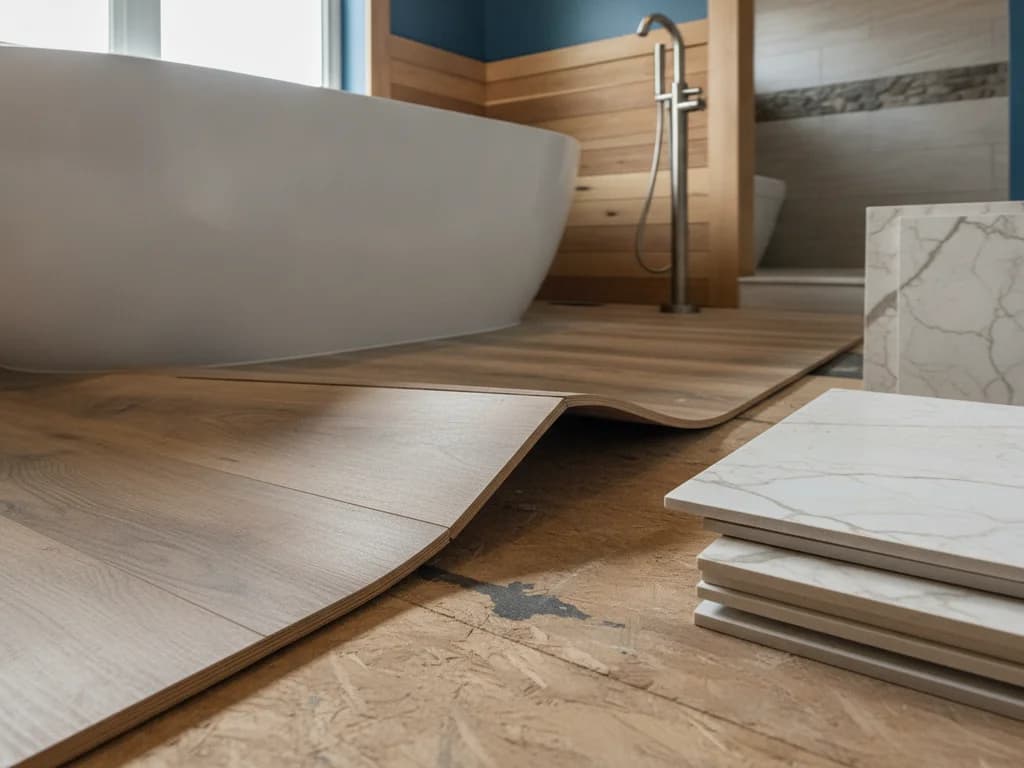
Wood is hygroscopic — it swells as it absorbs moisture and shrinks as it dries. A bathroom is the most punishing environment in the house for that behavior: shower steam pushes humidity to sauna levels, then Boise’s dry winters pull it back down, over and over. Boards respond by cupping at the edges, opening gaps, and working their finish loose at the seams.
Liquid water finishes the job. Splash zones along the tub, condensation dripping off a toilet tank, and slow supply-line seeps all find the board seams, and once water is in the wood, staining and rot follow. Even a flawless polyurethane finish only protects the top face — the edges and undersides of every board remain exposed.
Signs your bathroom hardwood is past saving
One or two of these in isolation might warrant a repair conversation. Several together — particularly black staining plus softness — mean moisture has been winning for years, and the honest fix is replacement. Softness also raises the subfloor question, which is worth understanding before work starts; the signs of bathroom water damage covers how far the problem typically extends.
- Cupped boards — edges raised, centers low — that persist through dry winter months
- Black or dark gray staining, especially around the toilet and along the tub: oxidized water damage deep in the wood fibers
- Gaps between boards that open and close with the seasons, collecting grime
- Finish that is peeling, clouding, or worn through in the splash zone
- Boards that feel soft or spongy underfoot, or movement at the toilet base
- A musty smell after showers that ventilation does not clear
Can you refinish it instead of replacing it?
Sometimes, but know what refinishing can and cannot fix. Sanding renews the surface and can flatten mild cupping, and a fresh finish buys protection — but it does not remove black staining that has penetrated the fibers, it cannot seal board edges against the next decade of steam, and each sanding removes wood a solid floor can only spare a few times.
The honest exception is the powder room. A half bath with no tub or shower sees hand-wash splashes, not humidity cycling, and hardwood can live a long, handsome life there. In a full bathroom, refinishing is a delay, not a solution.
Wood-look porcelain: the look without the risk
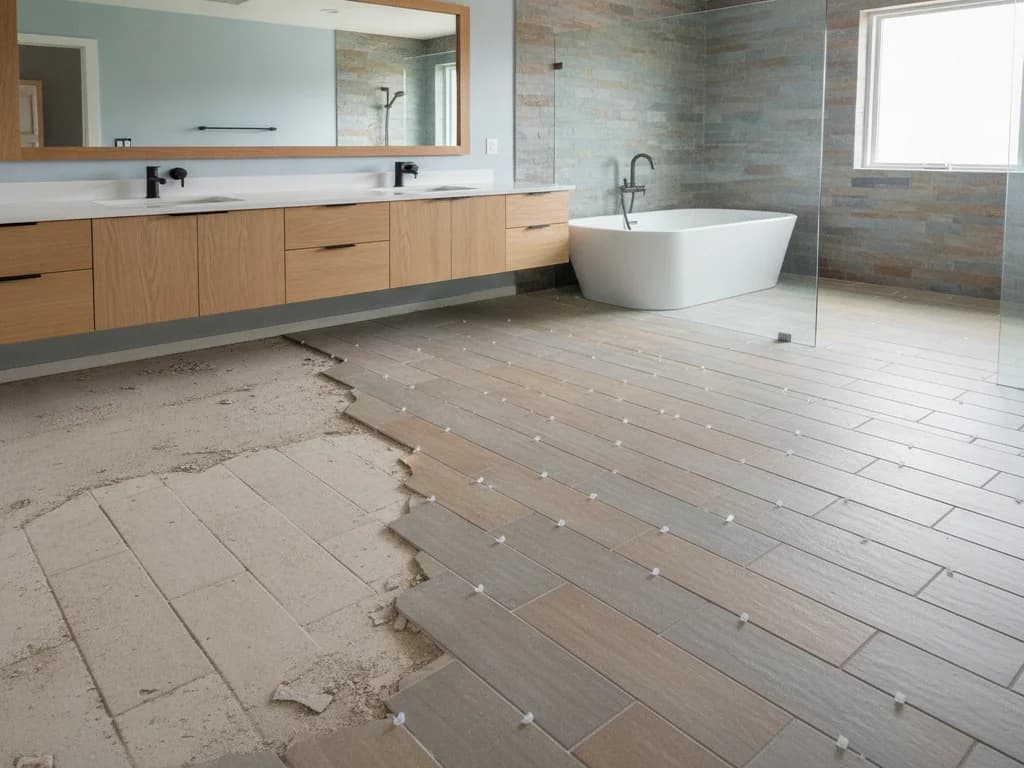
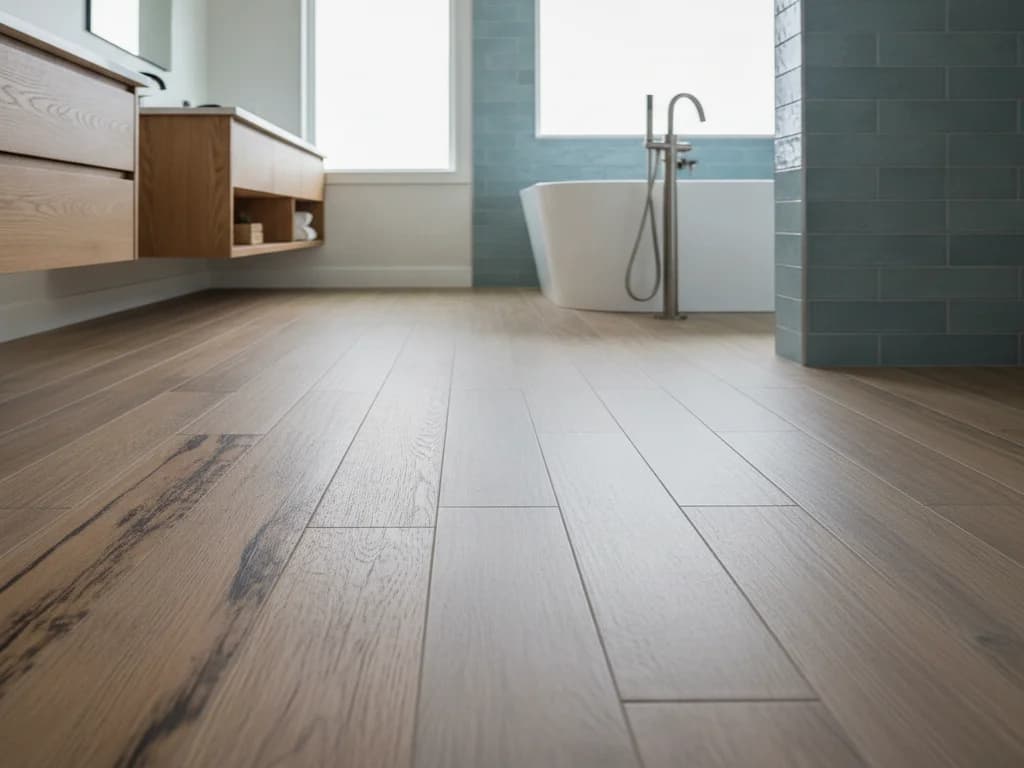
The reason this replacement decision has gotten easy is that porcelain plank tile now does a genuinely convincing wood impression — grain texture, matte finishes, and plank formats like 6×36 and 8×48 that lay out the way hardwood does. Porcelain absorbs almost no water, shrugs off our hard-water spotting, and will not care how long your showers run.
Laid with tight joints and a grout color matched to the plank, the floor reads as wood from the doorway and only reveals itself up close. It is the default recommendation when a bathroom sits off a hallway of real hardwood and you want continuity without the risk — the kind of detail work a custom tile installation is built around.
How do the alternatives compare?
Waterproof luxury vinyl plank deserves a fair hearing too — it is warmer underfoot, kinder to the budget, and faster to install, though it will not match porcelain for lifespan or resale presence. The full decision framework lives in tile vs LVP for bathroom floors and our best bathroom flooring guide.
| Floor | Moisture resistance | Feel underfoot | Look | Longevity in a bathroom |
|---|---|---|---|---|
| Solid hardwood | Poor — swells, cups, stains | Warm, natural | The real thing | Shortened by moisture cycling |
| Wood-look porcelain | Excellent — near-zero absorption | Hard, cool (heatable) | Convincing wood impression | Decades |
| Waterproof LVP | Very good — waterproof core | Warm, slightly soft | Good wood impression | Strong, shorter than tile |
What happens at the doorway?
Most bathroom hardwood continues from a hallway, so the replacement has to end gracefully at the door. The goal is a flush or near-flush transition under the closed door line: tile over an uncoupling membrane can usually be built to meet 3/4-inch hardwood within a small, clean threshold. What you want to avoid is a proud lump of transition strip announcing the change — flatness there is planning, not luck.
While the floor is open is also the moment to decide on radiant heat. An electric mat under the tile costs the least it ever will right now, and it converts tile’s one real drawback into the best feature in the room — our heated bathroom floor guide covers the systems.
Save the salvage
If the hallway hardwood continues through the house, have the crew set aside the sound boards coming out of the bathroom. Matching vintage oak for future hallway repairs is hard to buy and free to keep.
What does replacing bathroom hardwood cost?
The project prices like any bathroom floor replacement plus a modest tear-out premium, since nailed hardwood takes more labor to remove than vinyl or carpet. For a typical bathroom, professionally installed new flooring generally lands around $800–$3,000 depending on material and room size, per HomeAdvisor’s cost guides — wood-look porcelain toward the upper portion, LVP below it. Subfloor repairs where water got through, and radiant heat if you add it, move the number from there.
If the hardwood’s failure is part of a broader dated-bathroom story — a 1990s tub deck, worn vanity, tired tile — get the larger scope priced at the same time. Boards and backer come up once either way; a free estimate can show both numbers side by side.
What the process looks like
- 1
Confirm the extent of the moisture damage
A pro probes the stained and soft areas, checks the toilet flange and tub edge, and determines whether the damage stops at the flooring or continues into the subfloor — which sets the real scope before demolition.
- 2
Pull the toilet, trim, and door
The toilet comes out so flooring runs beneath it, baseboards come off, and the door is often removed for working room and re-hung after — its bottom clearance is checked against the new floor height.
- 3
Remove the hardwood
Boards are cut into sections and pried up, nails and staples pulled, and salvageable planks set aside for future hallway repairs if the same wood continues through the house.
- 4
Repair and flatten the subfloor
Water-damaged plywood is cut back to sound material and replaced, fasteners are refreshed to kill squeaks, and the floor is flattened to tile-ready tolerance.
- 5
Install the underlayment — and heat, if chosen
Cement backer board or an uncoupling membrane goes down; electric radiant mats are set and tested at this stage, before any tile covers them.
- 6
Set, grout, and finish
Plank tile is laid out with joints staggered like hardwood, set, and grouted in a matched color. The toilet is reset with a new seal, trim returns, and the doorway transition is fitted flush to the hall floor.
Ready to plan your Boise bathroom?
Licensed & insured · 3-year workmanship warranty
Frequently asked questions
- Is hardwood ever OK in a bathroom?
- In a powder room, yes — with no tub or shower there is no humidity cycling, and hardwood holds up fine against sink splashes with a sound finish. In a full bathroom, solid wood is a countdown: even careful households cannot stop steam from reaching board edges the finish does not cover.
- What about engineered wood instead of solid?
- Engineered flooring is more dimensionally stable than solid wood, so it cups and gaps less — but its wear layer and core still dislike standing water and repeated soakings, and most manufacturers hedge their bathroom warranties accordingly. If you want the wood look in a full bath, wood-look porcelain or waterproof LVP carries none of that fine print.
- Does wood-look tile actually look like hardwood?
- The good ones do, from standing height. Current porcelain planks carry printed grain with real surface texture, matte finishes, and long formats that lay out like boards. The tells are up close: grout lines and pattern repeats. Tight joints, matched grout color, and a random-length layout minimize both.
- Will a tile floor be cold in winter?
- Colder than wood, yes — tile conducts heat away from your feet faster. The fix is electric radiant heat installed under the tile during the replacement, which makes the floor warmer than the hardwood ever was on winter mornings. Adding it later means redoing the floor, so decide while it is open.
- Does replacing hardwood with tile hurt resale value?
- Not in a bathroom. Buyers read hardwood in a full bath as a moisture question, not a luxury — especially with visible staining. A well-installed porcelain floor, wood-look or otherwise, is what they expect to find in a bathroom and one less thing for an inspection to flag.
Sources
Claims and figures are drawn from the sources above and provided for general guidance; your project may vary. Photography is illustrative of design concepts. For a fixed price on your specific bathroom, request a free estimate.