Updated July 16, 2026 · 7 min read
By Boise Bath — bathroom & shower remodeling in Boise & the Treasure Valley
The short answer
Bathroom floor replacement means pulling the toilet, removing the old flooring down to the subfloor, repairing any water damage, then installing the new material with proper underlayment and transitions. A straightforward bathroom takes a professional crew roughly two to five days, with tile at the longer end because mortar and grout need cure time.
Key takeaways
- Every bathroom floor replacement starts with pulling the toilet — flooring installed around a toilet instead of under it is a shortcut that shows.
- The subfloor inspection is the most important step: soft spots, stains, and rot only become visible once the old floor is out.
- New flooring changes the finished floor height, which affects door clearance, transitions, and the toilet flange.
- Tile takes the longest to install because thinset and grout need cure time; vinyl and laminate go faster.
- If the floor failed because of moisture, replacing the flooring without fixing the source guarantees a repeat.
When is it time to replace a bathroom floor?
Some signals are cosmetic — dated tile, yellowed vinyl, a floor that fights the rest of the room. Those are judgment calls. The signals that should move you to act are functional: flexing or soft spots underfoot, cracked or loose tiles that keep spreading, seams or edges that have lifted, and any staining or musty smell near the toilet or tub.
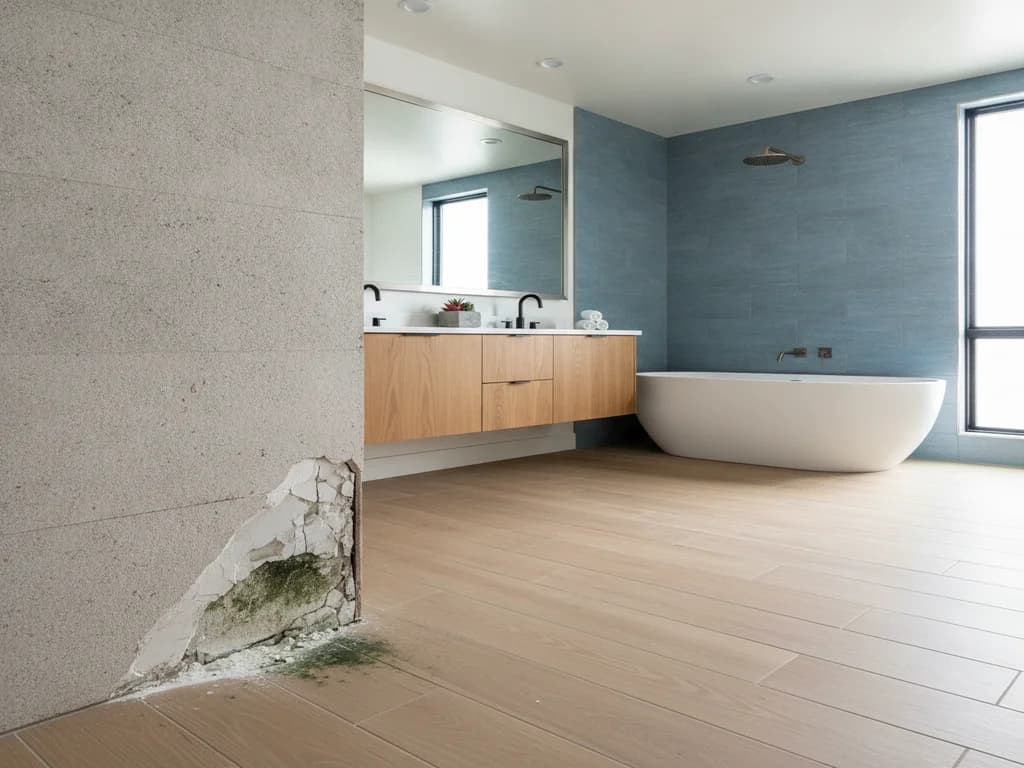
Soft spots matter most, because they usually mean the problem is below the flooring, not in it. Moisture that gets past a finished floor works on the subfloor quietly for years. If any of the warning signs in our guide to the signs of bathroom water damage sound familiar, treat the floor replacement as an investigation, not just a swap.
The floor is rarely the whole story
A failed bathroom floor almost always has a cause — a wax ring past its life, a tub that splashes past its curb, a slow supply-line weep. Replacing the flooring without finding the source means replacing it again.
Which flooring materials work in a bathroom?
Bathrooms punish flooring harder than any other room: standing water, temperature swings, and — across the Treasure Valley — hard water that spots and etches. The materials that hold up are porcelain and ceramic tile, luxury vinyl plank and sheet vinyl, and natural stone if you accept the sealing routine. Laminate, carpet, and solid hardwood are the materials people replace, not the ones they replace them with.
This article covers the process that is common to every material. For depth on a specific starting point, we have dedicated walk-throughs: replacing a bathroom tile floor, replacing vinyl flooring, replacing laminate with tile, swapping LVP for tile, and getting carpet out of a bathroom.
If you have not settled on the new material yet, start with the best bathroom flooring options compared — that guide owns the which-material decision, so we will not re-argue it here.
What happens during tear-out?
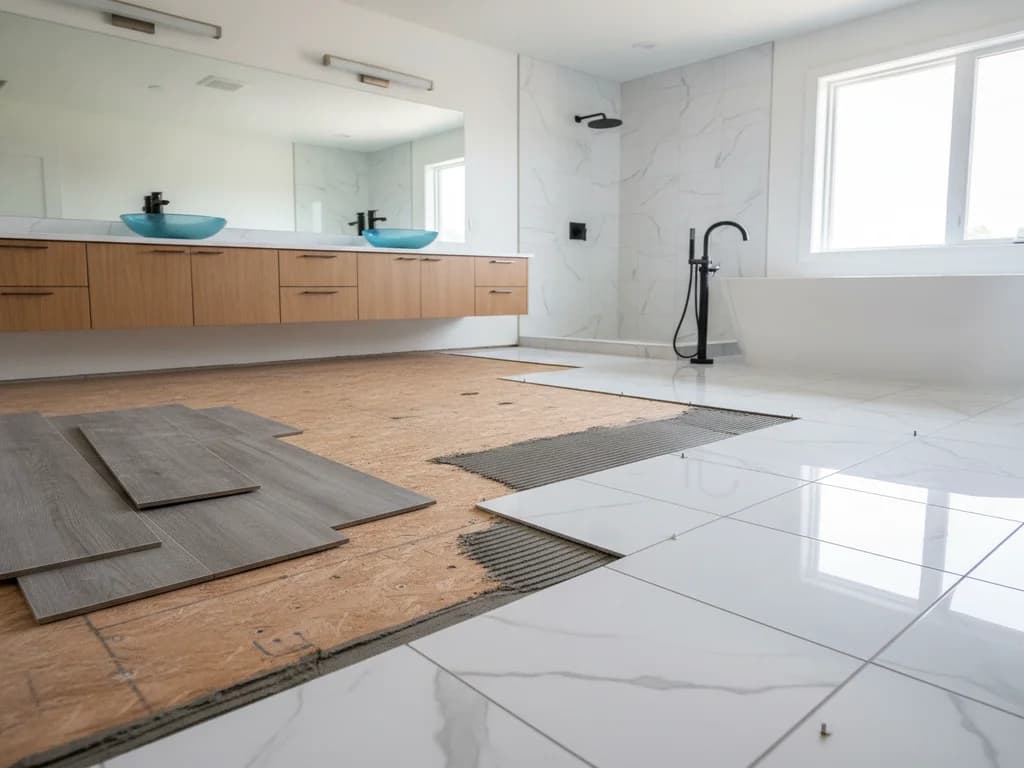
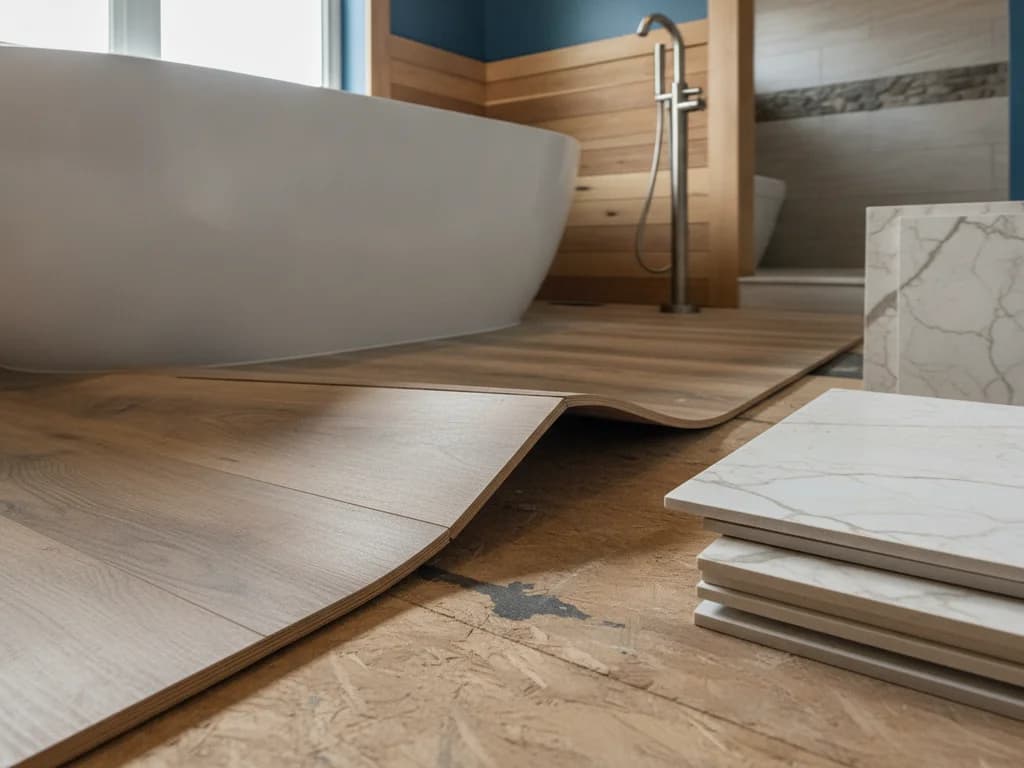
Tear-out difficulty depends entirely on what is coming up. Floating floors — laminate and click-lock LVP — come out fast because nothing is bonded. Glued vinyl takes scraping. Tile is the heavy lift: it comes up in pieces along with the thinset or mortar bed beneath it, which is loud, dusty work that a good crew contains with plastic barriers and dust-controlled tools.
Baseboards or the trim shoe typically come off so the new floor can run underneath cleanly — worth knowing if yours are older, since brittle trim often does not survive removal. Our guide to replacing bathroom baseboards and trim covers what that adds.
Why does the toilet have to come out?
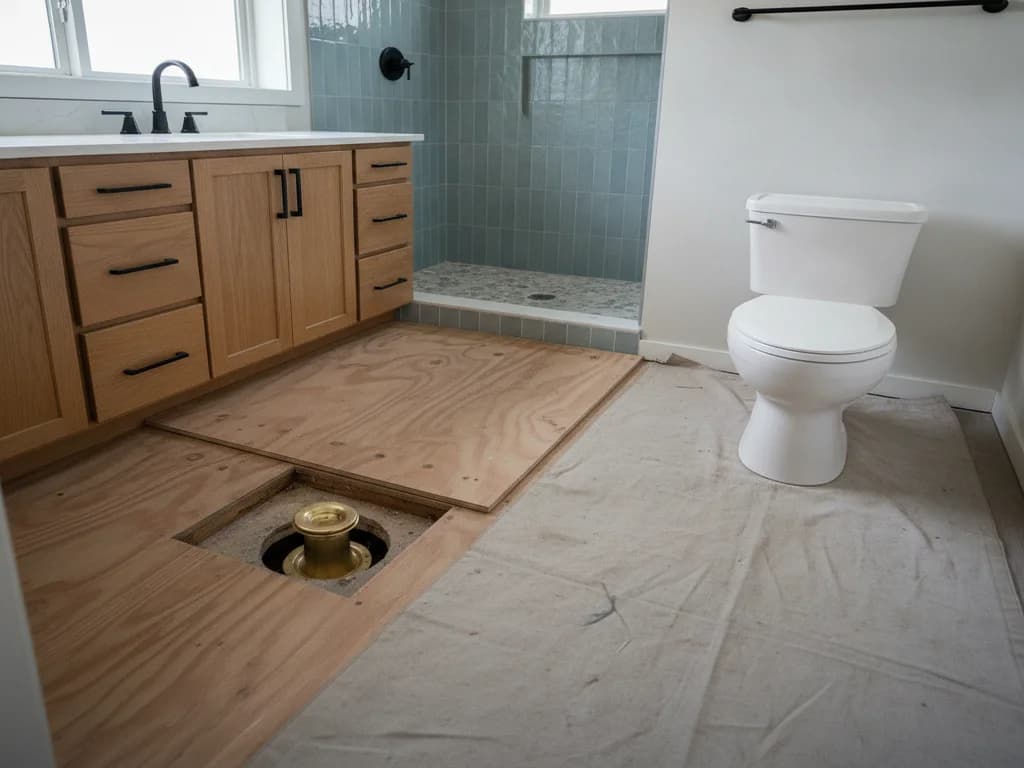
It does, every time. Flooring should run under the toilet, not be cut around it — a visible cut line around the base is the signature of a rushed job, and it leaves an unsealed edge exactly where water shows up. Pulling the toilet also exposes the flange and wax ring, which is the single most common source of hidden floor damage.
The area under and around the toilet deserves its own attention; we cover the flange-height and seal details in replacing the bathroom floor under a toilet. The vanity is a judgment call: a floating vanity stays, a floor-mounted one usually gets floored around only if it is staying for the long haul.
What does the subfloor inspection catch?
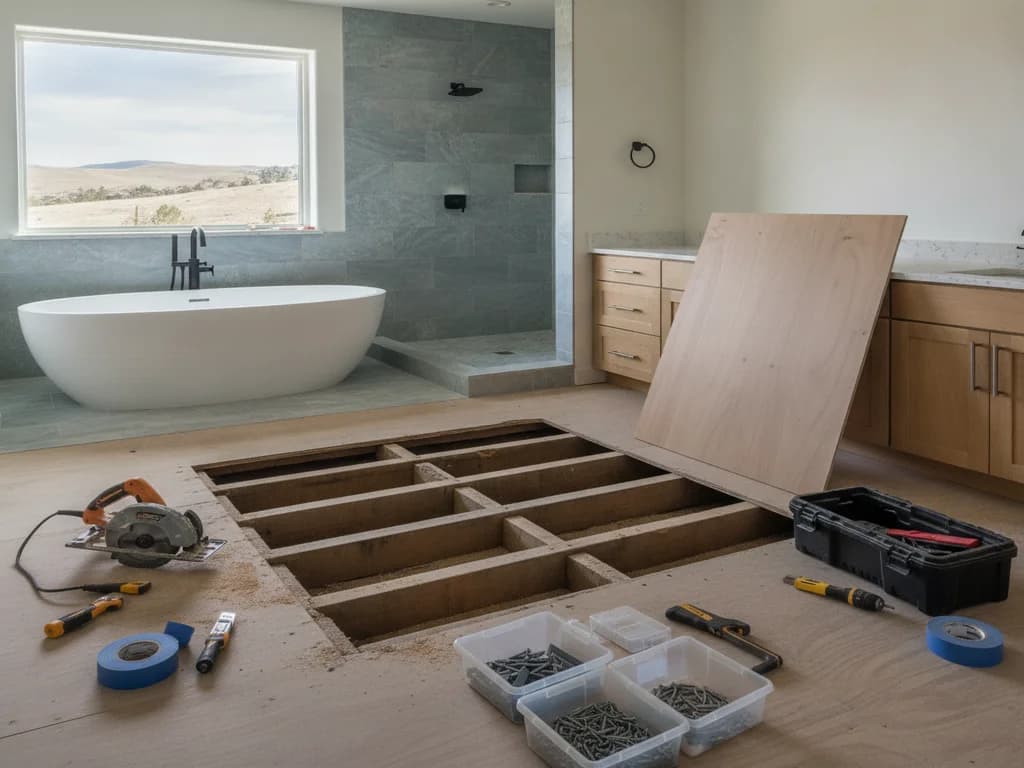
With the old floor out, a professional checks the exposed subfloor for staining, delamination, soft spots, and fastener pull-through — and probes anywhere near the toilet, tub, and shower. Plywood or OSB that has cycled wet and dry loses its structure even after it dries, so "it feels solid now" is not the standard.
Small damaged areas get cut out and patched; widespread damage means sheet replacement, which is a known, fixable scope — see replacing a bathroom subfloor and, for the worst case, dealing with a rotten bathroom floor. Skipping this step to save a day is how new tile ends up cracking over old rot.
How do height and transitions change?
Every flooring assembly has a stack height — the flooring plus whatever goes under it. Tile over backer board or an uncoupling membrane builds up more than LVP over a thin pad, so switching materials usually changes the finished floor height by a fraction of an inch. That fraction matters at three places: the door (which may need trimming), the doorway transition to the hallway floor, and the toilet flange.
A clean threshold detail is what makes a new floor read as professional from the hallway; the options are covered in replacing a bathroom threshold or transition strip.
How long does bathroom floor replacement take?
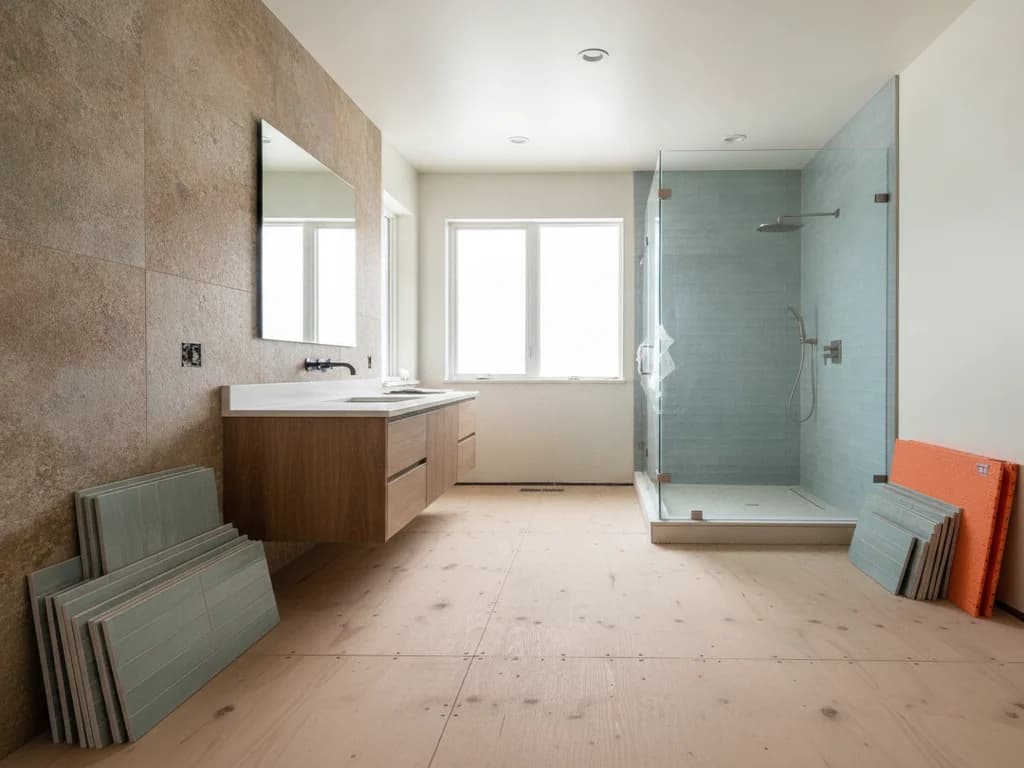
For a typical hall or primary bathroom, plan on two to five working days: a day for tear-out and subfloor work, a day or two for prep and installation, and — for tile — cure time before grout and another stretch before heavy use. Vinyl and laminate compress that schedule since there is no cure window. Subfloor surprises are the variable that stretches it.
Cost depends on the material, the tear-out, and what the subfloor reveals, which is why per-material pricing deserves its own treatment. For how flooring fits into overall project budgets, see what a bathroom remodel costs in Boise.
Should you fold flooring into a bigger remodel?
If the floor failed from moisture, the smart money looks at the whole wet zone before finishing new flooring around old problems. And mechanically, flooring is the layer everything else sits on — a tub swap, a tub-to-shower conversion, or a vanity change done after new flooring means cutting into a finished floor.
That is why floors are replaced early in a remodel sequence, and why many homeowners who came in for flooring end up scoping the project one size larger. It is worth pricing both versions before you commit to the small one.
What the process looks like
- 1
Protect the space and clear the room
The crew masks the vanity and tub, seals the doorway against dust, and removes the toilet and baseboards so the new floor can run wall to wall under everything.
- 2
Remove the old flooring
Floating floors are unclicked and carried out; glued vinyl is scraped; tile is broken out along with its thinset or mortar bed using dust-controlled demolition tools.
- 3
Inspect and repair the subfloor
The exposed subfloor is probed for soft spots and rot, especially around the toilet flange and tub. Damaged sections are cut out and replaced, and the surface is refastened flat and squeak-free.
- 4
Build the right underlayment for the material
Tile gets cement board or an uncoupling membrane bedded per manufacturer specs; vinyl gets a smooth, flat substrate; any leveling compound goes down now. This layer determines how long the floor lasts.
- 5
Install the new flooring
The layout is dry-fit first so cuts land where they are least visible. Tile is set, cured, and grouted; plank floors are clicked or glued with the correct expansion gaps at the walls.
- 6
Reset the toilet on a correct flange
The flange height is checked against the new floor height — extended if the floor came up — and the toilet is reset with a new seal, never the old wax ring.
- 7
Finish transitions, trim, and caulk
Thresholds and transition strips are fitted, baseboards or shoe molding reinstalled, and the tub and perimeter joints caulked so the finished edges shed water instead of catching it.
Ready to plan your Boise bathroom?
Licensed & insured · 3-year workmanship warranty
Frequently asked questions
- Can new flooring go over the old bathroom floor?
- Sometimes vinyl can float over an existing hard floor, but in bathrooms it is usually a false economy. Covering the old floor hides the subfloor you most need to inspect, raises the floor height at the door and toilet flange, and telegraphs any failure underneath into the new surface. Full removal is the standard for good reason.
- How long is the bathroom out of commission?
- Plan on two to five working days for a typical bathroom. Vinyl and laminate can be walkable the same day they go down; tile needs thinset cure time before grouting and roughly a day after grouting before normal traffic. The toilet is reset at the end, so you will need a backup bathroom for the duration.
- Does replacing a bathroom floor require a permit in Boise?
- Like-for-like flooring replacement is generally cosmetic work that does not trigger a permit. Permits come into play when the project grows — structural subfloor repairs, moving plumbing, or a full remodel. When the scope crosses that line, a licensed contractor handles the permitting with the City of Boise as part of the job.
- What does bathroom floor replacement cost?
- It varies too much by material to give one honest number here — tile with prep sits well above a basic vinyl swap, and subfloor repairs move any estimate. Cost guides like HomeAdvisor publish wide per-square-foot ranges by material. For how flooring fits a full project budget, see our Boise bathroom remodel cost guide.
- Do I have to replace the toilet when I replace the floor?
- No — the toilet is removed and reset, not replaced. That said, with the toilet already out, swapping a dated or inefficient one adds little labor, so many homeowners use the moment to upgrade. Either way, the reset should always include a new seal and a flange checked against the new floor height.
Sources
- Tile Council of North America (TCNA)
- National Association of Home Builders (NAHB)
- This Old House — Bathrooms
- HomeAdvisor — True Cost Guide
Claims and figures are drawn from the sources above and provided for general guidance; your project may vary. Photography is illustrative of design concepts. For a fixed price on your specific bathroom, request a free estimate.