Updated July 16, 2026 · 8 min read
By Boise Bath — bathroom & shower remodeling in Boise & the Treasure Valley
The short answer
Replacing the floor under a toilet means pulling the toilet, cutting out the rotted subfloor around the closet flange back to sound joists, repairing framing if the rot has spread, installing new panel with proper blocking, then resetting the flange at correct height on the new floor. Typical repairs run roughly $400–$2,000, per Angi and HomeAdvisor cost guides.
Key takeaways
- The flange area is the most common rot spot in a bathroom: a failed wax seal weeps slowly, invisibly, and directly into the subfloor with every flush.
- A rocking toilet and rot feed each other — movement breaks the seal, the leak softens the floor, and the softer floor rocks more.
- The flange must end up at the right height relative to the finished floor, on solid backing — resetting it is half the repair.
- Scope honestly starts as "a patch around the flange" and frequently grows once the floor is open; good contractors bid the discovery, not just the patch.
- Flange-area floor repairs typically run roughly $400–$2,000 depending on spread and framing involvement, per Angi and HomeAdvisor cost guides.
Why does the floor under a toilet rot first?
Every toilet sits on a closet flange — the ring that couples the fixture to the drain pipe and anchors it to the floor. The joint between toilet and flange is sealed by a wax ring (or a modern rubber equivalent). When that seal degrades, shifts, or was never quite right, a small amount of water escapes at the base of the fixture with use.
What makes this leak uniquely destructive is that it is hidden and patient. The water exits *under* the toilet, soaks straight into the subfloor around the flange, and evaporates slowly in a space with no airflow. There is no puddle to notice — often for years. Wood decay fungi get exactly what they need: sustained moisture, mild temperatures, and no drying cycle.
By the time symptoms surface — a toilet that rocks, discoloration creeping out from the base, a soft ring of floor around the fixture, or a sewer-gas smell — the panel around the flange is usually compromised in a rough circle far wider than the fixture footprint. What those symptoms mean and how to read them is its own topic; this article covers the repair.
The rocking-toilet spiral
Rot at the flange rarely stays static, because the toilet and the floor destroy each other in a loop. A slightly soft floor lets the toilet rock; rocking works the wax seal open; the bigger leak softens more floor; the toilet rocks more. Shimming a rocking toilet or re-tightening the closet bolts treats the symptom while the loop keeps running underneath.
This is why a toilet that has been "a little wobbly for a while" is the classic setup for a flange-area floor repair. The wobble is load-bearing information: the material the closet bolts anchor into is failing.
A rocking toilet is a floor symptom
If a toilet rocks and re-tightening the bolts does not produce a solid, lasting fix, stop tightening — the flange or the wood around it is likely compromised, and over-torqued bolts crack porcelain and flanges. Have the floor checked.
What does the repair actually include?
A proper flange-area repair rebuilds three things: the panel, the framing support, and the flange mounting. Skipping any of the three is how the same repair gets done twice.
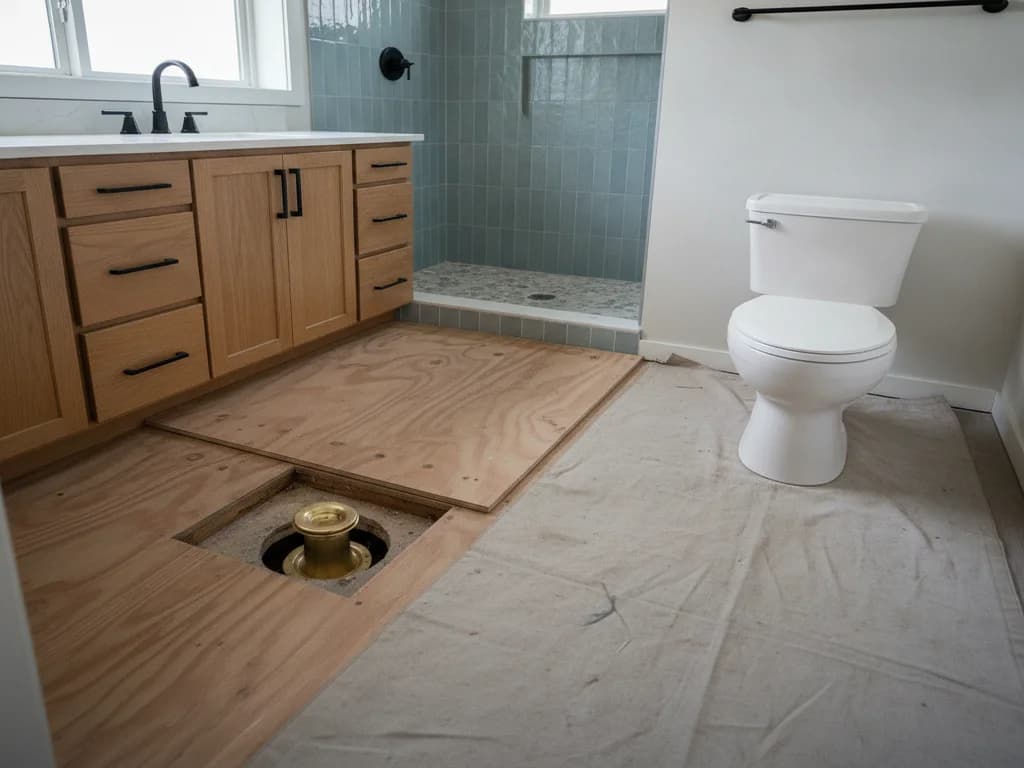
The panel work follows standard subfloor practice — cut back to sound wood on joist centerlines, not just around the visible ring of damage. Because the drain pipe usually runs between two joists, the cutout around a toilet almost always needs new blocking installed between those joists so the patch and the flange screws have solid backing. The full panel-and-framing methodology is covered in our guide to replacing a bathroom subfloor.
The flange is the detail that separates a plumber-grade repair from a handyman patch. It must sit at the correct height — the rim on top of the finished floor, per standard plumbing practice — be screwed into sound new wood, and be replaced outright if it is cracked, corroded, or a broken-bolt-track style. A flange set too low or anchored into mush is a pre-ordered repeat of the whole failure.
How far does the damage usually spread?
It depends on how long the seal has been leaking, and the honest answer is that nobody knows until the toilet is pulled and the floor is probed. The repair scopes fall into recognizable sizes:
| Scope | What it looks like | What the repair includes |
|---|---|---|
| Contained patch | Soft ring within ~1–2 ft of the flange; joists sound | Cut-out and new panel with blocking, flange reset, new seal, toilet reset |
| Spread panel damage | Softness extends toward tub or wall; underlayment wet under surrounding finish floor | Larger subfloor section replaced; portion of finish floor replaced or refloored |
| Structural involvement | Rot reached joist tops or a long-term leak also wet the framing below | Joist treatment or sistering plus the above — see full rotten-floor rebuild |
The scope-creep conversation, had honestly
"Replace the floor under the toilet" is the repair most likely to grow after work starts, and it is worth saying plainly why: the damage is concealed by the fixture and the finish floor until demolition, and water does not respect neat patch boundaries. Moisture wicks along the panel under vinyl or tile that looks fine from above, and the cut lines that framing geometry requires are wider than the stain.
A trustworthy bid handles this in the open. It prices the base scope, states in writing what discovery items would change the price — spread beyond a defined area, joist involvement, a corroded flange or drain fitting — and prices those contingencies before demolition rather than mid-job. This pattern of priced-in-advance discovery is the same one we describe in hidden remodel costs.
If the damage turns out to run well past the flange zone, the project stops being a patch and becomes a floor rebuild — at that point the economics in our guide to replacing a rotten bathroom floor take over.
What does replacing the floor under a toilet cost?
Contained flange-area repairs typically run roughly $400–$2,000, per Angi and HomeAdvisor cost guides — the low end for a clean patch with a healthy flange, the high end where the flange is replaced, blocking is rebuilt, and a section of finish floor goes back on top. Framing involvement moves the job into the larger rotten-floor ranges.
One cost note specific to this repair: the finish floor. A patch under the toilet is invisible only if the flooring above it can be reinstalled or seamlessly matched — easy with replaceable LVP planks, hard with discontinued vinyl or aged tile. When matching is impossible, the real decision becomes replacing the bathroom flooring across the room, which is often the moment homeowners fold the repair into a full bathroom remodel.
Can the leak be prevented from coming back?
Yes — this failure is one of the most preventable in a bathroom. A correctly set flange at the right height on solid wood, a quality seal, bolts snugged evenly, and a toilet that sits dead solid will run for decades. Modern rubber seal systems tolerate minor movement better than traditional wax, a small upgrade worth asking about at reset.
The other habit that pays: treat any new rocking, any moisture at the base, or any recurring musty smell near the toilet as a service call, not a shim job. Caught early, this is a seal replacement; caught late, it is the subject of this article.
What the process looks like
- 1
Pull the toilet and expose the flange area
Water is shut off, the tank drained, and the toilet unbolted and set aside. The old seal is scraped off and the flange and surrounding floor get their first honest look.
- 2
Probe and map the damage
The crew probes outward from the flange and moisture-meters under the surrounding finish floor to find where sound wood begins — from the crawl space too, where access allows.
- 3
Cut out the compromised subfloor
Finish floor is lifted as needed and the damaged panel is cut back to joist centerlines beyond the wet zone, working carefully around the drain pipe.
- 4
Add blocking and repair framing
New blocking is installed between joists around the drain so every patch edge and the flange screws have solid bearing; any joist-top rot is treated and sistered.
- 5
Install the new panel and reset the flange
Matching-thickness panel is glued and screwed in, and the closet flange is repaired or replaced and fastened at correct height relative to the finished floor.
- 6
Refinish the floor and reset the toilet
Finish flooring is patched or replaced over the repair, then the toilet is reset on a new seal with new bolts, checked dead solid, and leak-tested.
Ready to plan your Boise bathroom?
Licensed & insured · 3-year workmanship warranty
Frequently asked questions
- How much does it cost to replace a rotted floor under a toilet?
- Contained repairs typically run roughly $400–$2,000, per Angi and HomeAdvisor cost guides — covering the subfloor patch, blocking, flange reset, and toilet reinstallation. The price climbs when damage spreads under surrounding flooring, the flange or drain fitting needs replacement, or joists are involved, which shifts the job into full floor-rebuild territory.
- Can I just put a new toilet over a soft floor?
- No — a new toilet anchored into compromised wood will rock and leak just like the old one, and its closet bolts have nothing sound to grip. The floor and flange are the foundation; they get fixed first. A toilet reset on a repaired, solid floor is the cheap part of the job.
- How do I know if the floor under my toilet is rotted?
- Common tells: the toilet rocks or slowly loosens after tightening, the floor within a foot or two of the base feels soft or spongy, vinyl or tile near the base discolors or lifts, or there is a persistent musty or sewer-gas smell. Any one of these justifies pulling the toilet for a look — the inspection itself is quick and cheap.
- Does the whole bathroom floor need to be replaced?
- Usually not. Most flange-area repairs are contained patches — the panel is replaced a couple of feet around the flange and the finish floor is patched or partially re-laid. The whole-floor conversation starts when moisture readings show spread across the room, the finish flooring cannot be match-patched, or the damage reaches the framing.
- Who does this repair — a plumber or a contractor?
- It spans both trades: subfloor and framing work is carpentry, while flange replacement and drain checks are plumbing. A remodeling contractor runs both sides of the repair under one scope, which matters here because the hand-off — flange height versus finished floor height — is exactly where two separate trades tend to leave gaps.
Sources
Claims and figures are drawn from the sources above and provided for general guidance; your project may vary. Photography is illustrative of design concepts. For a fixed price on your specific bathroom, request a free estimate.