Updated July 6, 2026 · 8 min read
By Boise Bath — bathroom & shower remodeling in Boise & the Treasure Valley
The short answer
A full skylight admits more light and can vent steam if it opens, but costs more and needs real condensation control. A solar tube (sun tunnel) is cheaper, fits in about two hours per Solatube, and suits smaller bathrooms — a 10-inch tube covers roughly 150–200 sq. ft. Both need a fan alongside them; neither replaces one.
Key takeaways
- This Old House splits skylights into three types for this exact decision: fixed ("ideal for bringing light to areas without ventilation"), tubular/sun tunnel ("excellent for smaller spaces"), and venting ("perfect for kitchens and bathrooms" because they open for airflow).
- Solatube's own sizing guide: the 10-inch 160 DS model — the one it recommends for "bathrooms, laundry rooms, closets, hallways" — covers about 150–200 sq. ft.; the larger 14-inch 290 DS covers 250–300 sq. ft. and is pitched at "master bathrooms" and bigger rooms.
- VELUX markets its Sun Tunnel line for exactly this problem — delivering daylight to "hard-to-reach spaces like hallways, closets, and bathrooms" — and prices a typical single-unit installation at $880–$2,280.
- This Old House is direct about the tradeoff a skylight makes without ventilation: bathrooms need "adequate ventilation so condensation doesn't become a problem," and a venting model can "reduce moisture and prevent mold growth (if venting)" — a fixed skylight or solar tube can't do that job on its own.
- Modern glazing has mostly solved the old failure mode: This Old House notes "early skylights were notoriously leaky, and, due to their single glazing, often had problems with interior condensation," a problem double- or triple-pane insulating glass has largely designed out.
Two different fixtures solving the same problem
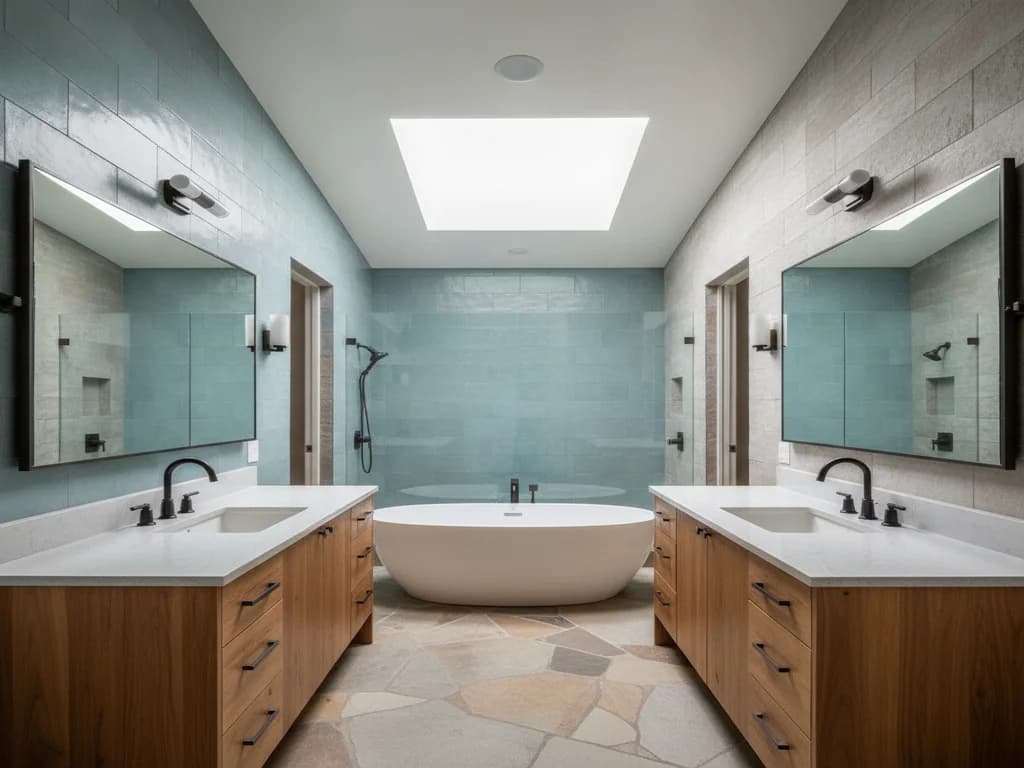
An interior bathroom — one with no exterior wall, or an exterior wall a window would just look onto a neighbor's fence — has exactly one path to real daylight: through the roof. Two products do that: a skylight, which is essentially a window built into the roof, and a solar tube (also called a tubular skylight or sun tunnel), which captures light on the roof and pipes it down through a reflective tube to a small ceiling fixture.
This Old House frames the category in three types: fixed skylights ("ideal for bringing light to areas without ventilation"), tubular skylights ("also known as sun tunnels, these are excellent for smaller spaces or areas where traditional skylights aren't feasible"), and venting skylights ("you can open these skylights to allow fresh air circulation, making them perfect for kitchens and bathrooms"). A bathroom is a candidate for any of the three — the right pick depends on room size, budget, and whether you want the skylight itself to help with ventilation or leave that job entirely to the exhaust fan.
The one-line version
A full skylight lets in more light and can vent if it opens; a solar tube is cheaper, faster to install, and sized for exactly the kind of small, windowless bathroom this decision usually comes up for.
What a solar tube actually delivers
Solatube's sizing guide gives a concrete sense of scale: the 10-inch 160 DS model covers roughly 150–200 sq. ft. and is the size the manufacturer specifically recommends for "bathrooms, laundry rooms, closets, hallways." The 14-inch 290 DS steps up to 250–300 sq. ft. and is positioned for "kitchens and family rooms" as well as "master bathrooms" — the larger diameter capturing and piping down roughly twice the light of the 10-inch tube. A 21-inch model exists for larger rooms still, but for a standard secondary bathroom, the 10-inch tube is the one the sizing guide points to.
VELUX makes the same case from its Sun Tunnel line: the product is built to bring daylight to "hard-to-reach spaces like hallways, closets, and bathrooms," is "designed to fit in the ceiling like a recessed light," and — per VELUX — installs "in an afternoon." VELUX prices a typical single-unit Sun Tunnel installation at $880 to $2,280, and backs it with a 10-year warranty on installation, materials, and workmanship.
What a solar tube doesn't give you is a view or an opening for fresh air — it's a light delivery system, not a window. That tradeoff is exactly why This Old House recommends it for "smaller spaces or areas where traditional skylights aren't feasible," rather than as a straight substitute everywhere a full skylight would work.
| Model | Diameter | Coverage | Best for |
|---|---|---|---|
| 160 DS | 10 in. | 150–200 sq. ft. | Bathrooms, laundry rooms, closets, hallways |
| 290 DS | 14 in. | 250–300 sq. ft. | Kitchens, family rooms, master bathrooms |
| 290 DS Plus | 21 in. opening | 275–350 sq. ft. | Large kitchens, oversized family rooms |
Coverage figures and room recommendations per Solatube's residential product literature; actual light delivered varies with roof orientation, tube length, and local weather.
What a full skylight adds — and what it asks for in return
A skylight is a larger, more architectural commitment than a solar tube: a real piece of glazing set into the roof structure, sized as a design element rather than a light-delivery pipe. This Old House's buying guide puts a practical limit on that ambition — skylights should make up "no more than 5% of floor area in naturally bright rooms or up to 15% in spaces lacking windows" — and it flags a placement mistake worth avoiding in a bathroom specifically: centering a skylight over open floor means "light simply spills straight down to the floor, and little of it reaches the rest of the space," where positioning it toward the back wall lets light bounce and spread more evenly.
Installation is also a bigger job. This Old House's guidance on skylight installation is direct that "proper flashing is the single most critical element in a leak-free skylight installation," and that before cutting into the roof, it's worth checking "if any electrical wiring, plumbing, or HVAC components... may need to be relocated," consulting a structural engineer if the roof framing needs reinforcement. A solar tube's small ceiling-diameter opening avoids most of that; a full skylight doesn't.

The condensation question, honestly
Condensation is the real risk either fixture introduces into a bathroom, and it's worth taking seriously rather than assuming a skylight solves it. This Old House traces the classic failure mode: "early skylights were notoriously leaky, and, due to their single glazing, often had problems with interior condensation" — a problem modern double- or triple-pane insulating glass with heat-reflective coatings has largely resolved on the glazing side. But glazing only addresses the glass itself; the room still generates the moisture.
That's where This Old House's bathroom-specific guidance matters: a bathroom skylight needs "adequate ventilation so condensation doesn't become a problem," and a venting model specifically can "reduce moisture and prevent mold growth (if venting)" — the parenthetical doing real work, since a fixed skylight or a solar tube doesn't vent at all. More broadly, condensation forms — as one home-improvement source puts it — because warm, moisture-laden air from "cooking, showering, and even breathing" meets a cool surface; the fix in any room is "using an exhaust fan to send some of that excess moisture outside," which is exactly the job description of a bathroom exhaust fan. Our bathroom ventilation tips guide covers fan sizing and habits in more depth — a skylight or solar tube adds light, but the exhaust fan is still what keeps that light source from fogging or dripping.
Where light meets privacy, and where it meets the rest of the design
A skylight or solar tube changes the light plan without changing the window-privacy conversation at all — if the bathroom also has a wall window, that window's privacy treatment is decided independently. Our bathroom window privacy ideas roundup covers frosted glass, high transoms, and window film for that separate question. And because a roof-mounted light source changes when and how much daylight a room gets through the day, it's worth planning it alongside the rest of the fixture lighting rather than as an afterthought — our bathroom lighting layers guide walks through building a full layout (ambient, task, accent) that a skylight or solar tube becomes one layer within, rather than a replacement for the others.
The bottom line
For a small, windowless secondary bathroom, a solar tube is usually the pragmatic choice — Solatube's own sizing puts the 10-inch model squarely in that room's wheelhouse, VELUX prices a comparable Sun Tunnel install at well under what a structural skylight typically runs, and neither requires reworking the roof framing. A full skylight earns its higher cost and complexity in a primary suite where the goal is a design statement and, if it vents, a second source of fresh air. Either way, the exhaust fan doesn't become optional — that's the piece doing the actual condensation-control work.
If you're weighing a skylight or solar tube as part of a larger primary bath plan, see how we build master bathroom retreats — daylighting gets planned alongside layout, ventilation, and the rest of the fixture plan from the start, not bolted on after the fact.
Ready to plan your Boise bathroom?
Licensed & insured · 3-year workmanship warranty
Frequently asked questions
- What size solar tube does a bathroom need?
- For most bathrooms, a 10-inch tube is the size manufacturers recommend. Solatube specifically pitches its 10-inch 160 DS model — covering roughly 150–200 sq. ft. — for "bathrooms, laundry rooms, closets, hallways." A larger primary bath might call for the 14-inch model instead, which covers 250–300 sq. ft.
- Do skylights cause condensation problems in bathrooms?
- They can, if ventilation isn't addressed alongside them. This Old House notes bathrooms need "adequate ventilation so condensation doesn't become a problem," and recommends a venting skylight where possible since it can "reduce moisture and prevent mold growth (if venting)." Modern insulated glazing has mostly solved the old single-pane condensation problem on the glass itself, but the room still needs an exhaust fan to clear the moisture that causes it.
- How much does a solar tube cost to install in a bathroom?
- VELUX prices a typical single-unit Sun Tunnel installation at $880 to $2,280, with the range driven by ceiling type, roof material, and tube run length. Solatube's own installation claim is that the job takes about two hours with "no modifications to your home" for a standard install.
Sources
- This Old House — What To Consider When Buying Skylights
- Solatube — Tubular Skylights (manufacturer)
- VELUX — Sun Tunnel Skylights (manufacturer)
- Bob Vila — Condensation on Windows: Why It Happens, and What to Do About It
- This Old House — How To Install a Skylight
- EPA — A Brief Guide to Mold, Moisture and Your Home
- DOE Building America Solution Center — Bathroom Exhaust Fans
Claims and figures are drawn from the sources above and provided for general guidance; your project may vary. Photography is illustrative of design concepts. For a fixed price on your specific bathroom, request a free estimate.