Updated June 30, 2026 · 9 min read
By Boise Bath — bathroom & shower remodeling in Boise & the Treasure Valley
The short answer
The costliest bathroom waterproofing mistakes are assuming tile and grout are waterproof, skipping the membrane, building a pan with no pre-slope, leaving pipe and niche penetrations unsealed, using a drain that doesn’t integrate with the membrane, and never running a flood test. Each is invisible once tiled — which is why catching the red flags early matters.
Key takeaways
- Tile and grout are not waterproof — the membrane behind them is the actual barrier, and skipping it is the #1 failure.
- A shower pan needs a pre-slope under the liner; without it, water pools and rots the assembly.
- Unsealed penetrations and untreated corners and seams are where most leaks actually start.
- A flood test before tiling is cheap insurance; skipping it hides a defect until it’s a tear-out.
- Red flags — musty smell, loose tile, efflorescence, soft floors — mean stop and investigate, not re-grout.
Why do bathroom waterproofing failures get so expensive?
Waterproofing is the most important part of a shower that nobody can see. When it is done right, water that gets past the tile and grout is caught by a hidden membrane and steered to the drain. When it is done wrong, that water disappears into the wall cavity, the subfloor, and the framing — quietly, for months or years — until the damage is structural and the only fix is a full tear-out.
That invisibility is exactly what makes these mistakes so costly. A homeowner cannot inspect a finished shower the way they would inspect paint or trim, and a corner cut behind the tile looks identical to a corner done right on day one. So this guide takes a different approach from a how-to: instead of teaching the method (we cover that in our shower waterproofing guide), it catalogs the 17 most common mistakes and pairs each with the visible red flag it eventually produces and the right question to ask a contractor — turning an invisible trade into something you can actually audit.
How to use this list
If you’re vetting a bid, use the "question to ask" in each item to separate pros who detail the hidden layer from those who only talk about tile. If you’re diagnosing an existing shower, match your symptom to the red flags — and resist the urge to just re-grout over a deeper problem.
Are tile and grout actually waterproof?
No — and this single misconception causes more failures than any other. Tile is water-resistant, but grout is porous and absorbs water, and the joints, corners, and changes of plane all move and crack over time. Water passes through a tiled surface routinely. In a correctly built shower, that water hits a continuous waterproofing membrane behind or under the tile and drains away harmlessly. The tile is the wear surface; the membrane is the barrier.
Once you accept that, the rest of this list makes sense: nearly every mistake is a failure of the actual barrier — missing it, breaking it at a penetration, or building it so water cannot escape.
What substrate and membrane mistakes cause leaks?
1. Using drywall or green board in the wet zone. Standard drywall — even moisture-resistant "green board" — is not rated as a waterproofing substrate inside a shower. It eventually turns to mush behind the tile. Wet areas need a proper backer board paired with a waterproofing system. *Red flag: soft or bulging walls, tile that sounds hollow. Ask: "What substrate and waterproofing system are you using behind the tile?"*
2. Skipping the waterproofing membrane entirely. The most common and most expensive miss: tiling directly over backer board with no membrane, trusting the tile and grout to keep water out. They won’t. *Red flag: persistent dampness, mold returning after cleaning. Ask: "Is the membrane sheet-applied or liquid-applied, and is it continuous?"*
3. Pairing incompatible board and membrane systems. Manufacturers test their boards, membranes, and drains as a system. Mixing a foam board from one system with a drain from another can void the performance and leave gaps the installer assumes are covered. *Red flag: hard to see — this is a question to ask. Ask: "Are all the waterproofing components from a tested, compatible system?"*
What goes wrong with shower pans and slope?
4. Building a pan with no pre-slope. Under a traditional pan liner there must be a pre-slope — a layer that tilts toward the drain — so any water that reaches the liner runs to the weep holes instead of sitting in a flat puddle. Skip the pre-slope and water pools under the liner indefinitely, breeding mold and rotting the assembly from below. The TCNA Handbook details correct shower receptor assemblies for exactly this reason. *Red flag: lingering musty smell, efflorescence at the base. Ask: "How is the pre-slope built under the pan liner?"*
5. Improper slope to the drain. The finished floor must slope evenly to the drain (a common target is about 1/4 inch per foot). Too little slope — or low spots — and water ponds on the tile after every shower. *Red flag: standing water that doesn’t drain within a minute or two. Ask: "What slope are you setting the shower floor to?"*
Where do leaks start at penetrations and transitions?
6. Unsealed pipe, valve, and niche penetrations. Every place a pipe, valve, or recessed niche breaks the membrane is a potential leak. Each must be sealed with the system’s collars, banding, or sealant. Niches are a frequent culprit because they add several extra feet of seams. *Red flag: staining or dampness around the valve or below a niche. Ask: "How are the valve, pipe, and niche penetrations sealed?"*
7. Untreated corners, seams, and curbs. Inside and outside corners and the curb move and are the first places a membrane cracks. They need reinforcing banding or proper overlap, and the curb must be fully wrapped — not left as bare mortar. *Red flag: cracked grout or caulk concentrated in corners and at the curb. Ask: "How are the corners and the curb waterproofed?"*
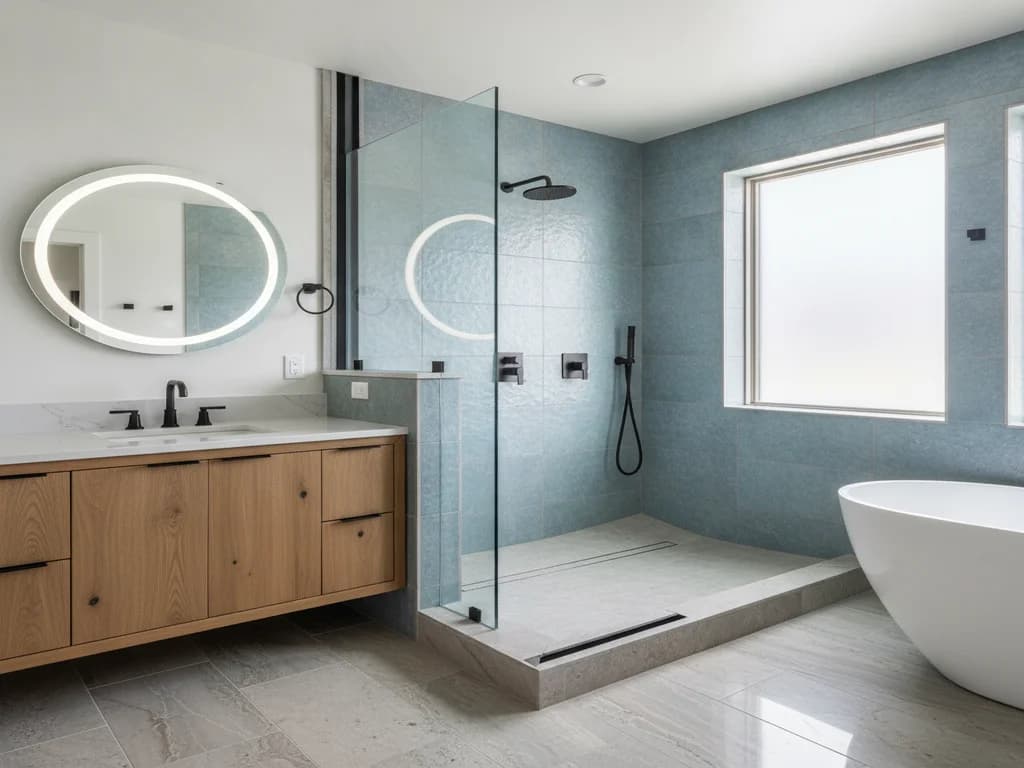
8. A poorly detailed curbless threshold. A curbless, barrier-free entry is a wonderful feature — but it is also the hardest transition to waterproof, because water can travel out toward the bathroom floor. It demands a linear drain and a carefully detailed, integrated membrane at the threshold. *Red flag: water creeping past the shower onto the bathroom floor. Ask: "How do you waterproof and contain a curbless entry?"*
Have a pro look before it’s a tear-out
If your shower is showing any of these red flags, the cheapest moment to act is now. Have a pro inspect or rebuild your shower — catching a penetration or pan failure early can mean a repair instead of a full demolition.
How do drain and membrane connections fail?
9. Using the wrong drain for the system. A clamping-ring (three-piece) drain is designed for traditional liner pans; a bonded-flange drain is designed for sheet-membrane systems. Using the wrong one means the membrane never actually ties into the drain, and water bypasses the whole assembly. *Red flag: leaks directly below the drain. Ask: "Is the drain matched to the membrane type — clamping ring or bonded flange?"*
10. Liner not integrated with the drain, or blocked weep holes. On a traditional pan, the liner must clamp into the drain and the weep holes must stay open (protected with gravel or a weep guard) so water in the mortar bed can escape. Thinset packed into the weep holes traps water permanently. *Red flag: chronic dampness with no obvious surface source. Ask: "How are the weep holes protected from being clogged?"*
Which process shortcuts cause failures?
11. Skipping the flood test. Before any tile goes down, the finished waterproofing should be flood-tested — the drain is plugged, the pan is filled with water to the curb, and it sits (often 24 hours) to confirm it holds. The TCNA Handbook and plumbing codes call for this test precisely because it catches a defect while it is still a cheap fix. Skipping it is the gamble that turns a small error into a tear-out. *Red flag: contractor can’t confirm a flood test was done. Ask: "Will you flood-test the pan before tiling, and can I see it?"*
12. Rushing cure times and the schedule. Liquid membranes need to fully cure before tile, and mortar and waterproofing have manufacturer wait times. Tiling over an uncured membrane traps solvents and compromises the bond. A rushed schedule is a common root cause behind early failures. *Red flag: an unusually fast timeline with no cure days. Ask: "What cure times are you allowing for the membrane before tiling?"*
What are the red flags of a failing shower?
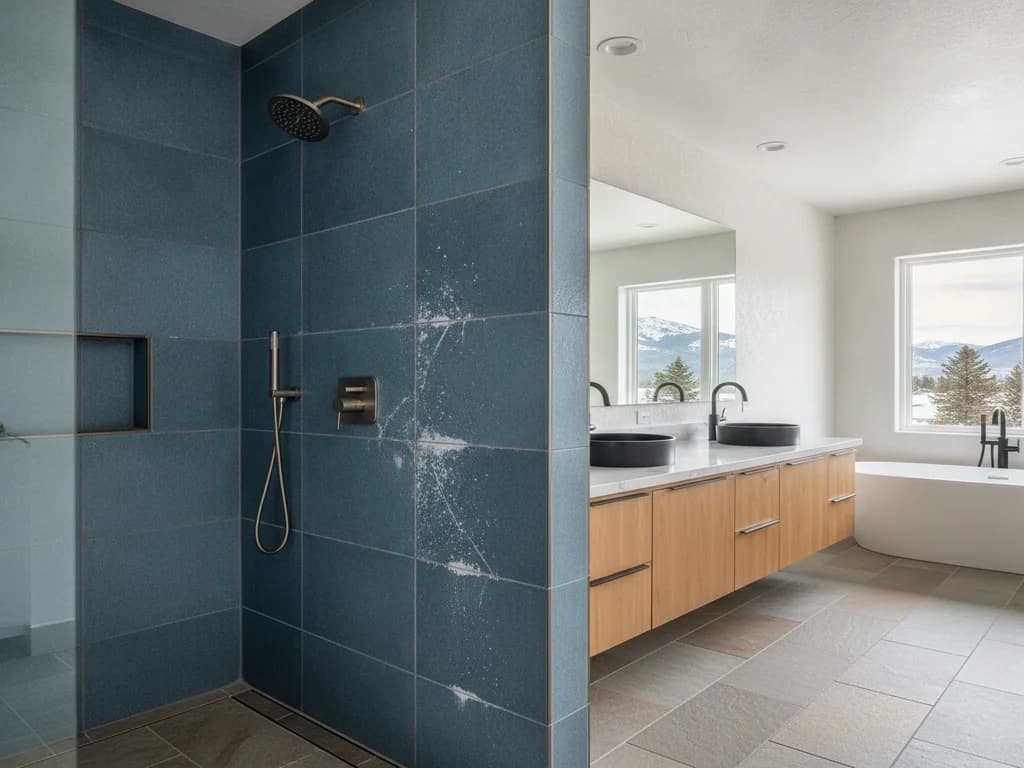
Even without opening a wall, your shower will tell you when waterproofing is failing. 13. A persistent musty or mildew odor that returns after cleaning means moisture is trapped somewhere it shouldn’t be. 14. Efflorescence — a white, chalky mineral residue at grout lines or the base — means water is moving through the assembly and evaporating at the surface. 15. Loose, cracked, or hollow-sounding tile signals the substrate behind it is wet or deteriorating. 16. A soft or spongy subfloor at the shower threshold means rot has already reached the framing. 17. Ceiling stains in the room below a second-floor bath are often the first visible sign of a long-running shower leak.
Any of these means stop and investigate — not re-grout or re-caulk over the symptom. Re-grouting a shower that is failing behind the tile only hides the problem while the damage spreads. This article owns the diagnostic side; for the broader project pitfalls beyond waterproofing, see the broader list of remodeling mistakes.
What Boise conditions make waterproofing failures worse?
A few Treasure Valley factors accelerate or mask these failures. Our moderately hard water leaves heavy mineral deposits, and that buildup — plus the efflorescence it feeds — can disguise a slow leak as "just hard-water residue," delaying the diagnosis until the damage is severe.
Idaho winters add freeze-thaw stress, which is hardest on showers built against exterior walls: moisture that penetrates the assembly can freeze, expand, and crack the waterproofing further. And many older Boise homes in the North End and the Bench have aging subfloors and prior, poorly done retrofits — a shower rebuilt twenty years ago over an already-compromised floor is a common find across Meridian and Nampa too. When you open up an old shower here, you often inherit yesterday’s mistakes.
A waterproofing red-flag checklist
Use this recap to connect each mistake to the symptom it produces and the question that exposes it before you sign a contract. If a shower is failing, a properly built custom shower rebuilt to the standards above is usually the durable fix; for the budget side, see what a shower rebuild costs in Boise.
| Mistake | Red flag | Question to ask |
|---|---|---|
| Drywall/green board in wet zone | Soft walls, hollow tile | “What substrate and waterproofing system?” |
| No membrane at all | Recurring mold, dampness | “Is the membrane continuous?” |
| Incompatible board + membrane | Hidden — ask only | “Are all components a tested system?” |
| No pre-slope under liner | Musty smell, base efflorescence | “How is the pre-slope built?” |
| Improper slope to drain | Standing water | “What floor slope are you setting?” |
| Unsealed penetrations | Staining at valve/niche | “How are penetrations sealed?” |
| Untreated corners/curb | Corner & curb cracking | “How are corners and the curb waterproofed?” |
| Bad curbless threshold | Water escaping the shower | “How do you contain a curbless entry?” |
| Wrong drain for system | Leaks below the drain | “Is the drain matched to the membrane?” |
| Liner/weep holes blocked | Chronic dampness | “How are weep holes protected?” |
| Skipped flood test | No proof of test | “Will you flood-test before tiling?” |
| Rushed cure times | Very fast timeline | “What cure times before tiling?” |
| Musty odor | Returns after cleaning | Investigate, don’t re-grout |
| Efflorescence | White chalky residue | Investigate, don’t re-grout |
| Loose/hollow tile | Tile moves or sounds hollow | Investigate the substrate |
| Soft subfloor | Spongy floor at threshold | Check framing for rot |
| Ceiling stains below | Stains under a 2nd-floor bath | Trace the shower leak |
Red flags indicate likely problems but are not a diagnosis; a professional inspection confirms the cause.
Ready to plan your Boise bathroom?
Licensed & insured · 3-year workmanship warranty
Frequently asked questions
- What is the most common bathroom waterproofing mistake?
- Skipping the waterproofing membrane entirely — tiling directly over backer board and trusting the tile and grout to keep water out. They can’t. The membrane behind or under the tile is the real barrier; without it, water seeps into the wall cavity and subfloor, leading to hidden rot and an eventual full tear-out.
- Are tile and grout waterproof?
- No. Tile is water-resistant but grout is porous and absorbs water, and the joints and corners crack over time. Water routinely passes through a tiled surface. A correctly built shower relies on a continuous waterproofing membrane behind the tile to catch that water and drain it away — the tile is just the wear surface.
- What is a pre-slope and why does a shower need one?
- A pre-slope is a sloped layer built under a traditional shower pan liner so any water that reaches the liner runs toward the drain’s weep holes instead of pooling. Without a pre-slope, water sits flat under the liner indefinitely, breeding mold and rotting the assembly from below — a common, costly failure.
- What is a shower flood test?
- A flood test confirms the waterproofing holds before tile is installed: the drain is plugged, the pan is filled with water to the curb, and it sits — often 24 hours — to verify it doesn’t leak. The TCNA Handbook and plumbing codes call for it because it catches defects while they are still a cheap fix.
- What are the signs of a leaking shower?
- Watch for a persistent musty odor that returns after cleaning, white chalky efflorescence at grout lines, loose or hollow-sounding tile, a soft or spongy subfloor at the threshold, and ceiling stains in the room below. Any of these means stop and investigate the waterproofing — don’t just re-grout over the symptom.
- Why do older Boise showers fail at the pan?
- Many older North End and Bench homes have aging subfloors and prior, poorly done retrofits — sometimes a shower rebuilt over an already-compromised floor with no pre-slope or membrane. Hard-water mineral buildup can mask the slow leak for years, and freeze-thaw stress on exterior-wall showers accelerates cracking until the failure is severe.
Sources
- Tile Council of North America (TCNA) — TCNA Handbook
- Schluter Systems — bonded waterproofing membrane & drain install guidance
- International Code Council — IRC/IPC shower receptor & water-test requirements
- Tile Council of North America — Handbook for Ceramic, Glass & Stone Tile Installation
- EPA — A Brief Guide to Mold, Moisture and Your Home
Claims and figures are drawn from the sources above and provided for general guidance; your project may vary. Photography is illustrative of design concepts. For a fixed price on your specific bathroom, request a free estimate.