Updated July 6, 2026 · 8 min read
By Boise Bath — bathroom & shower remodeling in Boise & the Treasure Valley
The short answer
Frameless shower glass runs 3/8" or 1/2" thick because it has to stand on its own without a frame; 3/8" suits most installations, while 1/2" adds break-resistance, weight, and cost. Framed or track-supported sliding doors can use much lighter 1/4" glass, since hardware — not the glass itself — carries the structural load.
Key takeaways
- A standard 30"×72" shower door panel weighs roughly 45 lb at 1/4" thickness, 74 lb at 3/8", and 97 lb at 1/2", based on float glass's approximate 2.99, 4.91, and 6.46 lb-per-square-foot weights.
- Bob Vila notes 3/8" glass "is sufficient for the majority of frameless installations," while "some bathrooms may not meet the structural needs of a large 1/2-inch-thick glass door."
- Kohler's own Levity sliding shower door spec sheet lists 1/4"-thick glass on a door marketed as "frameless" — because it rides in a roller and track system that bears the load, unlike a true self-supporting hinged panel.
- This Old House prices the 1/2" upgrade over 3/8" at an added $15–$58 per square foot — weight and break-resistance, not looks, are what that money buys.
- CRL sells shower door hardware — hinges, clamps, and U-channels — matched to a specific glass thickness, which is why swapping thickness after ordering hardware isn't a simple substitution.
This is about the physics, not the cost or the style
Our shower glass cost factors article covers what thickness (among eight other things) adds to your bid, and our shower glass enclosure guide covers framed vs. semi-frameless vs. frameless as a style decision. This article is neither of those — it's a plain look at what glass thickness actually does structurally, so you know what you're really choosing between when a quote says "3/8" or "1/2"."
The short version: thickness is about whether the glass itself has to hold itself up, or whether hardware is doing that job for it. Everything else — weight, hinge count, cost — follows from that one distinction.
The three thicknesses, and what each one actually weighs
Shower glass generally comes in three thicknesses: 1/4" (6mm), 3/8" (10mm), and 1/2" (12mm). Float glass weighs approximately 2.99 lb per square foot at 1/4", 4.91 lb per square foot at 3/8", and 6.46 lb per square foot at 1/2" — real numbers, not estimates, and they compound fast once you apply them to an actual door.
Take a standard 30"×72" shower door panel — 15 square feet. At 1/4" thick, that panel weighs roughly 45 lb. At 3/8", roughly 74 lb. At 1/2", roughly 97 lb. That is more than double the weight between the thinnest and thickest option on the exact same size of glass — and every pound of it has to be held up by whatever is supporting the panel.
| Thickness | Approx. weight | Approx. weight, 30"×72" panel | Typical use |
|---|---|---|---|
| 1/4" (6mm) | ~2.99 lb/sq ft | ~45 lb | Framed doors; track-supported sliding doors marketed as "frameless" |
| 3/8" (10mm) | ~4.91 lb/sq ft | ~74 lb | Standard for most true frameless, hinged installations |
| 1/2" (12mm) | ~6.46 lb/sq ft | ~97 lb | Larger or more open frameless designs prioritizing a heavier, more substantial feel |
Weight figures are approximate, based on standard float glass weight per square foot. Panel weight is calculated for a common 30"×72" (15 sq ft) shower door size and will scale with actual panel dimensions.
Why fully frameless glass has to be thick
A frameless shower door has no metal perimeter holding the panel rigid — the hinges and clamps grip the glass edge directly, and the glass itself is the only thing keeping the panel flat, square, and structurally sound under the daily stress of opening, closing, and the occasional bump. Bob Vila's guidance on frameless doors is direct about the consequence: thinner glass flexes and is more prone to breaking under that kind of unsupported use, which is exactly why frameless doors run thicker than framed ones in the first place.
That is the whole reason 3/8" and 1/2" exist as the standard frameless range, and it is also why a true frameless panel can never be spec'd as thin as 1/4" — there is nothing else in the system to compensate for the flex.
When 1/4" glass is genuinely fine — the track-supported exception
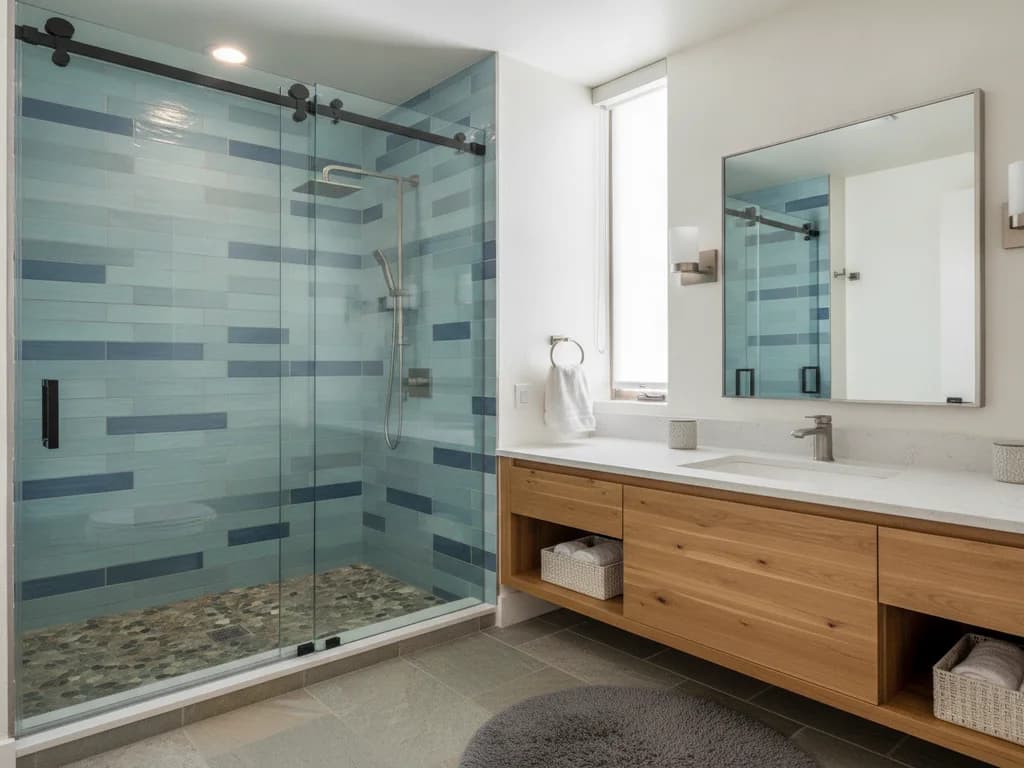
Here is the detail that trips people up: some doors marketed as "frameless" still use thin 1/4" glass, and it is not a contradiction. Kohler's own Levity® sliding shower door spec sheet lists it plainly — "Frameless, 1/4-inch-thick Frosted tempered glass" — on a door that rides on an "innovative roller design" along a top track. The word "frameless" here refers to the absence of a visible metal perimeter around the glass itself, not the absence of structural support: the roller and track system is carrying the weight and holding the panel rigid, which is precisely the job a hinge has to ask the glass alone to do on a true frameless swinging door.
That is the honest exception to "thicker is always better": when a track, header, or full metal frame is doing the structural work, thin glass is not a compromise — it is the correct engineering choice, and it is also lighter, easier to handle, and less expensive. The mistake is assuming a genuinely unsupported, hinged frameless panel can get away with the same thickness. It cannot.
The one question that settles it
Ask whether the door hangs from a track/roller/full frame, or whether hinges and clamps grip the bare glass edge with nothing else holding it rigid. The first case can honestly use 1/4" glass. The second needs 3/8" or 1/2", no exceptions.
3/8" vs. 1/2": what the upgrade actually buys you
Bob Vila states plainly that 3/8" glass "is sufficient for the majority of frameless installations" and is "easier to ship and install" than the thicker option — which is exactly why it is the default most fabricators quote first. This Old House prices the step up to 1/2" glass at an added $15–$58 per square foot, and the reasons to pay it are narrow: marginally better break-resistance, and a heavier, more substantial feel that some homeowners want in a very large or fully open enclosure.
The honest trade-off is the added roughly 23 lb per panel (using the 30"×72" example above) that 1/2" carries over 3/8" — weight the hinges, wall blocking, and framing behind the tile all have to support for the life of the door. Bob Vila is explicit that "some bathrooms may not meet the structural needs of a large 1/2-inch-thick glass door," which is worth confirming with your installer before you spec the heavier glass on a whim.
Hardware is thickness-specific, not universal
Shower glass hardware is not a one-size-fits-all part. CRL (C.R. Laurence), a leading manufacturer of shower door hinges, clamps, and channel systems, sells hardware explicitly matched to a specific glass thickness — its U-channel line, for example, is manufactured and sold as a product built "for 3/8" Thick Glass," a distinct SKU from the equivalent 1/2" version. That is not a marketing distinction; the channel depth and clamp tolerance have to match the glass edge precisely, or the hardware will not grip correctly.
The practical implication: glass thickness is one of the first decisions in a frameless project, not a late-stage tweak. Changing your mind about thickness after hardware has been ordered typically means reordering the hardware too, not just the glass.
How to actually decide
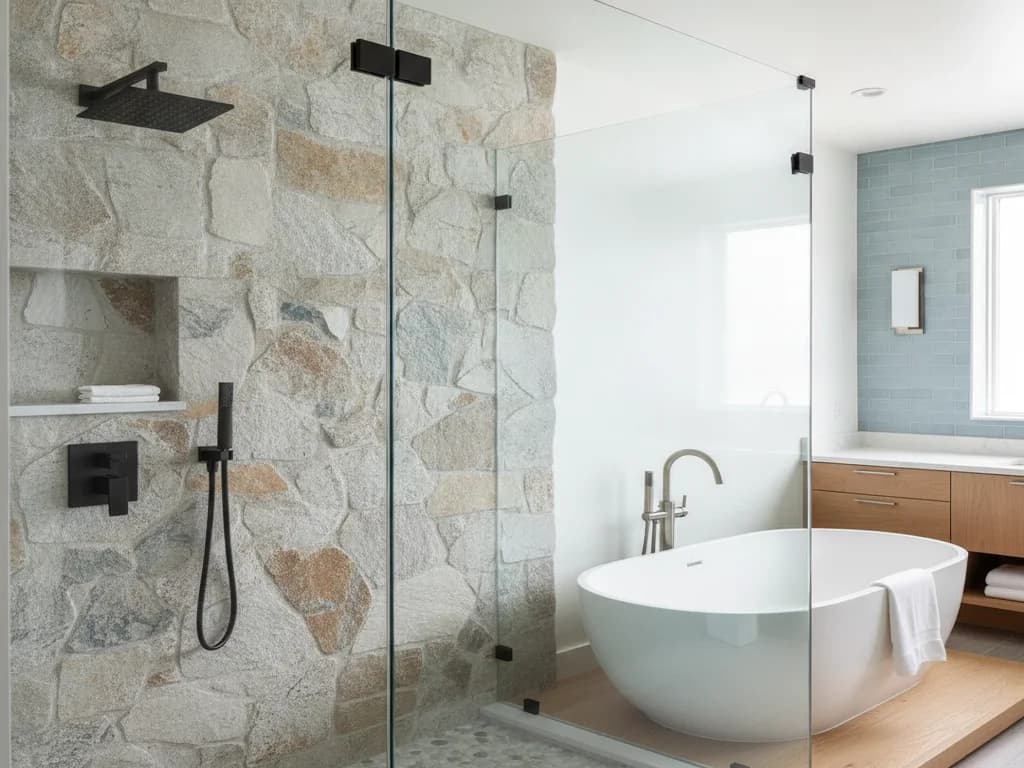
Pick 1/4" glass when the door is track-supported or fully framed — a sliding or bypass door with a header rail, or a traditional framed swing door — where hardware, not the glass, is doing the structural work. Pick 3/8" for the great majority of true frameless, hinged installations; it is the sufficient, easier-to-install, standard choice per Bob Vila. Reach for 1/2" only when you specifically want the heavier, more substantial feel on a large or fully open frameless design, and only after confirming your wall framing and hinge hardware can support the added weight.
Whichever you land on, this is a decision to make before ordering hardware, not after — see how we build walk-in showers with the right glass and hardware spec from the start.
The bottom line
Glass thickness is really a question about what is holding the panel up. Track and frame systems can honestly use thin, light 1/4" glass. True frameless, hinged panels cannot — they need 3/8" as the sufficient default, with 1/2" reserved for a specific look or an unusually large panel, at a real cost and weight premium. Get a fixed, itemized quote that specifies thickness explicitly, and confirm your installer has checked that your wall framing can carry whatever you choose.
Ready to plan your Boise bathroom?
Licensed & insured · 3-year workmanship warranty
Frequently asked questions
- Is 3/8" or 1/2" glass better for a frameless shower door?
- 3/8" is the better default for most installations — Bob Vila calls it "sufficient for the majority of frameless installations" and easier to ship and install. 1/2" adds real weight (roughly 97 lb vs. 74 lb on a standard 30"×72" panel) and cost (This Old House prices the upgrade at $15–$58 per square foot) for marginally better break-resistance and a heavier feel, worth it mainly on larger or fully open designs.
- Can shower glass be too thin?
- For a true frameless, hinged panel, yes — thin glass flexes and is more break-prone without a frame to hold it rigid, which is why 3/8" and 1/2" are the standard frameless range. But 1/4" glass is genuinely fine on doors where a track, roller, or full metal frame carries the structural load instead of the glass itself — Kohler's own Levity sliding door, marketed as "frameless," uses 1/4" glass for exactly this reason.
- Does thicker shower glass need different hardware?
- Yes. CRL, a major shower hardware manufacturer, sells hinges, clamps, and channel systems matched to a specific glass thickness — its U-channel products, for example, are sold as distinct items for 3/8" glass versus 1/2" glass. Channel depth and clamp tolerance have to match the glass edge, so thickness needs to be settled before hardware is ordered, not changed afterward.
Sources
- Bob Vila — Best Frameless Shower Doors
- This Old House — Shower Glass Door Installation Cost (2026)
- CRL (C.R. Laurence) — Frameless Shower Door Aluminum U-Channel for 3/8" Thick Glass (manufacturer)
- KOHLER — Levity® Frameless Sliding Shower Door Specification Sheet, K-706015-D3 (manufacturer)
- Glass Fab Inc. — Glass Weights and Metric Conversion Reference (manufacturer/fabricator)
Claims and figures are drawn from the sources above and provided for general guidance; your project may vary. Photography is illustrative of design concepts. For a fixed price on your specific bathroom, request a free estimate.