Updated June 30, 2026 · 9 min read
By Boise Bath — bathroom & shower remodeling in Boise & the Treasure Valley
The short answer
The biggest water savings come from WaterSense-labeled fixtures: a 1.28-gallon-per-flush toilet, a showerhead at or below 2.0 gpm, and faucet aerators at or below 1.5 gpm. Add LED lighting, an ENERGY STAR exhaust fan, and durable low-waste materials, and a Boise bathroom can cut water and energy use significantly.
Key takeaways
- WaterSense-labeled toilets, showerheads, and faucets are the fastest way to cut bathroom water use.
- Efficient showerheads save water and the energy used to heat it.
- LED lighting and ENERGY STAR fans reduce energy without sacrificing performance.
- Durable, long-lasting materials are inherently more sustainable — fewer redos, less waste.
- Conservation is locally meaningful in Idaho’s high-desert climate.
Why does a water-saving bathroom matter in Idaho?
Idaho is high desert. The Treasure Valley’s dry climate and seasonal demand make water conservation genuinely meaningful here, not just a feel-good gesture — and the bathroom is where a typical household uses the most water. Cutting that use lowers utility bills and eases pressure on the local supply, while efficient lighting and ventilation trim the energy side at the same time.
This article is a practical roundup of the ideas that actually move the needle, with savings figures attributed to the EPA, ENERGY STAR, and the Department of Energy. It deliberately leaves hard-water chemistry to the climate guide and ventilation sizing to the ventilation article — here, the goal is a greener, lower-bill bathroom and a clear sense of where to start.
Where the water goes
Toilets, showers, and faucets account for the lion’s share of bathroom water use. That is exactly why WaterSense-labeled versions of those three fixtures deliver the fastest, biggest savings.
What is WaterSense and how much does it save?
1. WaterSense is the EPA’s voluntary label for fixtures that are independently certified to use at least 20% less water than standard models while still performing well. The EPA estimates the average family can save thousands of gallons of water per year by choosing WaterSense-labeled products, with corresponding savings on water and energy bills. The label takes the guesswork out — if it carries the WaterSense mark, it has met the EPA’s efficiency and performance criteria.
Idea: a WaterSense or dual-flush toilet?
2. A WaterSense toilet uses 1.28 gallons per flush or less, compared with the 1.6 gpf federal standard and the 3.5+ gpf of older toilets — a substantial cut given how often a toilet is flushed. 3. A dual-flush model offers a reduced flush for liquid waste and a fuller flush for solids, trimming use further. Replacing an old, inefficient toilet is often the single highest-impact water move in a bathroom, per EPA WaterSense.
Idea: a low-flow showerhead that still feels good?
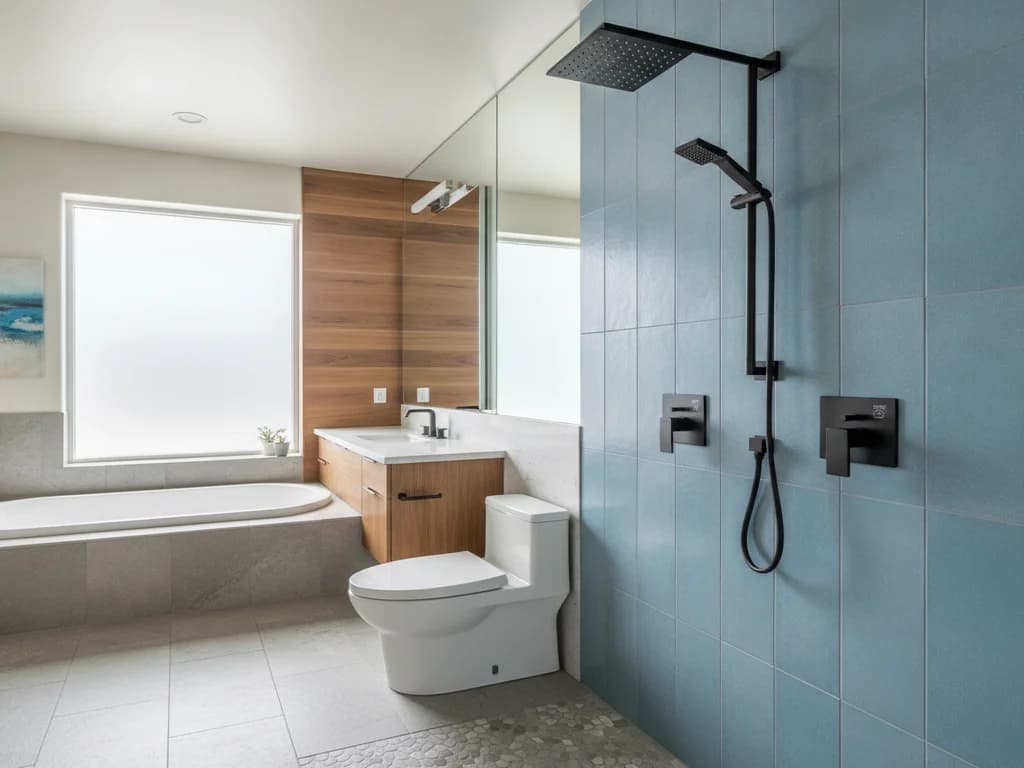
4. A WaterSense showerhead flows at 2.0 gpm or less versus the 2.5 gpm federal maximum, and modern pressure-compensating designs maintain a strong, satisfying spray at the lower flow. The old reputation of weak low-flow showers is outdated — today’s WaterSense heads are engineered to feel good while using less. The EPA notes meaningful annual water savings from this swap alone.
Idea: faucet aerators that cut water use?
5. A WaterSense bathroom faucet or aerator flows at 1.5 gpm or less, down from the 2.2 gpm standard, with no real loss in usability for handwashing and brushing teeth. An aerator is one of the cheapest, fastest upgrades you can make — often a few dollars and a few minutes — and it adds up across a household’s daily use.
Do water-saving fixtures also save energy?
6. Yes — hot water is the link. A large share of shower and faucet water is heated, so an efficient showerhead or aerator cuts both the water used and the energy used to heat it. The Department of Energy highlights efficient showerheads as a way to reduce water-heating costs, which are among the largest energy uses in a home. Saving water in the shower quietly saves energy too.
Idea: on-demand or recirculating hot water?
7. Cut the water wasted waiting for hot. If your shower or sink runs cold for many seconds before warming up, that water goes straight down the drain. On-demand recirculation or a well-placed water heater shortens that wait, reducing both wasted water and the small energy penalty of reheating standing pipe water. It is an idea-level upgrade worth raising with your contractor.
Idea: switch to LED bathroom lighting?
8. LED lighting uses a fraction of the energy of incandescent bulbs and lasts far longer, per ENERGY STAR, which means less energy and fewer replacements. In a bathroom, layered LED vanity and overhead lighting delivers excellent, flattering light at a fraction of the running cost. It is one of the simplest sustainability wins in the room.
Idea: an ENERGY STAR exhaust fan, right-sized?
9. An ENERGY STAR-rated exhaust fan moves air efficiently and quietly, using less energy than a standard fan while still clearing moisture. Right-sizing matters: an efficient fan that is correctly sized and not left running needlessly is both greener and better at preventing mold. For how to size and duct it properly, see right-sizing an efficient exhaust fan.
Idea: humidity sensors and smart controls?
10. Run equipment only when needed. A humidity-sensing fan switches on when humidity spikes and off when the air clears, so it never runs longer than necessary. Smart controls and occupancy sensors do the same for lighting. Automating run time saves energy while still protecting the bathroom from moisture — efficiency without having to think about it.
Idea: leak detection and smart shower timers?
11. Stop silent waste. A running toilet or a slow leak can waste a surprising amount of water unnoticed; the EPA flags household leaks as a major source of wasted water. Leak-detection devices and prompt repairs catch it early. 12. A smart shower timer gently nudges shorter showers, which is the simplest behavior-side saving of all.
Idea: durable, low-waste materials?
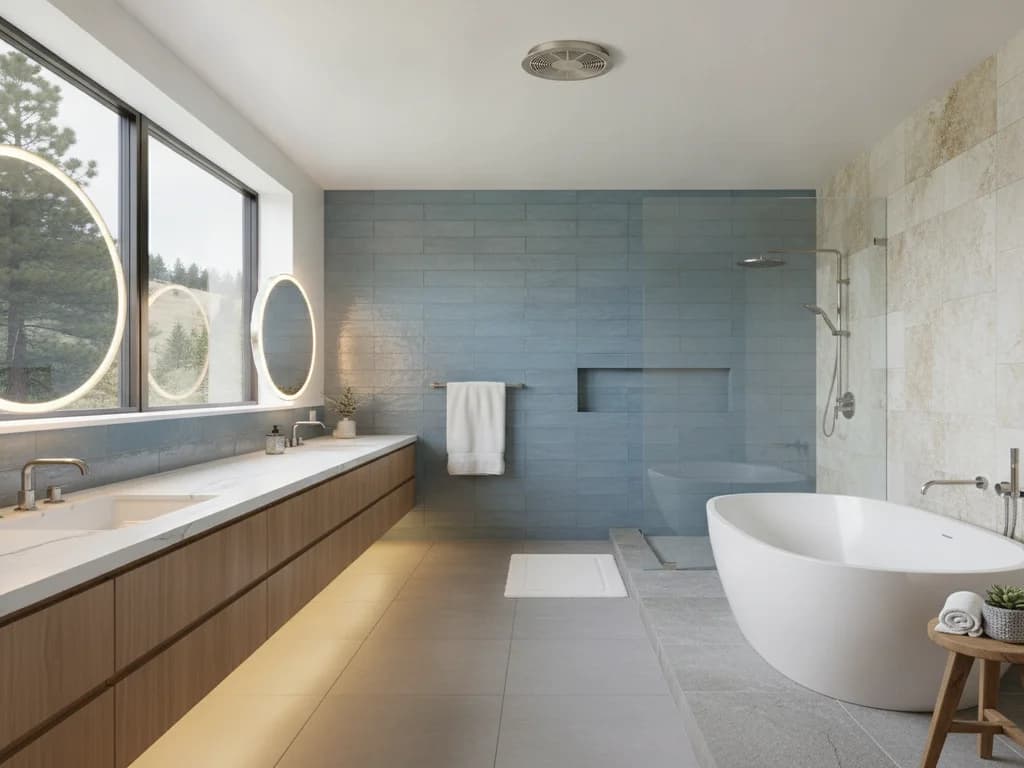
13. Longevity is sustainability. A bathroom finished in durable, long-lasting surfaces does not need to be redone in eight years, which avoids the waste of an early teardown. Non-porous, hard-wearing materials are the green choice precisely because they last. For which surfaces go the distance, see the most durable, low-waste materials.
Idea: low-VOC paint and recycled-content surfaces?
14. Healthier, greener materials. Low-VOC paints and finishes reduce indoor air pollutants, which the EPA flags as an indoor air-quality concern, and recycled-content tile and surfaces lower the embodied footprint of the remodel. These choices make a bathroom both more sustainable and healthier to be in, often at little or no premium.
Idea: refinish or repurpose instead of replacing?
15. Reuse where it makes sense. A solid cast iron tub can often be refinished rather than landfilled, and quality cabinetry can sometimes be refaced instead of replaced. Refinishing and repurposing keep usable materials out of the waste stream — the greenest material is frequently the one you already own. This pairs especially well with older Boise homes; see bathroom ideas for older Boise homes.
| Fixture | Standard maximum | WaterSense level |
|---|---|---|
| Toilet | 1.6 gallons per flush | 1.28 gallons per flush or less |
| Showerhead | 2.5 gallons per minute | 2.0 gallons per minute or less |
| Bathroom faucet / aerator | 2.2 gallons per minute | 1.5 gallons per minute or less |
Flow figures per EPA WaterSense product criteria; older fixtures may use considerably more.
How do these savings add up for a Boise household?
Stack the moves and the effect compounds: a WaterSense toilet, showerhead, and faucet cut the bulk of water use, efficient showerheads trim water-heating energy, and LED lighting plus an ENERGY STAR fan reduce the electric side. The EPA estimates a family can save thousands of gallons annually from WaterSense fixtures alone. For how these choices translate into project budgets and payback, see how much a Boise bathroom remodel costs.
Where should you start for the biggest impact?
If you do one thing, replace an old toilet with a WaterSense model — it usually delivers the largest single water saving. Then add a WaterSense showerhead and faucet aerators, switch to LED lighting, and right-size an efficient fan. Build the rest — durable materials, low-VOC finishes, smart controls — into a full bathroom remodel with efficient fixtures. When you are ready to plan it, request a free estimate.
Ready to plan your Boise bathroom?
Licensed & insured · 3-year workmanship warranty
Frequently asked questions
- What is the most effective way to save water in a bathroom?
- Replacing an old toilet with a WaterSense model (1.28 gallons per flush or less) usually delivers the largest single saving, since toilets account for a major share of household water use. Adding a WaterSense showerhead and faucet aerators captures most of the rest.
- What does the WaterSense label mean?
- WaterSense is the EPA’s voluntary label for fixtures independently certified to use at least 20% less water than standard models while still performing well. If a toilet, showerhead, or faucet carries the WaterSense mark, it has met the EPA’s efficiency and performance criteria.
- How many gallons per flush does a water-saving toilet use?
- A WaterSense toilet uses 1.28 gallons per flush or less, compared with the 1.6 gpf federal standard and the 3.5+ gpf of many older toilets. Dual-flush models add a reduced flush for liquid waste to save even more, per EPA WaterSense.
- Do low-flow showerheads still have good pressure?
- Yes. Modern WaterSense showerheads (2.0 gpm or less) use pressure-compensating designs to maintain a strong, satisfying spray at the lower flow. The old reputation of weak low-flow showers is outdated — today’s models are engineered to feel good while using less water.
- Do water-saving fixtures also lower energy bills?
- Yes, because much of the water used in showers and at faucets is heated. An efficient showerhead or aerator cuts both the water used and the energy to heat it. The Department of Energy highlights efficient showerheads as a way to reduce water-heating costs, a major home energy use.
- Are durable materials more eco-friendly?
- Yes. Durable, long-lasting surfaces mean the bathroom does not need an early teardown and rebuild, which avoids material waste. Non-porous, hard-wearing materials are the sustainable choice precisely because they last — fewer redos over the home’s life means less waste overall.
Sources
- EPA WaterSense — bathroom faucets, showerheads & toilets
- ENERGY STAR — ventilation fans & lighting efficiency
- U.S. Department of Energy — efficient showerheads
- EPA — indoor air quality & low-VOC guidance
Claims and figures are drawn from the sources above and provided for general guidance; your project may vary. Photography is illustrative of design concepts. For a fixed price on your specific bathroom, request a free estimate.