Updated July 16, 2026 · 7 min read
By Boise Bath — bathroom & shower remodeling in Boise & the Treasure Valley
The short answer
A windowless bathroom needs a mechanical exhaust fan — building code requires one — sized at roughly 1 CFM per square foot (50 CFM minimum, per HVI guidance), ducted to the outdoors, never the attic, and run for about 20 minutes after every shower. A humidity-sensing switch automates the runtime, which is where most setups fail.
Key takeaways
- No window means the exhaust fan is the bathroom's only moisture exit — code requires mechanical ventilation in bathrooms without an operable window.
- Size the fan at roughly 1 CFM per square foot with a 50 CFM floor, per Home Ventilating Institute guidance; larger bathrooms and enclosed toilet rooms need more.
- The duct must terminate outdoors. Venting into the attic relocates the moisture problem into your framing and insulation.
- Runtime matters more than fan size: about 20 minutes after each shower clears lingering humidity, and almost nobody does it manually — a humidity-sensing or timer switch does.
- A fan that is quiet gets used; loud fans get switched off, which is why sone ratings are a performance spec, not a comfort spec.
- Persistent condensation, peeling paint, or mildew in a fan-equipped bathroom means the system is failing at sizing, ducting, or runtime — and it is diagnosable.
Why a windowless bathroom is a special case
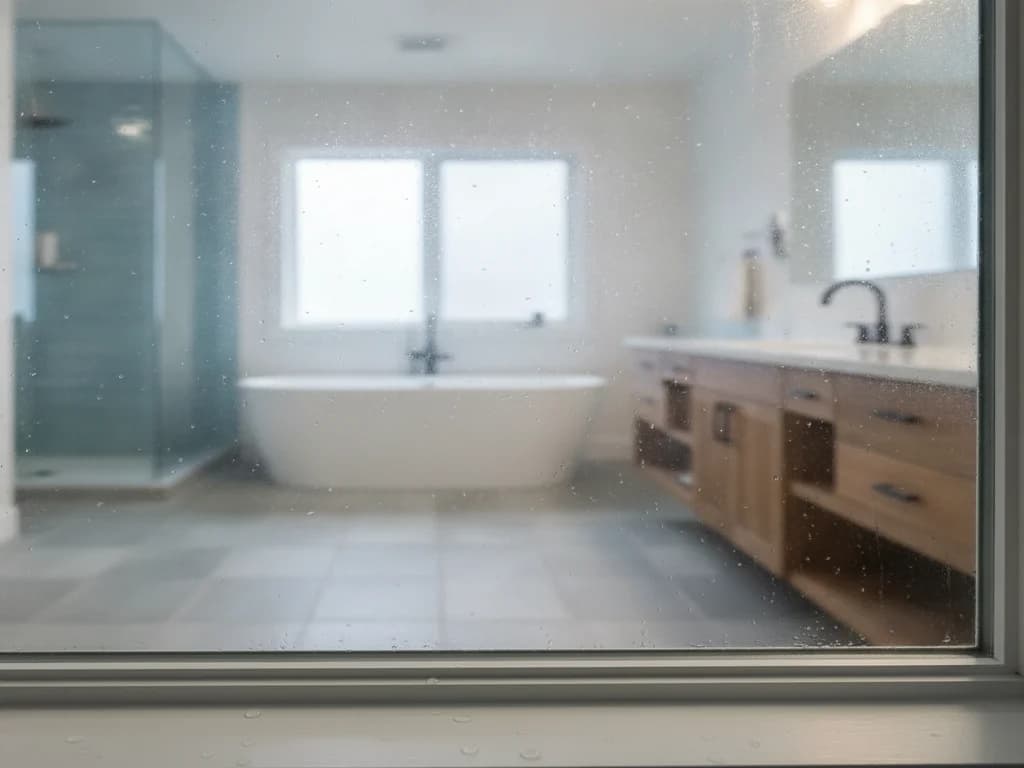
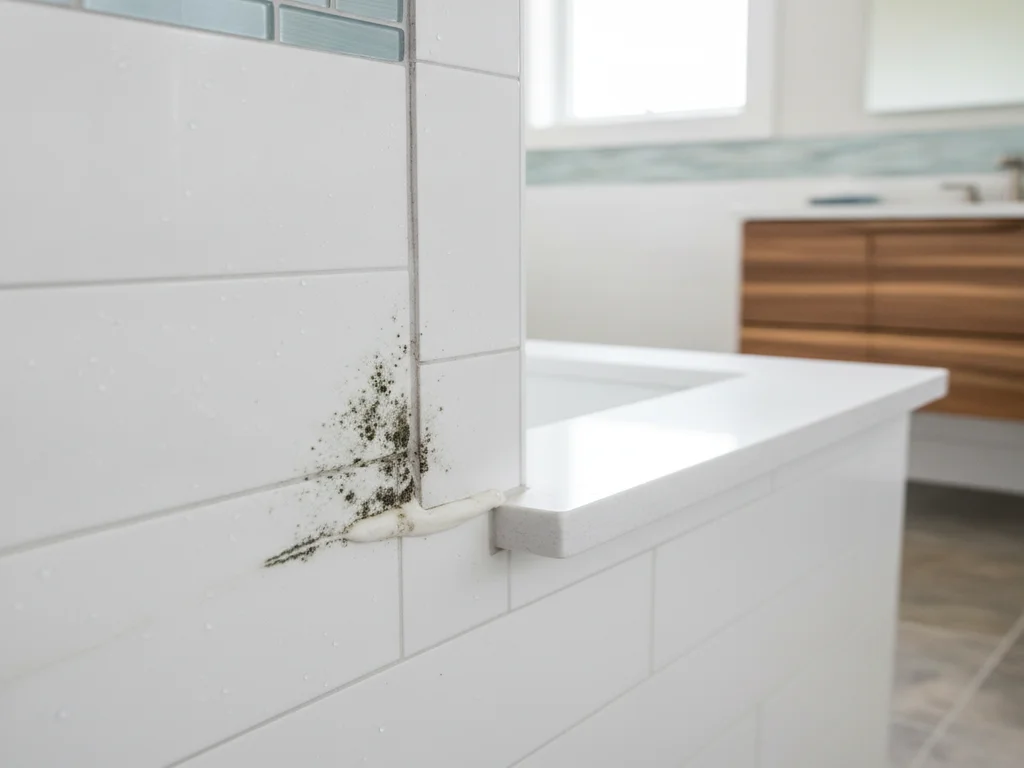
Every shower dumps a surprising amount of water into the air, and that vapor has to go somewhere. In a bathroom with a window, opening it is a crude but real escape route. In a windowless bathroom — the interior hall baths, basement bathrooms, and primary-suite additions common in Treasure Valley homes — there is no passive exit at all. Whatever the fan does not remove condenses on the coolest surfaces: mirrors first, then walls, ceiling paint, and the hidden framing behind them.
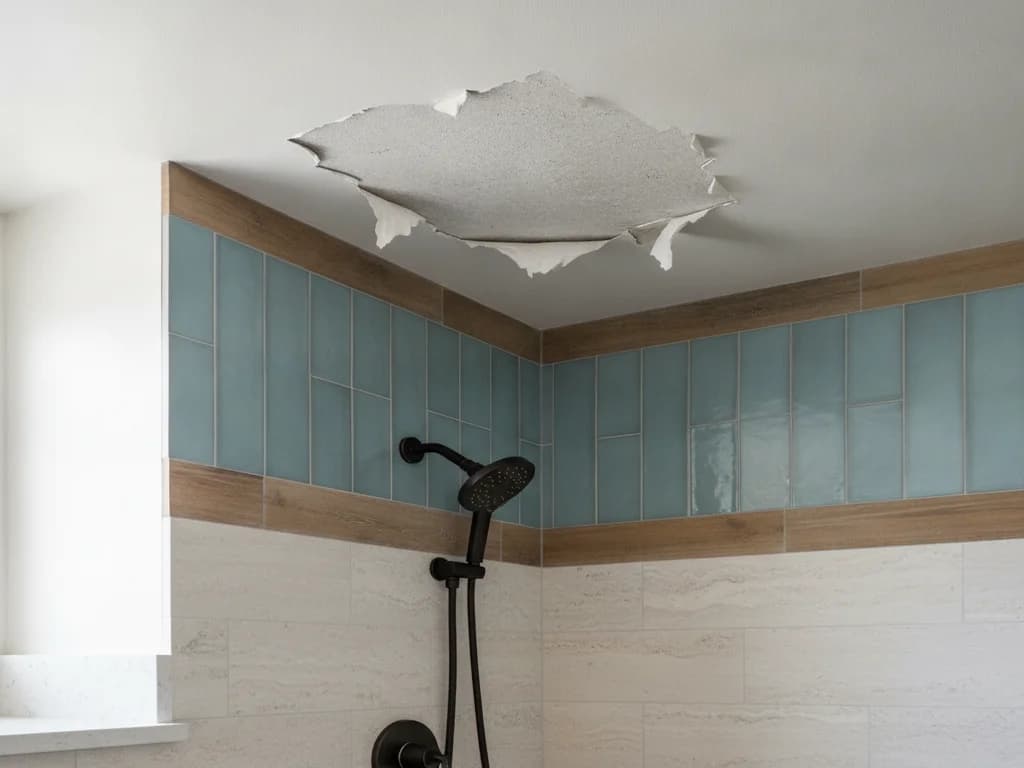
Building code treats it the same way: the International Residential Code requires bathrooms to have either an operable window or mechanical exhaust ventilation, and for a windowless bathroom that means a fan is not an upgrade — it is the legally required ventilation system. The stakes are cumulative rather than dramatic. A season of under-ventilation shows up as fogged mirrors and musty smell; a few years of it shows up as peeling paint, chronic mildew, and moisture damage in the ceiling.
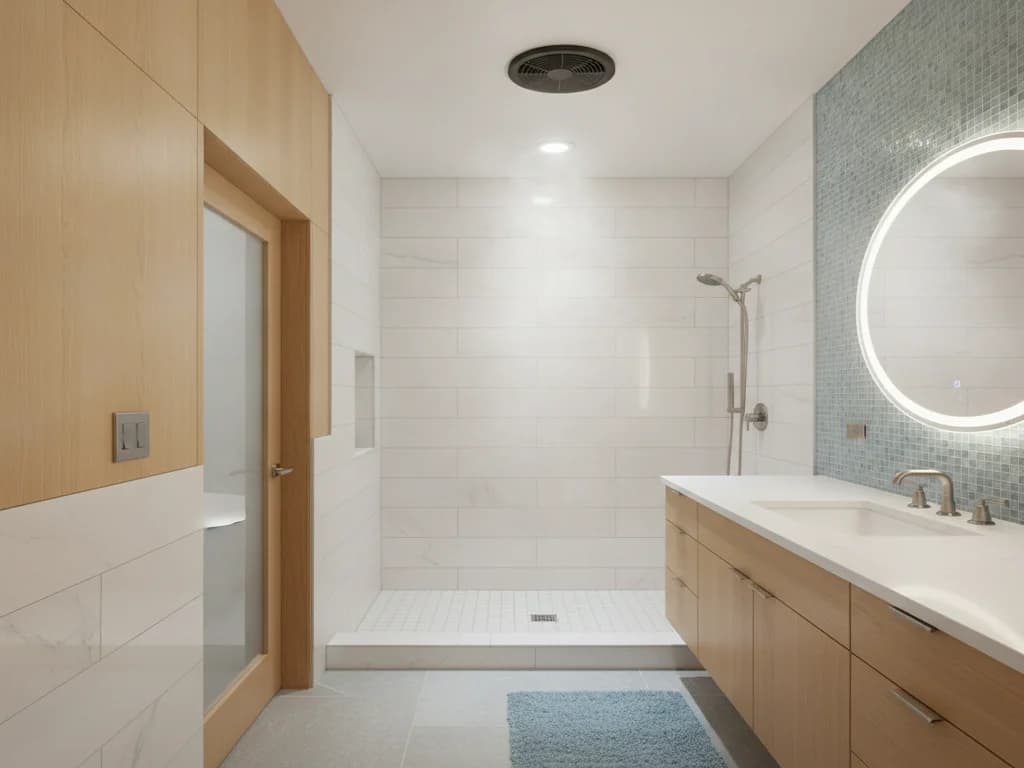
The fix is a system with three parts that all have to work: a fan sized for the room, a duct that actually reaches outdoors, and runtime long enough to clear the air. Most failing windowless bathrooms get one or two of the three right.
How big should the fan be?
Exhaust fans are rated in CFM — cubic feet of air moved per minute — and the Home Ventilating Institute's sizing guidance is the industry standard: roughly 1 CFM per square foot of bathroom, with a minimum of 50 CFM regardless of size. A typical 5-by-8 hall bath lands at the 50 CFM floor; a 10-by-12 primary bath wants around 120 CFM.
Larger bathrooms are sized by fixture instead: HVI guidance allocates roughly 50 CFM per toilet, shower, and tub, and an enclosed water closet needs its own fan — a door between the toilet and the main fan means that little room is effectively windowless and fanless at once.
Two spec-sheet numbers matter beyond CFM. Sones measure loudness, and they quietly determine whether the fan gets used: fans at 1.0 sone or below fade into background noise, while older builder-grade units at 3 to 4 sones are the ones families shut off mid-shower. And an ENERGY STAR listing signals the fan was performance-tested to deliver its rated airflow efficiently. Our roundup of the best bathroom exhaust fans covers specific models and features.
Ducting: where the moisture actually goes
A fan is only as good as its duct, and this is where windowless bathrooms most often fail invisibly. The rule is absolute: exhaust air must terminate outside the building — through the roof or an exterior wall with a proper vent cap. Venting into the attic, a soffit that recirculates into the attic, or a joist bay does not ventilate the bathroom; it relocates the moisture into insulation and framing, where it condenses and feeds exactly the mold problems the fan was supposed to prevent. The EPA's mold guidance is built on the same principle: control moisture at the source and move it out of the envelope.
Duct quality decides whether the fan's rated CFM survives the trip. Smooth, rigid duct of the diameter the fan calls for, in the shortest run with the fewest bends, keeps performance close to the rating; long runs of crushed flex duct can cut real-world airflow dramatically. In cold Boise winters, uninsulated duct through an attic adds its own failure mode — warm moist air condenses inside the cold duct and drips back through the fan housing, which homeowners misread as a roof leak.
This is also why a windowless bathroom retrofit is honest professional work rather than a weekend swap: routing new duct to daylight, cutting a roof or wall termination, and running electrical for the fan and switch is general-contractor territory, and it is one of the items we fold into nearly every windowless-bathroom remodel.
The attic-vent shortcut costs the most
If a fan was ever "vented" into the attic — a common shortcut in older installs — assume moisture has been accumulating above the ceiling every winter. Have the duct extended to a proper exterior termination and the attic checked while access is open. It is the single most consequential fix on this list.
Runtime: the 20 minutes almost everyone skips
Here is the quiet reason well-equipped bathrooms still grow mildew: the fan gets turned off when the shower ends, which is precisely when its real work begins. The steam you see clears in a couple of minutes, but the humidity load in the air and soaked into towels, walls, and grout takes far longer to exhaust. HVI's guidance is to run the fan for about 20 minutes after bathing ends.
Nobody stands around to manage that manually, so the fix is control hardware rather than discipline. A timer switch — set it and leave — is the budget answer. A humidity-sensing switch or fan is the better one: it turns the fan on when humidity spikes and off when the room actually returns to baseline, which adapts automatically to a two-minute rinse versus a long hot shower on a cold morning.
In a windowless bathroom used by a full household, some pros go further and run the fan continuously at a low background rate with boost-on-demand — an approach borrowed from whole-house ventilation. That is worth discussing during a remodel; for an existing bathroom, a humidity-sensing control captures most of the benefit for the cost of a switch.
Makeup air: the detail that makes fans underperform
A fan can only push air out as fast as replacement air can get in. A windowless bathroom with a tightly weatherstripped door and no gap beneath it can choke its own fan — the room depressurizes slightly and airflow drops well below the rating. The standard fix is a door undercut of around three-quarters of an inch, or a transfer grille for a tightly sealed room.
This is a two-minute check worth doing before blaming the fan: run the fan with the door closed, then crack the door slightly. If the fan's tone changes or a tissue held at the grille suddenly pulls harder, the room is starved for makeup air and the door gap is the cheap fix.
It also interacts with the rest of the house. In newer, tighter Treasure Valley construction, several exhaust appliances competing for limited infiltration can leave every one of them underperforming — a whole-home ventilation question a contractor or HVAC pro evaluates during larger remodels.
How to tell if your ventilation is actually working
The bathroom itself reports on the system. A working setup clears the mirror within roughly 10 to 15 minutes after a shower, and the room never develops a persistent musty smell. Chronic fogging, condensation beading on the toilet tank and walls, paint bubbling on the ceiling, or mildew returning to the same corners are all the same message: moisture is being generated faster than it is leaving.
Two quick checks locate the failure. The tissue test — hold a square of toilet paper to the running fan's grille; it should hold firmly against the grille by suction alone. If it flutters or falls, the fan is weak, the duct is obstructed, or the room is starved for makeup air. Then check the termination outside: run the fan and confirm the exterior flap actually opens and blows. If you cannot find an exterior termination at all, the duct likely dead-ends in the attic.
If the checks pass and problems persist, the issue is usually runtime or sizing — and if condensation is the dominant symptom, our guide to bathroom condensation and humidity problems walks the diagnosis in depth. For the broader habits that keep any bathroom dry, see our bathroom ventilation tips.
What the process looks like
- 1
Size the fan to the room
A pro measures the bathroom and applies HVI sizing: roughly 1 CFM per square foot with a 50 CFM minimum, moving to per-fixture allocations of about 50 CFM each in large baths, plus a dedicated fan for an enclosed toilet room.
- 2
Plan the duct route to daylight
The shortest practical run of smooth, correctly sized duct to a roof or exterior-wall termination — never the attic or soffit-to-attic. In cold climates the attic portion gets insulated so exhaust moisture cannot condense inside the duct and drip back.
- 3
Install the fan and wiring
The fan body is mounted to framing to limit noise, the housing is sealed to the ceiling plane, and the electrical run — often new switching — is handled by a licensed electrician. Retrofit installs typically confirm the ceiling can accept the housing depth first.
- 4
Add humidity-sensing or timer control
Runtime gets automated: a humidity-sensing switch or fan runs until the room actually returns to baseline, covering the roughly 20 post-shower minutes HVI recommends. A simple timer switch is the budget alternative; a bare on/off toggle is where good systems go to fail.
- 5
Verify makeup air
The door undercut or a transfer grille is checked so the room can replace the air the fan removes. A choked room quietly cuts real airflow far below the fan's rating no matter how good the hardware is.
- 6
Test the finished system
The tissue test at the grille confirms suction, the exterior termination is checked for visible airflow, and a post-shower mirror should clear within about 10 to 15 minutes. Anything less means revisiting sizing, duct, or makeup air — the three places systems fail.
Ready to plan your Boise bathroom?
Licensed & insured · 3-year workmanship warranty
Frequently asked questions
- Can a bathroom really have no window at all?
- Yes — building code allows it as long as mechanical ventilation stands in. The International Residential Code requires bathrooms to have either an operable window or an exhaust fan ducted outdoors, so interior and basement bathrooms are fully code-legal with a proper fan system. The fan simply carries the entire moisture load, which makes its sizing, ducting, and runtime matter more than in any other room.
- How long should the fan run after a shower in a windowless bathroom?
- About 20 minutes after bathing ends, per Home Ventilating Institute guidance — the visible steam clears quickly, but the humidity absorbed by air, towels, and surfaces takes much longer to exhaust. Since nobody manages that manually, a timer switch or, better, a humidity-sensing control that runs until the room genuinely dries out is the practical fix.
- Is it OK to vent a bathroom fan into the attic?
- No — this is the most damaging shortcut in bathroom ventilation. Exhaust air must terminate outside through a roof or wall cap. Venting into the attic pumps warm, moist air into cold insulation and framing, where it condenses and feeds mold and rot over years, largely invisibly. If your fan ducts to the attic, extending it to a proper exterior termination should be a priority.
- What size exhaust fan does a windowless bathroom need?
- Roughly 1 CFM per square foot of floor area, with 50 CFM as the minimum, per HVI sizing guidance — so a 5-by-8 bath needs at least 50 CFM and a 10-by-12 bath around 120 CFM. Large bathrooms are sized per fixture at about 50 CFM each, and an enclosed toilet room needs its own fan. Long or bendy duct runs justify sizing up, since real-world airflow always trails the rating.
- Why does my windowless bathroom still get moldy with the fan running?
- One of three failures, usually: the fan is undersized or its airflow is choked (crushed flex duct, clogged grille, no makeup air under the door), the duct never actually reaches outdoors, or runtime is too short — shutting the fan off at shower's end leaves most of the moisture behind. The tissue test, a look at the exterior termination, and a humidity-sensing switch address all three in order.
- Do dehumidifiers work instead of an exhaust fan?
- Not as a substitute. A dehumidifier condenses moisture but leaves odors and airborne contaminants in place, needs constant emptying at shower-level moisture loads, and does not satisfy the code requirement for mechanical exhaust in a windowless bathroom. It can help as a supplement in a chronically damp basement bath, but the ducted exhaust fan is the system code and building science both call for.
Sources
- Home Ventilating Institute (HVI)
- International Code Council (IRC/IBC)
- ENERGY STAR — Ventilating Fans
- EPA — Mold
Claims and figures are drawn from the sources above and provided for general guidance; your project may vary. Photography is illustrative of design concepts. For a fixed price on your specific bathroom, request a free estimate.