Updated July 16, 2026 · 7 min read
By Boise Bath — bathroom & shower remodeling in Boise & the Treasure Valley
The short answer
Stone — quartz or granite — is the better vanity top wherever the budget allows: waterproof through its body, undermount-sink ready, and durable for decades. Laminate costs a fraction as much and looks better than ever, but its particleboard core swells permanently if water reaches a seam, and it rules out undermount sinks. Choose laminate for low-traffic or rental baths; stone for daily-use bathrooms you plan to keep.
Key takeaways
- Laminate's weakness is not the surface — it is the particleboard core underneath, which swells permanently when water finds a seam or the sink cutout.
- Stone (quartz, granite) is solid through its body: water sitting on the surface is a wipe, not a risk.
- Laminate rules out undermount sinks; the exposed core at the cutout cannot face constant water. Drop-in or integrated bowls only.
- Cost per square foot installed differs by several multiples — laminate is the cheapest functional top, quartz and granite occupy the mid-to-upper tiers.
- Modern high-definition laminate genuinely mimics stone from a distance; edges and sink cutouts are where the difference shows.
- For daily-use family bathrooms, stone's durability usually justifies the gap; for rentals, powder rooms, and short-horizon budgets, laminate is the honest value pick.
The verdict: stone if the bathroom works daily, laminate if the budget rules
This is the classic budget-tier decision, and the honest framing is water plus time. A bathroom vanity top lives with standing water, dripping hands, and splashed edges every single day. Stone — quartz especially — is indifferent to all of it. Laminate handles it too, right up until water finds a seam or the sink cutout, at which point the particleboard core swells and the top is finished. No repair, no refinish; replacement.
That failure mode is why the answer splits by the bathroom's job. A primary or kids' bath that gets wet twenty times a day earns stone. A powder room that sees hand-washing, a rental where the top is a five-to-ten-year consumable, or a remodel where every dollar is spoken for — laminate is a legitimate, defensible pick, and modern laminate looks far better than its reputation.
Below is the full comparison — construction, water behavior, sinks, looks, and cost direction — then the scenarios. For installed pricing across every material including the tiers between these two, the bathroom countertop cost by material guide has the numbers; this article is about choosing, not pricing.
What each top actually is
Laminate is a thin layer of printed, resin-saturated paper fused under heat and pressure, glued over a particleboard or MDF core. The visible surface — the print — has gotten dramatically better: high-definition patterns with texture and realistic stone visuals that read convincingly from a few feet away. The core has not changed, and the core is the story. Particleboard is compressed wood chips and glue; when water reaches it, it swells, and swollen particleboard never shrinks back.
Stone tops come in two main forms. Quartz is engineered stone — roughly nine parts ground quartz to one part resin — pressed into slabs that are non-porous through their full thickness, consistent in pattern, and effectively maintenance-free; the Natural Stone Institute and fabricators alike treat it as the default bathroom top for exactly those reasons. Granite is quarried natural stone: harder-wearing than almost anything in the house, unique slab to slab, and needing periodic sealing because natural stone is mildly porous.
The construction difference explains everything downstream. Laminate is a waterproof skin over a water-vulnerable core; stone is the same material all the way through. Every row of the comparison table traces back to that one fact.
Laminate vs. stone: the side-by-side
Here is the decision in one table. Note where laminate's rows go from "fine" to "cannot": the sink row is the one that surprises people.
| Factor | Laminate | Stone (quartz/granite) |
|---|---|---|
| Water resistance | Surface sheds water; core swells permanently if seams or cutouts leak | Solid through the body — standing water is a non-event |
| Sink options | Drop-in or integrated bowls only — no undermount | Undermount, drop-in, or vessel, all fully supported |
| Durability | Scratches and chips expose the core; heat and impacts leave marks | Quartz shrugs off daily use; granite is harder still |
| Repairability | Effectively none — damage means replacement | Chips can be professionally filled; granite resealed |
| Maintenance | Wipe clean; keep seams caulked and dry | Quartz: wipe clean. Granite: wipe clean plus periodic sealing |
| Looks | High-definition prints read well at distance; edges and cutouts reveal it | The real thing — depth, polish, and edge profiles |
| Resale read | Reads budget-grade to most buyers | Reads remodeled and current |
| Cost direction | Cheapest functional top — roughly $20–$60 per square foot installed per HomeAdvisor | Mid-to-upper tiers — commonly $50–$150+ per square foot installed per HomeAdvisor |
Per-square-foot ranges are national installed figures from HomeAdvisor's cost guides; small vanity jobs often price as a unit, and slab minimums can raise stone's effective cost on tiny tops.
The water problem, honestly
Understand exactly how laminate fails, because it is avoidable right up until it is not. The laminate surface itself is waterproof — you can flood it daily forever. The vulnerabilities are the joints: the seam where two sections meet, the caulk line at the backsplash, and above all the sink cutout, where raw core is sealed against the sink rim by a bead of caulk. When that caulk ages and water tracks in, the core drinks it, swells, and lifts the laminate around the sink. Every dated laminate top with a puffy, ringed sink perimeter failed exactly this way.
A conscientious household can defend those joints for years — keep caulk fresh, wipe standing water, never let the sink rim seal fail silently. But that is a maintenance obligation stone simply does not have, and in a kids' bathroom or a rental, assuming vigilant caulk inspection is planning to lose.
Stone's water story is one sentence: quartz is non-porous through its thickness, and sealed granite is functionally the same in a bathroom. Hard water — a fact of life across the Treasure Valley — spots both materials cosmetically, but mineral film wipes off polished stone with far less drama than it etches into an aging laminate surface's micro-scratches.
Laminate cannot take an undermount sink
An undermount sink clamps beneath the countertop, leaving the cutout edge permanently exposed to water — fine in solid stone, fatal in particleboard-core laminate. If the wipe-crumbs-straight-into-the-sink convenience of an undermount matters to you, the countertop decision is already made. The full sink-mounting trade is covered in drop-in vs. undermount bathroom sinks.
Looks, edges, and what buyers actually notice
Give modern laminate its due: high-definition printing, matte and textured finishes, and stone-look patterns have closed most of the visual gap at a glance. Where laminate still tells on itself is geometry — the brown core line at a square edge, the pattern break at a corner seam, and the drop-in sink rim its core requires. Manufacturers hide the first with rolled and beveled edges, but the sink rim is structural, and it is the tell most buyers subconsciously read.
Stone offers what print cannot: actual depth and translucence, polished edge profiles cut into the material, and an undermount sink line that reads "remodeled" in a single glance. Between the two stone options, the practical bathroom pick is usually quartz — granite's pattern drama and hardness are real, but quartz's zero-maintenance consistency fits how bathrooms are actually used. That head-to-head lives in marble vs. quartz bathroom countertops if the upper tiers are in play.
For resale, keep the honest frame: a fresh laminate top beats a stained, swollen anything, and in an entry-level home a clean laminate bathroom is exactly what the market expects. Stone moves the needle in mid-tier and up homes, where buyers walk in expecting quartz and mentally deduct a remodel they think they will have to do.
Cost direction and the small-top wrinkle
The headline gap is real: laminate runs roughly $20–$60 per square foot installed, while quartz and granite commonly land at $50–$150 or more per square foot installed, per HomeAdvisor's cost guides. On a typical vanity of 15–25 square feet, that spread is a few hundred dollars versus a few thousand — a genuine budget-tier difference.
But vanity tops carry a wrinkle that kitchen math misses: small jobs price as units, not square feet. Prefabricated stone vanity tops in standard widths — cut, polished, and cutout-ready from the factory — compress stone's premium dramatically, because you skip custom templating and fabrication. On a standard 36- or 48-inch vanity, a prefab quartz top can land close enough to quality laminate that the laminate case evaporates. Always price both as installed units before deciding on principle. The material-by-material numbers live in the countertop cost guide.
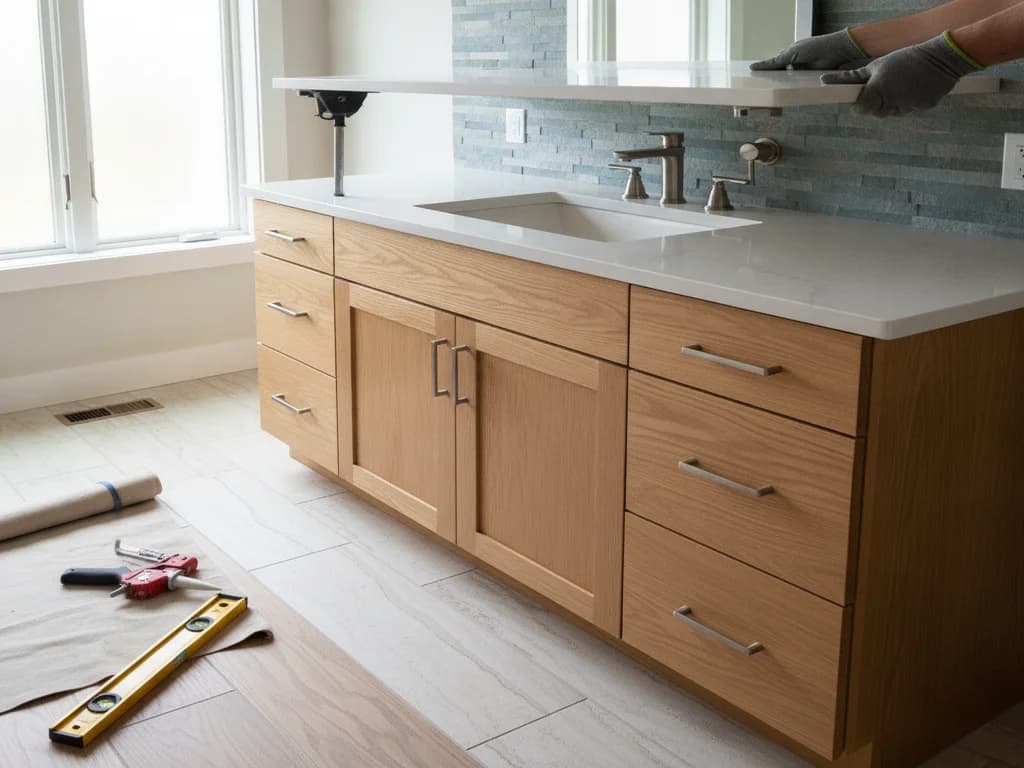
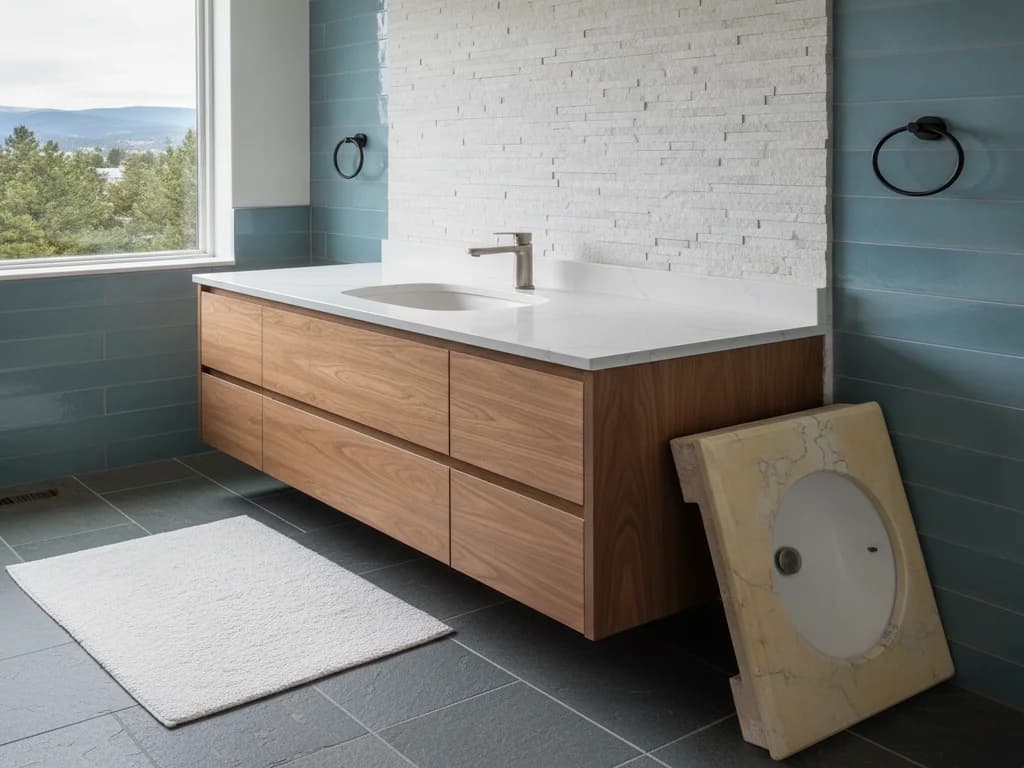
If the cabinet underneath is solid and only the top is dated, this whole decision can ride on a smaller project — replacing a vanity countertop walks through what a top-only swap involves and when it makes sense versus replacing the unit.
Which should you choose?
Let the bathroom's job and the horizon make the call:
- Daily-driver family or primary bath you plan to keep: stone — quartz for zero maintenance, and the undermount sink comes with it.
- Rental or flip: laminate or prefab stone, decided by the property's tier — laminate is a legitimate consumable in a rental bath.
- Powder room or rarely-used guest bath: laminate happily — minimal water exposure neutralizes its one real weakness.
- Standard-size vanity where budget is tight: price a prefab quartz top before defaulting to laminate — the unit-price gap is often smaller than the per-foot math suggests.
- You specifically want an undermount sink: stone, full stop — laminate cannot host one.
- Whole bathroom being remodeled anyway: fold the top into the bigger decision — a full bathroom remodel prices the vanity, top, and sink as one assembly, which is where the best value usually hides.
Ready to plan your Boise bathroom?
Licensed & insured · 3-year workmanship warranty
Frequently asked questions
- Is laminate OK for a bathroom vanity top?
- Yes, within its limits. The laminate surface itself is waterproof and modern prints look genuinely good; the risk is the particleboard core, which swells permanently if water gets through a seam or the sink-rim caulk. In powder rooms, guest baths, and rentals it is a legitimate value pick. In heavy daily-use bathrooms, the maintenance vigilance it demands usually argues for stone.
- How much cheaper is laminate than stone for a vanity?
- Per square foot, several multiples: roughly $20–$60 installed for laminate versus $50–$150+ for quartz or granite, per HomeAdvisor. On a whole vanity that is often a few hundred versus a few thousand dollars. The gap narrows sharply on standard-size tops, where prefabricated quartz units skip custom fabrication — always price both as complete installed units before deciding.
- Can you put an undermount sink in a laminate countertop?
- No — not durably. An undermount installation leaves the countertop's cutout edge permanently exposed to sink water, and laminate's particleboard core cannot survive that exposure; it swells and delaminates. Laminate tops take drop-in sinks or integrated bowls only. If an undermount sink is a requirement, the top needs to be stone or solid surface, which decides the material question by itself.
- What is the most durable vanity top material?
- Quartz and granite lead the practical field. Quartz is non-porous engineered stone that needs no sealing and resists stains, scratches, and daily bathroom chemistry; granite is even harder but wants periodic resealing because natural stone is mildly porous. Both routinely outlast the vanity beneath them. Laminate is the least durable common option — not because the surface fails, but because core damage is unrepairable.
- Why is my laminate countertop bubbling around the sink?
- Water has reached the particleboard core — usually through aged caulk at the drop-in sink rim or a backsplash seam — and the core has swollen, lifting the laminate above it. The swelling is permanent; no drying, gluing, or clamping restores a flat surface. The fix is a replacement top, and it is worth pricing prefab stone alongside new laminate while the sink and faucet are already coming out.
- Does a stone vanity top increase home value?
- It reads as "remodeled" to buyers, which matters most in mid-tier and higher homes where quartz is the expectation and laminate triggers a mental remodel deduction. In entry-level and rental properties the difference rarely moves price — a clean, fresh laminate top presents fine there. Bathroom remodels overall return solid resale value per Zonda's Cost vs. Value data; the top is one visible piece of that impression.
Sources
- HomeAdvisor — True Cost Guide
- Natural Stone Institute
- This Old House — Bathrooms
- Zonda — Cost vs. Value Report
Claims and figures are drawn from the sources above and provided for general guidance; your project may vary. Photography is illustrative of design concepts. For a fixed price on your specific bathroom, request a free estimate.