Updated July 6, 2026 · 8 min read
By Boise Bath — bathroom & shower remodeling in Boise & the Treasure Valley
The short answer
Small bathrooms often can't hold a full linen supply, so the honest fix is a split: keep a few days of towels and in-use toiletries inside the bathroom, and move the bulk — spare towels, sheet sets, backup toilet paper — to a hall closet, a freestanding armoire, or over-door storage just outside the door.
Key takeaways
- This isn't an in-bathroom storage roundup — that's our bathroom storage ideas guide. This is the overflow strategy for what genuinely doesn't fit inside a small bath.
- Keep only what gets used within a few days inside the bathroom itself; move the rest out rather than cramming a linen tower into a room that doesn't have the wall width for one.
- A hallway closet, even a narrow one, or a "found space" like the end of a cabinet run or a wall void can become dedicated linen storage, per Bob Vila's guidance on adding a closet where there is none.
- A freestanding armoire, chifferobe, or chest of drawers works as a linen closet substitute anywhere a built-in closet isn't possible.
- Once linens have a home outside the bathroom, This Old House's closet-organization guidance — dedicated shelves by category, rolled towels, dividers, high shelves for bulk items — makes that storage actually usable.
The honest math on small-bathroom storage
Most small-bathroom storage advice assumes you can find room for everything inside the bathroom itself — a recessed niche here, a taller cabinet there. Sometimes that's true. Often, in a genuinely tight full bath or a converted powder room, it isn't: there simply isn't enough wall width or cabinet depth to hold a household's entire linen supply without the room feeling like a closet with a sink in it.
This is the overflow half of that conversation. If you're looking for ways to add storage inside the bathroom itself — recessed niches, drawer vanities, over-toilet shelving — our bathroom storage ideas guide covers that ground already. This post is about the other half of the problem: what to do with the linens that don't fit, and which ones genuinely don't need to be in the bathroom at all.
The split to aim for
In the bathroom: what gets used within a few days. Outside the bathroom: everything else — spare towels, sheet sets, and bulk supplies.
What actually earns a spot inside the bathroom
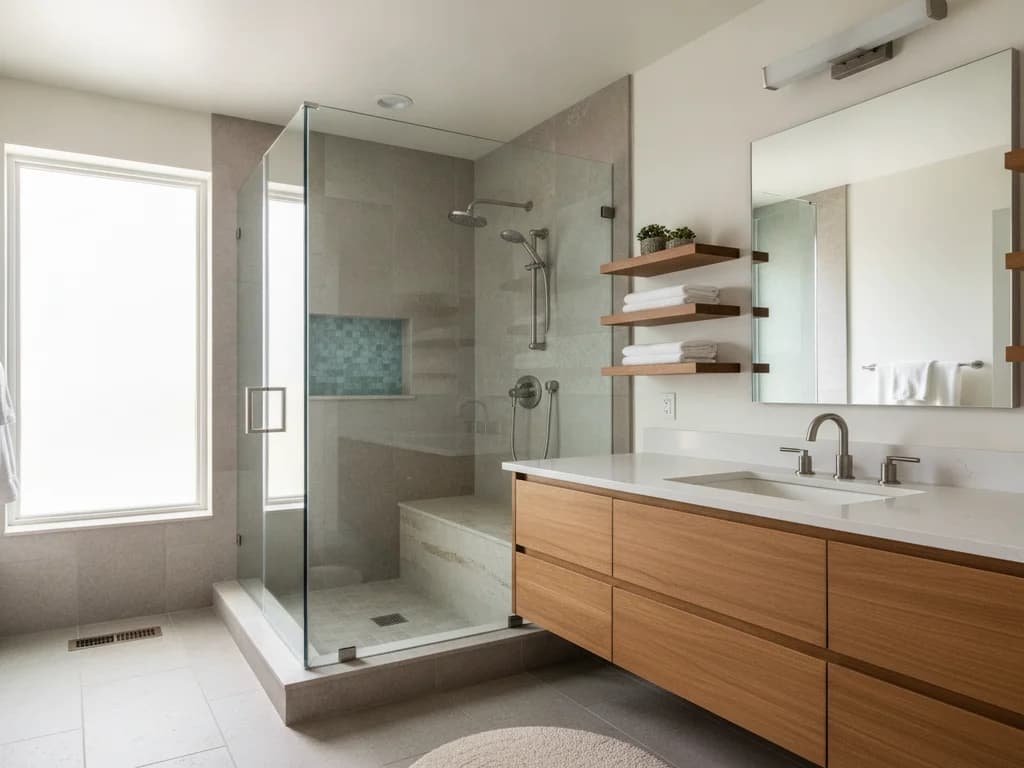
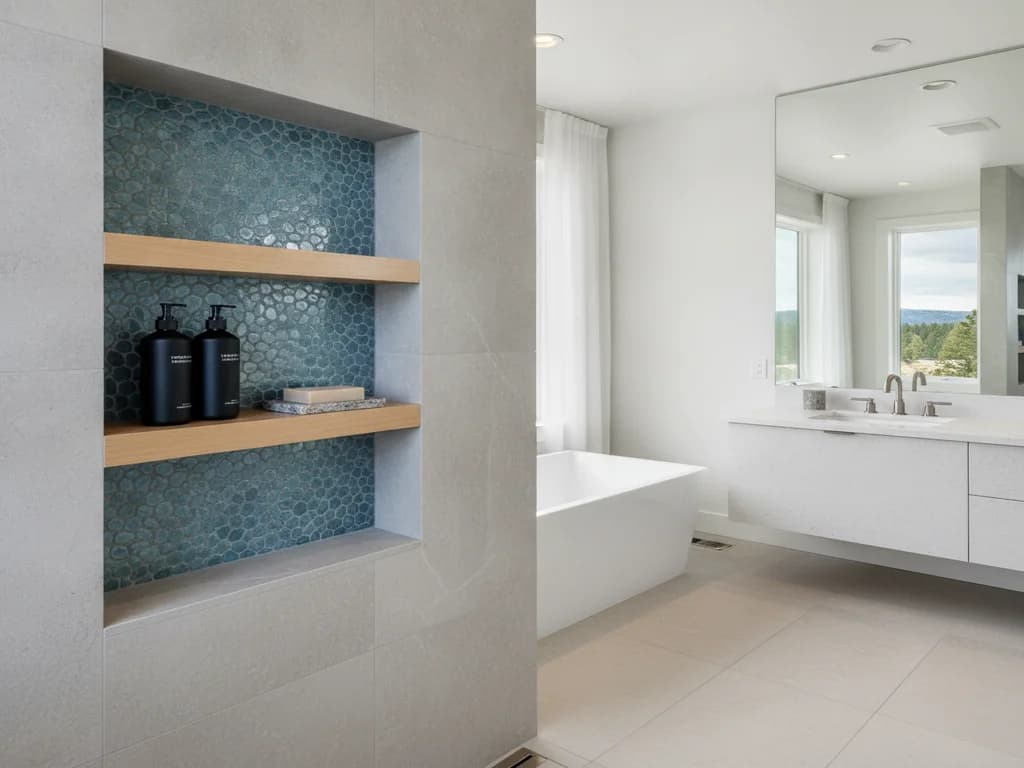
Not everything needs to leave. The items worth keeping inside a small bathroom are the ones you reach for daily or near-daily: the towels currently in rotation, the toiletries actually in use, and a short-term backup of toilet paper. A recessed niche or a few floating shelves size up well for exactly this category — small, frequent-use items that don't need deep storage, just accessible storage.
What doesn't earn a spot is the bulk supply behind that daily rotation: the spare towel sets waiting to replace worn ones, the sheet sets for beds elsewhere in the house, and the deep backup stock of paper goods. Trying to hold all of that inside a small bathroom is usually what forces an oversized vanity or an awkward linen tower into a room that doesn't have the width for either.
It's worth being specific about why this split works better than trying to fit everything in: a bathroom's useful wall space is already spoken for by the vanity, the mirror, and whatever clearance the door swing and fixtures require. Every inch given to bulk linen storage is an inch not available for the room's actual function. Once the daily-use category is defined narrowly — a working towel per person, the toiletries in active use, and a short backup roll of toilet paper — the case for moving everything else out gets much easier to make.
Where the overflow actually goes: the hallway closet
A hallway closet is the most direct answer, and it doesn't have to be a full walk-in to work. Bob Vila's guidance on adding a closet where there isn't one points to "found" spaces as the lower-cost route, since "the enclosure already exists": common spots include "under staircases, at the end of a kitchen cabinet run, in a wall that fronts a void." A shallow linen closet built into any of those found spaces, positioned in the hallway right outside the bathroom door, keeps the walk to get a fresh towel short without asking the bathroom itself to hold the inventory.
If there's truly no wall space to carve a new closet into, Bob Vila also notes that "a freestanding wardrobe is a quick and easy way to add a closet," since it "comes with the sawing and finishing already done" — a faster, less invasive fix than framing a new enclosure.
Furniture pieces as a linen closet substitute
A dedicated closet isn't always possible, especially in an older home with a floor plan that predates modern closet expectations. Bob Vila's guidance for homes without enough closets is direct about the substitute: "armoires, chifferobes, chests of drawers, and other large-scale storage furniture can be beautiful statement pieces that provide the storage space you need." Placed in a bedroom or hallway near the bathroom, a piece like this does the same job a linen closet would — it just does it as furniture instead of built-in millwork, which can be the better fit in a house where adding a true closet isn't practical.
This route also has a real advantage over cutting a new closet into a wall: it's reversible. A wardrobe or chest can move with you, get resized to a different room, or be replaced entirely without any construction — worth weighing against a built-in closet if you're not certain a hallway wall is the permanent answer.
Over-door and vertical storage right outside the door
For the last few feet of overflow capacity, the space right around the bathroom doorway itself is worth using. Bob Vila's guidance notes that "hooks are versatile and can hang on almost any vertical surface, including the backs of doors" — a genuinely low-cost way to add hanging storage for robes or spare towels without any construction. It's a supplement to a hall closet or furniture piece, not a replacement for one; it holds a handful of items well, not a household's full linen supply.
Where linen storage should live, at a glance
None of these options is "correct" on its own — most small bathrooms end up using two or three together.
| Location | Capacity | Best for |
|---|---|---|
| In-bathroom niche or shelf | Low — a few days of towels and in-use toiletries | Daily-use items only |
| Hall closet (built-in or found space) | High — full linen and sheet inventory | Households with any hallway wall to spare |
| Freestanding armoire or chest | Moderate to high | Older homes without built-in closet space |
| Over-door hooks | Very low — a few items | Supplementing another option, not replacing it |
Making the overflow storage actually work
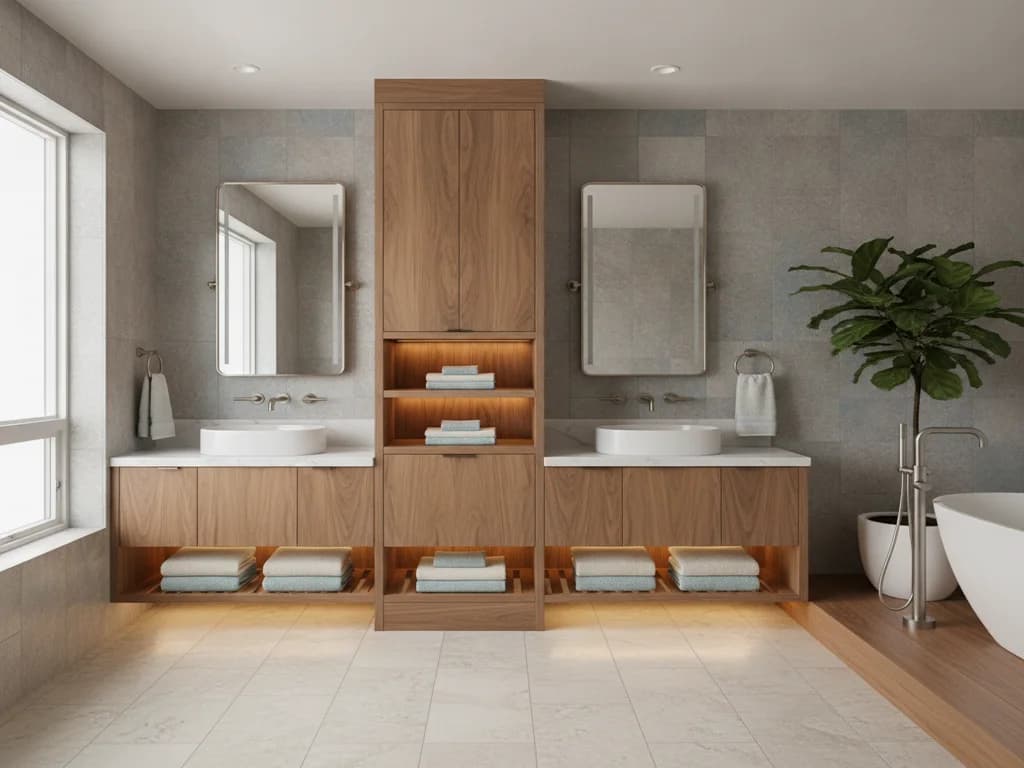
Moving linens out of the bathroom only helps if the new storage is organized well enough to find things quickly. This Old House's closet-organization guidance is specific and worth following directly: "designate specific shelves to towels and sheets. Group towels by their purpose and group sheet sets by bed size." For grabbing a towel without disturbing the rest of the stack, the same guidance recommends you "roll towels instead of folding them." On wider shelves, "add dividers to keep your stacks upright, or swap some for slide-out wire bins," and reserve the "high shelves" for "all those rolls of toilet paper and boxes of tissues you stock up on" — bulk items that don't need to be within easy reach.
Deciding what stays and what moves
The test is simple: if you'd reach for it in the next day or two, it belongs in the bathroom. If it's backup — for next week, next month, or a bed in another room — it belongs outside, in whichever of a hall closet, a furniture piece, or an over-door rack your home actually has room for. Getting that split right is often what makes a small bathroom feel adequately, rather than desperately, storage-short.
If you're planning storage as part of a larger remodel, a full bathroom remodel is where the in-bathroom niches and the adjacent hall closet or built-in get planned together, so neither one is an afterthought.
Ready to plan your Boise bathroom?
Licensed & insured · 3-year workmanship warranty
Frequently asked questions
- Do I need a linen closet inside my bathroom?
- No — most small bathrooms work better keeping only a few days of towels and in-use toiletries inside the room, with the bulk linen supply stored in a nearby hall closet, freestanding armoire, or other found space, per Bob Vila's guidance on adding closets where there aren't any.
- Where should I store towels if my bathroom has no closet?
- A hallway closet is the most direct fix, including "found" spaces Bob Vila points to like under a staircase, the end of a kitchen cabinet run, or a wall void. A freestanding armoire, chifferobe, or chest of drawers works just as well in an older home without room for a built-in closet.
- What should stay in the bathroom versus move to a hall closet?
- Keep what you'd use within the next day or two — the towels currently in rotation, in-use toiletries, and a short backup of toilet paper. Move the bulk supply — spare towel sets, sheets for other rooms, and deep backup stock — to a hall closet, furniture piece, or over-door storage outside the bathroom.
Sources
- Bob Vila — How to Add a Closet Where There Is None
- Bob Vila — What to Do When Your Home Has No Closets
- This Old House — Closet Organization Guide
Claims and figures are drawn from the sources above and provided for general guidance; your project may vary. Photography is illustrative of design concepts. For a fixed price on your specific bathroom, request a free estimate.