Updated July 17, 2026 · 8 min read
By Boise Bath — bathroom & shower remodeling in Boise & the Treasure Valley
The short answer
The most water-resistant bathroom baseboards are tile base, PVC or composite trim, and coved vinyl — all shrug off splashes and mopping. MDF is the cheapest and paints beautifully but swells if water reaches its core, so it belongs only in dry, low-splash baths. Solid wood works when primed on all sides and kept off the wet zone.
Key takeaways
- Tile base, PVC/composite, and coved vinyl are the truly moisture-tolerant choices — they do not absorb water, so they survive splashes, mopping, and Treasure Valley humidity swings.
- MDF baseboard is inexpensive and takes paint like glass, but its compressed core swells and crumbles once water breaches the paint film — keep it out of splash zones.
- Solid wood can work in a bathroom only when it is primed and sealed on all six sides and kept away from the tub and shower splash line.
- Tile base and coved vinyl close the floor-to-wall joint against water, which is why they belong in curbless showers, laundry-adjacent baths, and anywhere a mop lives.
- Match the trim to the floor: resilient and tile floors pair naturally with vinyl or tile base, while an engineered-wood-look floor may call for PVC that mimics painted wood.
- Whatever the material, the caulk joint at the floor and the paint or sealer film is what actually keeps water out — the material only buys you time when that line fails.
Why bathroom trim is a moisture decision first
In every other room, baseboard is a trim choice — a matter of profile and paint. In a bathroom it is a moisture decision that happens to look like trim. The base of the wall is where splash from the tub, drips off a body, condensation running down a cold wall, and mop water all collect. Whatever you run along that line has to either resist water or be protected from it, because the floor-to-wall joint is the single most common place a bathroom starts to fail.
The Treasure Valley adds two local pressures. Winters here are dry and heated, so a bathroom swings from steamy showers to arid, forced-air heat within an hour — the kind of humidity cycling that works absorbent materials loose over time. And the region’s hard water means splashes leave mineral film that gets scrubbed, so the base takes cleaning as well as wetting. The materials below are ranked by how they handle that reality, not by how they look in a showroom.
One rule cuts across every option: the caulk joint at the floor and the paint or sealer film on the trim is what actually stops water. The material only decides what happens after that line fails — whether you get a stain you can wipe, or a swollen board you have to replace. Choose the material for the splash exposure of its wall, and detail the joint carefully everywhere.
Tile base and coved tile
Tile base is the most water-resistant trim you can run in a bathroom, because it is the same fired, glazed material as the floor and it does not absorb anything. It comes two ways: a bullnose or cove tile set as a short base course against the wall, or a fully coved tile that curves the floor up into the wall to erase the 90-degree joint entirely. The coved version is the gold standard in wet-heavy rooms and curbless showers because there is no square corner for water to sit in.
The tradeoffs are cost and grout. Tile base is more expensive to install than any wood or vinyl option because it is set and grouted by hand, and the grout joint itself needs to be sealed and maintained — grout is porous. But once it is in, a tile base outlasts the rest of the trim in the room and cleans with the same spray you use on the floor. It pairs naturally with a tile floor and is the honest choice anywhere a mop, a shower splash, or a laundry sink is nearby. If you are choosing floor tile at the same time, our best tile for small bathrooms guide covers the sizes and finishes that carry up into a base neatly.
PVC and composite trim
PVC and composite (cellular-PVC or wood-plastic composite) baseboards are engineered to be waterproof, which makes them a strong fit for a bathroom. They will not absorb water, swell, rot, or grow the mold that feeds on the paper and wood fiber in other trims. They come in the same profiles as wood baseboard, take paint well, and cut and install with ordinary carpentry tools, so a finish carpenter treats them almost exactly like wood while getting far better moisture behavior.
The catch is mostly aesthetic and thermal. Some PVC trims have a slightly different surface texture than milled wood and can telegraph a plasticky sheen under gloss paint, and cellular PVC expands and contracts with temperature more than wood, so long runs need proper gapping and fastening or the joints can open. For most bathrooms those are minor, and the payoff — a baseboard that shrugs off standing water and cleans like a countertop — is exactly what a wet room wants. It is often the best value when you want the look of painted wood trim without the moisture risk.
MDF looks identical to primed wood — until it gets wet
The most common bathroom-trim regret is running MDF baseboard along a tub or shower wall because it was cheap and painted up beautifully. MDF is compressed wood fiber and glue; once water breaches the paint at a nail hole, a scuff, or the floor joint, the core wicks it up, swells, and crumbles. In a splash zone, spend the small premium for PVC, composite, or tile base.
MDF baseboard: cheap and paintable, but thirsty
MDF (medium-density fiberboard) is the default baseboard in modern homes for good reason: it is inexpensive, dead straight, and takes paint better than almost anything because it has no grain to telegraph. In a dry powder room or a low-splash guest bath — a room with a toilet and a vanity but no tub or shower — MDF can be perfectly appropriate, sealed and painted like the rest of the house.
The problem is water, and MDF has no defense once water gets past the paint. It is compressed wood fiber bound with resin; the moment moisture reaches the core — through a nail hole, a chipped edge, or an unsealed cut at the floor — it wicks in, the board swells, the paint blisters, and eventually the base crumbles at the bottom edge. Standard MDF has no meaningful moisture resistance, and even "moisture-resistant" MR-MDF only slows the process. Keep MDF out of the splash zone around tubs and showers; if the budget forces MDF, at minimum seal every cut end, prime all faces, and caulk the floor joint religiously — but understand you are managing a risk, not removing it.
Solid wood and coved vinyl
Solid wood baseboard is a beautiful, traditional choice and it can live in a bathroom — but only on terms most people skip. Wood moves with humidity, so it has to be primed and sealed on all six sides, including the back and the cut ends, before it goes on the wall, and it should be kept out of the direct splash line of the tub and shower. Detailed that way, a poplar or pine base painted in a durable enamel holds up in a moderate bath and matches the millwork in an older Boise home. Detailed carelessly — bare back, unsealed cuts, run tight against a wet tub — it cups and rots like any other wood.
Coved vinyl (rubber or vinyl wall base) sits at the opposite end: it is the utilitarian, fully waterproof option, a flexible strip that curves up the wall with an integral cove that closes the floor joint. It is the standard in commercial restrooms and laundry rooms precisely because it is impervious and mops clean, and it pairs naturally with a resilient or sheet-vinyl floor. In a residential bath it reads plainer than painted trim, but for a rental, a basement bath, or a hardworking family bathroom it is hard to beat on water resistance and price. If your floor is a resilient or luxury-vinyl product, coordinate the base with it — our bathroom flooring underlayment guide covers the substrate side of the same wet-floor equation.
Bathroom baseboard and trim comparison
The table compares the common options on the two things that matter in a wet room — moisture performance and where the material fits — alongside relative cost and paintability. Use it to match the material to each wall’s exposure: the highest-splash walls near the tub and shower want the top rows, while a dry powder room can use anything on the list.
| Material | Moisture performance | Relative cost | Best for |
|---|---|---|---|
| Tile base / coved tile | Excellent — does not absorb; seal grout | High (hand-set) | Curbless showers, wet rooms, tile floors |
| PVC / composite | Excellent — waterproof, will not rot | Medium | Splash zones with a painted-wood look |
| Coved vinyl / rubber base | Excellent — impervious, mops clean | Low | Rentals, basements, resilient floors |
| Solid wood (sealed all sides) | Good only if primed 6 sides, off wet line | Medium–high | Traditional/older homes, moderate baths |
| MR-MDF (moisture-resistant) | Fair — resists longer, not waterproof | Low–medium | Low-splash full baths, dry walls |
| Standard MDF | Poor — swells and crumbles when wet | Low | Dry powder rooms only |
Moisture ratings reflect material behavior and manufacturer guidance; verify installation and wet-area suitability against the manufacturer’s instructions and the International Residential Code for your assembly.
Matching trim to the floor and the caulk line
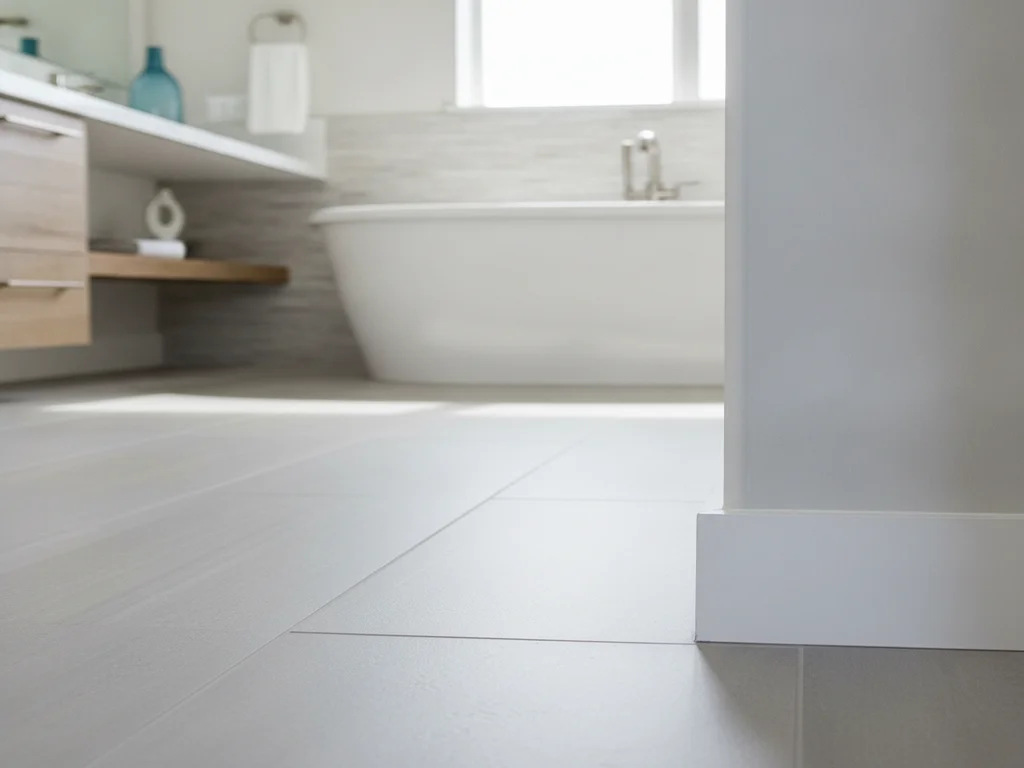
The best-performing trim still fails if it fights the floor or the joint. Match the base to the flooring system: a tile floor wants a tile base or a waterproof PVC; a resilient or luxury-vinyl floor pairs with coved vinyl or PVC; an engineered wood-look floor takes PVC milled to read as painted wood. Coordinating the two means the transition at the floor is a clean, caulkable line instead of a mismatch that collects water. When you are planning a floor swap, replacing bathroom flooring and the base go together — it is far easier to set the base after the new floor than to work around old trim.
Finally, treat the paint or sealer as part of the material. A durable, moisture-tolerant enamel is what keeps water out of wood and MDF, and the best paint for bathrooms — a satin or semi-gloss rated for humid rooms — is what makes a paintable trim survive. Detail the floor joint with a flexible, mildew-resistant caulk, seal the grout on a tile base, and the trim you chose will do its job for the life of the room instead of a couple of wet winters.
What the process looks like
- 1
Map the splash exposure of each wall
A professional walks the room and grades each wall by wetness — tub and shower walls and any curbless-shower perimeter are high-splash; the vanity wall is moderate; a far dry wall is low — so the material follows the exposure.
- 2
Choose the material per wall, not per room
The wet walls get tile base, PVC/composite, or coved vinyl; a dry powder room can take MR-MDF or sealed wood. Mixing is normal and keeps the budget on the walls that need it.
- 3
Coordinate the base with the floor system
The base is matched to the finished floor — tile to tile base, resilient to vinyl or PVC — and, on a remodel, set after the new floor goes in so the joint lands clean rather than working around old trim.
- 4
Seal every face and cut before install
For any wood or MDF trim, all faces and cut ends are primed and sealed before mounting so water cannot enter a raw edge — the step most often skipped and the most common failure point.
- 5
Set the base and detail the floor joint
The trim is fastened, then the floor-to-base joint is closed with a flexible, mildew-resistant caulk and, on a tile base, the grout is sealed — the line that actually keeps water out of the wall.
- 6
Finish with a bathroom-rated enamel
Paintable trim gets a satin or semi-gloss enamel rated for humid rooms, which resists moisture and scrubs clean against hard-water film without breaking down.
Ready to plan your Boise bathroom?
Licensed & insured · 3-year workmanship warranty
Frequently asked questions
- What is the best baseboard material for a bathroom?
- For wet walls, tile base, PVC or composite trim, and coved vinyl are the best because none absorb water. Tile base is the most durable but costs the most; PVC gives a painted-wood look without the moisture risk; coved vinyl is the cheapest waterproof option. Reserve MDF for dry powder rooms only.
- Can you use MDF baseboard in a bathroom?
- Only in a dry, low-splash bathroom — a powder room with no tub or shower — and even then it should be sealed on all faces and cut ends with the floor joint caulked. Standard MDF swells and crumbles once water breaches the paint, so keep it away from tubs and showers. Use PVC, composite, or tile base in any splash zone.
- Is PVC baseboard good for bathrooms?
- Yes. PVC and cellular-PVC trim is waterproof, will not rot or grow mold, takes paint, and installs like wood, which makes it one of the best bathroom baseboard choices. Its main quirks are a slightly plasticky sheen under gloss paint and more thermal movement than wood, so long runs need proper gapping and fastening.
- Should bathroom baseboards be caulked to the floor?
- Yes — the floor-to-base joint should be sealed with a flexible, mildew-resistant caulk. That joint is where mop water and splash try to get behind the trim and into the wall, so caulking it is what actually keeps water out, regardless of which material you chose. On a tile base, also seal the grout.
- Can you use solid wood trim in a bathroom?
- You can, but it must be primed and sealed on all six sides, including the back and cut ends, and kept out of the direct splash line of the tub and shower. Detailed that way and painted with a moisture-tolerant enamel, wood holds up in a moderate bath. Left with a bare back or run against a wet tub, it cups and rots.
- What baseboard goes with a curbless shower?
- A coved tile base or coved vinyl is the right call around a curbless shower, because both close the floor-to-wall joint against water instead of leaving a square corner where it can sit. Tile base matches a tile floor and is the most durable; coved vinyl suits a resilient floor and mops clean.
Sources
- National Kitchen & Bath Association (NKBA)
- International Code Council (IRC/IBC)
- Tile Council of North America (TCNA)
Claims and figures are drawn from the sources above and provided for general guidance; your project may vary. Photography is illustrative of design concepts. For a fixed price on your specific bathroom, request a free estimate.