Updated July 16, 2026 · 7 min read
By Boise Bath — bathroom & shower remodeling in Boise & the Treasure Valley
The short answer
A plywood cabinet box with hardwood or well-sealed MDF doors is the best bathroom vanity material combination. Plywood resists moisture and holds screws far better than particleboard; MDF makes the smoothest painted doors but swells if water reaches an unsealed edge. Thermofoil is the honest budget pick; solid wood suits dry climates when properly finished.
Key takeaways
- Judge a vanity by its box first: plywood construction resists moisture, holds fasteners under heavy drawer use, and outlasts particleboard in the wettest room of the house.
- MDF is the best paint-grade door material — dead flat, no grain telegraph, no seasonal cracking — but its weakness is edges: unsealed MDF swells permanently when water finds raw fiber.
- Solid wood doors handle Boise’s dry winters well if properly finished, but expect seasonal movement; hairline lines at painted joints are wood behaving, not failing.
- Thermofoil delivers a clean look at the lowest price; its known failure modes are peeling near heat (curling irons, styling tools) and delaminating edges that can’t be repaired, only replaced.
- Particleboard boxes are where budget vanities fail — one supply-line drip and the material blows out like a wet sponge.
- The finish does half the work: a factory-finished or properly sealed surface matters as much as the substrate under it.
The short answer: rank the box and the doors separately
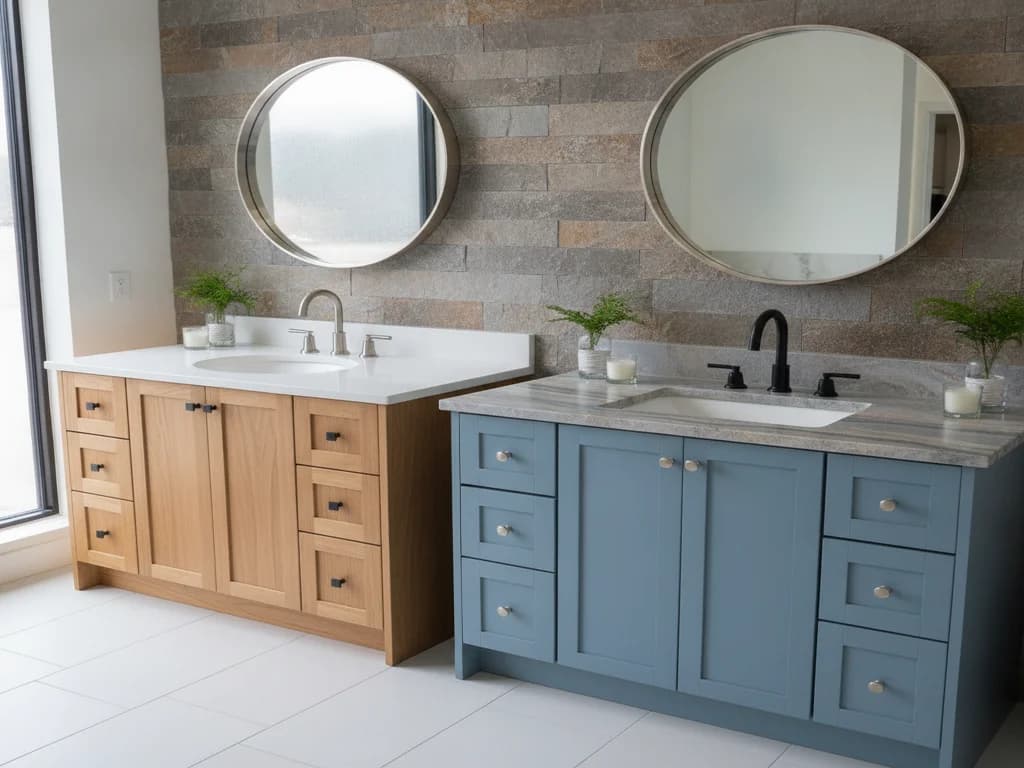
The trap in vanity shopping is treating “material” as one decision. A vanity is two: the cabinet box you never see and the doors and drawer fronts you see every day. The best value in the market is a plywood box wearing painted MDF or hardwood doors — and the worst failures are pretty doors on a particleboard box that dies from its first plumbing drip.
Moisture is the tiebreaker for everything here. Kitchens are hard on cabinets; bathrooms are hard on cabinets and humid, with supply lines and a drain running through the box itself. Fine Homebuilding and cabinet-industry guidance consistently point the same direction: in wet rooms, substrate quality and edge sealing decide lifespan more than the label on the door style.
This article ranks materials by component. For the rest of the buying decision — sizes, tops, sinks, configuration — the full bathroom vanity buying guide picks up where materials leave off.
Best cabinet box: plywood, with particleboard as the honest budget caveat
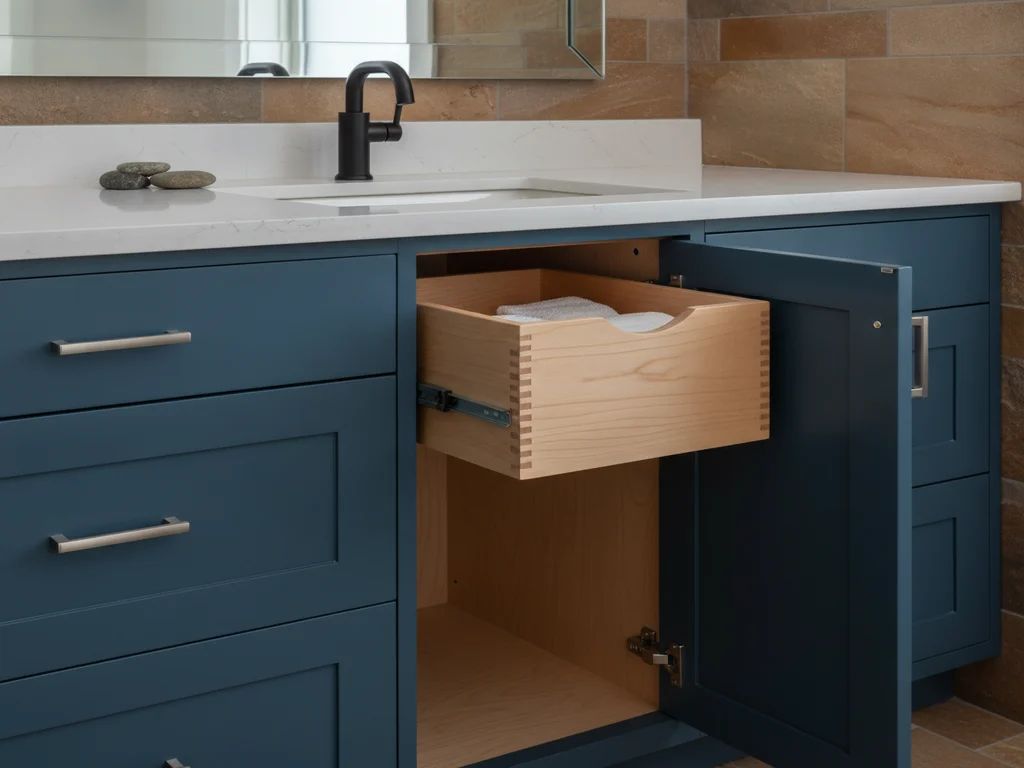
The box is where quality hides. Plywood — thin wood veneers glued in alternating grain directions — resists moisture, holds screws and drawer-slide hardware under years of daily slams, and survives the small plumbing leaks that a bathroom cabinet will eventually meet. When cabinet people say “all-plywood construction,” this is the spec they’re bragging about.
Particleboard (furniture board) is compressed wood chips and resin, and it’s in most budget vanities because it’s cheap and stays flat. Dry, it’s adequate. Wet, it’s done: the material swells, crumbles, and lets go of screws, and a slow supply-line drip inside the cabinet can quietly destroy the sink base before anyone notices. Consumer Reports’ cabinet guidance flags exactly this moisture vulnerability as the trade-off for the price.
The honest middle: a particleboard box with a plywood-boxed upgrade available is a fine place to spend the difference — the upgrade usually costs far less than replacing a swollen vanity in five years, a job scoped in replacing a bathroom vanity.
One drip is the whole test
Every material comparison in this article compresses to a single scenario: a supply-line fitting inside the vanity weeps for a month before anyone spots it. Plywood swells slightly and survives. Particleboard blows out permanently. MDF holds if its edges were sealed and fails where they weren’t. Buy the box that passes the test your bathroom will eventually run.
Best painted doors: MDF — flatter than wood, with one weakness
For painted finishes, MDF (medium-density fiberboard) is genuinely the better material, not the cheaper one. It machines dead flat with no grain to telegraph through paint, and it doesn’t expand and contract with seasonal humidity — so painted MDF doors don’t develop the hairline cracks at the joints that painted solid-wood doors do. That stability is why quality painted cabinet doors are so often MDF on purpose.
Its weakness is concentrated at the edges. MDF is compressed wood fiber, and where a raw or poorly sealed edge meets standing water — the bottom rail of a door under a leaky faucet, an unsealed cutout — it wicks moisture and swells permanently. There is no drying it back down; a blown MDF edge is a replaced door.
The buying implication: factory-finished MDF with fully sealed edges performs beautifully in bathrooms, while site-cut, site-painted MDF lives or dies on how carefully every edge got sealed. It’s a workmanship question as much as a material one — one reason the custom vs. prefab vanity comparison is really a comparison of who controls the details.
Best stained or natural look: solid wood — with dry-climate honesty
For stained, natural, or classic furniture looks, solid hardwood is the material — nothing else takes stain the same way or wears decades of use with the same grace. Hardwood frames with veneered-plywood panels are the standard quality construction, and they repair and refinish in ways engineered materials never will.
The honesty is that wood moves. It swaps moisture with the air, swelling in humid seasons and shrinking in dry ones — and Treasure Valley winters are seriously dry, which is exactly when panel lines and joint gaps appear. On stained doors this movement is invisible; on painted solid wood it eventually shows as hairline lines at the joints. That’s the material behaving normally, and it’s the specific reason painted doors are usually better in MDF.
Finish quality carries solid wood in a bathroom. A properly sealed hardwood door shrugs off humidity swings; a bargain finish lets steam in through the back face. If the budget forces a choice, spend it on the finish and box, not on exotic species.
Thermofoil and laminate: the budget tier, told straight
Thermofoil is a vinyl film heat-wrapped over an MDF core, and at its price it delivers a legitimately clean, seamless, wipeable door — no grain, no joints, easy to keep sanitary. For a rental, a kids’ bath, or a tight budget, it’s a rational pick and nobody should be talked out of it with vague quality snobbery.
Its failure modes are specific and worth knowing before buying. Heat is the enemy: the film can lift and peel near curling irons, styling tools, and even self-cleaning coffee-bar appliances parked on the vanity. Edges and corners can delaminate over years of moisture exposure. And there is no refinishing thermofoil — a peeled door is a replaced door, and matching a discontinued film years later is a lottery.
High-pressure laminate (HPL) doors are the tougher sibling — more impact- and heat-resistant than thermofoil, often with a crisp modern slab look. Between the two budget skins, laminate wears better; thermofoil molds into routed shaker profiles that laminate can’t.
The picks by component
The whole hierarchy, one table:
| Component | Best pick | Moisture performance | Skip / caveat |
|---|---|---|---|
| Cabinet box | Plywood (all-plywood construction) | Best in class — survives minor leaks, holds hardware | Particleboard box under a sink you care about |
| Painted doors | MDF, factory-finished, sealed edges | Very good — until water finds a raw edge, then permanent | Site-cut MDF with unsealed edges |
| Stained/natural doors | Solid hardwood frame + veneer panel | Good when well finished; moves with dry winters | Painted solid wood if hairline joint lines will bother you |
| Budget doors | Thermofoil over MDF | Fine day-to-day; edges delaminate over years | Parking hot styling tools near the doors |
| Modern slab on a budget | High-pressure laminate (HPL) | Good — tougher skin than thermofoil | Cheap low-pressure laminate that chips at edges |
| Drawer boxes | Solid wood or plywood, dovetailed or doweled | Handles daily load and humidity | Stapled particleboard drawers — first thing to fail |
Moisture characterizations reflect cabinet-industry and publication guidance (Fine Homebuilding, Consumer Reports); any material survives longer under a factory-quality sealed finish.
Matching the material to your bathroom
The hierarchy, applied to real situations:
- Primary bathroom you’ll keep 15 years: plywood box, factory-finished painted MDF or stained hardwood doors, wood drawer boxes — the reference spec.
- Kids’ or high-splash bathroom: plywood box is non-negotiable; thermofoil or laminate doors are honestly fine and wipe clean.
- Powder room (no shower humidity, light use): the one room where a particleboard-box budget vanity is a defensible save.
- Dry-winter houses with painted cabinets: choose MDF doors specifically to dodge seasonal joint cracking — this is Boise-relevant, not generic advice.
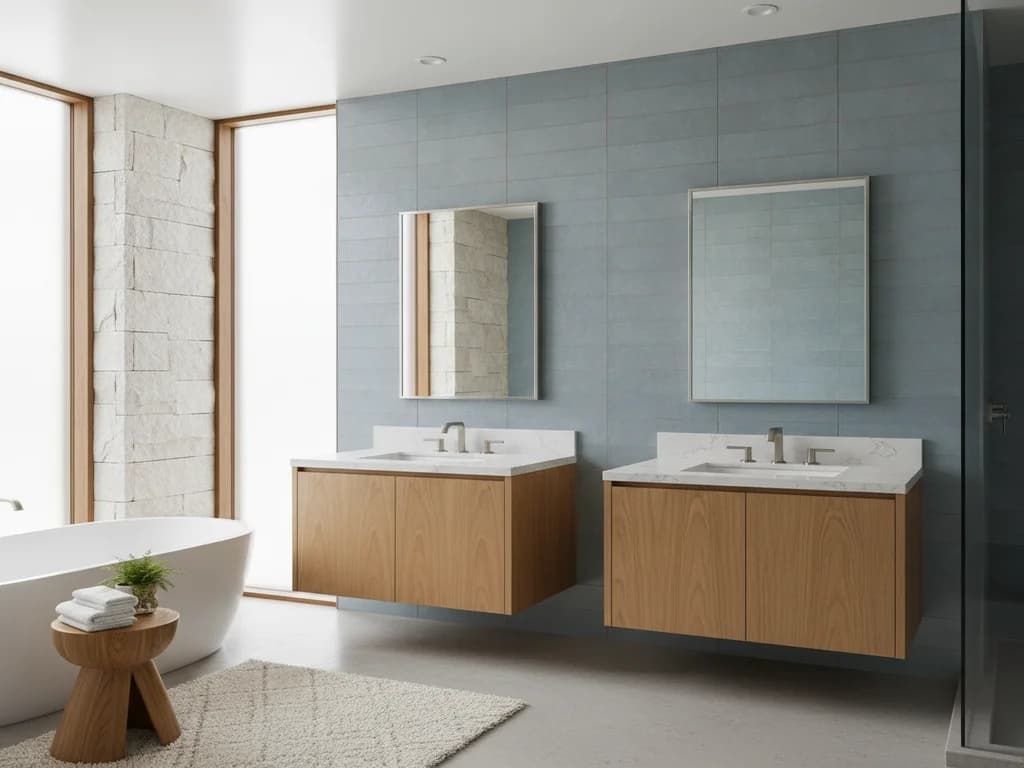
- Floating vanity plans: wall-mounted boxes carry their load through the box material, which makes plywood construction matter even more — see floating vs. traditional vanities.
- Whatever the box, the top is its own material decision — laminate vs. stone vanity tops covers that half.
Ready to plan your Boise bathroom?
Licensed & insured · 3-year workmanship warranty
Frequently asked questions
- Is MDF or solid wood better for a bathroom vanity?
- For painted doors, MDF — it stays dead flat, shows no grain through paint, and doesn’t crack at the joints when humidity swings, which matters in dry Idaho winters. For stained or natural finishes, solid wood is the only real answer. Neither belongs in the cabinet box, where plywood beats both for moisture resistance and hardware-holding.
- How can I tell if a vanity is plywood or particleboard?
- Open a door and look at the box interior and shelf edges. Plywood shows thin layered veneers at any exposed edge; particleboard shows a uniform granular texture, often hidden under white melamine skin. Check the spec sheet for “all-plywood construction” — if the listing only praises the door material and goes quiet about the box, the box is usually particleboard.
- Do thermofoil vanities hold up in bathrooms?
- Day to day, yes — the vinyl skin wipes clean and handles normal humidity fine. The known failures are heat and edges: film can peel near curling irons and styling tools, and edges can delaminate after years of splash exposure. There’s no repairing a peeled door, only replacing it. For budget bathrooms it’s a rational buy with eyes open.
- Is solid wood a bad idea in a humid bathroom?
- No — properly finished hardwood has served in bathrooms for a century. What’s true is that wood moves with humidity, so expect minor seasonal panel movement, and in painted solid wood, eventual hairline lines at door joints. Good ventilation and a quality sealed finish do most of the protecting; the material itself isn’t the risk a swollen particleboard box is.
- What’s the best vanity material for the money?
- A plywood box with painted, factory-finished MDF doors — it puts the spend where failure actually happens (the box and the edges) and uses the best paint-grade material where you look every day. That combination typically costs less than all-hardwood construction while outlasting the particleboard-box vanities that dominate the budget tier.
Sources
- National Kitchen & Bath Association (NKBA)
- Fine Homebuilding
- Consumer Reports
- This Old House — Bathrooms
Claims and figures are drawn from the sources above and provided for general guidance; your project may vary. Photography is illustrative of design concepts. For a fixed price on your specific bathroom, request a free estimate.