Updated August 28, 2026 · 7 min read
By Boise Bath — bathroom & shower remodeling in Boise & the Treasure Valley
The short answer
Caulk belongs anywhere two planes meet — corners, wall-to-floor, and around fixtures — because those joints move. Grout belongs between tiles on the same plane. If something is cracking in a corner, the usual cause is that grout was used where caulk should have been, and re-grouting it will crack again.
Key takeaways
- Grout is rigid and fills joints between tiles on the same plane; caulk is flexible and seals joints where planes change.
- Industry guidance calls for a flexible sealant at changes of plane and at transitions between different materials.
- A corner, a wall-to-floor junction, and the joint where a shower pan meets a wall all move — which is why they need caulk, not grout.
- Cracking confined to corners and edges almost always means grout was used at a movement joint.
- Re-grouting a movement joint reproduces the failure; the fix is to remove it and caulk instead.
- Cracking in the field of the tile, away from corners, is a different problem and may indicate substrate movement or deflection.
- Caulk is consumable and needs periodic replacement; grout is not expected to be replaced on a schedule.
- Mildew growing within caulk rather than on it means the material is spent and cleaning will not recover it.
Two materials, two jobs
Grout and caulk sit in similar-looking lines a few millimetres wide and are routinely treated as the same thing. They are not, and the difference explains most recurring shower problems.
Grout is a rigid filler. It goes between tiles that share a plane — across a wall, across a floor — where the tiles are bonded to a stable substrate and are not expected to move relative to one another. Rigidity is appropriate there.
Caulk is a flexible sealant. It goes where two planes meet, or where two different materials meet: an inside corner, the junction of wall and floor, the joint where tile meets a tub or shower pan, and around penetrations like a valve or a spout. Those locations move — because buildings settle, materials expand and contract with temperature and humidity, and a tub deflects slightly when it fills with water and a person.
Industry guidance is explicit that changes of plane and transitions between dissimilar materials call for a flexible sealant rather than grout. That is not a preference; it is what keeps the joint intact.
Diagnosing by location
Where the failure is tells you almost everything.
Cracking or gaps confined to inside corners, along the wall-to-floor junction, or at the top edge of a tub or shower pan is a movement-joint failure. If the material there is hard and cementitious, grout was used where caulk belongs, and it cracked because a rigid material cannot accommodate movement. This is extremely common, including in otherwise well-built showers.
Cracking in the middle of a tile field, away from any corner, is a different animal. Grout on a flat plane should not crack, so when it does the cause is usually below the tile — substrate movement, floor deflection, or a bonding failure. Patching that grout treats a symptom.
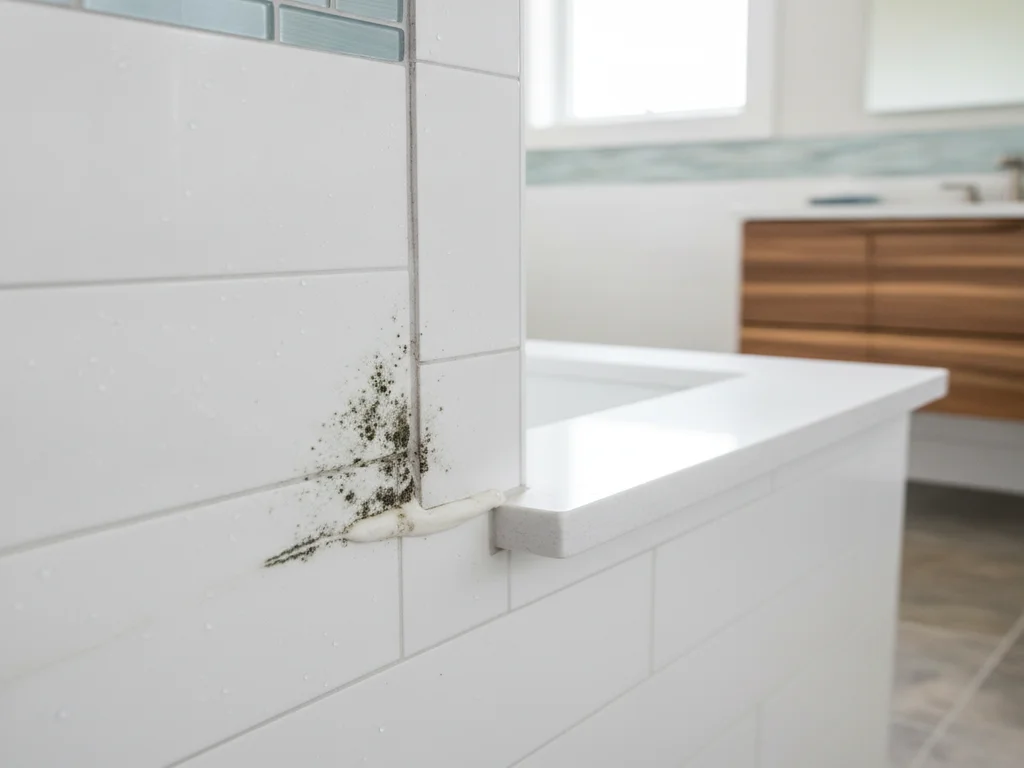
Discolouration and mildew without cracking is a third case, and often a cleaning or ventilation question rather than a repair one — unless the growth is within the material rather than on its surface, which means it is spent.
The test
Press a fingernail into the material. Caulk gives slightly and feels rubbery. Grout is hard. If the joint in your shower corner is hard, that is the problem — and re-grouting it will crack again within a year or two.
Why re-grouting a corner keeps failing
The most common repair sequence in a shower goes like this: a corner cracks, someone scrapes it out and re-grouts it, it cracks again, and the homeowner concludes the shower is poorly built.
The shower may be fine. The joint is simply moving, as it always did and always will, and a rigid material was installed in it a second time. Nothing about the repair addressed the reason for the failure.
The correct fix is to remove the grout from the movement joint entirely, clean the joint properly, and install a flexible sealant instead — matched to the grout colour so it disappears visually. Done once, it holds for years and can be renewed easily when it eventually wears.
This is also worth knowing when evaluating a contractor. A tile setter who caulks changes of plane rather than grouting them is following industry guidance, and a shower built that way will have fewer problems.
Which one is consumable
A useful framing: caulk is a maintenance item, grout is not.
Caulk is expected to be replaced periodically. It sits at joints that move, in the wettest part of the house, and no flexible sealant lasts forever. Re-caulking a tub or shower perimeter every few years is routine, inexpensive, and among the most cost-effective protective measures available for a bathroom.
Grout is not on a replacement schedule. Properly installed grout on a sound substrate can last decades. Cement grout needs periodic sealing to resist staining, and it can be cleaned and refreshed — but wholesale re-grouting is a response to a specific problem rather than routine upkeep.
So when a shower "needs work" annually, it is nearly always the caulk. When grout genuinely needs replacing across an area, it is worth asking what caused that rather than simply replacing it.
When it is neither
A few situations look like a caulk or grout problem and are not.
Water appearing outside a shower with intact-looking joints can indicate a waterproofing failure behind the tile. The finish surface is not what keeps water in a shower — the membrane behind it is — and a failure there produces symptoms elsewhere: a damp spot on an adjacent wall, a stain on a ceiling below, a soft floor at the shower edge.
Persistent mildew that returns within days of cleaning usually indicates a ventilation problem rather than a material one. Where a bathroom does not dry out between uses, no sealant will stay clean.
And repeated cracking in the tile field, not just the grout, points to movement in the assembly. That is a structural question and worth a professional look before any cosmetic repair.
Ready to plan your Boise bathroom?
Licensed & insured · 3-year workmanship warranty
Frequently asked questions
- What is the difference between caulk and grout?
- Grout is a rigid filler for joints between tiles on the same plane. Caulk is a flexible sealant for joints where planes change or materials meet — inside corners, wall-to-floor junctions, the top of a tub, around a valve. Those locations move, and only a flexible material can accommodate that movement.
- Why does the grout in my shower corner keep cracking?
- Because grout should not be there. Corners are changes of plane that move as the house settles and materials expand, and a rigid material cannot follow that movement. Re-grouting reproduces the failure. The fix is to remove it, clean the joint, and install a flexible sealant colour-matched to the grout.
- How do I tell whether a joint is caulk or grout?
- Press a fingernail into it. Caulk gives slightly and feels rubbery; grout is hard and cementitious. If a corner or a wall-to-floor joint in your shower feels hard, that is very likely the source of recurring cracking in that location.
- How often does shower caulk need replacing?
- Every few years is normal — caulk is a maintenance item, not a permanent installation. It sits at moving joints in the wettest room in the house, and no flexible sealant lasts indefinitely. Replacing it is inexpensive and among the most effective protective measures for a bathroom.
- Should grout ever need replacing?
- Not on a schedule. Properly installed grout on a sound substrate can last decades — cement grout needs periodic sealing and can be cleaned, but wholesale re-grouting is a response to a specific problem. If grout is failing across an area, the useful question is what caused it rather than simply replacing it.
Sources
- Tile Council of North America (TCNA)
- National Tile Contractors Association
- MAPEI — Tile & Stone Installation Systems
- LATICRETE
- This Old House — Bathrooms
Claims and figures are drawn from the sources above and provided for general guidance; your project may vary. Photography is illustrative of design concepts. For a fixed price on your specific bathroom, request a free estimate.