Updated July 16, 2026 · 7 min read
By Boise Bath — bathroom & shower remodeling in Boise & the Treasure Valley
The short answer
Cultured marble showers are cast panels of marble dust and polyester resin under a thin gelcoat — common in 1980s–90s homes. Once the gelcoat wears through, yellowing and etching are permanent. Replacement means prying the heavy panels off, stripping to the studs, and rebuilding with waterproofing under tile, wall panels, or an acrylic system.
Key takeaways
- Cultured marble is marble dust cast in polyester resin under a thin clear gelcoat — the veining is molded in, so the pattern often repeats panel to panel.
- Yellowing near the showerhead and a finish that stays dull after cleaning mean the gelcoat has worn through — that damage is permanent, not a cleaning problem.
- The panels come off individually, so removal is less dramatic than a one-piece fiberglass tear-out — but they are heavy and brittle, and the adhesive usually takes the drywall with it.
- Cultured marble panels were typically glued to drywall with no waterproofing behind them, so the replacement starts with a new substrate and membrane.
- Modern replacements — large-format wall panels, custom tile, or a multi-piece acrylic system — all outperform the original on durability and maintenance.
How do you know your shower is cultured marble?
Cultured marble was the upgrade finish of its era — a staple of 1980s and early-90s construction, including plenty of older Boise Bench and West Boise bathrooms. It is not stone slab: each panel is marble dust cast into polyester resin inside a mold, then sealed with a thin, clear gelcoat that gives it the glossy finish.
The tells are easy to spot. The veining is molded in rather than natural, so the swirl pattern often repeats from panel to panel or mirrors itself. Panels are large — frequently a single sheet per wall — with few or no grout lines, and edges are smoothly rounded rather than cut. The surface feels warmer to the touch than tile or real stone, and the back of any exposed edge shows a chalky, concrete-like casting rather than stone all the way through.
Matching vanity tops with integral molded sinks in the same veining are the other giveaway — builders typically ordered the whole bathroom from one cast-marble shop.
Why does cultured marble fail?
The panel itself is durable; the gelcoat is the weak point. That clear layer is only a few mils thick, and decades of scrubbing — especially with abrasive cleaners — wear it away. Once it is gone, the porous resin underneath is exposed, and it stains, etches, and yellows with nothing left to protect it.
Heat accelerates the decline. Polyester resin yellows with prolonged hot-water exposure, which is why the discoloration almost always shows up first in the spray zone below the showerhead. Hard Treasure Valley water compounds it: mineral deposits etch into exposed resin and become effectively permanent.
Cracks are the other failure mode. Cultured marble is brittle, and panels crack from impact, from settling, or around fixture cut-outs. Hairline crazing in the gelcoat is cosmetic; a crack you can catch a fingernail on lets water through to whatever is behind the panel.
Refinishing is a short-term patch
Spray-on refinishing can make worn cultured marble look better for a while, but the coating is thinner than the original gelcoat and fails faster in a wet, hot environment. On a shower that gets daily use, budget it as a two-to-five-year cosmetic bridge — not an alternative to replacement.
What does removing cultured marble panels involve?
Unlike a one-piece fiberglass unit — which has to be cut apart to fit through the door — cultured marble surrounds come off as individual panels. That makes the demo more surgical, but not lighter: a single wall panel can weigh well over a hundred pounds, and the material is brittle enough to shatter if it is pried carelessly.
The panels were typically set in generous beds of construction adhesive directly over drywall or greenboard. That adhesive rarely lets go cleanly, so the drywall behind usually comes out with the panels — which is fine, because it should not stay anyway.
The pan below is its own decision. Many cultured-marble showers have a matching cast pan, which shares the same gelcoat problems and usually comes out with the walls so the new system starts from a clean, waterproofed base.
What is behind the panels — and why it matters
Almost always plain drywall or greenboard, with no waterproofing membrane. The panel was the water barrier, and the seams between panels relied on caulk. Every failed caulk joint over the decades sent splash water into paper-faced drywall, so it is common to find soft, stained board — and sometimes framing damage — once the panels are down.
That is why a proper replacement never re-skins the old walls. The alcove goes back to the studs and gets a real assembly: cement board or foam board with a continuous waterproofing membrane, as covered in our shower waterproofing guide. Skipping that step is how a new shower inherits the old one’s problems.
What are the modern replacement options?
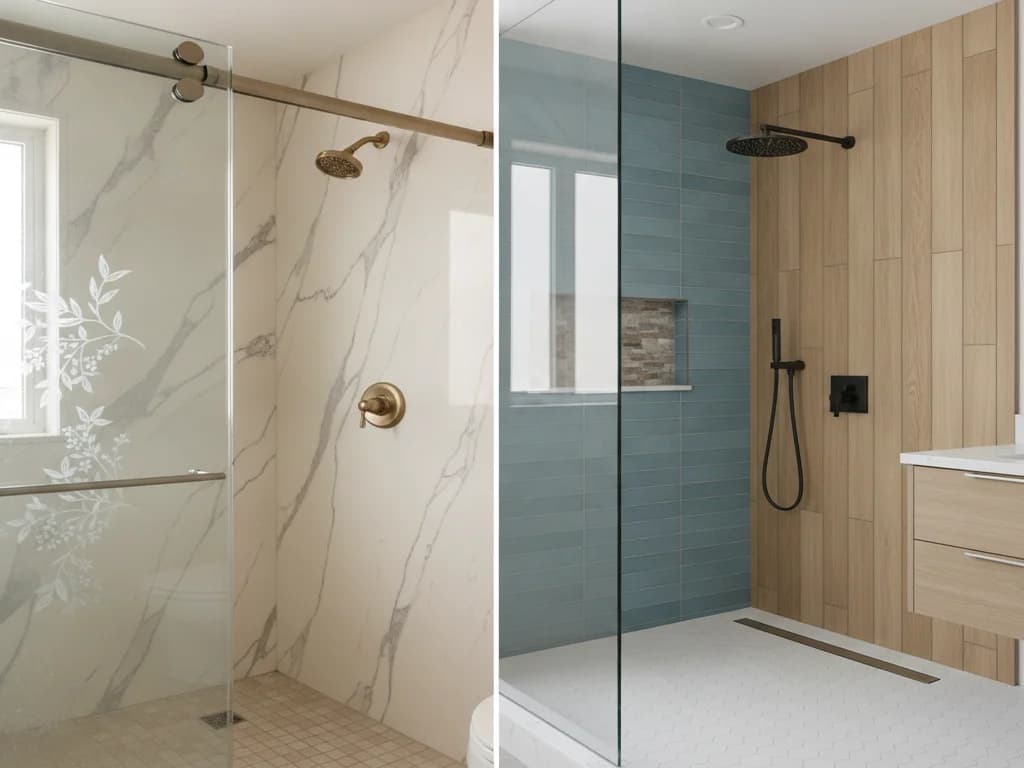
The like-for-like swap in spirit is a large-format wall panel system — solid-surface or composite sheets that give the same low-grout look cultured marble was chosen for, in current colors and with far better wear. We compare the systems in shower wall panel systems.
Custom tile is the full-transformation path: any size, any layout, curbless if the framing allows, and the option that changes a dated bathroom the most. A multi-piece acrylic system is the budget end — fast to install and low-maintenance, covered in our acrylic vs. tile comparison.
For a wider look at the whole field, see best shower wall materials.
| Option | Look vs. cultured marble | Maintenance | Best for |
|---|---|---|---|
| Large-format wall panels | Same low-seam look, modern finishes | Low — no grout | Keeping the easy-clean surround feel |
| Custom tile | Complete design change | Grout upkeep | Full remodel, curbless entries, resale impact |
| Multi-piece acrylic system | Simpler, budget-friendly | Lowest | Fast, cost-focused replacement |
What does replacement cost and how long does it take?
National cost guides such as HomeAdvisor and Angi put a full shower replacement broadly in the range of a few thousand dollars for a panel or acrylic system to ten thousand or more for custom tile — the spread is driven almost entirely by what goes back in, since the demo portion is similar either way.
Timeline runs roughly three days to a week: panel and acrylic systems at the short end, tile at the long end with waterproofing and grout cure time. If the valve or drain is replaced — likely, given the age of any cultured-marble bathroom — the City of Boise and neighboring Treasure Valley cities require a plumbing permit, which a licensed contractor pulls and inspects out.
For budget context on the upgrade path, our Boise walk-in shower cost guide breaks down what drives the number locally.
What the process looks like
- 1
Confirm the material and scope
The contractor verifies the surround is cultured marble (not solid surface or laminate), checks the pan and any matching tub deck, and scopes whether the vanity top from the same era is joining the project.
- 2
Protect the room and disconnect fixtures
Floors and the exit path are covered, the room is masked, and the valve trim, showerhead, and drain connections are disconnected before any prying starts.
- 3
Cut seams and remove the panels
Caulk joints and adhesive lines are cut, then panels are pried free one at a time and carried out — heavy, brittle work that usually takes the glued drywall along with it.
- 4
Strip to studs and inspect
Remaining drywall in the wet area comes out, and the crew inspects framing and subfloor for moisture damage at old caulk seams and around the drain, replacing anything compromised.
- 5
Update plumbing and blocking
A new pressure-balancing valve goes in, the drain is adjusted for the new pan, and blocking is added for niches, glass, and grab bars. Permitted work gets its rough-in inspection here.
- 6
Build the new substrate and waterproofing
Cement board or foam board is installed with a continuous waterproofing membrane — the layer the original shower never had.
- 7
Install the new pan, walls, and finish
The pan is set and connected, tile or panels go up per the system spec, then glass and trim are installed, everything is sealed and water-tested, and the permit is closed with a final inspection.
Ready to plan your Boise bathroom?
Licensed & insured · 3-year workmanship warranty
Frequently asked questions
- How can I tell cultured marble from real marble or solid surface?
- Cultured marble has molded-in veining that often repeats or mirrors between panels, rounded cast edges, and a chalky core visible at any exposed edge. Real marble is stone throughout with irregular natural veining and grout joints between slabs. Solid surface (like Corian) is a uniform color through its full thickness with no clear gelcoat layer.
- Can yellowed cultured marble be restored?
- Not reliably. Yellowing means the gelcoat has worn through and the polyester resin underneath has discolored from heat and water — polishing removes surface film but cannot reverse discoloration in the resin itself. Refinishing coatings can hide it temporarily, but in a daily-use shower they typically fail within a few years.
- Can you tile over cultured marble shower walls?
- No. The glossy gelcoat sheds thinset adhesion, the panels flex slightly on their adhesive beds, and the drywall behind them was never waterproofed. Tile needs a rigid, bonded, waterproofed substrate, so the panels come out and the wall is rebuilt — which also reveals any hidden moisture damage before it gets sealed in.
- How much does it cost to replace a cultured marble shower?
- National guides like HomeAdvisor and Angi put full shower replacement roughly between a few thousand dollars and ten thousand or more, depending on what replaces it — an acrylic or panel system at the low end, custom tile at the top. Cultured marble demo itself does not add much; the panels come off faster than tile.
- Is cultured marble removal messy?
- Less than a fiberglass cut-out, but it is heavy demolition. Panels are pried off whole where possible and broken up where the adhesive wins, and the glued drywall behind usually comes out too. A prepared crew masks the room, protects the floors, and hauls debris the same day — the demo phase is typically a single day.
- Should the matching cultured marble vanity top go at the same time?
- It is worth pricing. The vanity top shares the same gelcoat wear and yellowing clock, the same trades are already on site, and replacing both at once keeps the bathroom finishes coherent instead of pairing a new shower with a visibly dated top. It is a common add-on rather than a requirement.
Sources
- This Old House — Bathrooms
- HomeAdvisor — True Cost Guide
- Angi — Cost Guides
- City of Boise — Planning & Development Services
Claims and figures are drawn from the sources above and provided for general guidance; your project may vary. Photography is illustrative of design concepts. For a fixed price on your specific bathroom, request a free estimate.