Updated July 16, 2026 · 6 min read
By Boise Bath — bathroom & shower remodeling in Boise & the Treasure Valley
The short answer
A shower ceiling that keeps peeling or has begun to sag needs more than paint: the damaged board comes out, the cause — usually weak ventilation or a leak above — gets fixed, and moisture-rated board goes back in, finished with bathroom-grade paint, tile, or waterproof panels. Steam showers require a fully waterproofed, sloped ceiling.
Key takeaways
- Peeling paint over a shower is almost always a moisture symptom — repainting without fixing ventilation or the board underneath buys a year, not a fix.
- A sagging ceiling means the board itself has absorbed water and failed; it gets replaced, never repainted.
- Standard drywall does not belong directly over a shower — moisture-rated board is the minimum, and tile or panels need cement board or equivalent behind them.
- Ventilation is half the fix: an exhaust fan sized and ducted per Home Ventilating Institute guidance keeps the new ceiling from failing the same way.
- Rule out a leak from above before closing anything up — a stained shower ceiling under a second-floor bathroom is a plumbing question first.
Why do shower ceilings peel and sag in the first place?
The ceiling over a shower lives in the wettest air in the house. Every hot shower loads it with steam, and if that moisture is not exhausted fast, it condenses on the coolest surface in the room — usually the ceiling. Ordinary flat paint on ordinary drywall has no defense: the paint film blisters and peels, and with enough cycles the board’s paper face and gypsum core absorb water and soften.
Peeling is the early stage. Sagging, crumbling texture, or brown water stains mean the board itself has failed — at that point there is nothing to repaint, and the question becomes what to rebuild with.
Dry Idaho winters add a quirk: homes here run humidifiers and keep windows shut for months, so bathroom steam lingers longer than the climate’s reputation suggests. The dry air outside does not help a bathroom whose fan cannot move the wet air out.
Repaint, patch, or replace: which does your ceiling need?
Be honest about the stage. If the paint is peeling but the board underneath is hard, flat, and dry, a proper prep — scrape, stain-blocking primer, bathroom-rated paint — plus a ventilation fix can be a legitimate repair. If the board flexes when pressed, sags visibly, crumbles, or shows recurring dark staining, the board is done and comes out.
Dark staining deserves respect beyond aesthetics. Persistent moisture on ceiling board is exactly the environment the EPA’s mold guidance warns about, and mold inside a ceiling assembly is not fixed by painting over it — the affected material is removed, the moisture source corrected, and clean board installed.
Check above before you close up
A stained or sagging ceiling directly under a second-floor bathroom or attic HVAC gear may not be a steam problem at all — it can be a leaking drain, a failed supply fitting, or a sweating duct. Opening the ceiling is the moment to find out. Closing new board over an active leak wastes the whole repair.
Ventilation is half the replacement
Whatever surface goes back up inherits the same air. A new ceiling over a bathroom with a weak, undersized, or poorly ducted fan will fail the same way on the same schedule — so the fan gets evaluated as part of the ceiling job, not as an afterthought.
The Home Ventilating Institute publishes the sizing standard installers work from — as a baseline, roughly one CFM per square foot of bathroom floor area, more for larger rooms or enclosed shower compartments — and ENERGY STAR certifies quiet, efficient fans that people actually leave running long enough to matter. Ducting counts as much as the fan: a fan exhausting into the attic instead of outdoors just relocates the moisture problem to the framing above your new ceiling.
A humidity-sensing fan switch is the cheapest insurance in the whole project: it runs the fan until the room is actually dry rather than until someone remembers to flip it off.
What should the new shower ceiling be made of?
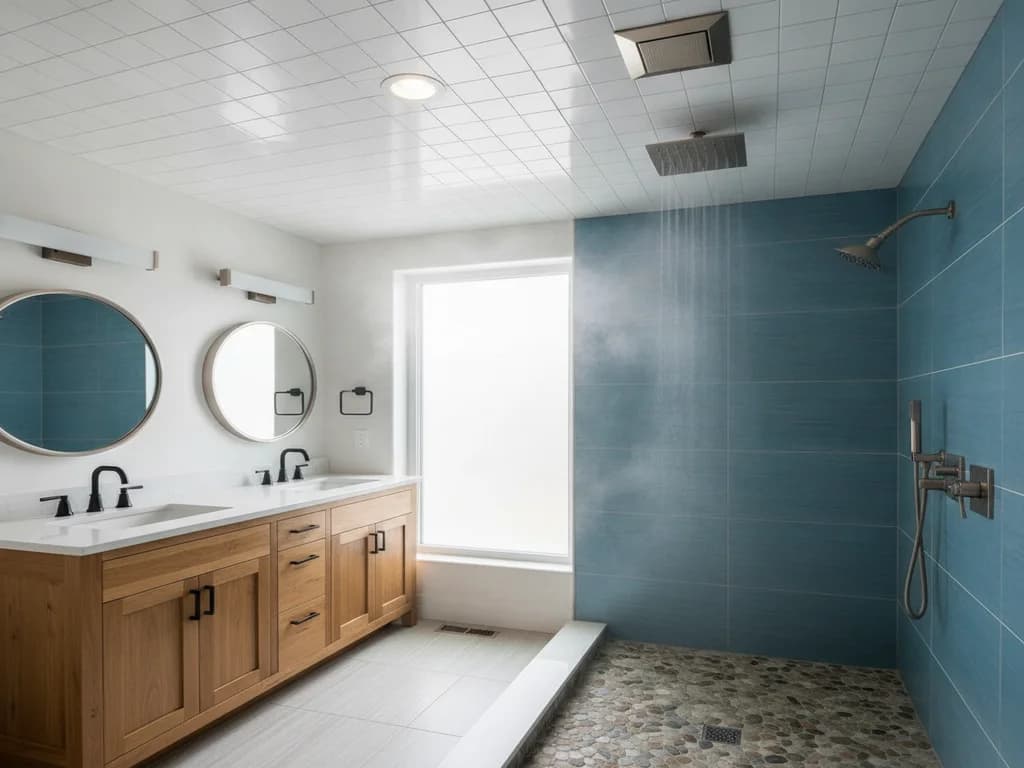
Above an open shower in a normally ventilated bathroom, moisture-rated drywall finished with a quality bathroom paint is the standard rebuild — economical and durable when the ventilation is right. Directly inside a shower enclosure, or anywhere the ceiling gets wetted rather than merely steamed, the assembly steps up to cement board or an equivalent substrate with a finish that tolerates water outright.
A tiled ceiling is the premium path: it matches the walls, shrugs off condensation, and turns the enclosure into a finished six-sided room. It requires proper backer and, in steam applications, membrane waterproofing overhead — tile-industry standards from the Tile Council of North America cover ceiling assemblies for exactly this use.
Waterproof wall panels are the third option, run overhead: large-format, grout-free sheets that install faster than tile and wipe clean. The panel systems themselves — brands, materials, price tiers — are compared in shower wall panel systems.
| Finish | Where it belongs | Moisture tolerance | Relative cost |
|---|---|---|---|
| Moisture-rated drywall + bath paint | Open showers, well-vented rooms | Steam only — not direct wetting | $ |
| Waterproof panels over backer | Enclosed showers, low-upkeep rebuilds | High — grout-free, wipeable | $$ |
| Tile over cement board | Enclosed showers, design-matched ceilings | High | $$$ |
| Tile over waterproofing membrane, sloped | Steam showers — required, not optional | Full waterproofing | $$$$ |
Steam showers change the rules entirely
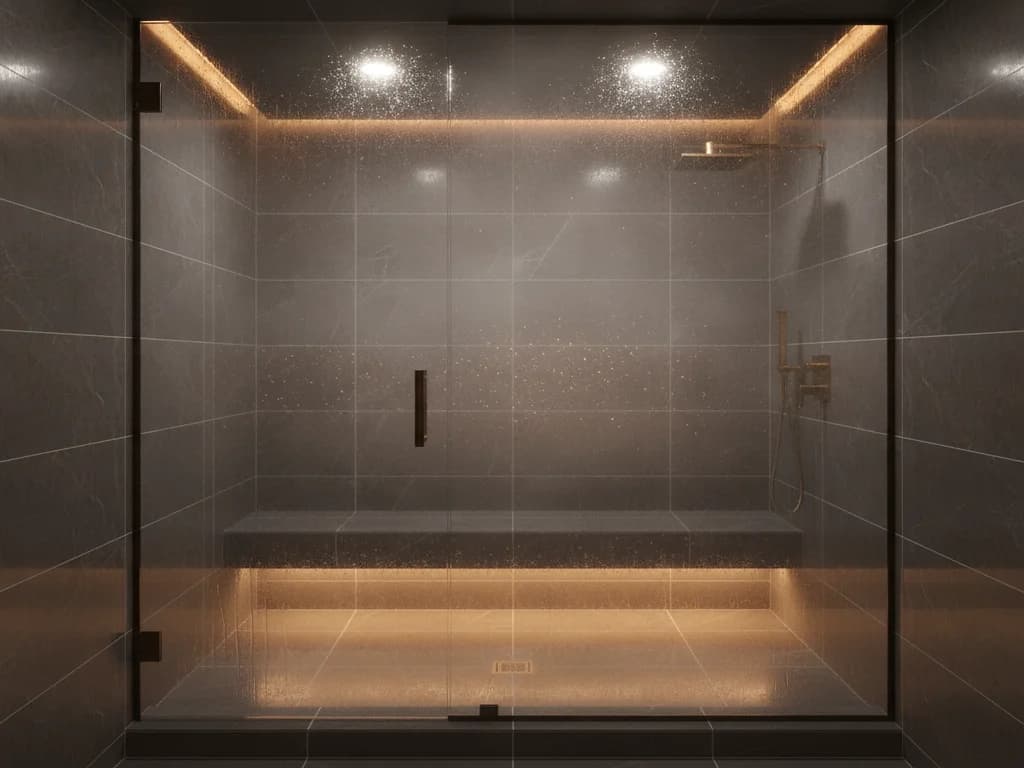
If the shower is — or will become — a steam shower, the ceiling stops being a finish decision and becomes part of the waterproofing envelope. A steam enclosure holds pressurized vapor against every surface, so the ceiling gets the same membrane treatment as the walls and is typically sloped so condensation sheets to a wall instead of dripping cold onto whoever is inside.
That is a meaningfully different build from a standard ceiling swap, and it is worth planning at ceiling-replacement time even if the steam generator comes later: the substrate and slope are cheap to frame now and disruptive to retrofit. Our steam shower ideas guide covers what a full steam build involves, and steam shower maintenance covers keeping one healthy.
When a ceiling job should widen into a shower job
A failed ceiling in an aging shower is often the first visible symptom of an enclosure at end of life — the same steam that ruined the ceiling has been working on the wall grout and the seams below it. If the walls are hollow-sounding, the grout keeps failing, or the surround is a dated glue-up kit, replacing the ceiling alone means opening the same room twice.
The economics favor bundling: demo, protection, and trades are already on site. See replacing shower tile for what a wall rebuild involves and replacing a shower surround if panels are what is failing. City of Boise Planning & Development Services requires permits when plumbing or electrical work rides along — a new fan circuit or a valve swap — which a licensed contractor handles.
What the process looks like
- 1
Diagnose the moisture source
The contractor confirms whether the failure is condensation, a leak from above, or a fan problem — moisture readings, a look in the attic or at the floor above, and a check of the fan’s actual airflow and ducting.
- 2
Protect the room and open the ceiling
The shower and floor are masked, then the damaged board comes down to the framing across the affected area — cut back to sound material, not just the visible stain.
- 3
Inspect framing, insulation, and anything above
Joists are checked for moisture damage, wet insulation is replaced, and any plumbing or duct issue found above gets fixed before a single sheet of new board goes up.
- 4
Correct the ventilation
The fan is upsized or replaced to HVI-based sizing, ducted to the exterior with sealed, insulated duct, and ideally switched on a humidity sensor. Electrical work here is permitted and inspected.
- 5
Install the right substrate
Moisture-rated board goes up over open showers; cement board or equivalent goes up where tile or panels will follow, with membrane waterproofing and slope framed in for steam applications.
- 6
Finish the surface
Bathroom-grade paint over sealed board, or tile or panels set and sealed per the system spec, with silicone at the wall-ceiling junction inside enclosures.
- 7
Verify and close out
The fan’s airflow is confirmed, the finish is cured and water-checked where applicable, and permitted electrical or plumbing work gets its final inspection.
Ready to plan your Boise bathroom?
Licensed & insured · 3-year workmanship warranty
Frequently asked questions
- Why does my shower ceiling keep peeling after I repaint it?
- Because the paint was never the problem. Steam is condensing on the ceiling faster than the room exhausts it — usually an undersized, unused, or badly ducted fan — and no paint film survives repeated soaking. The durable fix pairs surface prep and bathroom-rated paint with a ventilation correction, and if the board has softened, replacement board.
- Is a sagging shower ceiling dangerous?
- Treat it as urgent. Sagging means the board has absorbed enough water to lose strength, and wet gypsum eventually lets go — dropping soggy, possibly moldy material into the shower. It can also be the first visible sign of an active leak from a bathroom or plumbing run above, which keeps doing damage until someone opens the ceiling and looks.
- Can you tile a shower ceiling?
- Yes — over the right substrate. Ceiling tile inside an enclosure needs cement board or an equivalent rated backer, appropriate thinset coverage for overhead work, and in steam showers a continuous waterproofing membrane and a slight slope. Done to tile-industry standards it is the most durable, design-cohesive ceiling a shower can have.
- Do I need moisture-resistant drywall over a shower?
- At minimum, yes — moisture-rated board is the baseline over tubs and open showers, and standard drywall directly above a shower is asking for the failure you just repaired. Where the ceiling gets wetted rather than steamed, or in any steam enclosure, the assembly steps up to cement board with a waterproof finish or membrane.
- How much does it cost to replace a shower ceiling?
- A board-and-paint rebuild over an open shower is typically a few hundred to around a thousand dollars, per national cost guides like HomeAdvisor — while tiled or panel ceilings inside an enclosure, ventilation upgrades, or leak repairs found along the way move the number up from there. The diagnosis drives the price more than the square footage.
Sources
- Home Ventilating Institute (HVI)
- EPA — Mold
- ENERGY STAR — Ventilating Fans
- Tile Council of North America (TCNA)
- HomeAdvisor — True Cost Guide
Claims and figures are drawn from the sources above and provided for general guidance; your project may vary. Photography is illustrative of design concepts. For a fixed price on your specific bathroom, request a free estimate.