Updated September 11, 2026 · 9 min read
By Boise Bath — bathroom & shower remodeling in Boise & the Treasure Valley
The short answer
TCNA’s steam shower methods call for a bonded membrane rated 0.5 perms or less under ASTM E96 Procedure E. By their own data sheets, KERDI-DS (0.19), HYDRO BAN 1 (0.25), RedGard (0.35 at 30 mils dry) and Mapelastic AquaDefense (0.35) are under it; standard KERDI (0.90) is not.
Key takeaways
- TCNA steam shower methods SR613 and SR614 require a bonded waterproof membrane of 0.5 perms or less, tested to ASTM E96 Procedure E at 90% relative humidity — or a secondary vapor retarder behind the tile substrate.
- LATICRETE’s HYDRO BAN XP data sheet publishes 1.25 perms under Procedure B and 0.19 perms under Procedure E for the same membrane. A perm number without its test procedure cannot be compared with anything.
- Standard Schluter KERDI is 0.90 perms. Schluter rates it for intermittent-use steam showers and specifies KERDI-DS — 20 mil, 0.19 perms — for continuous-use steam rooms.
- A liquid membrane’s rating belongs to a thickness. RedGard’s 0.35 perms is published “at 30 mils dry,” and the same sheet gives its cured thickness as 0.015–0.038" “determined by application.”
- Flood-test waits move with temperature. LATICRETE’s 2-hour figures apply at 70°F or higher; below that its sheets typically call for 24 hours. Boise’s January normal averages 32.2°F.
The short answer
For an ordinary shower, the perm rating of the waterproofing membrane barely matters. For a steam shower it is the number that decides whether the wall assembly behind the tile is doing its job, and the manufacturers publish it — but not all in the same way, and not all measured the same way.
Read against the Tile Council of North America’s 0.5 perm threshold, the data sheets sort into three groups: membranes rated under it by the specified test, membranes rated over it, and membranes whose published figure comes from a different test and cannot be checked against it at all.
The threshold every number is measured against
A perm rating is, in TCNA’s words, “the amount of moisture vapor that a membrane allows to pass through in a given time under a given pressure.” Lower means less vapor gets through.
Since the 2013 edition of the TCNA Handbook, steam shower installation methods SR613 and SR614 have required a bonded waterproof membrane with a perm rating of 0.5 perms or less — or, if the membrane is rated higher, a secondary vapor retarder behind the tile substrate. The Handbook Committee also fixed the test: ASTM E96 Procedure E, at 90% relative humidity. wedi’s steam technical report and MAPEI’s data sheet both give the Procedure E conditions as 100°F and 90% RH.
The reason is what escaping vapor does. TCNA’s own explanation lists wood or metal framing, the drywall on the far side of the wall cavity and nearby wood subflooring among the materials excessive vapor transmission can damage. As the same article puts it: “the more steam, the more critical the wall system design.”
The data sheets, side by side
Every figure below comes from the manufacturer’s own technical data sheet. Where a sheet does not publish something, the table says so rather than filling the gap.
| Membrane | Form | Published perm rating | Test stated | Steam use, per the manufacturer |
|---|---|---|---|---|
| Schluter KERDI | Sheet, 8 mil | 0.90 | E96 Procedure E, 90% RH | Intermittent-use steam showers; not continuous-use steam rooms |
| Schluter KERDI-DS | Sheet, 20 mil | 0.19 | E96 Procedure E, 90% RH | Continuous-use steam rooms |
| RedGard (liquid) | Liquid | 0.35 at 30 mils dry | E96 Method E | Lists steam showers and steam rooms |
| RedGard Fabric Membrane | Sheet | Under 0.5 | E96 Method E | Lists residential steam showers |
| LATICRETE HYDRO BAN | Liquid, 20–30 mils dried | 1.247 | E96 Procedure B | “Do not use as a vapor barrier (especially in steam rooms)” |
| LATICRETE HYDRO BAN XP | Liquid, 20–30 mils dried | 1.25 (Procedure B) · 0.19 (Procedure E) | Both | Lists steam showers and steam rooms |
| LATICRETE HYDRO BAN 1 | Trowel-applied liquid | 0.25 | E96 Procedure E | Lists steam showers and steam rooms |
| MAPEI Mapelastic AquaDefense | Liquid, about 20 mils dry minimum | 0.35 | E96 Procedure E, 100°F, 90% RH | Steam rooms and showers, referencing TCNA SR613/SR614 |
| wedi Building Panel | Foam backer board | Not rated (“N/A”) | — | Sheet directs steam rooms and showers to wedi Vapor 85 |
Published water vapor permeance, shower waterproofing membranes
Figures from each manufacturer’s current data sheet, retrieved September 2026; always check the sheet for the exact product you are buying. Schluter’s steam-shower FAQ gives KERDI-DS as 0.18 perms where its data sheet says 0.19. wedi states that Vapor 85 exceeds the TCNA requirement but does not print a perm figure in the documents reviewed, so none is listed here.
One membrane, two perm ratings
The most useful line in this whole comparison is on LATICRETE’s HYDRO BAN XP data sheet, which publishes two water vapor permeance figures for the same membrane: 1.25 perms under ASTM E96 Procedure B, and 0.19 perms under ASTM E96 Procedure E. Same product, same sheet, about six and a half times apart.
Neither number is wrong. They are answers to different test conditions — which is exactly why TCNA specified one. Only the Procedure E figure can be read against the 0.5 perm threshold, and on that figure HYDRO BAN XP sits well under it.
The original HYDRO BAN sheet publishes only a Procedure B figure, 1.247 perms, and is consistent with itself about what that means: it lists steam rooms only “when used in conjunction with a vapor barrier,” and separately says “Do not use as a vapor barrier (especially in steam rooms).” The steam-rated products in the same family are the ones publishing Procedure E numbers.
The question that settles most comparisons
When someone quotes a perm rating, ask which ASTM E96 procedure it was measured under. If the answer is not Procedure E, the number cannot tell you whether the membrane meets the TCNA steam shower threshold — however low it looks.
“Intermittent” and “continuous” are doing a lot of work
Schluter draws a line between intermittent-use steam showers, where standard KERDI is acceptable, and continuous-use steam rooms, where KERDI-DS is required. TCNA’s 0.5 perm requirement is likewise framed around continuous use, and its article notes the steam showers run continuously are the kind found in fitness clubs and hotels.
Neither document puts a number of minutes or hours on the difference, and we are not going to invent one. What can be said plainly is that the distinction exists, that it decides which Schluter membrane the manufacturer itself specifies, and that the cleanest way around the ambiguity is to specify a membrane rated at 0.5 perms or less by Procedure E. At that point the question of how the steam shower will be used no longer changes the answer.
A liquid membrane’s number belongs to a thickness
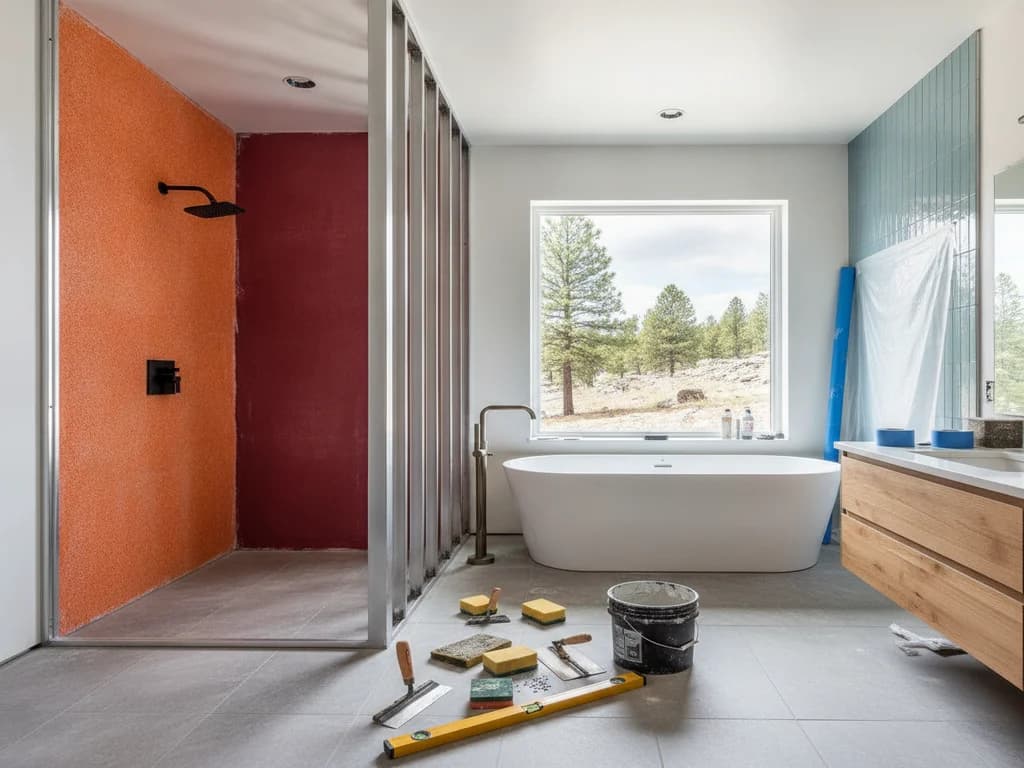
Sheet membranes arrive at their rated thickness from the factory: KERDI is 8 mil and KERDI-DS is 20 mil, every square foot. A liquid membrane becomes whatever thickness the installer puts on the wall, and its published performance is tied to a thickness the sheet states.
RedGard’s data sheet reports 0.35 perms at 30 mils dry, and its waterproofness test as passing at 25 mils dry. The same sheet gives the product’s cured thickness as 0.015–0.038" — 15 to 38 mils — noting that “thickness is determined by application.” The figure is real; it describes a particular film.
The other liquid sheets say the same thing in their own ways. LATICRETE gives HYDRO BAN XP a wet coat of 15–22 mils per coat and tells installers to “use a wet film thickness gauge to check thickness.” HYDRO BAN 1 specifies a 30–40 mil wet coat. MAPEI asks for a final dry thickness of about 20 mils at minimum for AquaDefense — “about the thickness of a credit card,” in its own description.
A wet film gauge is an inexpensive tool, and every liquid manufacturer here names a thickness it expects. On a steam shower, whether that thickness was checked is a fair question to ask.
Flood-test waits, and what a Treasure Valley January does to them
Every sheet here calls for the membrane to cure before it is flood tested, and the waits vary widely — and depend on temperature:
- LATICRETE HYDRO BAN: 2 hours at 70°F or higher and 50% RH; typically 24 hours at 50–69°F and 70% RH.
- HYDRO BAN XP and HYDRO BAN 1: 2 hours at 70°F or higher; typically 24 hours at 35–69°F. (HYDRO BAN 1 counts from full colour change.)
- MAPEI Mapelastic AquaDefense: at least 12 hours at 73°F and 50% RH.
- RedGard (liquid): drying typically 1–1.5 hours per coat but “as much as 12 hours” depending on ambient conditions; flood test after both coats are fully cured.
- RedGard Fabric Membrane: not sooner than 24 hours in moderate temperatures.
Why this matters here
NOAA’s 1991–2020 climate normals put Boise’s average temperature at 32.1°F in December and 32.2°F in January, with a January normal high of 38.8°F. The temperature that governs cure is the room and the substrate, not the weather — but a bathroom with an exterior wall, mid-remodel, in a Treasure Valley winter is not at 70°F by default. On LATICRETE’s own sheets, that is the difference between a 2-hour wait and a 24-hour one.
What to ask before the membrane goes on
- Which membrane is it, and does its data sheet list the kind of steam use you are planning?
- What is its perm rating — and under which ASTM E96 procedure?
- If it is a liquid, what thickness is that rating tied to, and how will the applied thickness be checked?
- If the Procedure E rating is above 0.5 perms, or there is no Procedure E figure, where is the secondary vapor retarder?
- What flood-test wait does the sheet give at the temperature the room will actually be?
- Will the shower be flood tested before tile goes on? Every sheet reviewed here calls for it.
Ready to plan your Boise bathroom?
Licensed & insured · 1-year workmanship warranty
Frequently asked questions
- Can you use RedGard in a steam shower?
- Custom Building Products says so on its data sheet: RedGard “meets low perm requirements for steam room vapor barriers per ASTM E-96 Procedure E” and lists steam showers and steam rooms among its uses. The published figure is 0.35 perms at 30 mils dry, against TCNA’s 0.5 perm threshold — so the rating assumes a film of that thickness, and the sheet notes that cured thickness is determined by application.
- Can you use regular KERDI in a steam shower?
- Schluter says yes for intermittent-use steam showers, and requires KERDI-DS for continuous-use steam rooms. Standard KERDI is 8 mil and 0.90 perms by ASTM E96 Procedure E; KERDI-DS is 20 mil and 0.19 perms. Schluter does not publish a definition of intermittent versus continuous use.
- Is HYDRO BAN rated for steam showers?
- It depends which HYDRO BAN. The original HYDRO BAN sheet publishes 1.247 perms under ASTM E96 Procedure B and says not to use it as a vapor barrier, especially in steam rooms. HYDRO BAN XP (0.19 perms, Procedure E) and HYDRO BAN 1 (0.25 perms, Procedure E) both list steam showers and steam rooms among their uses.
- What perm rating does a steam shower membrane need?
- TCNA’s steam shower methods, SR613 and SR614, call for a bonded waterproof membrane of 0.5 perms or less when tested to ASTM E96 Procedure E at 90% relative humidity. If the membrane is rated higher, the methods call for a secondary vapor retarder behind the tile substrate instead.
- Why does the test procedure matter so much?
- Because the same membrane can produce very different numbers under different procedures. LATICRETE’s HYDRO BAN XP data sheet lists 1.25 perms under Procedure B and 0.19 perms under Procedure E. TCNA specifies Procedure E, so only a Procedure E figure can be compared against its 0.5 perm threshold.
Sources
- Tile Council of North America (TCNA)
- Schluter Systems
- Custom Building Products (RedGard)
- LATICRETE
- MAPEI — Tile & Stone Installation Systems
- wedi Corporation
- NOAA NCEI — U.S. Climate Normals (1991–2020)
- TCNA — Membranes in Steam Showers: Better Clarity on a Foggy Issue
- Schluter — KERDI Technical Data Sheet
- Schluter — Waterproofing Membranes Data Sheet (KERDI and KERDI-DS)
- Schluter — Can I use KERDI in my steam shower?
- Custom Building Products — RedGard Waterproofing and Crack Prevention Membrane, TDS-104
- Custom Building Products — RedGard Fabric Membrane, TDS-550
- LATICRETE — HYDRO BAN Product Data Sheet
- LATICRETE — HYDRO BAN XP Product Data Sheet
- LATICRETE — HYDRO BAN 1 Product Data Sheet
- MAPEI — Mapelastic AquaDefense Technical Data Sheet (via BuildSite)
- wedi — Building Panel Technical Data Sheet
- wedi — Steam Rooms and Steam Showers Technical Report
Claims and figures are drawn from the sources above and provided for general guidance; your project may vary. Photography is illustrative of design concepts. For a fixed price on your specific bathroom, request a free estimate.