Updated July 16, 2026 · 7 min read
By Boise Bath — bathroom & shower remodeling in Boise & the Treasure Valley
The short answer
Both systems work when installed correctly — the real difference is control. Schluter’s Kerdi sheet membrane gives factory-consistent thickness and same-day tiling; RedGard’s liquid membrane costs less and wraps complex shapes but depends on applied thickness. For steam showers or vapor-sensitive builds, sheet membranes win; for budget projects with a disciplined installer, RedGard performs.
Key takeaways
- Schluter Kerdi is a bonded sheet membrane with factory-controlled thickness; RedGard is a liquid-applied membrane whose thickness depends entirely on the person rolling it on.
- Both are recognized bonded-membrane approaches under TCNA shower methods — the brand matters less than whether the system is installed complete and to spec.
- Sheet systems fail at seams; liquid systems fail at thin spots. Every waterproofing argument on the internet is really about which failure mode you trust an installer to avoid.
- Liquid membranes cure between coats; sheet membranes can be tiled the same day — a real schedule difference on a multi-trade remodel.
- Steam showers and vapor-heavy builds favor low-permeance sheet membranes; manufacturers publish the ratings, and they are not equivalent.
- Never mix brands within one shower — each manufacturer warranties its own complete system, not a hybrid.
The verdict: a systems decision, not a brand war
Schluter versus RedGard is really sheet membrane versus liquid membrane — two legitimate ways to build the waterproof layer that keeps a tile shower from rotting the wall behind it. Both approaches are recognized in TCNA handbook methods, both carry decades of field history, and both fail in predictable ways when corners get cut.
The honest verdict: sheet systems like Schluter Kerdi buy you consistency — the membrane leaves the factory at a known thickness, so the installer’s job is seams and coverage, not chemistry. Liquid systems like RedGard buy you flexibility and a lower material bill — but the membrane’s thickness is created on your wall, coat by coat, and thin spots are invisible under tile.
This article covers the products themselves. If you want the bigger picture — why grout was never the waterproofing, and what a complete shower assembly looks like — start with the shower waterproofing guide; it owns the method-level explanation.
What each system actually is
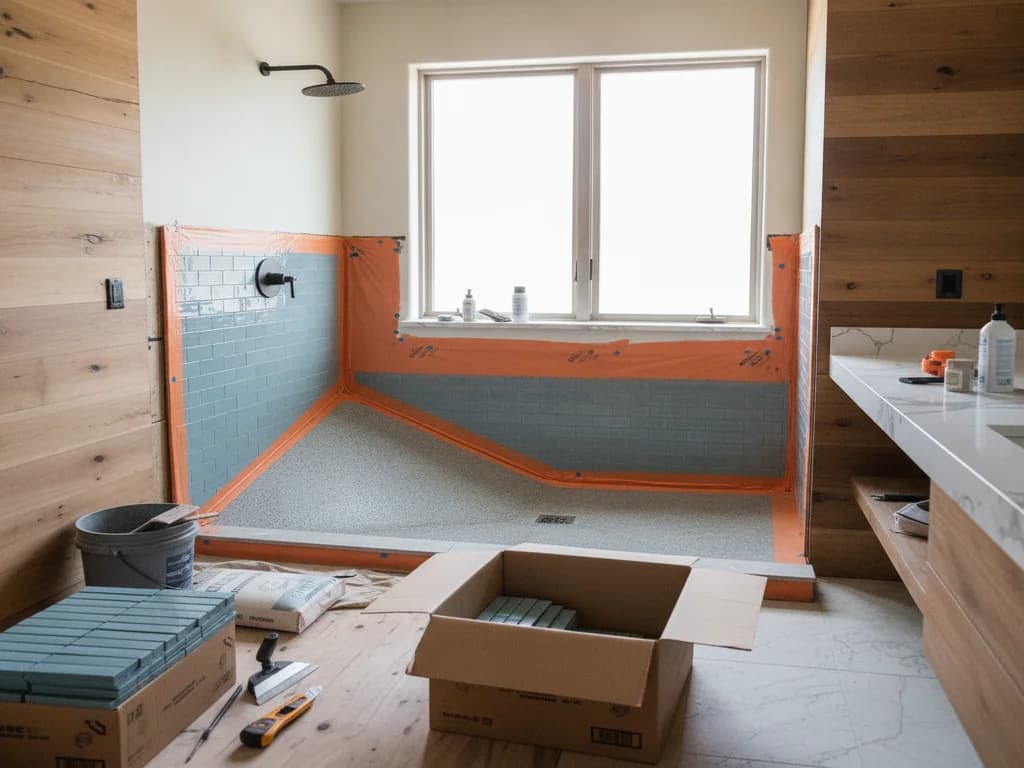
Schluter Kerdi is the best-known bonded sheet membrane: a thin polyethylene sheet faced with fleece, embedded in thinset over drywall or backer board. Thickness is factory-controlled, seams overlap and get sealed with the same thinset or banding, and the wall can be tiled the same day. It anchors a family that includes Laticrete’s sheet membranes and, one step further, foam building panels like wedi board and Kerdi-Board — panels that are the waterproofing and the substrate in one piece.
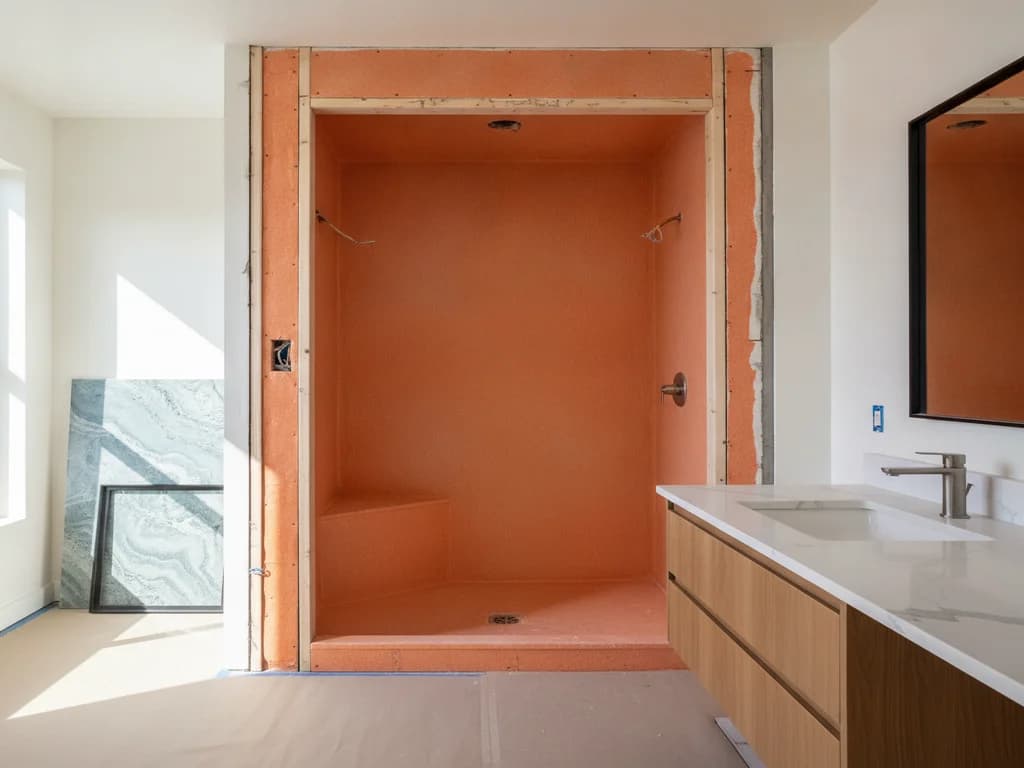
RedGard, from Custom Building Products, is the best-known liquid-applied membrane: an elastomeric coating rolled, troweled, or sprayed onto the substrate, going on pink and curing to red. It anchors the liquid family that includes LATICRETE Hydro Ban and similar products. Applied to the manufacturer’s specified film thickness — verified with a wet-film gauge, usually across two coats — it forms a seamless rubber-like skin rated for bonded tile.
Both families, installed complete, meet the same ANSI performance standard for bonded waterproof membranes. That is why the professional answer to “which is better?” starts with “which will this crew install correctly?”
Schluter vs. RedGard: the side-by-side
Here is the comparison installers actually weigh, brand names aside — sheet system versus liquid system:
| Factor | Sheet membrane (Kerdi, wedi, Laticrete sheet) | Liquid membrane (RedGard, Hydro Ban) |
|---|---|---|
| Thickness control | Factory-set — every square foot identical | Installer-dependent — verified by wet-film gauge, coat by coat |
| Weak point | Seams and banding at corners, curb, and drain | Thin spots, missed coverage, pinholes |
| Cure time | Tile the same day | Hours between coats, plus final cure before tiling |
| Complex shapes | Requires cutting, folding, and banding | Paints around niches, benches, and curves easily |
| Steam showers | Low-perm versions rated for continuous vapor (e.g., Kerdi-DS) | Generally higher permeance; check the specific rating before specifying |
| Material cost | Higher — membrane, bands, and corners add up | Lower — a pail covers a standard shower |
| Verification | Visual — seams either overlap or they don’t | Harder — proper thickness is invisible once cured |
Performance specs come from each manufacturer’s published data sheets (Schluter, Custom Building Products, LATICRETE, wedi). Both families meet ANSI A118.10 when installed to spec.
Thickness and consistency: the real difference
Everything else in this comparison is downstream of one fact: sheet membranes arrive at their rated thickness, and liquid membranes have to be built to it on site. Schluter publishes one thickness for Kerdi and every roll matches it. RedGard performs to its rating only at the specified dry-film thickness, which typically takes two full coats and a wet-film gauge to confirm.
That is not a knock on RedGard — it is a knock on rushed installs. A liquid membrane rolled on like paint, in one thin coat, on a Friday afternoon, is the failure story behind most “RedGard doesn’t work” posts. Applied to spec, it is a proven membrane used in thousands of showers.
The flip side: sheet systems concentrate their risk at seams. Every corner, curb wrap, pipe penetration, and drain connection is a joint that must be banded and embedded correctly. A sheet shower with sloppy seams is no drier than a thin liquid one. This is why replacing shower waterproofing jobs almost always trace back to installation shortcuts, not product choice.
Never mix waterproofing brands in one shower
Kerdi walls over a RedGard-coated pan, or RedGard patches on a wedi panel, may bond fine — but no manufacturer warranties the hybrid, and chemistry conflicts between systems are real. A shower should be one complete system, one brand, installed per that brand’s handbook. If a contractor proposes mixing, ask which manufacturer will stand behind the assembly. The answer is neither.
Schedule, budget, and buildability
On schedule, sheet wins: Kerdi and foam-board systems can be tiled the same day they go up, while liquid systems need cure time between coats and before tile — often adding a day to the waterproofing phase. On a one-bathroom house, that day matters.
On budget, liquid wins the material line: a pail of RedGard covering a standard shower costs meaningfully less than the membrane, bands, preformed corners, and seals of a sheet system. Labor narrows the gap, because careful liquid application takes time too, but the material math favors liquid on tight budgets.
On buildability, it depends on the shower. A simple three-wall alcove suits either. A shower with a bench, two niches, a curved half-wall, and odd angles favors liquid, which paints around complexity instead of folding and banding it. A steam shower or a build where vapor matters favors low-permeance sheet — the manufacturers’ own perm ratings, not marketing, make that call. And curbless or heavily reconfigured showers often land on foam-board systems like wedi, where the panels replace the substrate entirely — a decision that runs through pan and drain design as much as wall waterproofing.
Which should you choose?
Let the project profile pick the system:
- Standard alcove shower, experienced tile crew, tight schedule: Schluter Kerdi — consistent, verifiable, tile-ready the same day.
- Budget remodel with a careful installer and no steam plans: RedGard to full specified thickness — proven performance at a lower material cost.
- Steam shower or vapor-sensitive assembly: a low-permeance sheet system rated for it, such as Kerdi-DS — confirm the perm rating in the data sheet.
- Complex geometry — benches, curves, multiple niches: liquid membrane, or a foam-board system that builds the shapes and waterproofs them in one step.
- Curbless conversion or full reconfiguration: foam-board systems (wedi, Kerdi-Board) earn their premium — see the full waterproofing guide for how the pan, walls, and drain integrate.
- Any shower, any system: complete assembly, one brand, installed to the handbook — the common waterproofing mistakes are almost all shortcuts, not product failures.
Ready to plan your Boise bathroom?
Licensed & insured · 3-year workmanship warranty
Frequently asked questions
- Is RedGard as good as Schluter Kerdi?
- At full specified thickness, yes — both meet the same ANSI bonded-membrane standard, and both have long field histories. The difference is where the risk sits: RedGard’s performance depends on the installer building the membrane to spec coat by coat, while Kerdi’s thickness is factory-set and its risk concentrates at seams. Pick based on the crew and the shower, not the forum wars.
- Can you tile the same day over RedGard?
- No — RedGard needs to cure between coats and reach its final cure before tile, per Custom Building Products’ instructions, which typically pushes tiling to the next day. Sheet membranes like Kerdi are the same-day option: once the membrane is embedded and seams are treated, tile can go on immediately. On a tight remodel schedule, that difference is worth a day.
- Do you still need waterproofing over cement backer board?
- Yes — this is the most expensive misconception in shower construction. Cement board is not waterproof; it holds up when wet but passes water straight through to the framing. Every modern TCNA shower method puts a bonded membrane (sheet or liquid) or a topical barrier over or behind the board. A shower tiled on bare backer board is a slow leak with a start date.
- Can you use RedGard and Kerdi together in one shower?
- You shouldn’t. Each manufacturer tests and warranties its own complete system — Schluter’s handbook assumes Schluter components, and Custom Building Products assumes theirs. A hybrid may physically bond, but nobody stands behind it, and dissimilar materials meeting at seams and corners is exactly where showers fail. One shower, one system, one brand.
- Which is better for a steam shower?
- A low-permeance sheet membrane rated for steam — Schluter specifies Kerdi-DS for continuous high-vapor environments, and wedi publishes steam-rated assemblies. Standard liquid membranes generally carry higher permeance ratings, which matters when the shower generates vapor for thirty minutes at a time. Check the manufacturer’s data sheet for a steam rating before specifying anything.
- How do I know if my existing shower was waterproofed properly?
- From the finished side, you mostly can’t — proper membrane work is invisible under tile, which is why failures show up as symptoms: darkening grout that never dries, a musty smell, soft drywall on the wall behind the valve, or staining on the ceiling below. If those are appearing, the membrane conversation is already over; see what [replacing shower waterproofing](/guides/replacing-shower-waterproofing) involves.
Sources
- Schluter Systems
- Custom Building Products (RedGard)
- LATICRETE
- wedi Corporation
- Tile Council of North America (TCNA)
Claims and figures are drawn from the sources above and provided for general guidance; your project may vary. Photography is illustrative of design concepts. For a fixed price on your specific bathroom, request a free estimate.