Updated July 16, 2026 · 7 min read
By Boise Bath — bathroom & shower remodeling in Boise & the Treasure Valley
The short answer
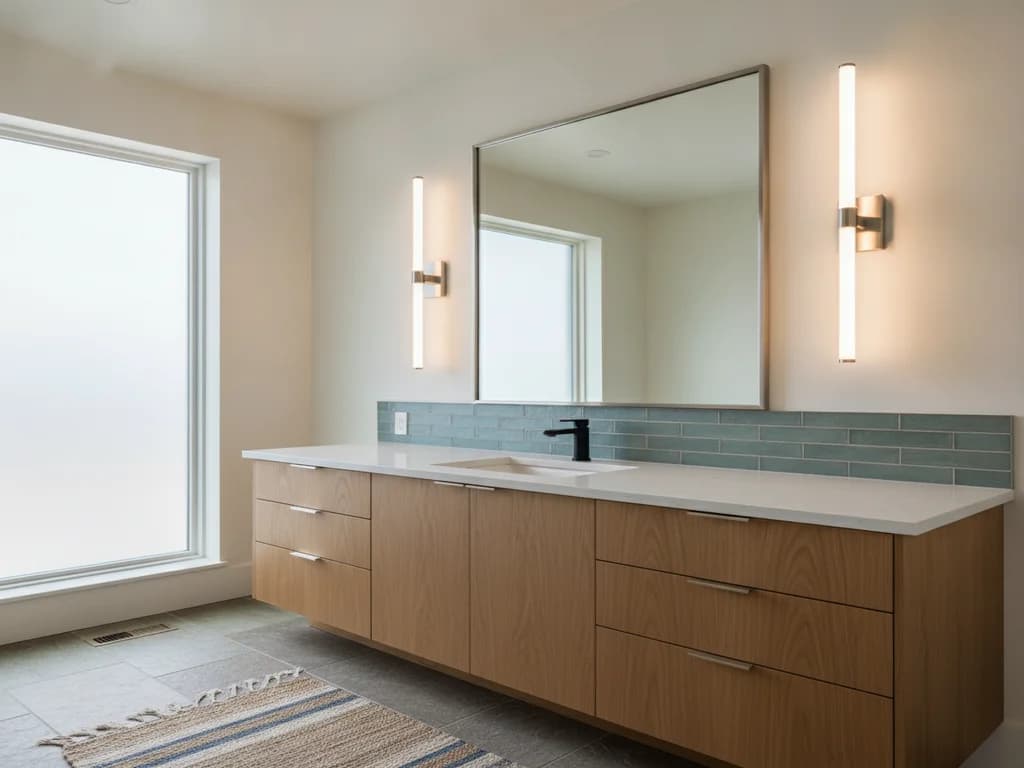
The best makeup vanity lighting is a pair of vertical fixtures or sconces flanking the mirror at eye level — roughly 60 to 66 inches off the floor — with bulbs rated 90+ CRI in the 2700–3000K range. Light from the sides fills the face evenly; a single overhead fixture casts the shadows that sabotage makeup work.
Key takeaways
- Placement beats wattage: fixtures flanking the mirror at eye level light the face straight-on and shadow-free, which is the entire job of makeup lighting.
- A lone bar light over the mirror is the classic mistake — it rakes light down the face and throws shadows under the eyes, nose, and chin, exactly where makeup work happens.
- CRI (color rendering index) is the honesty spec: 90+ CRI light shows skin tone and makeup color accurately; low-CRI bulbs make colors lie indoors and outdoors disagree.
- Color temperature between 2700K and 3000K flatters skin while staying warm enough for the room; whatever you pick, every bulb at the mirror must match.
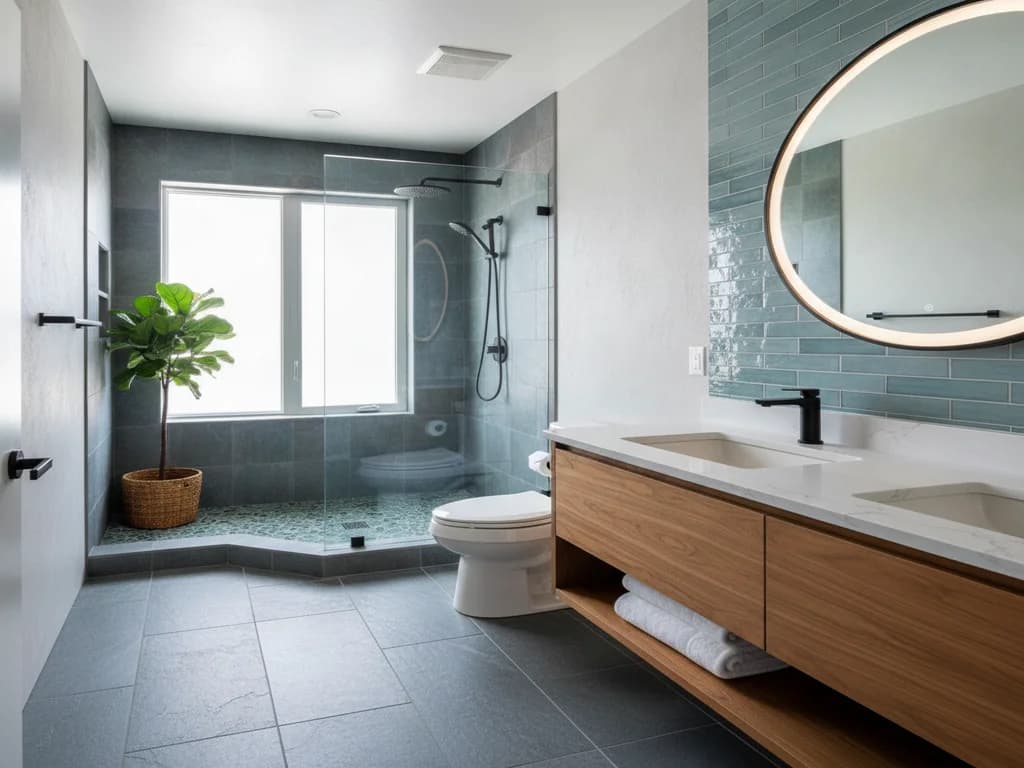
- Backlit and lighted mirrors put diffuse light exactly where sconces would — the built-in route to the same side-lighting physics.
- Bathroom fixtures near water need damp-rated listings, and vanity circuits fall under electrical code — fixture swaps in wet locations are electrician work, not décor work.
The short answer: light the face, not the room
Makeup lighting fails when it’s treated as room lighting that happens to be near a mirror. The job is narrower: put even, color-honest light onto a face from the front and sides, with no shadows. Every recommendation in this article — placement, CRI, color temperature, fixture type — falls out of that one sentence.
The good news is the spec is cheap to hit. The physics of a $80 pair of sconces placed correctly beats a $400 fixture mounted in the wrong place, and the bulb specs that make color honest cost a few dollars more per lamp, not hundreds.
This article covers the makeup station specifically. The rest of the bathroom still needs its ambient and task plan — that whole-room system lives in bathroom lighting layers, and this page is effectively a deep-dive on its task layer.
Why side lighting beats overhead — the shadow problem
A single fixture above the mirror throws light down the face. Down-light shades the eye sockets, the underside of the nose, and the chin — precisely the zones where concealer, contour, and blending happen. The result is makeup calibrated to shadows that don’t exist anywhere else, which is why it “looked fine in the bathroom” and wrong in daylight.
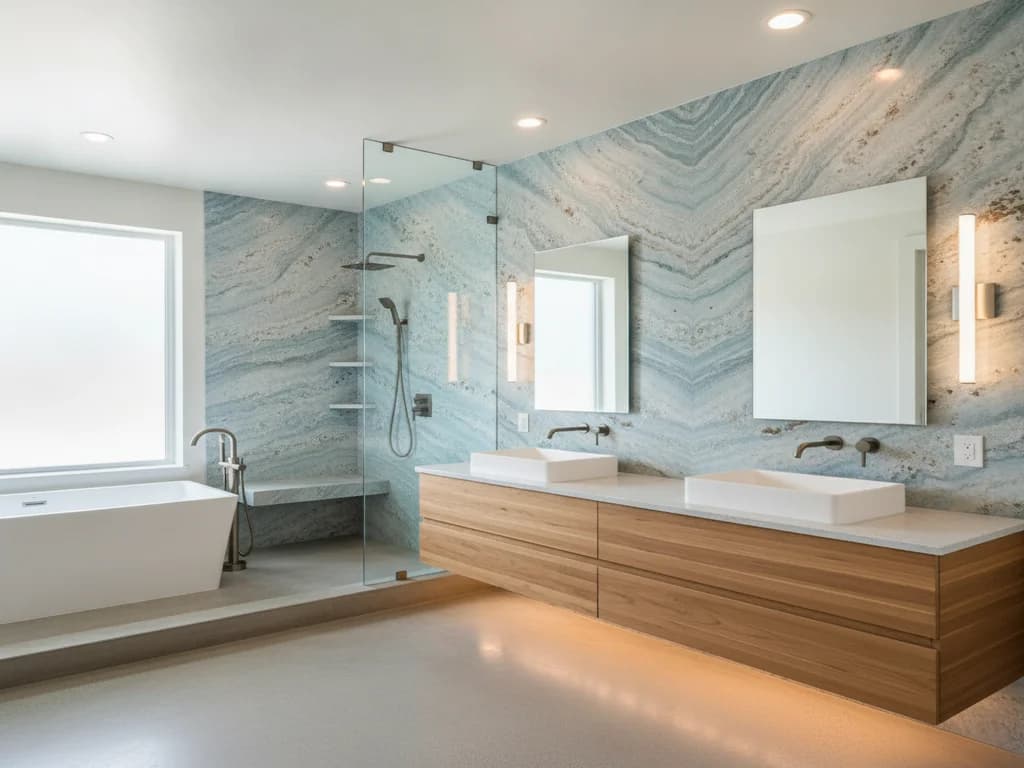
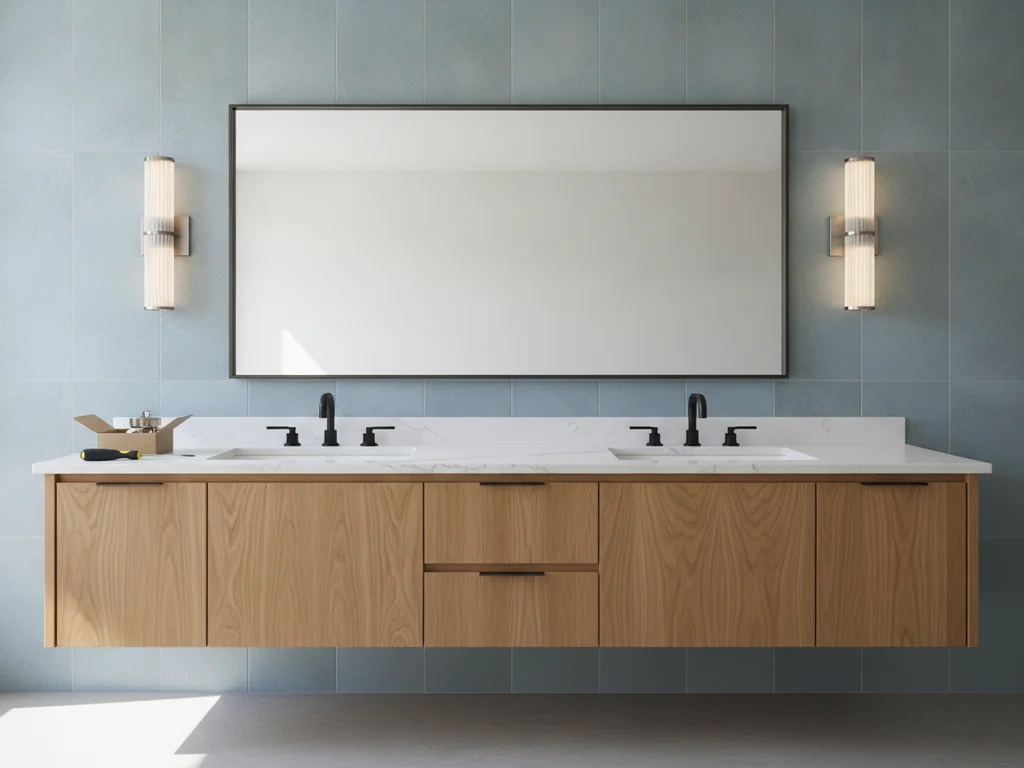
Fixtures at the sides of the mirror, at eye level, light the face straight-on from both directions. Each side fills the shadows the other would cast, producing the even, cross-lit face that makeup artists build with ring lights and that NKBA bathroom-lighting guidance echoes: light at the mirror should illuminate the face, not rain down on it.
The practical target is centering fixtures roughly 60 to 66 inches off the floor — eye level for most adults, adjusted to the primary user — and spacing them at the mirror’s edges so light arrives from beside the face rather than behind it. If only one fixture position is possible, side placement wins over overhead every time.
The honesty spec: CRI 90 or better
CRI — color rendering index — measures how faithfully a light source shows colors compared with a reference source, on a scale to 100. Cheap LEDs commonly land in the low 80s, and the shortfall lands hardest on the reds — the very wavelengths that carry skin tone. Under low-CRI light, foundation shades mismatch, undertones vanish, and blush reads as a different color than it will at the office.
The fix is a number printed on the box: buy 90+ CRI, and treat 95+ as the connoisseur tier. Consumer LED packaging and spec sheets list CRI alongside lumens and color temperature; Consumer Reports’ lightbulb guidance flags it as the spec shoppers skip most. It is the difference between light that flatters and light that tells the truth — makeup needs the truth.
One warning shortcut: any fixture or integrated-LED mirror that won’t publish its CRI has answered the question. Integrated fixtures live and die on their built-in diodes, so the spec sheet matters more there than anywhere.
Integrated LEDs: check the spec before you buy the fixture
Sconces that take standard bulbs let you fix a bad spec for the price of new lamps. Integrated-LED fixtures and lighted mirrors are permanent marriages to their diodes — if the CRI is a low-80s number or unpublished, no bulb swap can ever rescue it. Before buying any integrated fixture, find CRI and color temperature in writing on the spec sheet.
Color temperature: 2700–3000K, and everything must match
Color temperature sets the warmth of white light: 2700K is warm household white, 3000K a touch crisper, 4000K–5000K progressively cooler and clinical. For a vanity that serves both daily life and makeup, 2700–3000K is the reliable band — warm enough to live with, neutral enough for honest color work with high-CRI lamps carrying the accuracy.
Some makeup-first users prefer cooler light — 4000K and up mimics daylight and suits calibrating a look for outdoor settings. That’s a legitimate preference, with a cost: cooler light reads harsh as room lighting. Selectable-temperature fixtures and lighted mirrors split the difference, letting one station serve both moods, and are worth their premium for serious daily makeup work.
What is not negotiable is consistency. Mixed temperatures at the same mirror — a 2700K sconce beside a 4000K ceiling can — tint each side of the face differently and make honest color matching impossible. Whatever temperature you pick, every source hitting the mirror zone matches it. Fixture styles and finishes that carry these specs handsomely are collected in bathroom lighting ideas.
The picks by fixture type
Every fixture route to the same physics, compared:
| Fixture type | Makeup performance | Best for | Watch out for |
|---|---|---|---|
| Paired vertical sconces / linear LEDs flanking the mirror | The benchmark — even cross-light at eye level | Any mirror with wall space beside it | Mounting height; exposed-bulb glare at eye level |
| Backlit / lighted mirror (90+ CRI) | Excellent — diffuse light from the mirror face itself | Tight walls with no room for sconces; modern looks | Unpublished CRI; non-replaceable diodes |
| Sconces + overhead bar combined | Excellent — side light does makeup, bar fills the room | Full remodels wiring the mirror wall fresh | Temperature mismatch between layers |
| Overhead bar light alone | Poor — down-light shadows the working zones | Rooms where no side placement is possible | The classic builder-grade mistake |
| Hollywood bulb strip around the mirror | Very good — multi-point light approximates a ring light | Dedicated makeup stations | Glare and heat from many exposed lamps |
| Recessed ceiling cans at the vanity | Poor alone — the harshest down-light angle | Ambient layer only, never the task layer | Relying on them as mirror lighting |
Whichever type you choose: 90+ CRI, one consistent color temperature at the mirror, and damp-rated fixtures where required by their location listing.
The install realities: ratings, wiring, and when it’s pro work
Bathroom light fixtures carry location listings for a reason: fixtures in damp locations need damp-rated listings, and anything in a shower zone needs wet-rated — requirements that flow from the National Electrical Code the NFPA publishes. A vanity fixture beside a steamy mirror is a damp location in practice, so the rating on the box matters.
Placement upgrades usually mean wiring changes. Moving from an over-mirror junction box to flanking sconce positions means new boxes, new cable runs inside a finished wall, and possibly circuit and GFCI-protection questions — genuinely electrician territory, not a décor swap. What that scope looks like, including patching and mirror coordination, is walked through in replacing vanity lighting.
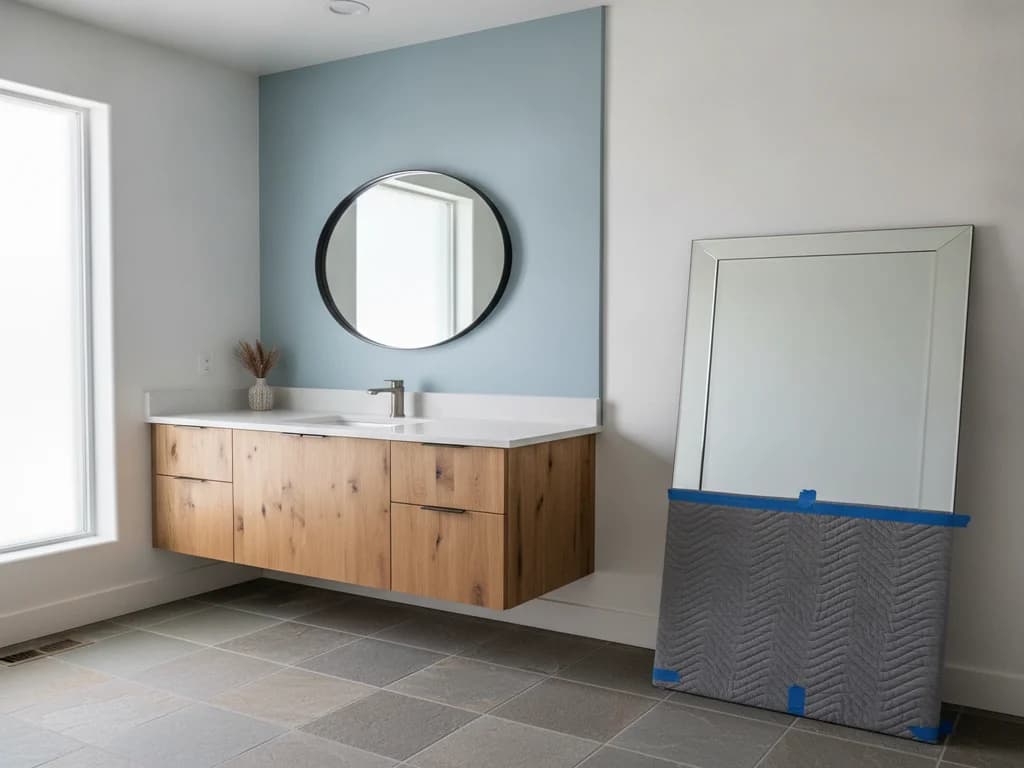
And because side placement depends on the mirror’s size and position, lighting and mirror decisions travel together — a wall-to-wall mirror forces lighted-mirror or overhead solutions, while a framed mirror opens the flanking positions. If the mirror is changing anyway, replacing a bathroom mirror is the companion read, and the two upgrades cost less done in one visit than in two.
Ready to plan your Boise bathroom?
Licensed & insured · 3-year workmanship warranty
Frequently asked questions
- What height should vanity sconces be mounted for makeup?
- Center them at eye level — roughly 60 to 66 inches off the floor for most adults, tuned to the primary user’s height. The goal is light arriving from beside the face, not above it. Space the pair at the mirror’s edges, typically just outside the glass, so both sides of the face receive equal fill.
- What CRI do I need for makeup lighting?
- 90 or higher, and 95+ if color accuracy is the whole point of the station. CRI measures how faithfully light renders color, and low-CRI LEDs distort reds — the wavelengths carrying skin tone — which makes foundation matching guesswork. The number is printed on bulb packaging and fixture spec sheets; if an integrated fixture won’t publish it, pass.
- Is warm or cool light better for applying makeup?
- Match the light to where the makeup will be seen. 2700–3000K suits daily wear and evening settings and doubles as pleasant room light; 4000K-plus mimics daylight for looks judged outdoors. High CRI matters more than the temperature choice itself. Selectable-temperature mirrors and fixtures cover both — the one hard rule is never mixing temperatures at the same mirror.
- Are backlit mirrors good for makeup?
- The good ones are excellent — a backlit or edge-lit mirror places diffuse light exactly where flanking sconces would, which is the correct geometry. The variable is the integrated LED: verify 90+ CRI and a stated color temperature on the spec sheet before buying, because the diodes are permanent. An unpublished CRI on a lighted mirror is a no.
- Why does my makeup look different outside than in my bathroom?
- Two mismatches: color rendering and direction. A low-CRI bulb hides undertones that sunlight then reveals, and an overhead-only fixture lights the face top-down while the world lights it from all around. Fix both — 90+ CRI lamps at a consistent temperature, placed at the sides of the mirror at eye level — and the bathroom stops lying.
- Can I just swap my vanity light fixture myself?
- A like-for-like swap on the same box is the simplest electrical job there is, but bathrooms raise the stakes: damp-location ratings, GFCI-protection rules, and aluminum or degraded wiring in older Treasure Valley homes all surface mid-job. Moving fixture positions — the upgrade that actually improves makeup light — means opening walls and running cable, which is licensed-electrician work.
Sources
- National Kitchen & Bath Association (NKBA)
- National Fire Protection Association (NEC)
- Consumer Reports
- This Old House — Bathrooms
Claims and figures are drawn from the sources above and provided for general guidance; your project may vary. Photography is illustrative of design concepts. For a fixed price on your specific bathroom, request a free estimate.