Updated July 16, 2026 · 8 min read
By Boise Bath — bathroom & shower remodeling in Boise & the Treasure Valley
The short answer
Efflorescence — the white, chalky mineral deposit on shower tile and grout — means water is soaking into the cement assembly behind the tile, dissolving minerals, and carrying them back to the surface as it evaporates. Occasional light haze is cosmetic. Recurring deposits at the shower floor, curb, or bench mean the waterproofing is letting water live inside the assembly.
Key takeaways
- Efflorescence is evidence of water movement: water enters the cement assembly, dissolves mineral salts, migrates back out, evaporates, and leaves the salts behind on the surface.
- The deposit itself is harmless and cleanable — what matters is the round trip it proves water is making through your shower assembly.
- One-time efflorescence on a newish shower is often just construction moisture leaving the mortar bed; efflorescence that keeps returning means water keeps getting in.
- Location is the diagnosis: recurring deposits at the floor, curb, and bench — the horizontal, water-holding surfaces — point at the pan and waterproofing.
- Boise hard-water spotting mimics efflorescence, but hard water deposits sit where spray dries; efflorescence grows out of joints and returns after cleaning.
- Scrubbing removes the symptom; only fixing the water path stops it. Sealer over active efflorescence traps the problem and worsens it.
What efflorescence actually is
Efflorescence is mineral salts making a round trip. The cement products in a tiled shower — the mortar bed under the floor tile, the thinset behind the wall tile, the grout between everything — all contain soluble mineral salts, mostly calcium compounds. When water soaks into that assembly and sits there, it dissolves some of those salts. When the water later migrates back to the surface and evaporates, it leaves the salts behind as a white, chalky, sometimes crusty deposit growing out of grout lines and tile edges.
That mechanism is the entire diagnostic value: efflorescence cannot happen without water getting into the assembly, dwelling long enough to dissolve minerals, and coming back out. The deposit is a delivery receipt for a water round trip. The Natural Stone Institute and tile-industry bodies describe the same mechanism in stone and cement assemblies everywhere — shower efflorescence is just the bathroom edition.
The deposit itself does no harm. It is not mold, not efflorescing grout "failing," and not a health issue. What deserves your attention is never the white stuff — it is the water path behind it.
First, rule out the imposter: hard water
Treasure Valley water is hard — the USGS classifies much of the region's supply as hard to very hard — and hard-water mineral spotting is white, chalky, and lives in showers. Plenty of "efflorescence" here is actually just our water drying on the tile. The two are worth telling apart, because one is a squeegee problem and the other is a waterproofing question.
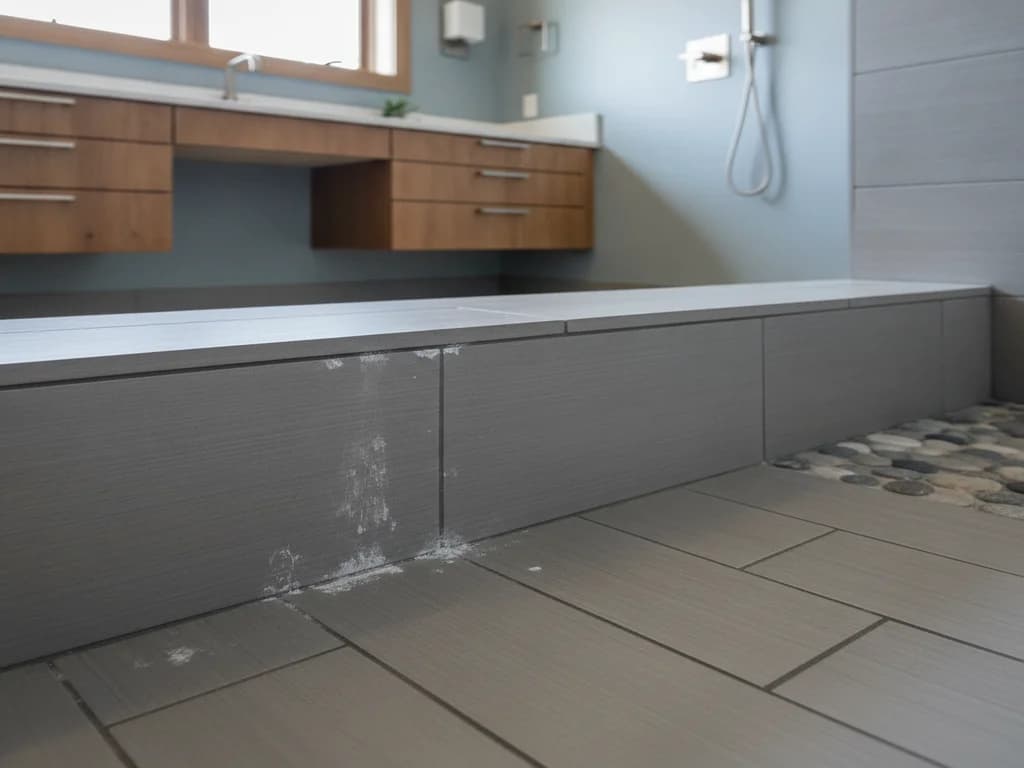
The tells: hard-water deposits form where spray lands and dries — on tile faces, glass, and fixtures, in an even film or droplets — and they dissolve readily with a vinegar-type cleaner. Efflorescence grows out of the joints: it concentrates along grout lines, at tile edges, at the curb and bench seams, often with a fluffy or crystalline texture, and it returns in the same lines after cleaning because the source is behind the tile, not on it.
A practical test: clean a patch thoroughly and watch it for a few weeks of normal shower use. Deposits that rebuild evenly wherever water dries are hard water. Deposits that re-emerge from the same grout lines and seams — especially low in the shower — are efflorescence.
What efflorescence says about your waterproofing
Here is the uncomfortable part, stated honestly: tile and grout are not waterproof. Cement grout absorbs water, and every tiled shower is designed with a waterproofing layer behind or beneath the tile — a pan liner and mortar bed, or a surface-applied membrane — to catch what soaks through. Some moisture entering the assembly is therefore normal, and in traditional mortar-bed showers, a damp bed that dries between uses is by design.
Efflorescence tips from normal to symptomatic when the assembly is holding enough water, long enough, to keep dissolving and delivering minerals. Recurring efflorescence means the wet-dry cycle has become mostly wet: water is entering faster than the assembly can dry, pooling on the waterproofing layer, or worse, sitting in an assembly whose waterproofing has failed and is wetting what is behind it.
Two versions of that story, in order of severity. In an older mortar-bed shower, heavy recurring efflorescence at the floor often means the pan liner has aged, the weep holes at the drain are clogged, and the bed has become a permanently saturated sponge — functioning, barely, but at the end of its design life. In any shower, efflorescence paired with the signs of a leaking shower — staining below, a musty smell, damp adjacent walls — means the water is not staying inside the assembly at all.
Do not seal over active efflorescence
The tempting fix — scrub the white off and seal the grout — is the one move that makes things worse. Sealer slows evaporation from the surface, but the water is entering from behind. Trapping it in the assembly increases saturation, pushes the moisture to exit somewhere else, and can pop the deposits out as spalling. Find and fix the water path first; seal, if at all, only once the assembly is dry and stays that way.
Reading the location: where the white shows up matters
Like most shower symptoms, geography is diagnosis:
- Shower floor grout lines — the most common and most meaningful. The floor takes all the water and drains through weep holes that clog with age; recurring floor efflorescence points at a saturated mortar bed and aging pan. Cross-check against the signs of a failing shower pan.
- The curb — second most telling. Curbs are horizontal, heavily wetted, and a classic waterproofing weak point where liners get nailed through or membranes get lapped wrong. Persistent white crust along curb grout usually means water inside the curb.
- Bench and niche seams — same story as the curb: horizontal surfaces and detail work where waterproofing errors concentrate. Efflorescence emerging from a bench joint means the bench is absorbing water.
- Lower wall courses only — water wicking up from a saturated floor bed, or splash working through lower wall grout. Alone, less alarming; combined with floor deposits, part of the same saturation picture.
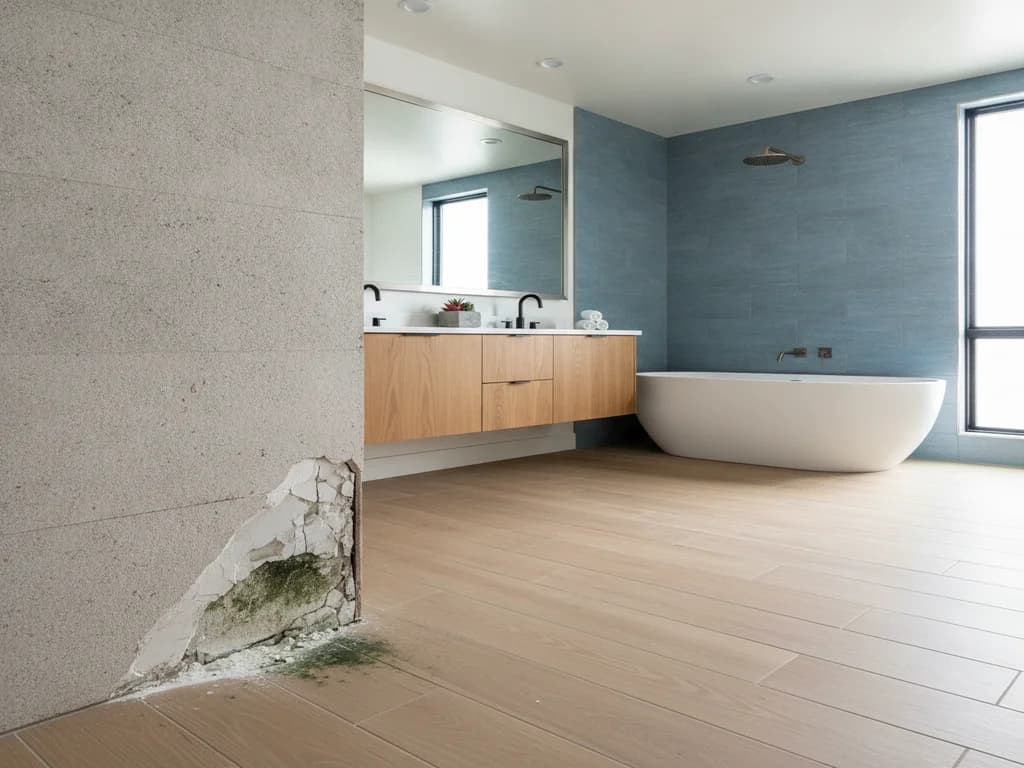
- Outside the shower — at the base of the adjacent wall, on the slab beside the curb, or on a basement wall or ceiling area below. This is the serious one: minerals are being carried beyond the shower footprint, meaning water is too.
Severity triage: haze, habit, or failure
A one-time light haze on a shower under a year old is usually construction moisture — the considerable water mixed into a mortar bed leaving as the assembly dries out. Clean it off and expect it not to return. New-construction efflorescence that keeps returning past the first months, though, deserves the same scrutiny as an old shower.
Recurring but contained deposits — the same floor and curb lines rebuilding a few times a year — mark a shower whose assembly stays wet. Nothing may be leaking beyond the pan yet, but the drying cycle has failed, and a permanently damp cement-and-wood sandwich is where debonding tile, cracking grout, and mold get their start. This is a monitor-and-plan situation: the shower is telling you its waterproofing is on the clock.
Heavy, fast-returning, or spreading efflorescence — thick crusts, deposits appearing outside the shower, or the white stuff paired with any leak evidence — is failure territory. At that stage the deposit is the least of it; the questions are where the water is going and what it has already reached.
What a pro inspection looks like — and the repair-vs-remodel call
A contractor evaluating shower efflorescence works from evidence you cannot easily get: a flood test of the pan (plugging the drain, filling to the curb, and watching whether the level holds), moisture-meter readings across the walls and the floor outside the shower, a check of the drain weep holes, and a look below from the basement or crawl space for staining under the drain. Together those separate a saturated-but-sound assembly from an actively failing one.
The honest repair menu is short, because efflorescence is a water-path symptom. Clogged weep holes can sometimes be cleared, spray patterns and door sweeps redirected, and open grout joints made good — legitimate fixes when the waterproofing itself tests sound. What does not work: any surface-level cure for a failed pan or membrane. The waterproofing layer lives under the tile, so replacing it means rebuilding the shower floor or the wet area — the scope covered in replacing shower waterproofing.
That is why heavy recurring efflorescence in an aging shower usually becomes a remodel conversation rather than a repair ticket. If the pan and bed are at end of life, the tile above them has no future either — and rebuilding the shower once, with a modern bonded membrane system designed to keep water out of the assembly entirely (the approach detailed in our shower waterproofing guide), beats paying twice to open the same floor.
Ready to plan your Boise bathroom?
Licensed & insured · 3-year workmanship warranty
Frequently asked questions
- Is efflorescence in a shower harmful?
- The deposit itself is not — it is mineral salts, not mold, and it poses no health risk. Its significance is what it proves: water is entering the assembly behind your tile, dwelling long enough to dissolve minerals, and migrating back out. Occasional light efflorescence can be normal, especially in a new shower drying out. Recurring or heavy deposits mean the assembly stays wet, which is how tile, grout, and pan failures begin.
- How do I remove efflorescence from shower tile and grout?
- Light deposits often brush off dry or come away with a stiff scrub and water. Stubborn crusts need a mildly acidic cleaner formulated for tile — used per the label and rinsed well, and tested first on natural stone, which acids can etch. But cleaning only removes the symptom. If the deposits return in the same joints, the water path behind them is still open, and the useful money goes toward finding it, not toward stronger cleaners.
- Does efflorescence mean my shower pan is failing?
- Not automatically, but it is one of the better early indicators. Recurring efflorescence concentrated at the shower floor and curb means the mortar bed is staying saturated — commonly because drain weep holes have clogged or the pan liner is aging. A flood test settles it: if the pan holds water level for the test period, the liner is intact but the bed is not drying; if it drops, the pan is leaking. Either way, heavy floor efflorescence says the system is near end of life.
- Why does efflorescence keep coming back after I clean it?
- Because the source is behind the tile, not on it. Cleaning removes the delivered minerals; the delivery route — water entering the assembly, dissolving salts, and evaporating out through the same joints — is untouched. Deposits will rebuild until the assembly can dry out or the water path is closed. Recurrence in the same lines is actually useful evidence: it maps exactly where water is moving through your shower.
- Is white buildup in my shower efflorescence or hard water?
- Check where it forms and how it behaves. Hard-water scale — common with the Treasure Valley's hard supply — forms wherever spray dries: tile faces, glass, fixtures, in an even film that vinegar-type cleaners dissolve. Efflorescence grows out of grout lines, tile edges, and seams at the curb or bench, often crystalline or fluffy, and returns in those same lines after cleaning. Surface-wide film = water quality. Joint-line crust = water in the assembly.
- Can efflorescence happen in a brand-new shower?
- Yes, and in the first months it is usually benign: a traditional mortar bed goes in carrying a lot of mix water, and as the assembly dries, that construction moisture can carry salts to the surface once or twice. Clean it and watch. What is not normal is new-shower efflorescence that keeps returning past the break-in period — that suggests water is entering the assembly in service, which on a new build is a workmanship conversation with your installer.
Sources
- Tile Council of North America (TCNA)
- Natural Stone Institute
- USGS Water Science School — Hardness of Water
- Schluter Systems
Claims and figures are drawn from the sources above and provided for general guidance; your project may vary. Photography is illustrative of design concepts. For a fixed price on your specific bathroom, request a free estimate.