
Updated September 10, 2026 · 8 min read
By Boise Bath — bathroom & shower remodeling in Boise & the Treasure Valley
The short answer
Cast iron lasts generations and holds heat; fiberglass is inexpensive, light enough for one person to carry, and typically lasts about ten years. Kohler publishes 310 pounds for a standard cast iron alcove tub. Choose cast iron for a forever bathroom on a sound floor, fiberglass for budget or upstairs work.
Key takeaways
- Weight decides more of these installs than preference does: Kohler publishes 310 lbs for a 60" cast iron alcove tub, against roughly 67–72 lbs for a porcelain-on-steel tub of the same size (Bootz) and less for fiberglass.
- This Old House puts a fiberglass tub’s typical life span at about 10 years and cast iron’s at up to 70 — the widest longevity gap between any two common tub materials.
- Fiberglass is a gel-coated laminate, so its failure mode is surface: fading, crazing and flex. Cast iron’s failure mode is a chip in the enamel, which is cosmetic until it reaches the iron and rusts.
- Neither material is repaired the way people assume. Gel coat can be patched but rarely disappears; cast iron enamel cannot be re-fired in place, and refinishing is a coating over it, not a restoration of it.
- In Boise the choice is often already made for you by the house: Census data puts roughly half the city’s homes at 1970–1999, the decades when fiberglass units were standard, and the original tub is usually what you are replacing.
The short answer
These are the two ends of the bathtub market, and they are not really competing for the same job. A fiberglass tub is a molded laminate shell with a sprayed gel-coat surface — cheap, light, and serviceable. A cast iron tub is molten iron cast into shape and fired with a porcelain enamel surface — heavy, rigid, and effectively permanent.
Choose cast iron when the bathroom is meant to be finished for a very long time, the floor can carry it, and someone in the household actually takes baths. Choose fiberglass when the budget is the constraint, the tub is going upstairs, or the room is a rental or a secondary bath where a ten-year service life is acceptable.
Everything below is the detail behind that, including the one number most comparisons get wrong.
What each one actually is
Fiberglass (FRP) is fiberglass-reinforced plastic: layers of glass matting laid into a mold and saturated with resin, then finished with a sprayed gel coat that provides the colour and the gloss. The structural part and the visible part are two different materials, which is the key to understanding how it ages. Many tubs sold as fiberglass are now acrylic-surfaced composites, where a vacuum-formed acrylic sheet is backed with fiberglass — a meaningfully better product with a harder wearing surface.
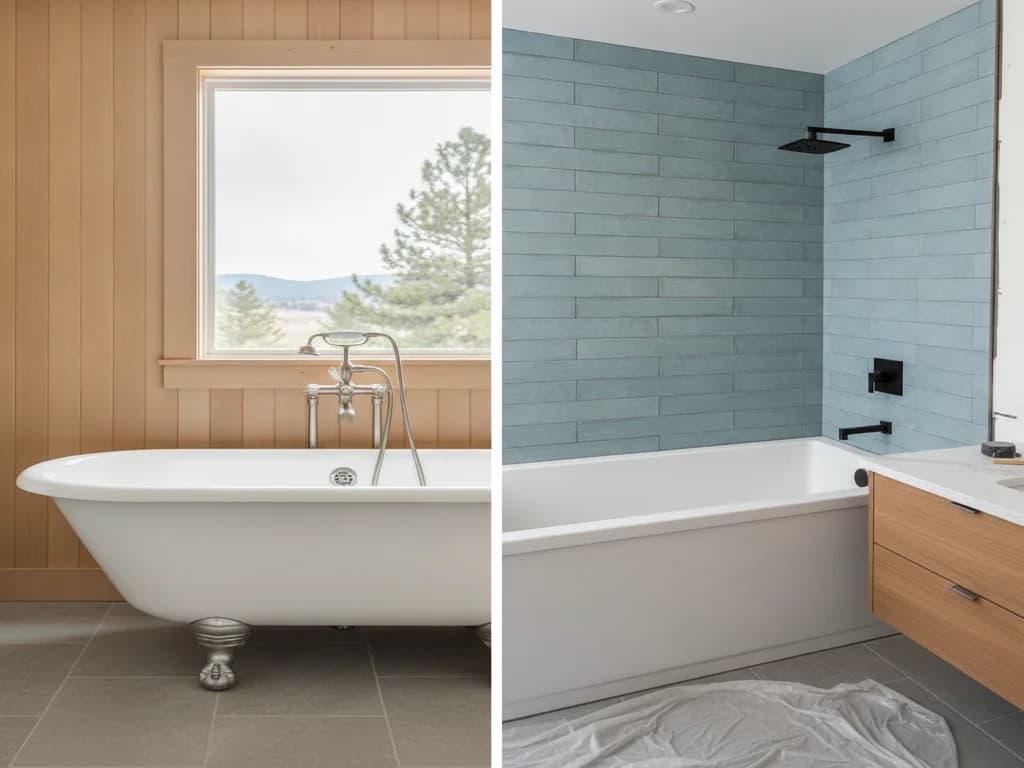
Cast iron is exactly what it sounds like: iron cast in a mold, then coated with powdered glass and fired at high temperature until the glass fuses into a porcelain enamel. The enamel is glass, not paint, which is why it resists scratching, staining and chemistry the way it does, and why it chips rather than scuffs when something heavy lands on it.
That difference in construction explains everything else — the weight, the heat behaviour, the lifespan, and the way each one eventually fails.
Weight: the number that decides the install
This is where published comparisons are least reliable, so here are manufacturer figures rather than round numbers.
Kohler’s spec sheet for the Bellwether 60" × 30¼" alcove bath (K-838), a standard enameled cast iron tub, gives a product weight of 310 lbs. For contrast, Bootz — the largest American maker of porcelain-on-steel tubs — publishes 72 lbs for its Aloha 60" × 30" and 67 lbs for the Aloha Plus 60" × 32". A fiberglass or composite tub sits in that same light class.
A cast iron tub therefore arrives as a two-to-four-person lift, will not go up a finished staircase casually, and concentrates its load on a small footprint once filled. On a concrete slab that is a non-issue. On wood-framed second-storey floors it is worth raising during design rather than on delivery day.
A note on the numbers you will find elsewhere: several widely-read comparison sites put porcelain-on-steel at 150–200 lbs. The manufacturer’s own catalogue says 67–72. When a spec and a blog disagree, the spec wins.
| Material | Model | Published weight |
|---|---|---|
| Enameled cast iron | Kohler Bellwether K-838, 60" × 30¼" | 310 lbs |
| Porcelain-enameled steel | Bootz Aloha AFR, 60" × 30" | 72 lbs |
| Porcelain-enameled steel | Bootz Aloha Plus, 60" × 32" | 67 lbs |
| Fiberglass / composite | Varies by maker | Light enough for one person — see note |
Figures from the manufacturers’ own specification sheets. No single fiberglass weight is quoted here on purpose: retailer listings for one composite tub (Sterling Ensemble 71171110) report 68 lbs and 95 lbs for the same model number, and a figure that cannot be pinned down should not be presented as one.
Lifespan, and how each one actually fails
This Old House puts a fiberglass tub’s typical life span at about 10 years and cast iron’s at up to 70. That is the widest longevity gap between any two common tub materials, and it is the honest centre of this comparison.
They do not fail the same way. Fiberglass fails at the surface: the gel coat dulls, then crazes into fine cracks, then stains in the crazing where cleaning cannot reach. Underneath, the laminate flexes — a fiberglass tub that was not fully supported by its bed will move underfoot, and that movement is what drives the cracking. It is a slow cosmetic decline that ends in replacement.
Cast iron fails at a point: something heavy is dropped, and the enamel chips. Until the chip reaches bare iron it is purely cosmetic. Once it does, the exposed iron rusts and the rust creeps under the surrounding enamel. The tub is still structurally fine for decades after that — which is why century-old cast iron tubs are routinely still in service, and why they are also routinely stained.
Heat, sound, and the feel of the thing
Cast iron is a heat sink. It is cold to first contact and then holds temperature, so a long bath stays warm without topping up — which matters if you actually soak, and matters not at all if the tub is mostly a shower floor.
Fiberglass is the opposite: warm to first touch because it barely conducts heat, but with no thermal mass to give back, so the water cools at whatever rate the room takes it. Some steel and composite tubs are sold in insulated versions specifically to close that gap.
Sound follows the same logic. Cast iron is silent under a running tap and rigid underfoot. A thin fiberglass shell drums, and flexes slightly when you step in — the single most common complaint about builder-grade tubs, and the one people notice every day.
Repair and refinishing: what is actually possible
Neither material is repaired the way homeowners expect, and the difference matters when you are deciding whether to keep what you have.
Fiberglass gel coat can be patched with a colour-matched kit, and on a small chip in an inconspicuous spot the result is acceptable. Over a large faded or crazed area it is not — you are painting one section of a surface whose gloss and colour have already shifted everywhere else.
Cast iron enamel cannot be repaired in place at all in the true sense. Fusing porcelain to iron takes a furnace. What refinishing does is bond a coating over the old enamel, which restores appearance and buys years rather than decades, and which behaves like a coating from then on — it can peel, and it cannot be refinished indefinitely. Our bathtub refinishing vs. replacement guide covers when that trade is worth making.
The chip that matters
A chip in cast iron enamel is cosmetic while the iron underneath is still covered. The moment bare metal shows, seal or touch it up — not for looks, but because rust spreads underneath the surrounding enamel and lifts it. A ten-minute job at the right time prevents the stain that eventually justifies replacing a tub that would otherwise have outlived the house.
What this looks like in Boise specifically
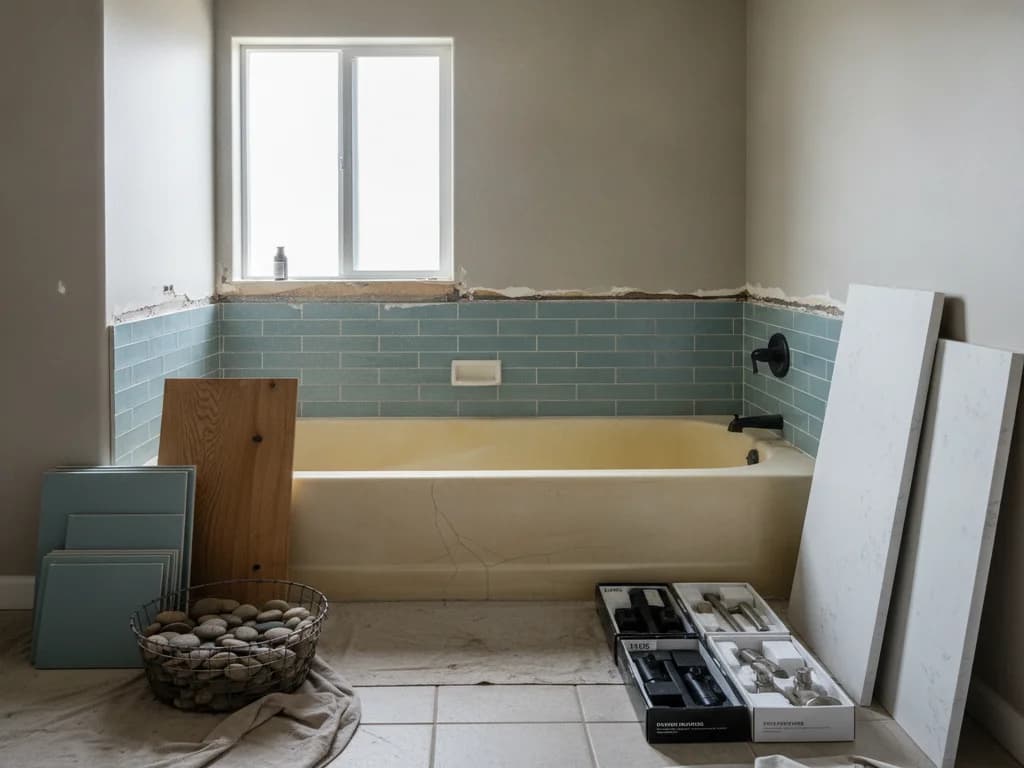
The choice is frequently pre-made by the house you own. Census data puts roughly half of Boise’s homes at 1970–1999 — the decades when one-piece fiberglass tub-shower units were the builder standard across the Bench, Southeast Boise and the subdivisions that filled in during that stretch. If your tub is original to a home from that era, you are almost certainly looking at fiberglass, and it is almost certainly at or past the ten-year mark by a wide margin.
The older stock changes the question. In the North End, where the historic district’s period of significance ends in 1915, the original tub is often cast iron and still serviceable — worth keeping, refinishing, or moving rather than skipping. Emmett has the oldest housing of any city we serve, with roughly a third of it built before 1960, so the same applies there more often than anywhere else in the valley.
One practical Treasure Valley note that applies to both materials: local water is hard enough to leave mineral deposits, and those deposits are far more visible on a dulled gel coat than on intact enamel. That is a maintenance difference rather than a durability one, but it is the one homeowners actually see. We cover it in hard water and your Boise bathroom.
Which one belongs in your bathroom
- Primary bath, staying long-term, ground floor or slab, someone genuinely baths: cast iron. The weight is manageable, the heat retention is the point, and the surface will outlast several remodels.
- Upstairs bathroom in a wood-framed house: think hard before cast iron. It is not impossible, but the floor should be assessed at design rather than discovered at delivery.
- Rental, secondary bath, or a budget that has to stretch across the whole room: fiberglass or a composite. Accept the service life for what it is and put the saved money where it shows.
- Replacing an original 1970s–90s fiberglass unit and wanting a real upgrade: the honest middle is a quality acrylic or composite tub, not necessarily cast iron — see cast iron vs. acrylic for that comparison.
- Keeping an original cast iron tub that is chipped and stained: get it assessed before replacing it. That tub is often the most durable object in the bathroom.
Ready to plan your Boise bathroom?
Licensed & insured · 3-year workmanship warranty
Frequently asked questions
- How much does a cast iron bathtub weigh compared to fiberglass?
- Kohler publishes 310 lbs for its Bellwether 60" × 30¼" enameled cast iron alcove bath. A porcelain-on-steel tub of the same size runs 67–72 lbs per Bootz’s catalogue, and fiberglass and composite tubs sit in that same light class — one person can carry one. Filled with water and a bather, a cast iron tub concentrates well over a thousand pounds on a small footprint, which is a design-stage question on a wood-framed upper floor and a non-issue on a slab.
- Do fiberglass bathtubs really only last 10 years?
- That is This Old House’s stated typical life span, and it matches what shows up in remodels — though "fails" usually means the gel coat has faded, crazed and stained rather than the tub having stopped holding water. A well-supported tub in a lightly used guest bath can go considerably longer. A poorly bedded one in a family bathroom flexes underfoot and crazes sooner. Composite tubs with an acrylic wearing surface generally outlast plain gel-coated fiberglass.
- Can a chipped cast iron tub be repaired?
- A chip can be filled and colour-matched, and doing it promptly matters more than doing it perfectly — once bare iron is exposed it rusts, and rust creeps under the surrounding enamel and lifts it. What cannot be done is true repair: porcelain enamel is fused to iron in a furnace, so nothing applied in your bathroom is the same material. Full refinishing bonds a coating over the original enamel, which restores appearance for years rather than decades and behaves like a coating from then on.
- Is cast iron worth it if I mostly shower?
- Usually not. Cast iron’s two distinguishing properties are heat retention and rigidity, and heat retention is worth nothing to someone standing up. Rigidity and silence still count — a cast iron floor does not flex or drum — but if the tub is essentially a shower base, a quality acrylic or composite unit delivers most of the daily experience without the weight, the freight or the install cost.
- Which is better for resale?
- Neither material sells a house, but a visibly failed tub can cost you one. Buyers notice a stained, crazed, flexing fiberglass unit far more than they notice what a sound tub is made of. If resale is the driver, the useful question is whether the tub reads as cared-for, not whether it is cast iron — and in a home where a single bathtub serves the house, keeping a tub at all matters more than its material.
Sources
- Kohler
- Bootz Industries — porcelain-on-steel bathtub specifications
- This Old House — Bathrooms
- HomeAdvisor — True Cost Guide
- U.S. Census Bureau — American Community Survey, table B25034 (year structure built)
Claims and figures are drawn from the sources above and provided for general guidance; your project may vary. Photography is illustrative of design concepts. For a fixed price on your specific bathroom, request a free estimate.