Updated July 6, 2026 · 8 min read
By Boise Bath — bathroom & shower remodeling in Boise & the Treasure Valley
The short answer
A swing door costs less, seals sound and privacy better, and its hardware is easier to repair — but it needs floor clearance to open. A pocket door recovers that floor space by sliding into the wall, at a higher retrofit cost, with thinner panels, weaker locks, and a wall cavity that must be free of plumbing and wiring.
Key takeaways
- Clearance math: a standard 32-inch swing door sweeps roughly that much floor space open, while a pocket door needs a wall "twice as wide as the door" — about 64–66 inches of unobstructed linear wall — to house it, per Bob Vila.
- Cost: Fixr prices a standard swing door installation at $350–$1,100, a new-construction pocket door at $500–$2,500, and a pocket door retrofitted into an existing wall at $1,350–$4,250 — the retrofit costs more because the wall has to be opened and rewired or replumbed around.
- Hardware and durability: a pocket door trades a full lever handle and deadbolt-capable latch for a shallow, recessed edge-pull that Bob Vila says "can be difficult for some people" to operate, and any track repair means opening the wall.
- Sound and privacy: pocket door panels are typically thinner and lighter so they glide easily, which means they don't seal a room or block sound as tightly as a hinged door.
- A pocket door's wall cavity has to stay clear of outlets, switches, and plumbing — Bob Vila is direct that "walls with electrical wiring or plumbing running through them are not suitable for a pocket door" without rerouting that infrastructure first.
Pocket door vs. swing door — the quick verdict
Both are legitimate ways to get a door in and out of a bathroom doorway, and the honest answer is that the right choice depends on what your floor plan is actually short on. A swing door is simpler, cheaper, and seals a room better. A pocket door trades some of that simplicity for floor space it doesn't need to open — space that matters a lot in a small hall bath and barely at all in a spacious primary suite.
The comparisons below use cited figures so you can weigh the real differences in clearance, cost, and durability, rather than the “just switch to a pocket door” advice that skips over what it actually costs to retrofit one.
How to read this comparison
If your bathroom door currently hits the toilet, a vanity, or another door when it swings open, a pocket door solves a real problem. If it doesn't, a swing door is simpler, cheaper, and easier to live with — there's no prize for installing a pocket door where a hinged one works fine.
Quick comparison
This table summarizes where each door type lands across the dimensions homeowners weigh most.
| Dimension | Swing Door | Pocket Door |
|---|---|---|
| Floor clearance needed | Roughly the door's width sweeps into the room | None into the room — but a wall bay about twice the door's width (Bob Vila) |
| Typical installed cost | $350–$1,100 (Fixr) | $500–$2,500 new construction; $1,350–$4,250 retrofit (Fixr) |
| Hardware | Full lever or knob, deadbolt-capable | Recessed edge-pull, lighter-duty lock (Bob Vila) |
| Repairability | Hinges and hardware fully exposed and easy to service | Track hidden inside the wall; repairs mean opening drywall (Bob Vila) |
| Sound and privacy seal | Tighter seal, better sound isolation | Thinner, lighter panel — less sound isolation (Bob Vila) |
| Wall requirements | Any wall works | Wall cavity must be free of plumbing, wiring, and outlets (Bob Vila) |
| Best for | Most bathrooms; where privacy and cost matter most | Tight footprints where the door swing fights a fixture or another door |
Clearance math: how much space does each door actually need?
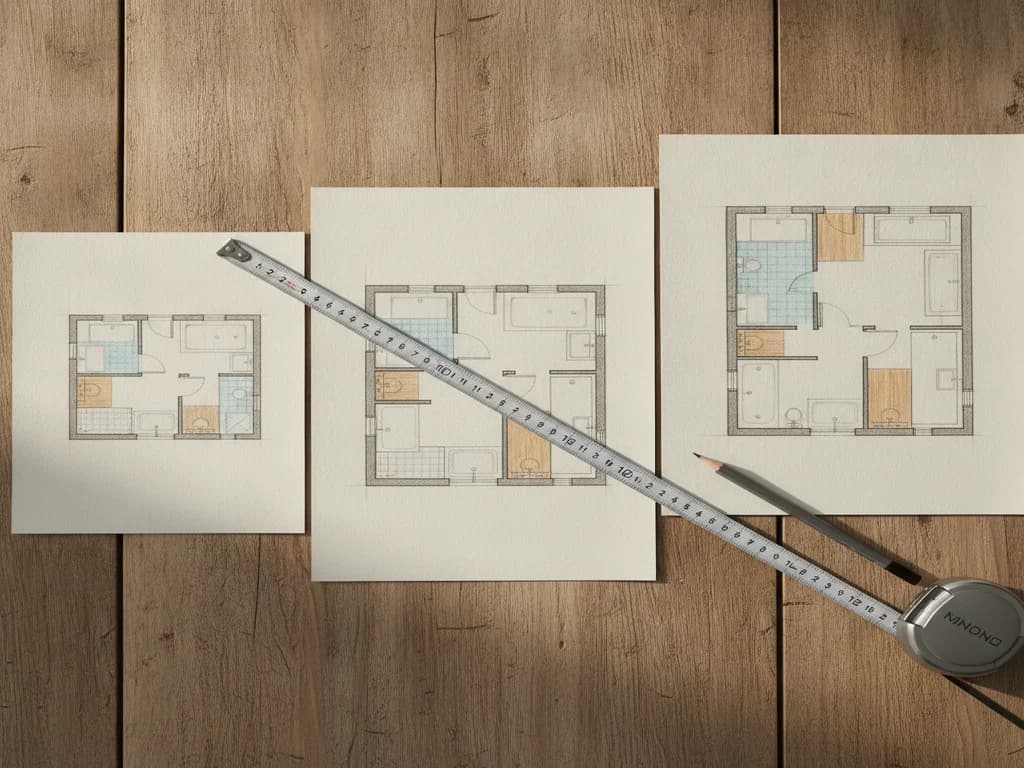
A swing door needs an arc of clear floor space roughly equal to its own width — for a standard bathroom door, that's about 32 inches of unobstructed floor on the side it opens into. That arc is what most often causes trouble in a small hall bath: it can collide with a toilet, a vanity corner, or a linen closet door if the room is tight enough.
A pocket door removes that arc from the equation entirely, but it doesn't need zero space — it needs it somewhere else. Bob Vila is specific about this: a wall built to house a pocket door "must be twice as wide as the door" to fit the stowed panel, meaning a standard 32-inch bathroom door needs on the order of 64 to 66 inches of unobstructed linear wall space to slide into. A narrower French pocket door configuration needs a little over 18 inches of wall space on each side instead, since its panels split the width in two.
The practical upshot: a pocket door only solves a clearance problem if the wall next to the doorway is long enough, straight enough, and free enough of obstructions to take it. If that wall is short, has a window, or backs up to a shower, the swap may not be possible without a larger renovation than it first appears.
Cost: what does each option actually run?
Fixr prices a standard swing door installation at $350–$1,100 — the baseline most bathrooms are already working with, since it's usually the existing door type in an unrenovated home.
A pocket door costs more, and how much more depends heavily on whether the wall is already open. In new construction, where the framing is exposed and the pocket can be built in before drywall goes up, Fixr prices the job at $500–$2,500, with labor alone running $100–$500. Retrofitting a pocket door into an existing, finished wall is a different job: Fixr's figure jumps to $1,350–$4,250, with retrofit labor alone at $1,000–$2,500, because — as Fixr puts it — "in a retrofit, labor is more complicated because you need to open it and potentially reroute utilities."
That gap, roughly $450–$1,400 more than a comparable swing door depending on scope, is the real number to plan around if a pocket door is on your list. It's a legitimate upgrade for the floor space it buys back, but it isn't a cosmetic swap — it's a wall-opening job.
What actually drives the retrofit cost up?
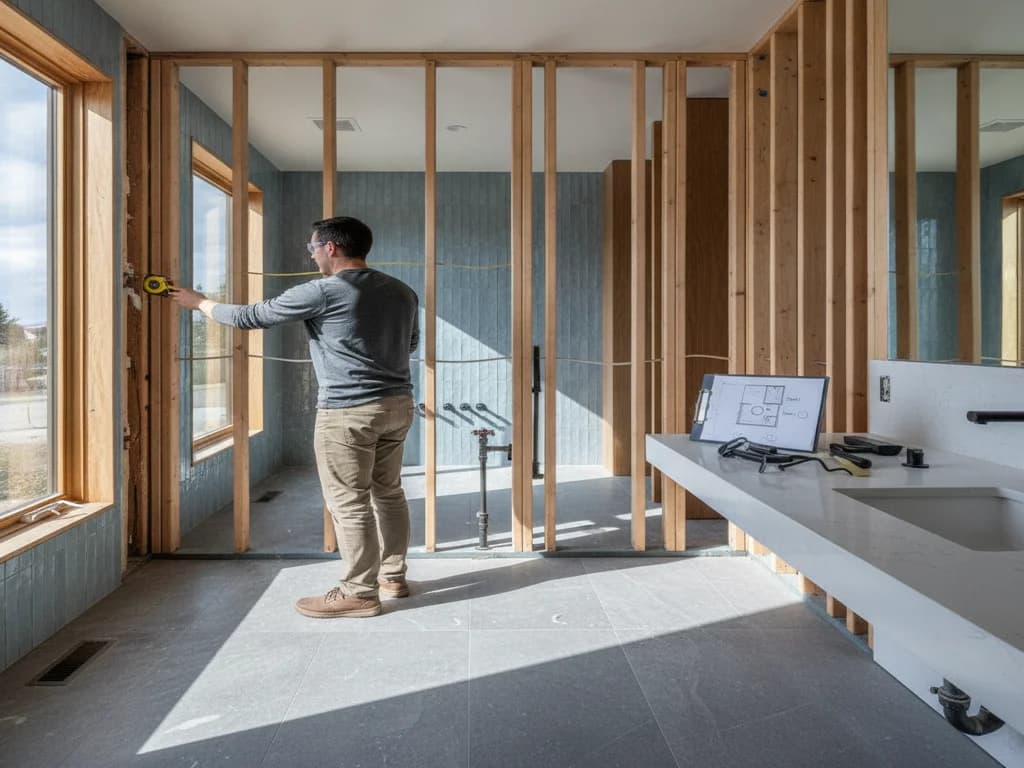
The jump from new-construction pricing to retrofit pricing comes down to a short list of real cost drivers, per Fixr: opening and reframing the existing wall to create the pocket cavity, rerouting any electrical wiring or plumbing that runs through that stretch of wall, and — if the existing wall is too thin to accommodate the door's track hardware — rebuilding it to a workable thickness. If the wall needs full interior demolition to get at any of that, Fixr notes that can add another $1,200–$5,000, and hazardous-material remediation in an older wall (think old plaster or asbestos-era materials) can add $500 or more on top of that.
None of this means a retrofit is a bad idea — it just means the "extra cost of a pocket door" question has a very different answer depending on whether your contractor is starting from open studs or from a finished, plumbed, wired wall.
Hardware and durability: which one lasts, and which is easier to fix?
A swing door's hardware is about as simple as it gets: a hinge on one side, a full-size lever or knob and latch on the other, both fully exposed and easy for any handyman to service or replace. Deadbolt-style privacy locks are also straightforward to add.
A pocket door asks more of its hardware while giving it less room to work with. Bob Vila describes the typical mechanism plainly: you "insert a single finger into a small retractable latch...and pull the door closed," and adds that "this manual maneuver can be difficult for some people" — a real consideration in a household with young kids, older adults, or anyone with limited hand dexterity. Locking mechanisms are similarly compact and, per Bob Vila, harder to manipulate than a standard bathroom privacy lock.
Repairability is the other half of the durability question. A swing door's hinges and hardware sit in the open, so a squeak, a loose screw, or a worn latch is a five-minute fix. A pocket door's rollers and track live inside the wall — Bob Vila notes they're "largely hidden inside the wall" — so anything beyond a simple adjustment usually means opening drywall to get at it.
Sound and privacy: does either door seal a room better?
A hinged door seals against a full-perimeter jamb and typically carries more weight and thickness in its slab, which is part of why it blocks both sound and sightlines more effectively — genuinely useful in a primary bathroom shared with a partner, or any bathroom where privacy matters as much as function.
A pocket door's panel is usually thinner and lighter by design, since it has to glide smoothly along a track rather than swing on hinges. Per Bob Vila, that construction means pocket doors "don't seal a room as tightly as a traditional swinging door" and don't block sound as completely either. For a powder room off a busy living area, that gap in sound isolation is worth thinking through before committing to a pocket door on privacy grounds alone.
When a swing door genuinely wins
Be honest about this: a swing door is the right call for most bathrooms. It wins clearly when the doorway already has room to open without hitting anything, when privacy and sound isolation matter most, when budget is a real constraint, or when you want hardware that's trivial to service for the life of the house. If your current door works fine, there's no functional reason to switch it to a pocket door.
When a pocket door genuinely wins
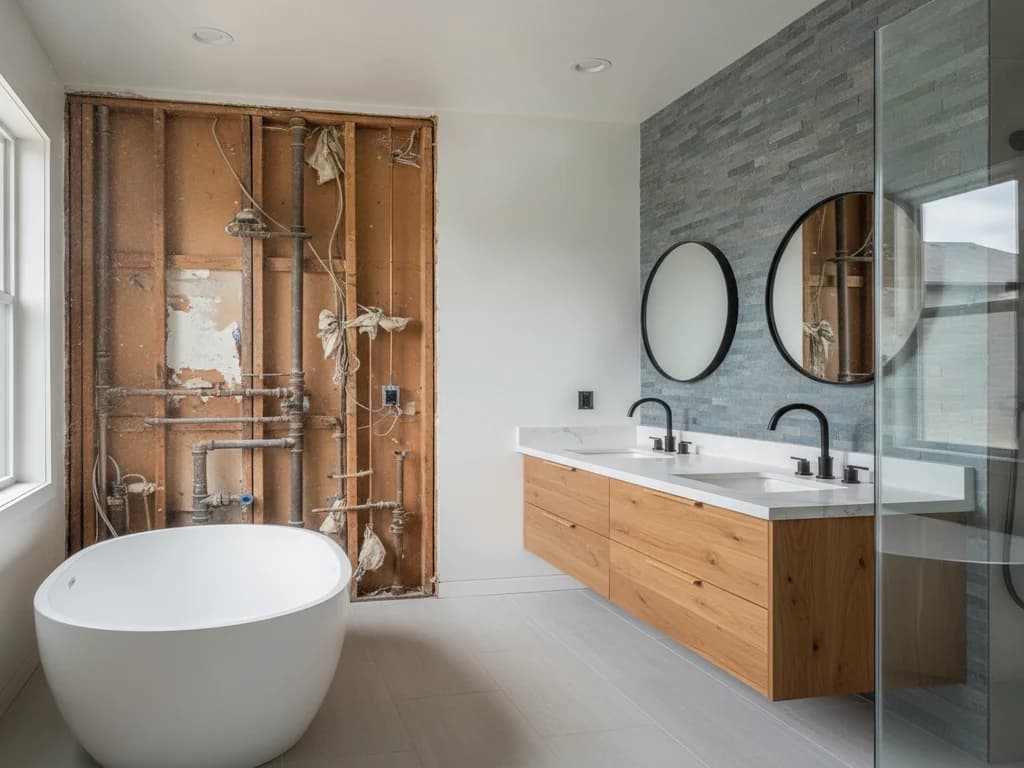
A pocket door pulls ahead when the swing itself is the problem — a door that currently clips a vanity corner, a toilet, or another door's swing path, or a layout where recovering that floor arc is what finally makes a small bathroom's layout work. It's also worth considering for a doorway on a long, uninterrupted, unplumbed wall, where the retrofit cost is closer to the lower end of the range above. It's not the right fix for every tight bathroom — sometimes the layout itself needs to change first, not just the door.
The bottom line
There's no universal winner — only the right door for your doorway, your wall, and how much you value the floor space a swing door needs to open. Before committing to either direction, have your contractor open the wall (or at least confirm what's inside it) so the retrofit cost above isn't a surprise once demolition starts. A full bathroom remodel is also the point where a layout change — moving the doorway itself, not just swapping the door — sometimes solves the clearance problem more permanently than either door type on its own.
Ready to plan your Boise bathroom?
Licensed & insured · 3-year workmanship warranty
Frequently asked questions
- Is a pocket door more expensive than a swing door for a bathroom?
- Yes, in almost every case. Fixr prices a standard swing door installation at $350–$1,100, while a pocket door runs $500–$2,500 in new construction and $1,350–$4,250 when retrofitted into an existing wall — the retrofit number is higher because the wall has to be opened and any wiring or plumbing inside it rerouted.
- How much wall space does a pocket door actually need?
- Roughly twice the door's width. Bob Vila notes a pocket door's wall "must be twice as wide as the door," so a standard 32-inch bathroom door needs about 64–66 inches of unobstructed linear wall space to house it in the open position — and that stretch of wall can't contain outlets, switches, or plumbing.
- Do pocket doors block sound and light as well as swing doors?
- Not quite. Pocket door panels are typically thinner and lighter than a hinged door's slab so they can glide easily on their track, which means, per Bob Vila, they don't seal a room as tightly or block sound as well. For a primary bathroom where privacy matters most, that's worth weighing against the floor space a pocket door saves.
Sources
- Bob Vila — Are Pocket Doors Right for Your Home?
- Fixr — Pocket Door Installation Cost
- U.S. Access Board — Chapter 4: Entrances, Doors, and Gates
Claims and figures are drawn from the sources above and provided for general guidance; your project may vary. Photography is illustrative of design concepts. For a fixed price on your specific bathroom, request a free estimate.