Updated August 28, 2026 · 7 min read
By Boise Bath — bathroom & shower remodeling in Boise & the Treasure Valley
The short answer
Porcelain slabs are very large, thin porcelain panels — often called gauged porcelain tile panels — used to clad shower walls with few or no grout joints. They offer the appearance of continuous stone with porcelain’s durability and low maintenance, but require specialized handling, substrate preparation, and installer experience.
Key takeaways
- Gauged porcelain panels are large thin porcelain sheets, dramatically larger than conventional tile.
- The main appeal is the near-absence of grout lines, which removes most of the cleaning and sealing burden in a shower.
- Porcelain itself is dense and low-absorption, so it performs well in wet areas regardless of format.
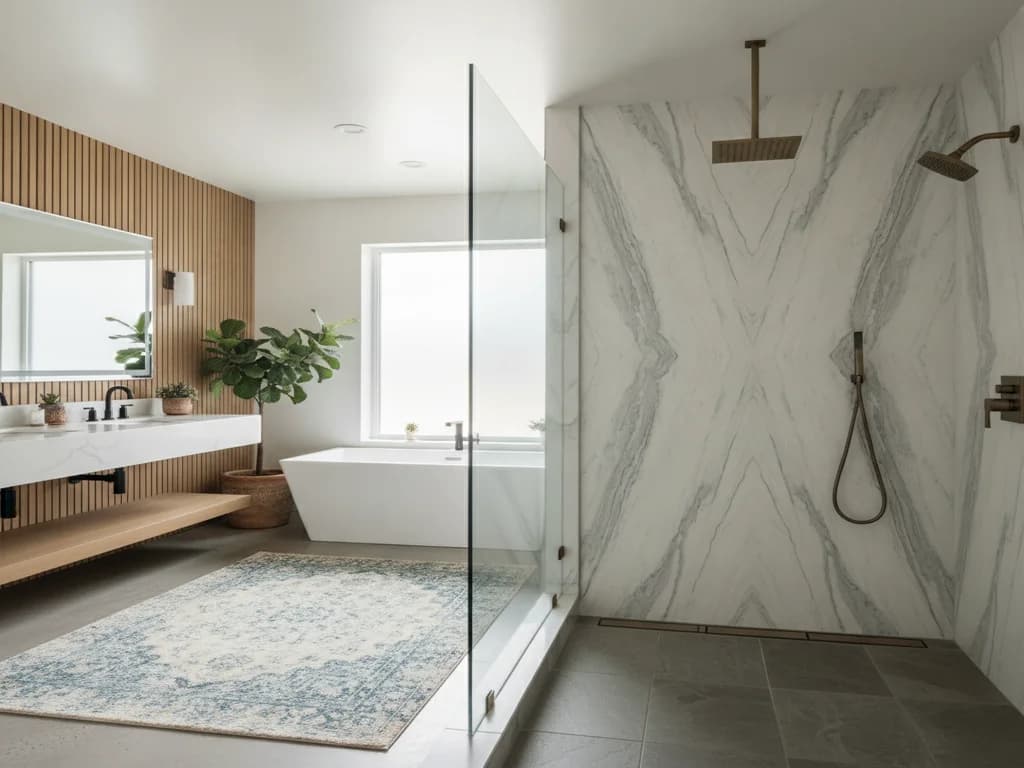
- Patterns can be book-matched across panels to produce continuous veining that looks like a single slab of stone.
- Installation is the constraint: panels are heavy, awkward, and unforgiving of substrate irregularity.
- The substrate must be flatter than conventional tile requires, because a large rigid panel cannot follow a wavy wall.
- Fewer grout lines also means fewer places for the assembly to accommodate movement, so layout and setting materials matter.
- Waterproofing behind the panels is unchanged — the panel is a finish, not a waterproofing layer.
What the material actually is
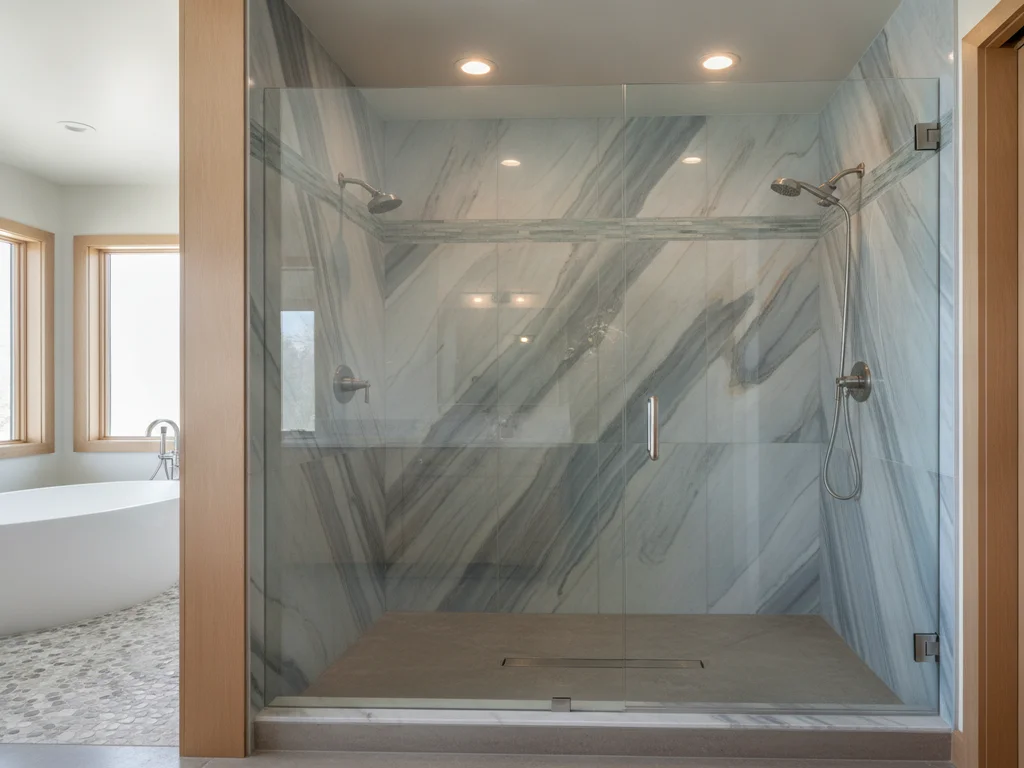
Gauged porcelain tile panels — commonly called porcelain slabs — are porcelain manufactured in very large formats and relatively thin sections. Instead of covering a shower wall with dozens of tiles, a wall can be clad in one, two, or three pieces.
The porcelain itself is not exotic. It is the same dense, low-absorption ceramic material used in ordinary porcelain tile, with the same resistance to water, staining, and wear. What changes is the format, and the format changes almost everything about how the material is handled and what the finished room looks like.
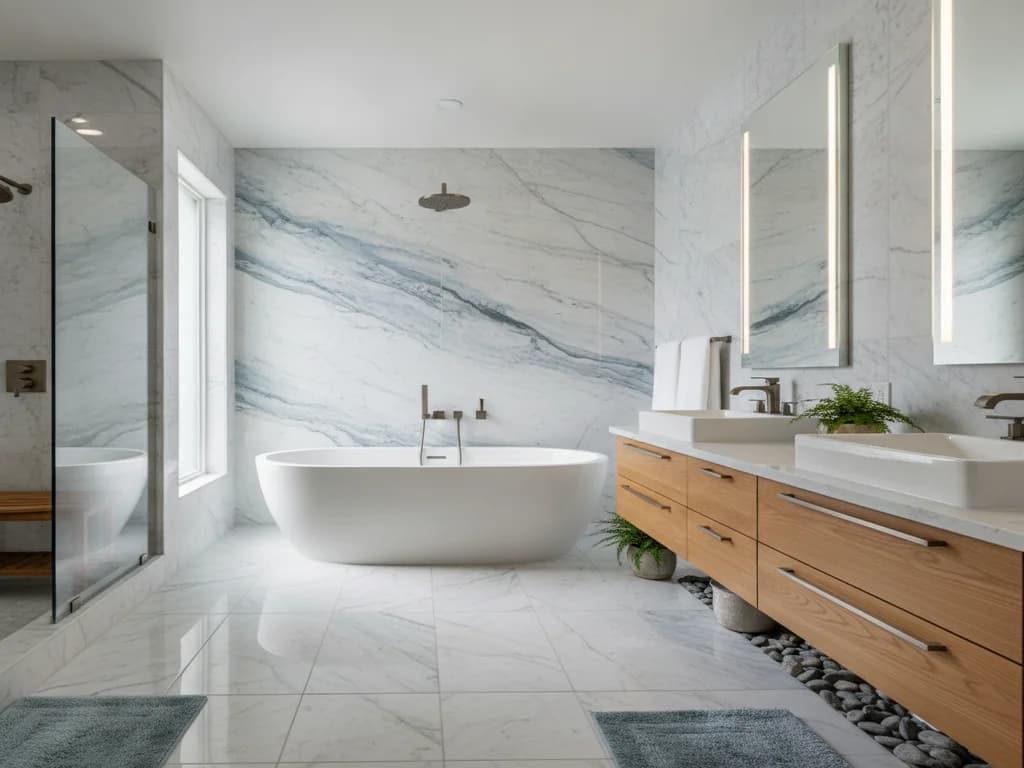
Printing technology is the other half of the appeal. Large panels can carry a continuous pattern, and adjacent panels can be book-matched so veining runs across a seam — producing the look of a single enormous piece of marble without marble’s porosity, sealing requirements, or vulnerability to acidic cleaners.
The real advantage: almost no grout
Ask anyone what they dislike about maintaining a tiled shower and grout will come up first. It stains, it holds soap film and mineral deposits, it needs sealing if it is cement-based, and in hard-water areas it discolours faster than the tile around it.
A slab-clad shower has a fraction of the grout line of a conventionally tiled one — sometimes only at corners and edges. That is a genuine, durable reduction in maintenance rather than a cosmetic claim, and it is the reason most homeowners who choose this material choose it.
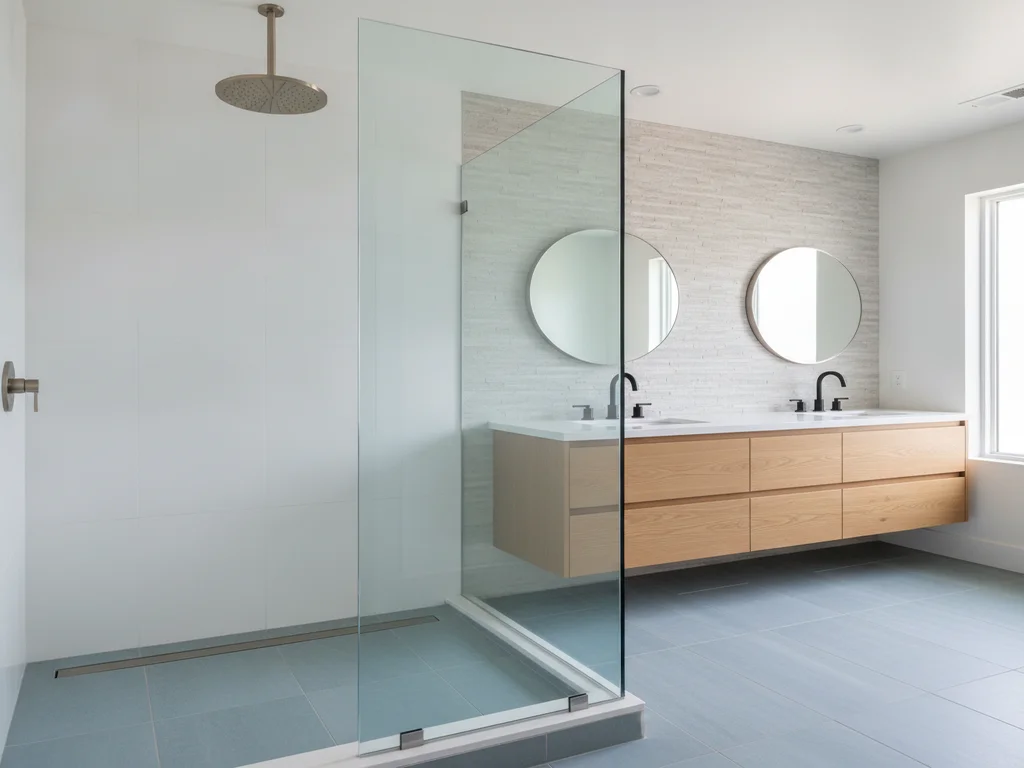
It also reads differently. Grout lines create visual rhythm and make a small shower feel busier; large uninterrupted surfaces make the same space feel calmer and larger. In a compact bathroom that effect can be worth more than the maintenance saving.
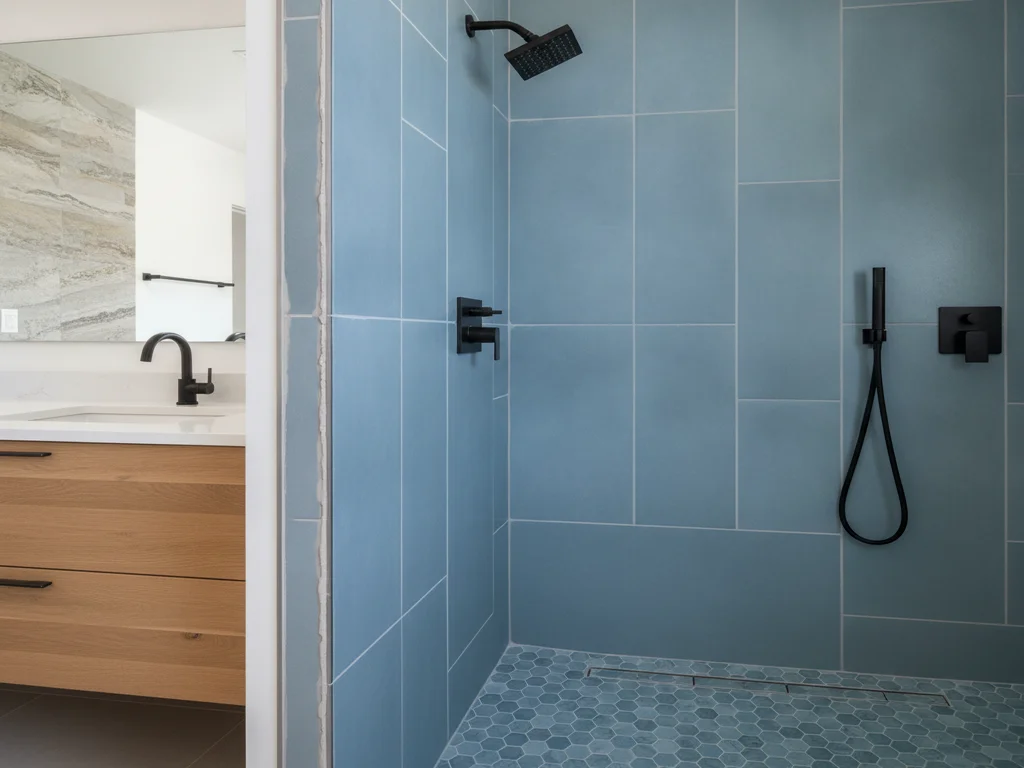
One caveat belongs here: fewer grout lines does not mean a lower-maintenance floor. Shower floors still want small-format tile for slope and traction, so the floor keeps its grout regardless of what the walls are clad in.
The installation reality
This is where porcelain slabs separate from conventional tile, and where projects go wrong.
The panels are large, heavy, and rigid, and they are handled with suction-cup frames rather than by hand. Cutting requires specific tooling and technique, and a cracked panel is an expensive mistake in a way a cracked tile is not.
Substrate flatness is the binding constraint. A conventional tile is small enough to follow minor irregularity in a wall; a panel several feet across cannot. Any deviation in the substrate telegraphs through as lippage, stress, or a hollow spot behind the panel — so walls typically need more preparation than they would for standard tile, and that preparation is part of the cost.
Setting materials and coverage matter more too. A large rigid panel over a wet-area substrate needs full support behind it, and the industry guidance on mortar coverage for large panels is more demanding than for conventional tile.
The practical conclusion is that this is not a material to hand to whoever is cheapest. Ask directly whether an installer has done gauged porcelain panels before, and what tooling they use.
Waterproofing does not change
A porcelain panel is a finish surface, not a waterproofing membrane. The shower still needs a properly detailed waterproofing assembly behind it. Fewer grout lines reduces maintenance; it does not reduce the need to build the wet area correctly.
When it makes sense
Porcelain slabs are a strong fit where the design goal is a calm, continuous surface — a large walk-in shower, a wet room, or a feature wall where veining can run uninterrupted. They also suit households that want a marble look without marble maintenance, which is a common and reasonable ask.
They are less compelling in a small enclosed shower where the panels must be cut heavily anyway, in a project where budget is tight enough that substrate preparation will be rushed, or where the available installers have no experience with the format.
Cost sits above conventional tile on both material and labor, and the labor difference is the larger of the two. That premium buys a specific aesthetic and a real reduction in ongoing maintenance — a fair trade for some households and an unnecessary one for others.
Ready to plan your Boise bathroom?
Licensed & insured · 3-year workmanship warranty
Frequently asked questions
- What are porcelain slab shower walls?
- Very large, relatively thin porcelain panels — often called gauged porcelain tile panels — used to clad shower walls with few or no grout joints. The porcelain is the same dense, low-absorption material as ordinary porcelain tile; only the format differs, which changes the look and the installation entirely.
- Do porcelain slabs eliminate grout in a shower?
- Nearly, on the walls — often leaving grout only at corners and edges. The floor is a different matter: shower floors still want small-format tile for slope and traction, so they keep their grout lines regardless of what the walls are clad in.
- Are porcelain slabs harder to install than tile?
- Considerably. Panels are large, heavy, and rigid, handled with suction-cup frames and cut with specific tooling. Substrate flatness is the binding constraint, because a large panel cannot follow a wavy wall the way a small tile can — so wall preparation is more demanding and is a real part of the cost.
- Do porcelain slab walls still need waterproofing behind them?
- Yes, exactly as any other shower does. The panel is a finish surface, not a waterproofing membrane. Fewer grout lines reduces cleaning and sealing; it does not change the requirement for a properly detailed waterproofing assembly behind the finish.
- Are porcelain slabs a good substitute for marble?
- For many households, yes. Book-matched panels can produce continuous veining resembling a single slab of stone, while the porcelain underneath is dense, low-absorption, and unbothered by the acidic cleaners that etch real marble. It is one of the more convincing look-alike options available.
Sources
- Tile Council of North America (TCNA)
- National Tile Contractors Association
- Daltile
- MSI Surfaces
- LATICRETE
Claims and figures are drawn from the sources above and provided for general guidance; your project may vary. Photography is illustrative of design concepts. For a fixed price on your specific bathroom, request a free estimate.