Updated September 10, 2026 · 7 min read
By Boise Bath — bathroom & shower remodeling in Boise & the Treasure Valley
The short answer
Quartz shower walls trade tile's grout lines for two or three seamless engineered-stone slabs — a dramatic, nearly maintenance-free look that costs as much as custom tile or more. Tile wins on repairability, design range, and installer availability; quartz wins on grout-free upkeep and bookmatched drama. Check the manufacturer's wet-area warranty before committing — not every quartz line is approved for showers.
Key takeaways
- Quartz shower walls are full slabs of engineered stone — roughly 90% ground quartz in resin — installed as two or three seamless panels instead of hundreds of tiles.
- The grout-free appeal is real: seams drop from hundreds of feet of grout line to a handful of caulked joints, which is most of the maintenance difference.
- Quartz is not the budget alternative — slab material plus fabrication and a two-person specialty install typically lands at or above custom tile pricing, per Angi.
- The fine print matters: quartz resins can be sensitive to prolonged heat and some manufacturers limit or exclude steam showers and wet walls from warranty coverage.
- Repairability favors tile decisively — a damaged tile is a spot swap; a damaged quartz slab is a fabrication-and-replacement project.
- Both systems live or die on the waterproofing membrane behind them; slabs are cladding, not waterproofing.
The verdict: quartz for seamless drama, tile for flexibility and repair
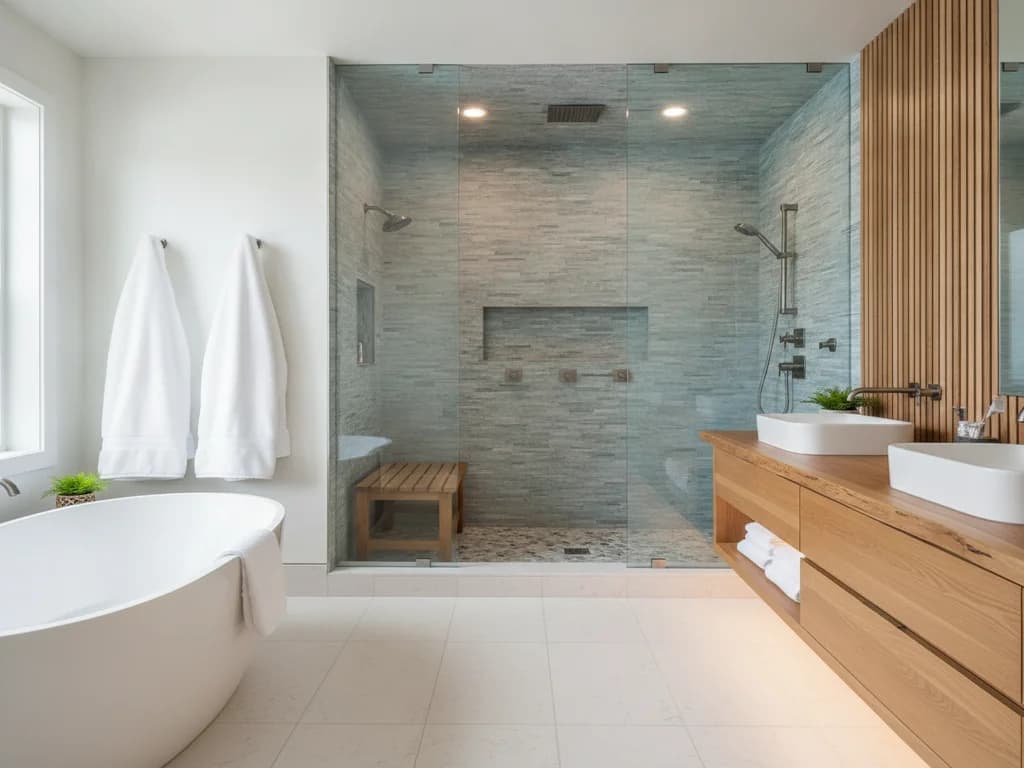
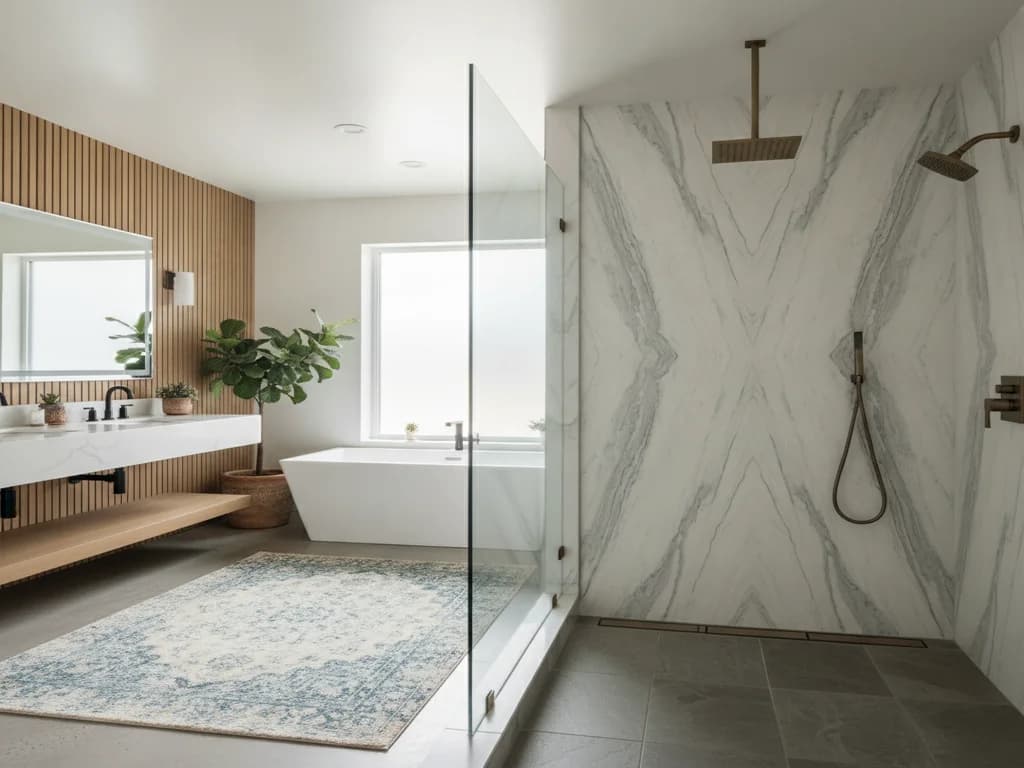
Slab walls are the current showpiece move in shower design: two or three full-height panels of veined engineered stone, no grout lines, often bookmatched so the veining mirrors across the corner. Quartz — the same engineered stone on half the countertops in America — is the material most people ask about, because they already know and trust it from the kitchen.
The honest framing: quartz walls are a luxury alternative to tile, not a practical upgrade over it. You are paying tile money or more for a different aesthetic and near-zero grout maintenance, and giving up tile's spot-repairability and unlimited design range to get it. Both are excellent showers when built over proper waterproofing. Neither is the wrong answer — but one of them is probably wrong for your budget, your bathroom, or your local installer market.
If you are earlier in the decision — surveying every wall option rather than comparing these two — start with the shower wall materials guide and come back when it is down to finalists.
What quartz shower walls actually are
Engineered quartz is ground natural quartz — typically around 90% by weight — bound in polymer resin with pigments, pressed into slabs, and polished. It is non-porous, consistent from slab to slab, and available in the marble-look veining that drives most of the demand. On a shower wall, it is installed as full panels: template, fabricate, and set, the same trade workflow as a countertop, done vertically.
Two distinctions matter. First, quartz is not "cultured marble" — the glossy molded panels in 90s Treasure Valley builder baths are cast marble dust under a thin gel coat, a different material in a different price class; that comparison is covered in cultured marble vs. tile. Second, quartz slabs are one member of a wider seamless-wall family that includes porcelain slabs, solid surface, and laminate panels — the panel system roundup maps that whole category.
And one thing quartz walls are not: waterproofing. Like tile, slabs are decorative cladding over a waterproofed substrate. The membrane behind the walls determines whether the shower lasts — the waterproofing guide explains why that hidden layer is the real purchase in either system.
Quartz vs. tile: the side-by-side
Here is the decision in one table. The pattern: quartz concentrates its advantages in maintenance and looks; tile spreads its advantages across cost flexibility, repair, and logistics.
| Factor | Quartz slab walls | Tile (porcelain/ceramic) |
|---|---|---|
| Seams & grout | Two or three slabs; a handful of caulked seams, zero grout | Hundreds of feet of grout line — the primary maintenance surface |
| Maintenance | Wipe-down; no sealing, no grout care | Grout cleaning and periodic sealing; caulk renewal at changes of plane |
| Cost direction | At or above custom tile — slab material plus fabrication and specialty installation, per Angi | Wide range; labor-heavy but scalable from modest ceramic to high-end porcelain |
| Design range | Manufacturer slab patterns; dramatic bookmatched veining | Effectively unlimited — format, pattern, color, niches, borders |
| Repairability | Chips can be filled; a cracked slab is a fabricate-and-replace project | Individual tiles swapped; grout renewable indefinitely |
| Heat & steam | Resin content is heat-sensitive; some brands restrict steam showers or wet walls in warranty terms | Porcelain and ceramic are fired — indifferent to heat and steam |
| Installer availability | Fabricator-installed; fewer shops do vertical wet-area slab work | Every tile contractor; deepest trade bench in the market |
Cost direction reflects Angi and HomeAdvisor cost-guide data for slab fabrication versus tiled walls; slab brand, wall count, and local fabricator rates drive the spread.
The grout-free appeal, honestly weighed
The case for quartz walls is genuinely strong on maintenance. Grout is tile's one recurring chore — cleaning, occasional sealing, and eventual renewal — and hard Treasure Valley water makes film on grout lines more visible and more stubborn than on a polished slab. Replace hundreds of feet of grout with three caulked seams and the weekly shower-cleaning job becomes a squeegee pass.
Two honest qualifications. First, tile has closed much of this gap: large-format porcelain with tight rectified joints and epoxy-class grout dramatically shrinks the maintenance surface — the middle path for people who want tile's flexibility with less upkeep. Second, seams do not disappear entirely; quartz walls still have caulked joints at corners and the pan, and caulk is a renewal item in any shower, slab or tile.
What the slab look uniquely buys is the drama: uninterrupted veining across a full wall, bookmatched corners, and a five-second visual read of "high-end remodel." Tile can be beautiful in a hundred ways; it cannot be seamless.
Cost reality: quartz is not the budget play
People arrive at quartz walls expecting panel-system pricing and find countertop economics instead. The slab material is sold by the square foot at countertop rates, fabrication (templating, cutouts for valves and niches, edge polishing) is billed like countertop work, and installation takes a crew that can safely handle full-height slabs in a confined wet room. Per Angi's cost guides, that stack typically lands at or above what a fully custom tile shower costs — and HomeAdvisor's roughly $2,000–$9,000 shower-remodel range is a floor for slab projects, not a ceiling.
Tile's advantage here is not that it is cheap — good tile work is skilled, multi-day labor — but that it scales. A tile budget can flex from modest ceramic to premium large-format porcelain while keeping the same watertight build underneath. A quartz wall budget starts high and moves higher with slab tier and wall count. If total project cost is the deciding constraint, the broader prefab vs. custom comparison covers the full cost ladder.
Durability, heat, and the warranty fine print
On day-to-day durability, quartz walls perform beautifully: non-porous, stain-resistant, and impervious to the scrubbing that destroys gel-coat surfaces. Walls also live an easier life than countertops — nobody sets a hot pan on a shower wall.
The caveat is the resin. Engineered quartz is roughly one-tenth polymer, and resin is sensitive to prolonged heat and, in some formulations, to UV. In practice this surfaces in the fine print: some quartz manufacturers exclude steam showers, limit wet-wall applications, or condition coverage on specific installation details. Porcelain and ceramic tile, being fired clay, have no such asterisk. This is not a reason to avoid quartz walls — it is a reason to read the specific brand's warranty before fabrication starts, and to consider porcelain slabs (same seamless look, fired material) where steam is planned.
Repair is the decisive durability difference. A chipped tile is a spot swap any tile contractor can do; a chipped quartz slab can often be filled, but a cracked one is a template-fabricate-replace project on a wall that may no longer have a matching slab in production. Tile ages in maintainable increments; slabs age toward binary decisions.
Verify the wet-area warranty before you buy the slab
Quartz brands differ meaningfully on shower and steam-shower coverage — some approve wet walls outright, others exclude steam applications or void coverage over installation details. Get the specific line's wet-area warranty terms in writing before fabrication. If the answer is vague, porcelain slab delivers the same seamless look in a fired material with no resin caveats.
Which should you choose?
Let the budget, the look, and the fine print make the call:
- High-end remodel where seamless drama is the design goal: quartz or porcelain slab walls — budget for countertop-class fabrication and confirm wet-area warranty coverage first.
- Steam shower planned: tile or porcelain slab — fired materials carry no resin heat caveats, and several quartz lines exclude steam outright.
- Maximum design control — niches, benches, borders, mixed formats: tile, no contest; slabs offer patterns, tile offers composition.
- Grout-averse but budget-bound: large-format porcelain tile with rectified joints and epoxy-class grout, or a quality panel system — most of the low-maintenance benefit at a fraction of slab cost.
- Long-haul repairability in a forever home: tile — spot repairs and grout renewal keep it serviceable for decades, per TCNA installation standards, without ever matching a discontinued slab.
- Still surveying every option: the shower wall materials guide ranks the whole field — slab, tile, panels, and solid surface — in one place.
Ready to plan your Boise bathroom?
Licensed & insured · 3-year workmanship warranty
Frequently asked questions
- Can you use quartz on shower walls?
- Yes — engineered quartz is non-porous and performs well as full-slab shower cladding over a properly waterproofed substrate. The qualifications are heat and coverage: quartz resins are sensitive to prolonged high heat, and manufacturer warranties differ on wet walls and steam showers. Confirm the specific brand approves shower use in writing, and use fired porcelain slab where a steam shower is planned.
- Are quartz shower walls more expensive than tile?
- Usually as expensive or more. Slab material is priced at countertop rates, fabrication and templating are billed like countertop work, and vertical slab installation takes a specialty crew — a stack that typically lands at or above custom tile pricing, per Angi cost guides. Tile's budget can also scale down with material selection; a quartz wall budget starts at the premium tier and climbs from there.
- Do quartz shower walls have grout?
- No — that is the core appeal. A quartz wall installation uses two or three full-height slabs with a handful of caulked seams at the corners and pan, versus hundreds of feet of grout line in a tiled shower. Caulk remains a renewal item as in any shower, but the recurring grout maintenance — cleaning, sealing, eventual regrouting — disappears with the grout itself.
- What happens if a quartz shower wall cracks?
- It becomes a replacement project. Small chips can often be filled with color-matched resin, but a crack through a slab cannot be meaningfully repaired in place — the panel has to be templated, fabricated, and replaced, and matching an aged or discontinued slab pattern is often impossible. This is the sharpest contrast with tile, where a cracked tile is a routine spot swap by any tile contractor.
- Are quartz walls better than porcelain slab walls?
- They compete for the same seamless look, and porcelain slab has the technical edge in wet areas: it is fired clay, so it carries no resin content, no heat sensitivity, and no steam-shower warranty exclusions. Quartz counters with familiar branding and countertop-matching patterns. If you want slab walls and a steam shower — or just fewer asterisks — porcelain slab is usually the stronger specification.
Sources
- Angi — Cost Guides
- HomeAdvisor — True Cost Guide
- Tile Council of North America (TCNA)
- National Kitchen & Bath Association (NKBA)
Claims and figures are drawn from the sources above and provided for general guidance; your project may vary. Photography is illustrative of design concepts. For a fixed price on your specific bathroom, request a free estimate.