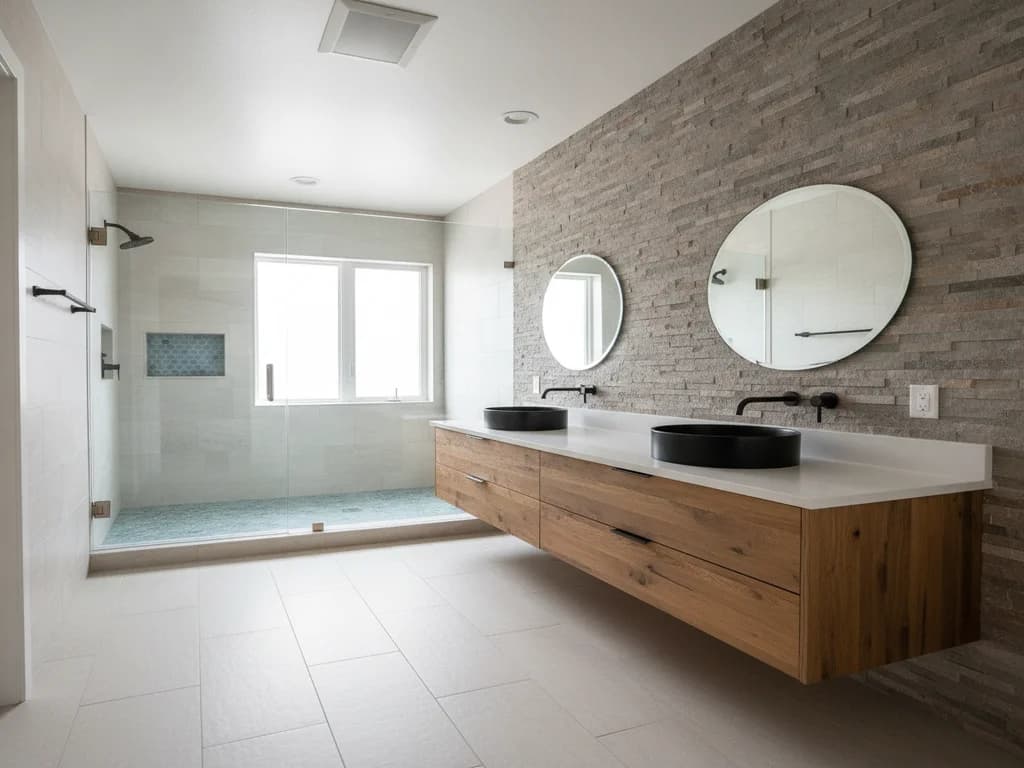
Updated July 16, 2026 · 7 min read
By Boise Bath — bathroom & shower remodeling in Boise & the Treasure Valley
The short answer
Large format tile (any side 15 inches or longer) wins on looks and maintenance — fewer grout lines, a calmer surface, a bigger-feeling room — while small tile wins on slip resistance, forgiving installation, and curved or sloped surfaces. Choose large format for walls and open floors; choose smaller tile for shower floors and wavy substrates.
Key takeaways
- Large format means any tile edge 15 inches or longer — the threshold where industry standards get stricter about substrate flatness and installation method.
- Fewer grout lines is the real large-format payoff: less scrubbing, less sealing, and a visually calmer surface that makes small bathrooms read larger.
- TCNA-referenced standards tighten the flatness requirement for large format tile to 1/8 inch in 10 feet — half the tolerance allowed for smaller tile — and meeting it often means substrate prep you cannot skip.
- Small tile conforms to slopes and imperfect walls, which is why shower floors are almost always mosaic — the tile has to follow the pitch to the drain.
- Labor, not material, drives the cost gap: large format needs flatter prep, back-buttering, and often two installers per piece.
- Most well-designed bathrooms mix both scales — large format on the field, small tile where slope or grip demands it.
The verdict: large format for walls and open floors, small tile where slope and grip matter
Tile size is not a style-only decision, even though most homeowners treat it that way. The size of the tile determines how much grout you will maintain, how flat your walls and floors have to be before setting begins, how much the labor costs, and whether the surface can safely follow a slope. Get the scale right and the room looks intentional for decades; get it wrong and you either overpay for prep or live with lippage — edges that sit proud of their neighbors and catch your eye in every raking light.
The short version: large format tile is the better default for bathroom walls and main floors, because fewer grout lines mean less maintenance and a more expansive feel. Small tile is the better tool wherever the surface curves, slopes, or needs traction — which is why the shower floor is almost always the smallest tile in the room.
If you are still deciding on material rather than size, start with how to choose bathroom tile — this article assumes you have a porcelain or ceramic candidate and are deciding how big it should be.
What counts as large format tile?
The industry line is specific: a tile is large format when any edge measures 15 inches or longer. That covers the popular 12x24 plank and rectangle sizes, 24x24 squares, wood-look planks at 8x48, and the panel-scale slabs now showing up in high-end showers. Small tile runs from mosaics on mesh sheets (penny rounds, 1-inch and 2-inch hex, small squares) up through the classic 3x6 subway and 4x4 squares.
The 15-inch threshold is not marketing — it is where the installation standards referenced by the Tile Council of North America (TCNA) change. Bigger tiles bridge more substrate, so any hump or dip underneath shows up as a rocking tile or a raised edge. The standards respond by tightening the flatness tolerance and pushing installers toward medium-bed mortars and back-buttering, where thinset is applied to both the substrate and the back of each tile for full coverage.
In between sits the middle ground — 12x12s, 4x12 subways, 6x24 planks — which behaves mostly like small tile for installation purposes but starts delivering some of the visual calm of large format.
Large format vs. small tile: the side-by-side
Here is the whole decision in one table. Notice that neither column wins outright — they win in different rooms and on different surfaces.
| Factor | Large format (15"+ edge) | Small tile & mosaics |
|---|---|---|
| Grout lines | Dramatically fewer — less cleaning, less sealing, less to discolor | Grout can be 15–20% of the visible surface on small mosaics — more maintenance, more pattern |
| Visual effect | Calm, seamless, makes small rooms read larger | Texture, pattern, and detail; can feel busy over large areas |
| Substrate flatness | 1/8" in 10 ft per the ANSI standards TCNA references — often requires leveling before setting | 1/4" in 10 ft — forgives typical wavy walls and older floors |
| Slopes & curves | Cannot follow a sloped shower floor to a center drain; needs a single-plane slope and linear drain | Conforms to any slope or curve — the default shower-floor choice |
| Slip resistance | Fewer grout joints underfoot; depends entirely on the tile surface rating | Grout joints add grip; naturally higher traction in wet areas |
| Installation labor | Higher — flatness prep, back-buttering, leveling clips, heavy handling | Lower skill floor per piece, but sheet alignment and grout volume take time |
| Lippage risk | High if prep is skipped; unforgiving of shortcuts | Low — small units telegraph substrate waves less |
Flatness tolerances are from the ANSI A108 installation standards referenced in the TCNA Handbook; your installer should be quoting them, not guessing.
The grout math: why large format is easier to live with
Grout is the highest-maintenance component of any tile surface — it is the part that stains, darkens, and eventually needs deep cleaning or renewal. So the fastest way to cut tile maintenance is to install less grout, and tile size is the lever. A wall of 1-inch mosaic is a grid of joints; the same wall in 12x24 tile has a handful of long, straight lines. On small mosaic sheets, grout can account for roughly 15 to 20 percent of what you actually see; on large format with tight joints, it drops to a small fraction of that.
That difference compounds in a shower, where soap scum and hard water — a daily reality with Treasure Valley water — settle into every joint. Fewer joints means fewer places for film to build and fewer linear feet to scrub or reseal.
The counterpoint is honest, too: grout joints are functional underfoot. Every joint is a tiny edge that interrupts a wet, smooth surface, which is part of why mosaic-floored showers feel grippier than any large tile can. On a bathroom floor outside the shower, that matters less; inside the wet area, it matters a lot — more on that in mosaic vs. large tile shower floors.
Why large format costs more to install (and when the prep is non-negotiable)
The tile itself is often a wash — large format porcelain and quality mosaic sheets overlap heavily in price per square foot. The gap opens in labor and prep, for reasons that are physical rather than negotiable.
First, flatness. The ANSI installation standards referenced by TCNA allow 1/4 inch of variation in 10 feet for small tile, but only 1/8 inch in 10 feet for tile with any edge 15 inches or longer. Very few existing bathroom floors or framed walls meet the tighter number, so a proper large-format job frequently starts with self-leveling underlayment on floors or flattening walls — real hours and material before the first tile is set. Skipping this step is the number one cause of lippage complaints, and it makes our list of bathroom tile mistakes for a reason.
Second, handling and coverage. Big tiles need back-buttering for full mortar coverage, leveling-clip systems to hold edges flush while the mortar cures, and often two sets of hands per piece on walls. National tile-installation costs run a wide range — HomeAdvisor puts typical installed tile broadly between about $10 and $50+ per square foot depending on material and complexity — and large format with real prep lands in the upper half of whatever your market charges. What drives your specific number is covered in bathroom tile installation cost factors.
If the bid does not mention flatness, ask
A contractor quoting large format tile without addressing substrate flatness is planning to set tile over whatever is there. On a typical Boise-area house — 90s framing, some settling, original mortar beds long gone — that is how you end up with edges you can feel with a bare foot. The flatness check and any leveling work should be an explicit line in the scope.
Visual scale: what each size does to the room
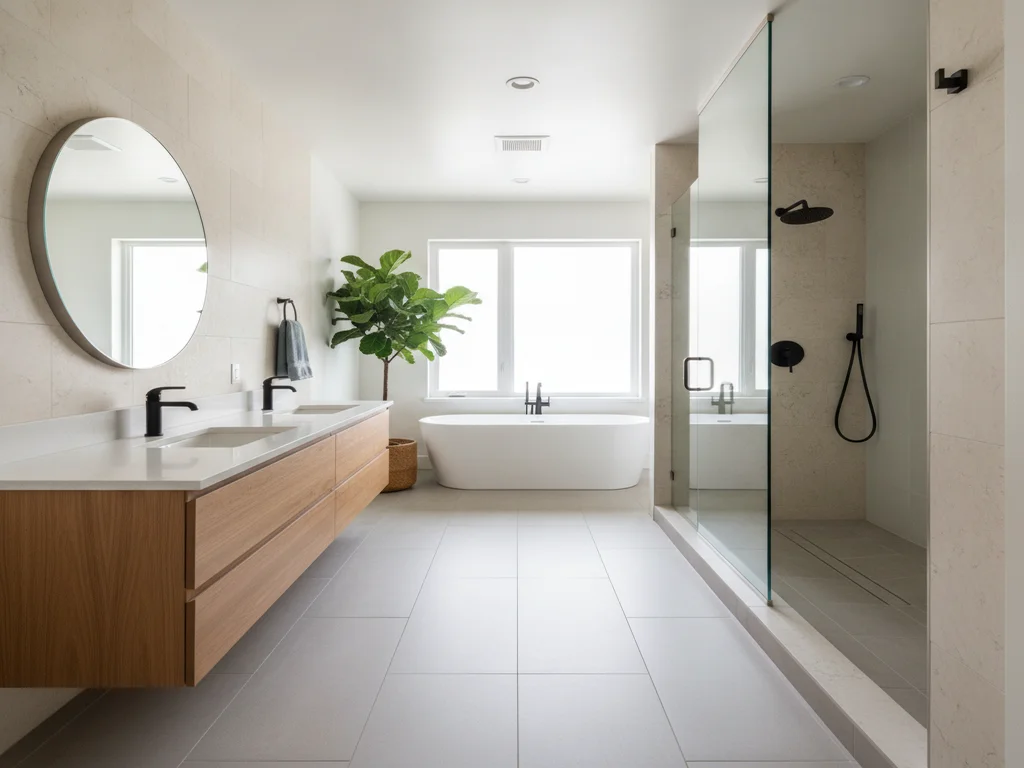
Large format tile makes rooms feel bigger, and the effect is strongest in small bathrooms — which surprises people who assume big tile belongs only in big rooms. Fewer grout lines mean fewer interruptions, so the eye reads the floor or wall as one continuous plane. Running the same large tile from the bathroom floor into a curbless shower amplifies it further; the room stops being subdivided into zones.
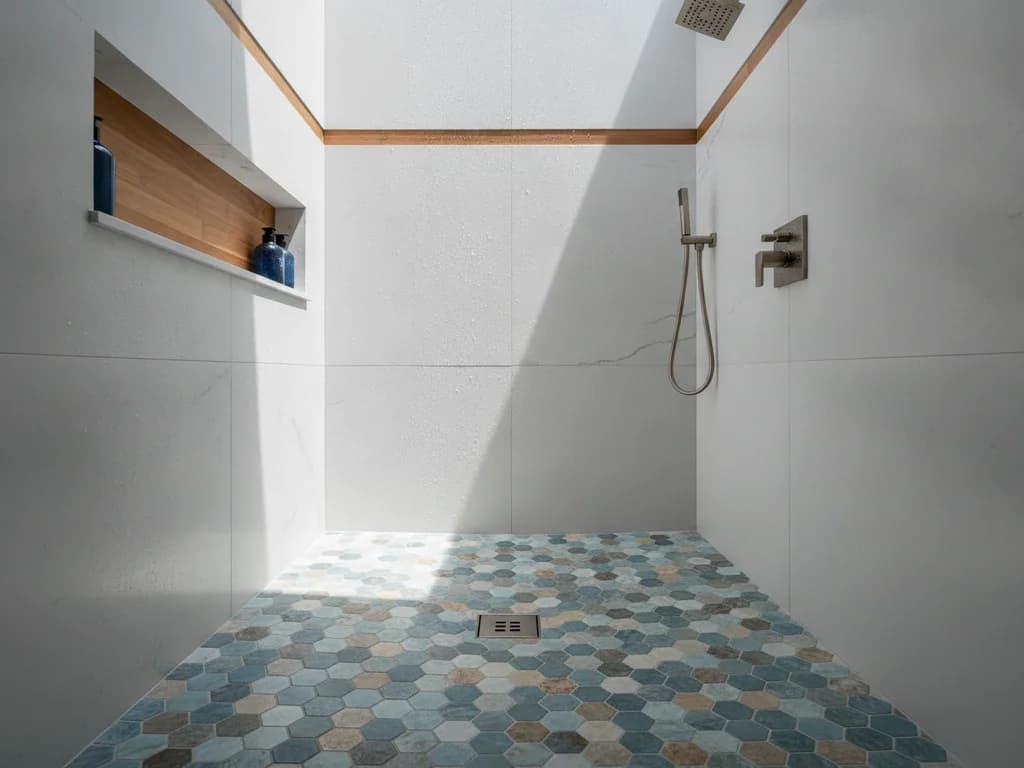
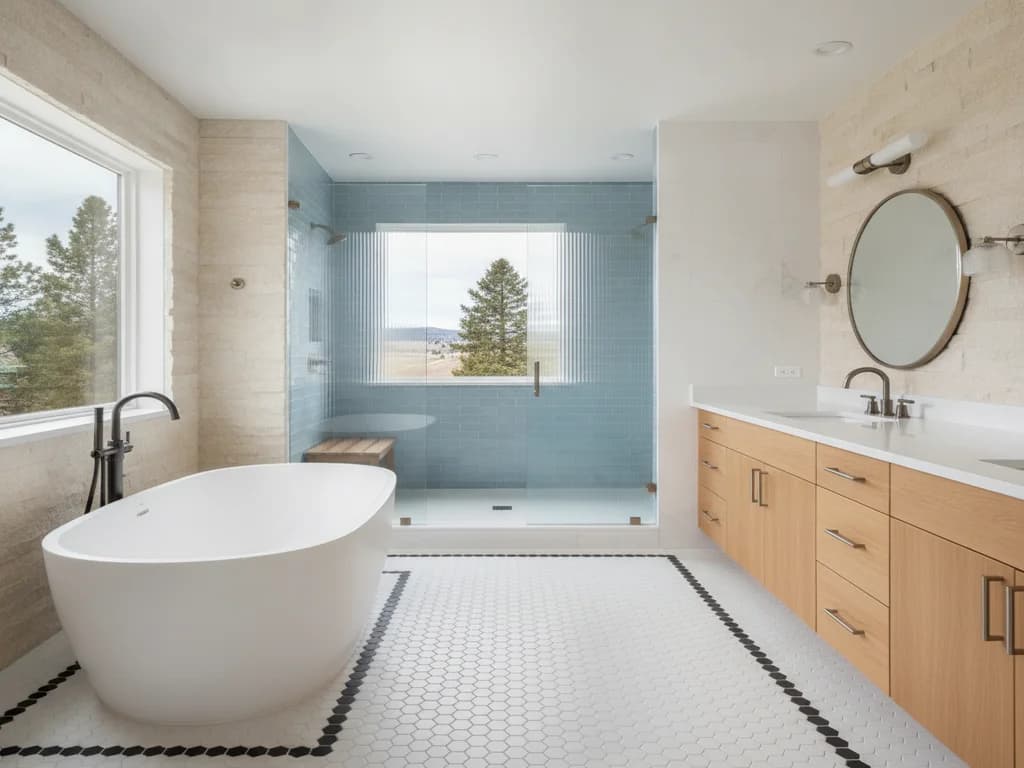
Small tile brings pattern, texture, and history. Penny rounds and hex mosaics carry a period character that large format cannot fake, and a mosaic accent — a niche back, a shower floor, a band — adds detail exactly where you want the eye to go. The risk is visual noise: an entire small bathroom in busy mosaic can feel restless, and heavily contrasting grout multiplies the effect.
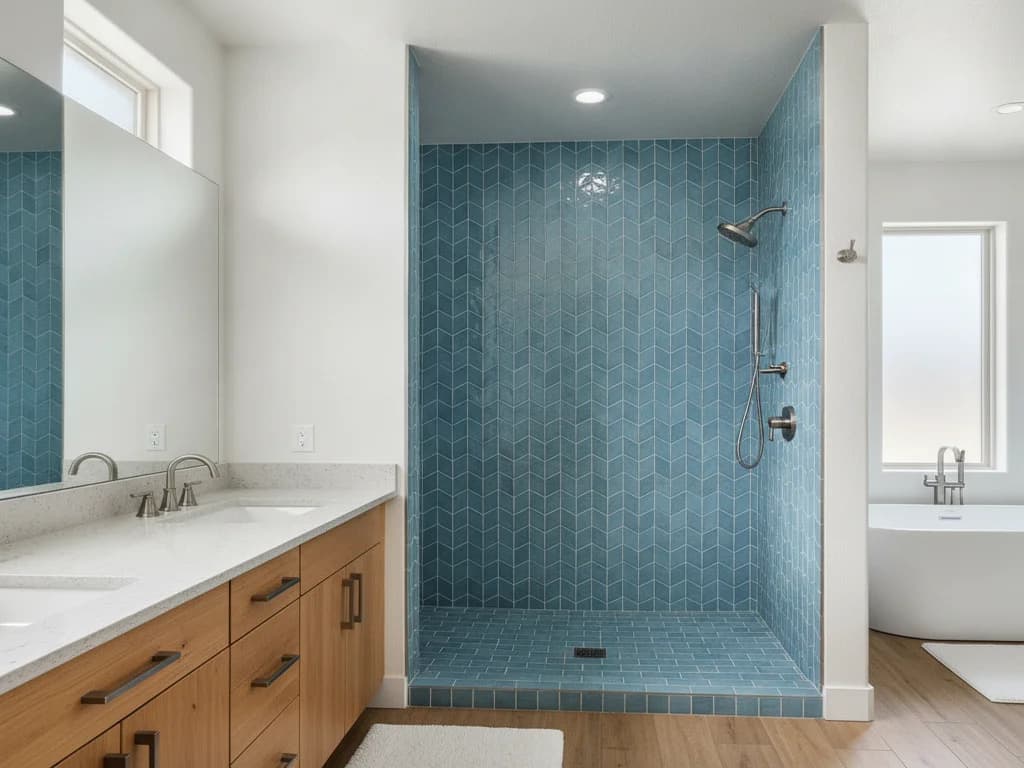
Layout choices — stacked vs. offset, herringbone, vertical orientation — change what either size does to a room, and they are their own decision. We keep the full treatment in bathroom tile pattern ideas and the planning mechanics in the tile layout planning guide; the short version is that large format rewards simple layouts and small tile rewards deliberate ones.
Which should you choose?
Let the surface, not the showroom, make the call:
- Main bathroom floor: large format (12x24 or larger) — fewer joints to clean, calmer surface, and modern porcelain handles the traffic. Verify the substrate gets flattened to the tighter standard.
- Shower walls: large format for a seamless modern look, or classic subway if the style calls for it — walls carry no slip-resistance duty, so this one is almost pure aesthetics and budget.
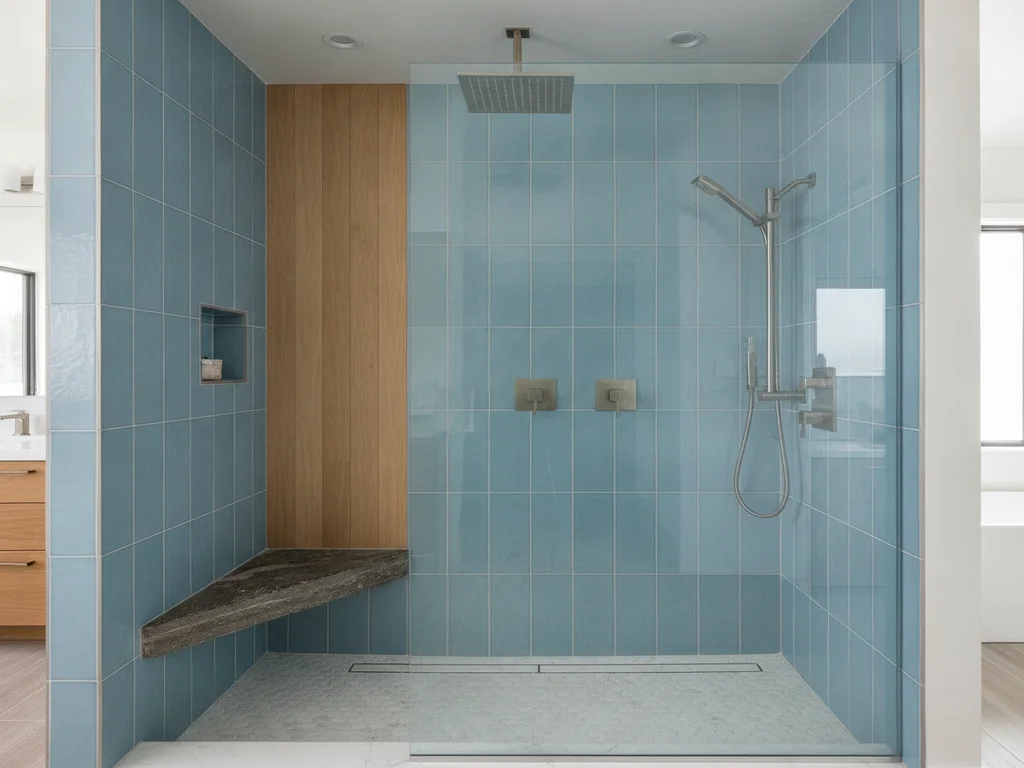
- Shower floor: small tile or mosaic, almost always — it conforms to the slope toward the drain and the extra grout joints add grip. Large format only works over a single-plane slope with a linear drain.
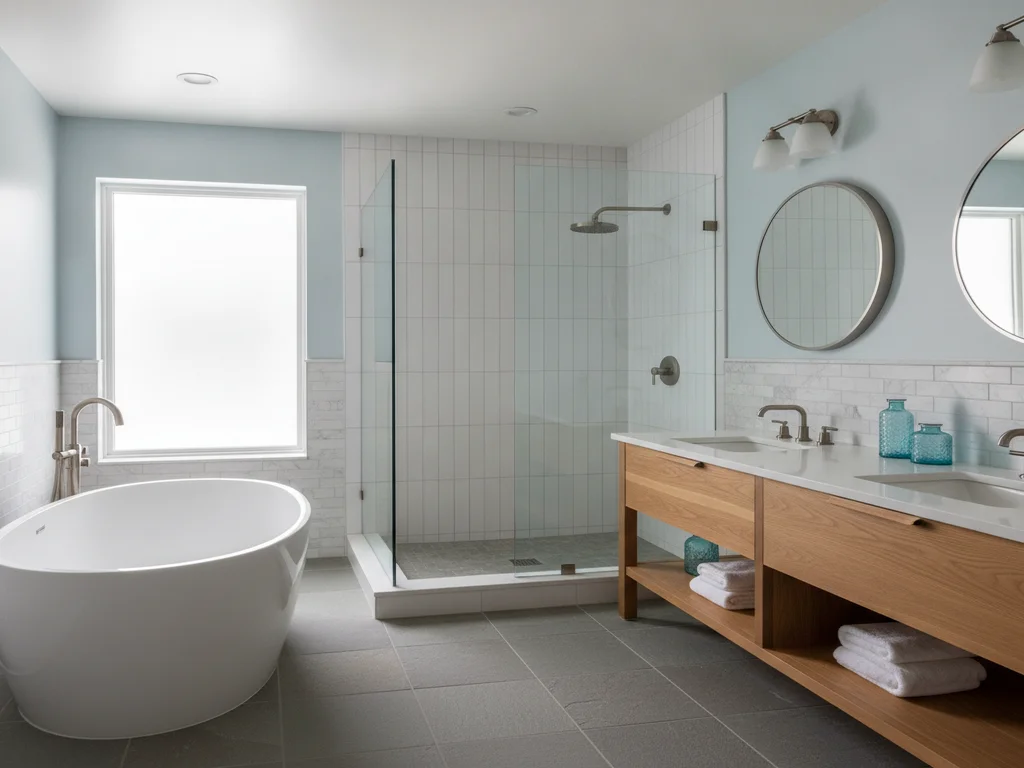
- Small or windowless bathroom: large format, counterintuitively — the fewer the visual interruptions, the larger the room reads.
- Older house with wavy walls or out-of-flat floors, and no budget for leveling: smaller tile — it telegraphs imperfection far less and keeps prep costs contained.
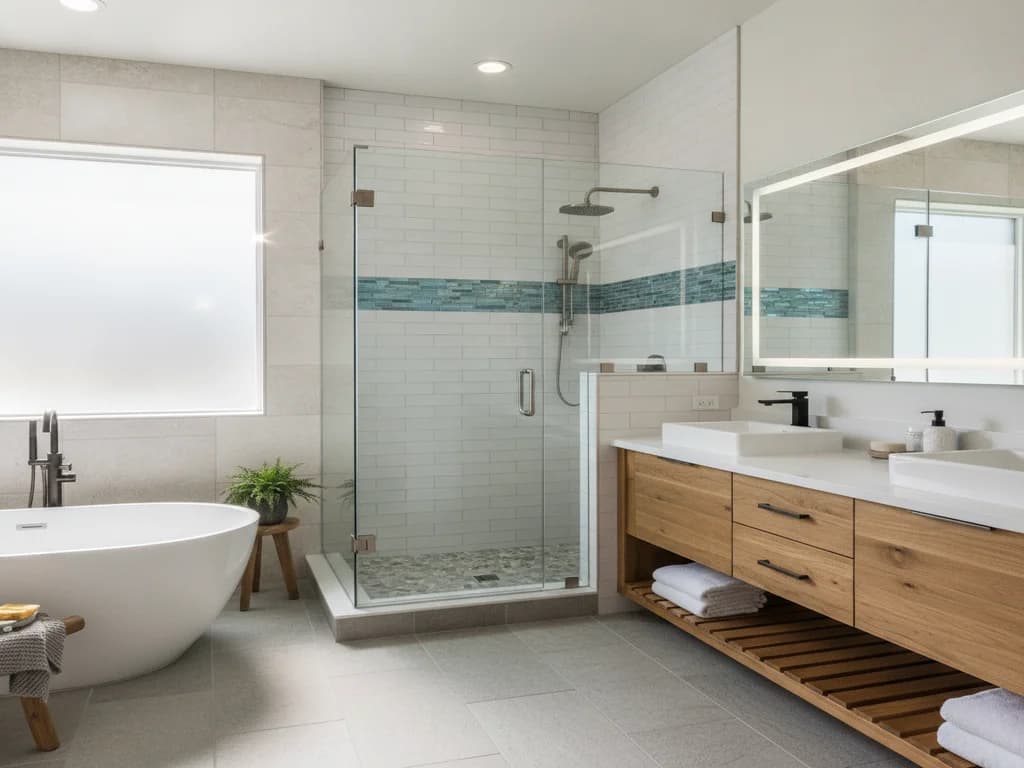
- Design-forward remodel: both — large format field tile with mosaic used deliberately at the shower floor, niche, or an accent band. This is how most of the bathrooms you have saved to a folder are actually built.
Ready to plan your Boise bathroom?
Licensed & insured · 3-year workmanship warranty
Frequently asked questions
- What size tile is considered large format?
- Any tile with at least one edge 15 inches or longer — the threshold at which the ANSI installation standards referenced by TCNA tighten substrate flatness requirements and installation methods. In practice that includes 12x24 rectangles, 24x24 squares, long wood-look planks, and wall-panel slabs. A 12x12 is technically not large format, though it delivers some of the same visual calm.
- Does large format tile make a small bathroom look bigger?
- Yes — this is one of the most reliable effects in bathroom design. Fewer grout lines mean fewer visual interruptions, so the floor and walls read as continuous planes and the room feels more expansive. Running the same large tile from the main floor into a curbless shower strengthens the effect. The old rule that small rooms need small tile has it backwards.
- Is large format tile harder to install?
- Meaningfully harder, yes. The flatness tolerance drops to 1/8 inch in 10 feet per the standards TCNA references — half what small tile allows — so floors and walls usually need leveling first. Each tile needs back-buttering for full mortar coverage, leveling clips to prevent lippage, and careful handling. That is skilled-labor time, and it is why large format installs cost more than the tile price suggests.
- Can you use large format tile on a shower floor?
- Only with a single-plane slope draining to a linear drain at one edge. A conventional center drain requires the floor to slope from four directions, and rigid large tiles cannot fold to follow that geometry — which is why traditional shower floors use mosaics. If you love the large-format look underfoot, a linear-drain curbless design is the way to get it done correctly.
- Is small tile more slippery or less slippery than large tile?
- Less slippery, generally. Every grout joint is a small interruption in an otherwise smooth wet surface, so mosaic floors offer more natural traction than a large tile of the same material. That said, the tile surface itself matters most — wet-area floor tile should meet the DCOF threshold of 0.42 or higher under ANSI A326.3, whatever its size. Ask for the rating; it is printed in every manufacturer spec.
- Which is cheaper to install, large tile or small tile?
- Usually the middle sizes — 12x12 to 4x12 subway — are cheapest to install. Large format adds substrate leveling, back-buttering, and lippage-control labor; tiny mosaics add sheet-alignment time and a lot of grouting. HomeAdvisor puts installed tile work broadly in the $10–$50+ per square foot range nationally, and both extremes of tile size push toward the upper end for different reasons.
Sources
- Tile Council of North America (TCNA)
- National Tile Contractors Association
- HomeAdvisor — True Cost Guide
- This Old House — Bathrooms
Claims and figures are drawn from the sources above and provided for general guidance; your project may vary. Photography is illustrative of design concepts. For a fixed price on your specific bathroom, request a free estimate.