Updated July 16, 2026 · 6 min read
By Boise Bath — bathroom & shower remodeling in Boise & the Treasure Valley
The short answer
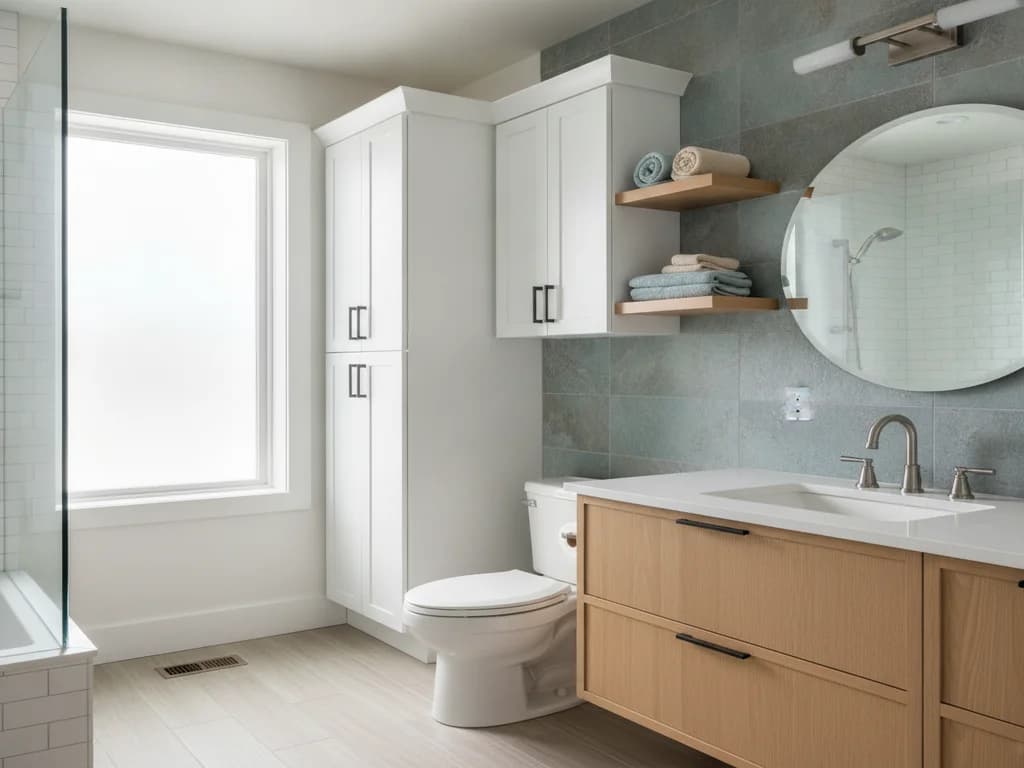
Replacing bathroom cabinets — linen towers, wall-hung units, and over-toilet storage — means removing the old boxes, repairing the wall behind them, locating studs or adding blocking for solid anchoring, and hanging or setting the new cabinets plumb and level. Most swaps take half a day to a day, and the real skill is anchoring wall cabinets so they safely carry loaded weight.
Key takeaways
- Bathroom storage cabinets are structural, not decorative: a wall cabinet loaded with towels and bottles can weigh well over 100 pounds and must anchor into studs or blocking.
- Linen towers are the workhorse of bathroom storage — a tall cabinet adds more usable capacity than any combination of shelves and baskets.
- Replacing cabinets one at a time almost always produces a mismatched room; planning the vanity, tower, and wall units as a set is what makes a bathroom look designed.
- The wall behind an old cabinet needs inspection and repair before anything new goes up — anchors in damaged drywall are how cabinets end up on the floor.
- Humidity is the silent killer of bathroom cabinetry: plywood boxes and sealed finishes outlast bare particleboard in a room that steams daily.
Which cabinets are we talking about?
The vanity gets all the attention, but most bathrooms lean on a supporting cast of storage: a tall linen tower, a wall-hung cabinet over the toilet, open shelving, and mirrored medicine storage. These fail in their own ways — sagging shelves, swollen particleboard, doors that no longer close in a humid room — and they get replaced on their own schedule, often without touching the vanity at all.
This guide covers those storage pieces. The vanity itself is a plumbing project and has its own replacement guide; mirrored units recessed into the wall are covered in replacing a medicine cabinet.
When is a cabinet worth replacing?
Bathroom cabinets live in the hardest environment in the house: daily steam, temperature swings, and splashed water at every edge. Bare particleboard — the material of most builder-grade boxes in Treasure Valley homes from the 1990s and 2000s — swells permanently once moisture gets past the surface, and there is no fixing a swollen box.
Clear replacement signals: shelves that sag under towel weight, a bottom panel that has puffed up or delaminated, hinges pulling out of soft material, doors that rub or will not stay closed, and any dark staining that suggests moisture inside the box. Cosmetic complaints on a structurally sound cabinet — dated color, tired hardware — can sometimes wait for a larger remodel where the whole room gets addressed at once.
The three cabinet types and what each swap involves
Each storage type has its own removal and installation logic, and the anchoring requirements are what separate a safe installation from a hazard.
| Type | How it mounts | What the swap involves | Relative scope |
|---|---|---|---|
| Linen tower (tall cabinet) | Floor-standing, anchored to wall for anti-tip | Remove, repair wall, set plumb, anchor | Simplest |
| Wall-hung cabinet | Screws into studs or blocking, carries full load | Remove, verify framing, hang level and secure | Moderate |
| Over-toilet unit | Wall-hung or floor-straddling frame | Work around the toilet; check clearances | Moderate |
Recessed units that sit inside the wall cavity are a different project — see the medicine cabinet guide.
Why anchoring is the part that matters most
A wall cabinet loaded with towels, bottles, and a hair dryer can easily exceed 100 pounds, and it hangs at head height over the toilet or beside the shower. Drywall anchors alone are not an acceptable mounting for that load — the cabinet must fasten into studs, or into solid blocking added inside the wall where the studs do not line up with the cabinet rail.
Tall linen towers have the opposite problem: they rarely tip forward on their own, but an open upper door plus a child reaching for a shelf is exactly the tip-over scenario the U.S. Consumer Product Safety Commission warns about with tall furniture. Anti-tip anchoring into a stud is a two-minute step that should never be skipped.
The wall behind the old cabinet tells the story
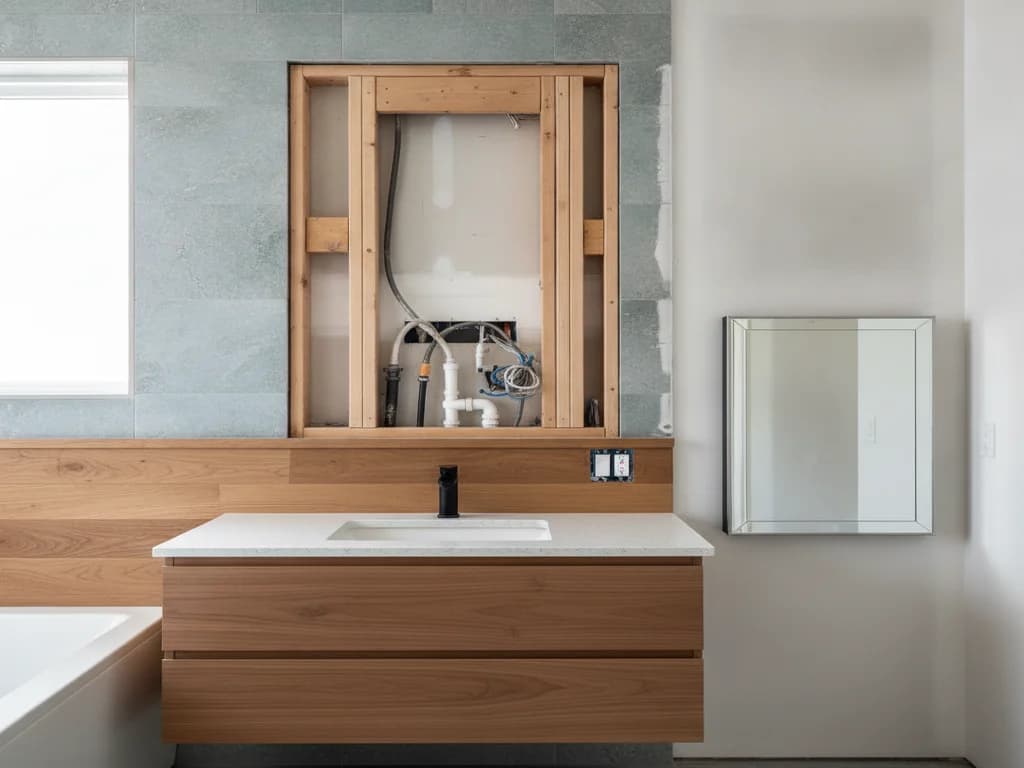
Removal exposes wall the room has not seen in decades. Old anchor holes, torn drywall paper, and moisture staining all need repair before the new cabinet goes up — fresh anchors in damaged drywall are how loaded cabinets end up pulling off the wall. Budget for patching and paint behind every swap.
Planning cabinets as a set, not one-off swaps
The most common regret in bathroom storage is the piecemeal look: a vanity in one finish, a tower bought two years later in another, and an over-toilet cabinet that matches neither. Cabinet lines get discontinued quickly, so "I will add the matching tower later" often is not an option.
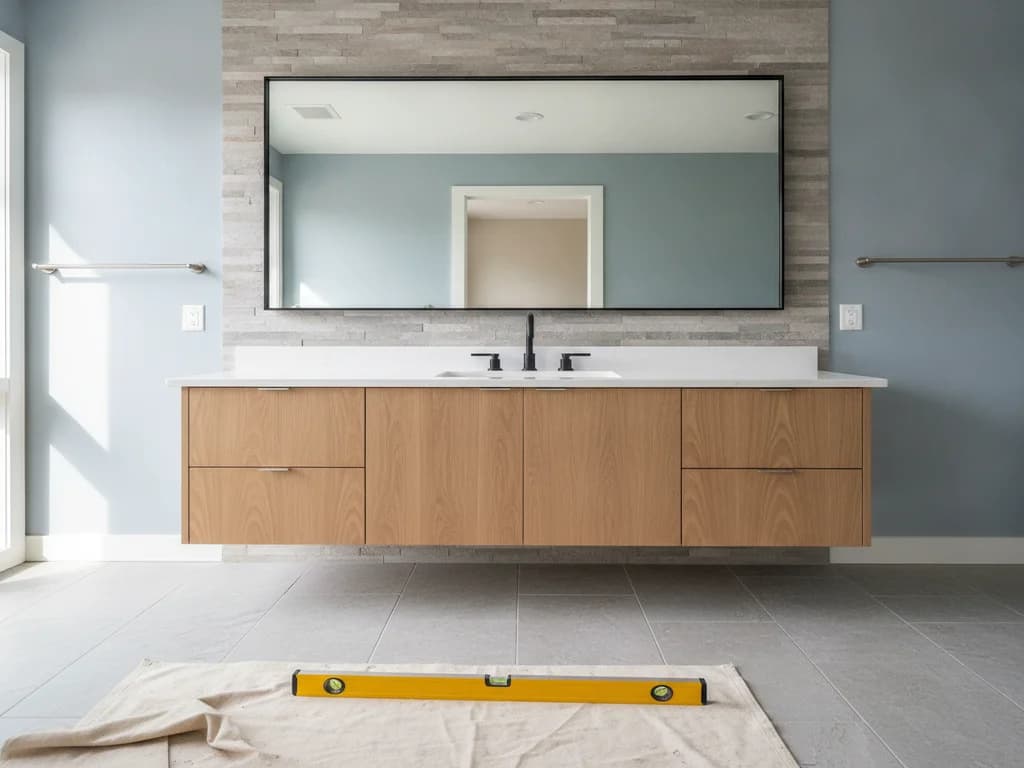
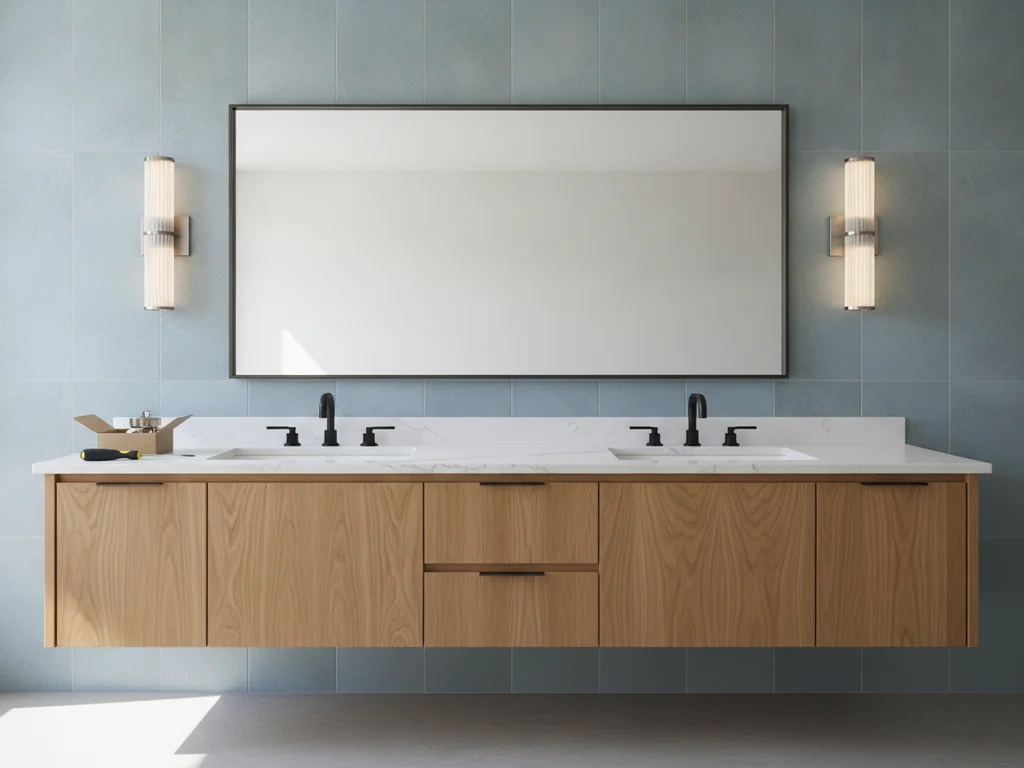
If more than one piece is tired, replacing them together — same door style, finish, and hardware — is what makes a bathroom read as designed rather than accumulated. It also lets you rethink the storage plan as a whole: a single 18-inch linen tower frequently replaces an over-toilet unit and a freestanding shelf at once. For the broader layout thinking, see our bathroom storage ideas roundup, and pull hardware and finish choices from mixing bathroom hardware finishes so the new set works with your existing faucet and lighting.
Materials that survive a humid room
Bathroom cabinets fail from moisture, so box construction matters more here than anywhere else in the house. Plywood boxes shrug off humidity that destroys bare particleboard; thermofoil and painted MDF doors handle steam well as long as the seal is intact; solid wood moves with humidity swings but takes decades of it.
Ventilation is the other half of the equation. A bathroom that steams up and stays wet will age any cabinet prematurely — the Home Ventilating Institute sizes exhaust fans to actually clear that moisture, and if your mirror stays fogged long after a shower, a fan upgrade protects the new cabinetry as much as the walls.
Boise’s dry winters add a wrinkle: wide indoor humidity swings between a steamy shower and single-digit outdoor dew points make stable, sealed materials worth the modest upcharge over bare builder-grade boxes.
What the project costs and how long it takes
A single wall cabinet or linen tower swap is typically a half-day of labor; a coordinated set — tower, wall unit, and hardware across the room — runs a full day plus wall repair and paint time. None of it requires permits or plumbing, which keeps this among the most contained bathroom projects.
On budget, national cost guides such as HomeAdvisor and Angi put individual bathroom storage cabinets roughly in the low-hundreds-to-low-thousands range installed, with the spread driven almost entirely by cabinet quality and size rather than labor. Semi-custom pieces that precisely fit an alcove sit at the top of that range and are often worth it in a small bathroom, where a two-inch gap wastes real storage.
What the process looks like
- 1
Audit the storage plan first
The contractor measures the wall, checks what the room actually needs to store, and confirms whether one piece is being swapped or the set should be coordinated — finish, door style, and hardware decided together.
- 2
Empty and remove the old cabinets
Contents come out, doors and shelves are pulled to reduce weight, and each cabinet is unscrewed from the wall or floor and removed without tearing the drywall around old fasteners.
- 3
Repair and prep the wall
Old anchor holes, torn paper, and any moisture staining get patched, sealed, and painted. Framing behind wall-cabinet locations is verified, and blocking is added inside the wall where studs miss the cabinet rail.
- 4
Locate studs and lay out heights
Stud locations are marked, cabinet heights are laid out level around the room — coordinated with the mirror, lighting, and any towel bars — and clearances over the toilet and beside the shower are confirmed.
- 5
Hang wall units level and secure
Wall cabinets are hung with structural screws into studs or blocking, checked level and plumb, and load-tested before shelves go in. Drywall-anchor-only mounting is never acceptable for a loaded cabinet.
- 6
Set and anchor tall cabinets
Linen towers are shimmed plumb against the wall and anchored with anti-tip fasteners into a stud, then scribed or trimmed to the wall where the drywall is not flat.
- 7
Install hardware and adjust
Doors and drawers are aligned, soft-close hinges adjusted, knobs and pulls installed on a consistent layout, and every door is checked for full swing against the toilet, shower, and door casings.
Ready to plan your Boise bathroom?
Licensed & insured · 3-year workmanship warranty
Frequently asked questions
- Can I replace bathroom cabinets without replacing the vanity?
- Yes — linen towers, wall cabinets, and over-toilet units have no plumbing connection and can be swapped independently. The catch is finish matching: if the new pieces will not coordinate with the existing vanity, the room can end up looking piecemeal. Choose a finish that deliberately complements the vanity, or plan to update the set together.
- How do you attach a bathroom wall cabinet safely?
- With structural screws driven into wall studs, or into solid blocking added inside the wall where studs miss the cabinet’s mounting rail. A loaded bathroom wall cabinet can exceed 100 pounds, and drywall anchors alone are not rated for that kind of sustained load at head height. If a cabinet is currently held by anchors only, that is worth correcting even before it fails.
- What is the best cabinet material for a humid bathroom?
- Plywood boxes with sealed painted, thermofoil, or laminate surfaces hold up best. Bare particleboard — common in builder-grade cabinets — swells permanently once moisture penetrates and cannot be repaired. Whatever the box, running a properly sized exhaust fan during and after showers does more for cabinet lifespan than any material upgrade.
- Should bathroom cabinets match the vanity exactly?
- They should coordinate deliberately, which usually means either an exact match in door style and finish or an intentional contrast — such as a white vanity with a wood-tone tower. What reads as a mistake is a near-miss: two slightly different whites or wood stains a shade apart. Since cabinet lines get discontinued quickly, buying coordinated pieces at the same time is the reliable path.
- Do tall linen cabinets need to be anchored to the wall?
- Yes. Freestanding tall furniture is a documented tip-over hazard — the CPSC attributes injuries every year to unanchored tall units, and a bathroom tower with open doors and loaded shelves is exactly the risk profile. Anchoring into a stud with an anti-tip bracket takes minutes during installation and should be treated as non-optional, especially in homes with children.
Sources
- HomeAdvisor — True Cost Guide
- Angi — Cost Guides
- U.S. Consumer Product Safety Commission
- Home Ventilating Institute (HVI)
- National Kitchen & Bath Association (NKBA)
Claims and figures are drawn from the sources above and provided for general guidance; your project may vary. Photography is illustrative of design concepts. For a fixed price on your specific bathroom, request a free estimate.