Updated July 16, 2026 · 7 min read
By Boise Bath — bathroom & shower remodeling in Boise & the Treasure Valley
The short answer
LVP is a legitimate bathroom floor — waterproof planks, warm underfoot, and roughly half the installed cost of tile per HomeAdvisor. Its honest weaknesses: the floor system is not waterproof even when the planks are, it dents and cannot be refinished, and it reads budget-grade at resale. Great for kids’ baths, basements, and rentals; tile still wins the forever-home master.
Key takeaways
- “Waterproof LVP” means the plank cannot be damaged by water — it does not mean water can’t get past the seams to the subfloor below.
- LVP installs at roughly half to a third of tile’s cost per HomeAdvisor, and in a fraction of the time.
- Warmth, softness underfoot, and slip resistance are real daily-life advantages over unheated tile.
- LVP cannot be refinished: dents, gouges, and worn wear layers are permanent until you replace the floor.
- The bathrooms where LVP disappoints are predictable — high-splash kids’ tubs with failing caulk, and upscale masters where buyers expect tile.
- In a full remodel where the floor is open anyway, the labor savings shrink and tile’s case gets much stronger.
The honest verdict on LVP in bathrooms
Luxury vinyl plank earned its market share. It looks convincingly like wood, shrugs off splashes that would ruin laminate or hardwood, costs a fraction of tile installed, and feels warmer and softer under bare feet than anything ceramic. For a lot of bathrooms — kids’ baths, basements, rentals, budget remodels — it is not the compromise choice. It is the correct choice.
It also gets oversold. “Waterproof” on the box describes the plank, not the floor system, and the difference matters in exactly one room of the house: the one with a toilet, a tub, and daily standing water. LVP also dents, cannot be refinished, and reads as a budget material to buyers touring an otherwise high-end bathroom.
This article gives you both halves honestly. If you are weighing it directly against tile, the full head-to-head lives in our tile vs. LVP comparison — this page is about whether LVP belongs in your bathroom at all.
What LVP actually is (and what “waterproof” means)
Luxury vinyl plank is a layered product: a rigid or flexible core (usually SPC — stone-plastic composite — in current bathroom-grade lines), a printed image layer, and a clear wear layer on top measured in mils. Planks click together and float over the subfloor, unglued, held down by their own interlocked weight.
Every layer is plastic or mineral-plastic composite, which is why the plank itself is genuinely waterproof: you can submerge a plank for a week and nothing happens to it. That claim is true and it is also the most misunderstood claim in flooring. A floor is planks plus hundreds of feet of click seams, a perimeter expansion gap under the baseboards, and cutouts around the toilet flange and tub — and none of those joints are sealed.
So when water sits on an LVP floor long enough, it finds a seam and reaches the subfloor, where it can sit trapped under a vapor-tight plastic floor. The planks survive; the OSB underneath may not. That is the single most important sentence in this article, and the specific ways it plays out — swollen subfloors, cupped seams around toilets — are worth their own deep dive, which we cover separately.
The pros: where LVP genuinely earns its place
The case for LVP in a bathroom is strong, and it is worth stating without hedging:
- Cost: vinyl plank installs at roughly $3–$10 per square foot per HomeAdvisor, versus roughly $10–$25+ for tile once prep, setting, and grouting labor are counted. In a small bathroom that is often a four-figure difference.
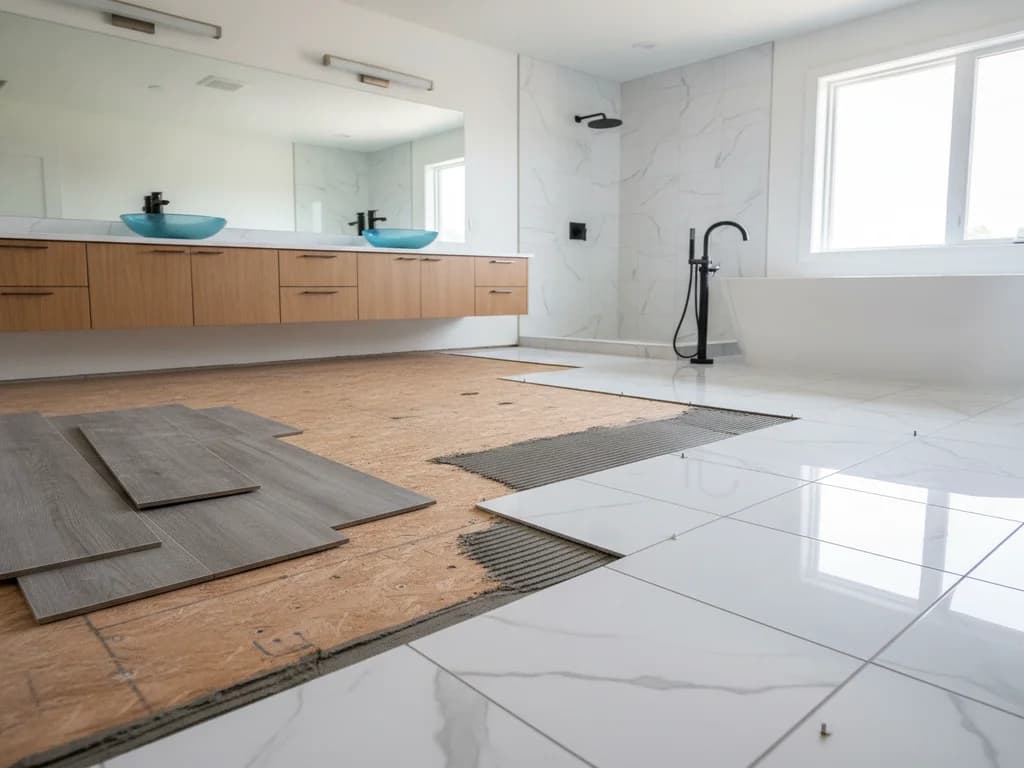
- Speed and disruption: a bathroom floor can be done in a day, with no cure times, no wet trades, and often no demolition of the existing floor if it is flat and sound.
- Comfort: LVP is warmer and softer underfoot than tile — a real difference on a January morning in Boise, and one that matters more than most people expect. Tile answers this only with electric heat mats, at added cost.
- Slip resistance: textured wood-look LVP is generally grippier when wet than polished tile, which is part of why it shows up so often in our recommendations for family bathrooms.
- Forgiveness: dropped shampoo bottles bounce; on tile they can chip the floor. And a floating floor tolerates minor subfloor imperfections that tile would telegraph as cracks.
- Style range: current photographic layers are good enough that convincing oak, hickory, and even stone looks are all available in the same product line at the same price.
The cons: where LVP disappoints
Now the half the flooring aisle does not tell you. These are not edge cases — they are the predictable ways LVP falls short in bathrooms specifically:
- The floor system is not waterproof. Toilet-base leaks, tub-edge splash past aging caulk, and supply-line drips all put water through the seams onto the subfloor, where a vapor-tight floating floor traps it. You often learn about the problem only when a seam cups or a plank swells — months after the water got in.
- It cannot be repaired, only replaced. There is no refinishing a worn wear layer or filling a gouge. A single damaged plank mid-floor means unclicking the floor back to that plank — and discontinued colorways make partial fixes a gamble.
- It dents. Vanity feet, toilet flange bolts torqued through it, dropped curling irons — rigid-core products resist this better than older flexible LVP, but none match porcelain.
- It reads budget-grade at resale. In an entry-level home nobody blinks. In a $700K+ master bath, buyers touring the house register vinyl underfoot, and appraisers class it below tile. Tile is the material that says “remodeled”; LVP says “refreshed.”
- Transitions and details are where it shows. Around a toilet flange, at a curbless shower edge, or against a tub skirt, LVP needs trim pieces and caulk lines that tile handles with a cleaner, more permanent edge.
- Heat and sun are real limits. Rigid cores can expand in direct sun through a big south-facing window, and radiant-heat compatibility varies by product — check the spec sheet, not the shelf tag.
The one habit that protects an LVP bathroom
Caulk is the waterproofing. The bead where the floor meets the tub, the toilet base, and the vanity kick is the only thing standing between daily splash and your subfloor. Inspect it yearly and recaulk when it pulls loose — a $10 tube of sealant is the entire maintenance program, and skipping it is how good LVP floors go bad.
Who LVP is right for
Choose LVP with confidence when the bathroom fits one of these profiles:
- Kids’ and family baths on a budget — warm, grippy, forgiving of chaos, and cheap enough to replace in ten years without grief.
- Basement bathrooms — LVP is unbothered by concrete-slab moisture vapor that would complicate wood, and it handles the occasional minor seep better than any organic floor.
- Rentals and flips at the entry-level price point — durable enough for tenants, fast to install between occupants, and the budget stays pointed at kitchens and curb appeal.
- Half baths and powder rooms — minimal water exposure means LVP’s one real weakness barely applies, and its cost advantage is pure savings.
- Floors-only refreshes — when the walls are staying closed and the goal is a one-day transformation, LVP’s speed advantage is at its maximum.
Who should skip LVP
And choose something else — usually tile — when the situation looks like this:
- Forever-home master bathrooms. You will live with the dents and the resale perception for decades, and the labor savings amortize to nothing. This is tile’s room.
- Full remodels where the floor is already open. Most of LVP’s cost advantage is avoided labor and demolition; when you are down to the subfloor anyway, the gap narrows and tile with an electric heat mat becomes the better buy. Plenty of homeowners reach this conclusion a few years late — replacing LVP with tile is a common request for exactly this reason.
- Curbless showers and wet rooms. Open-concept showers need continuous waterproofing across the bathroom floor, and that is a tiled-membrane job — a floating plastic floor has no honest role there.
- Bathrooms with a known moisture history. If a toilet has leaked before or the subfloor has ever been wet, do not install a floor that hides the next leak. Tile over a proper membrane fails loudly; LVP fails silently.
- Anyone whose decision is really “LVP or tile” on looks and lifetime value — read the full tile vs. LVP comparison before committing, and see the best floor tile options to know what the alternative actually costs.
How to buy LVP well, if LVP is the answer
If your bathroom lands in the LVP column, the product tiers matter more than the brand names. Look for a rigid SPC core rather than a soft flexible plank, a wear layer of at least 20 mils (12 mils is builder-grade and shows traffic lanes within a few years), and an attached underlayment pad rated for bathrooms.
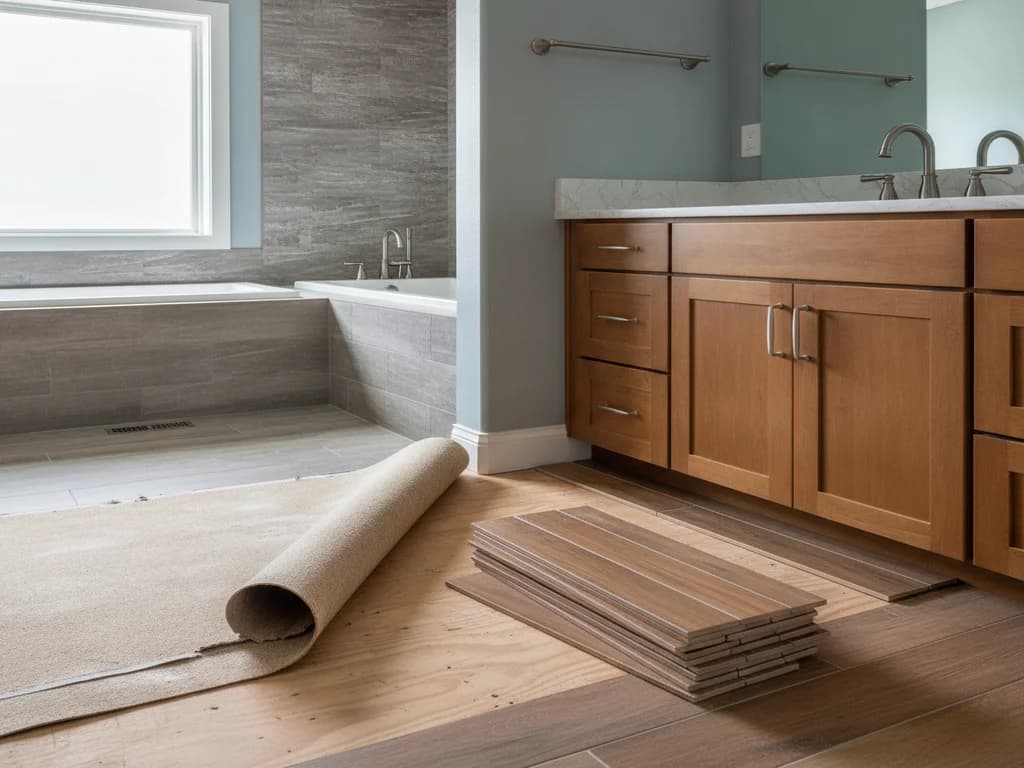
Installation quality matters too, even for a floating floor. The subfloor needs to be flat within the manufacturer’s spec or seams flex and open; the toilet should be pulled and reset over the new floor rather than caulked around; and the perimeter gap needs to be genuinely covered and sealed at wet walls. These are small-money details that determine whether the floor lasts five years or twenty — our guide to replacing bathroom flooring walks through what a professional install includes.
One honest note on the economics: because LVP is cheap to install, it is also cheap to install badly, and the failures rarely show up before the installer’s truck is long gone. In a bathroom — the one room where the floor meets a toilet, a tub, and daily water — the install is worth doing right the first time.
Ready to plan your Boise bathroom?
Licensed & insured · 3-year workmanship warranty
Frequently asked questions
- Is LVP really waterproof in a bathroom?
- The planks are — soak one for a week and it is unchanged. The floor is not: click seams, the perimeter gap, and the toilet-flange cutout all let standing water reach the subfloor, where a vapor-tight floating floor traps it. In practice LVP handles splashes and humidity fine; it does not protect you from leaks, and it can hide them.
- How long does LVP last in a bathroom?
- Quality rigid-core LVP with a 20-mil wear layer commonly carries 15–25-year residential warranties, and in a low-abuse bathroom it can serve that long. The honest caveat: it ages by accumulating dents and wear that cannot be refinished, so the floor’s end usually comes from looking tired or from a hidden moisture event — not from the plank wearing through.
- Is LVP or tile better for a bathroom?
- Tile is better where lifetime, resale, and wet-area performance matter — masters, forever homes, and anywhere near a curbless shower. LVP is better where budget, warmth, speed, and forgiveness matter — kids’ baths, basements, rentals, and quick refreshes. Cost is the biggest separator: roughly $3–$10 per square foot installed for LVP versus $10–$25+ for tile, per HomeAdvisor. The full comparison is in our tile vs. LVP guide.
- Does LVP in a bathroom hurt resale value?
- It depends entirely on the home’s tier. In entry-level and mid-market homes, clean new LVP reads as a positive. In upper-tier homes, buyers and appraisers expect tile in bathrooms, and vinyl underfoot quietly discounts an otherwise nice remodel. Match the floor to what the comps in your neighborhood have — not to the flooring aisle’s marketing.
- Can you put LVP around a toilet and tub?
- Yes, and this is where install quality shows. The right way is pulling the toilet and laying plank under it, then resetting it with a new wax ring — not caulking plank around the base. At the tub, the plank edge gets an expansion gap sealed with quality caulk. Those caulk lines become the floor’s real waterproofing, and they need occasional renewal.
- What thickness of LVP is best for bathrooms?
- Focus on the wear layer, not overall thickness: 20 mils is the sensible floor for a bathroom, and 12-mil builder-grade product wears visibly faster. Core type matters too — rigid SPC cores resist denting and telegraphing better than flexible planks. Overall plank thickness of 5–8 mm mostly affects feel and how well it bridges minor subfloor flaws.
Sources
Claims and figures are drawn from the sources above and provided for general guidance; your project may vary. Photography is illustrative of design concepts. For a fixed price on your specific bathroom, request a free estimate.