Updated September 9, 2026 · 7 min read
By Boise Bath — bathroom & shower remodeling in Boise & the Treasure Valley
The short answer
DCOF stands for dynamic coefficient of friction — a laboratory measurement of how much a tile surface resists a moving slip when wet. The ANSI A137.1 standard sets a DCOF of 0.42 or greater for tile intended to be walked on in level interior spaces expected to be walked on when wet.
Key takeaways
- DCOF measures resistance to a slip already in motion, which is the relevant scenario for a person losing footing.
- The ANSI A137.1 standard, referenced widely across the tile industry, sets 0.42 as the threshold for level interior floors expected to be walked on when wet.
- DCOF is published by manufacturers on spec sheets, so slip resistance is knowable before purchase rather than discovered afterward.
- A 0.42 result is a minimum threshold, not a safety guarantee — the standard itself is explicit that it does not by itself determine suitability.
- Texture, tile size, and grout lines all affect real-world footing in ways a single laboratory number cannot fully capture.
- Smaller tile means more grout lines per square foot, and grout is textured and slightly recessed — which is why mosaic is common on shower floors.
- Topical anti-slip treatments are maintenance, not specification: they wear and need reapplication, whereas surface texture is permanent.
- Polished tile that looks excellent dry can be genuinely hazardous wet, and no coating reliably changes that long-term.
What the number is measuring
DCOF stands for dynamic coefficient of friction. It is a laboratory measurement of the friction between a tile surface and a standardized sliding material while that material is already moving, with the surface wetted.
The "dynamic" part matters. An older measure, static coefficient of friction, tested the force needed to start something moving from rest. That is not the situation a person is in when they slip. A slip is a foot already in motion on a surface that failed to stop it, which is why the industry moved to a dynamic measure.
The ANSI A137.1 standard sets the widely referenced benchmark: tile intended for level interior spaces expected to be walked on when wet should have a DCOF of 0.42 or greater. Manufacturers publish this figure on spec sheets, which means the question of whether a floor will be slippery when wet has a published answer before anyone buys anything.
What 0.42 does not mean
It is tempting to treat 0.42 as a pass mark that settles the question. The standard itself is more careful than that, and so should anyone specifying a bathroom floor be.
The measurement is taken under controlled laboratory conditions with a specified contaminant and a specified sliding material. A real bathroom floor has soap film, shampoo residue, body oils, hard-water mineral deposits, and bare wet feet rather than a test sled — and the interaction of those variables is not what the test reproduces.
The standard is explicit that meeting the threshold does not by itself determine that a tile is suitable for a given installation. The TCNA bulletin puts it in one sentence: “Not all products with a DCOF AcuTest value over 0.42 are suitable for all applications.” It is a necessary screen, not a sufficient one. Treat 0.42 as the floor beneath which a tile should be excluded from a wet area, not as proof that anything above it is fine.
One practical consequence: the bulletin is equally blunt that “to know definitely if a floor meets the minimum 0.42 DCOF AcuTest criterion, it must be measured.” A tile that looks textured is not evidence. Ask for the DCOF value on the spec sheet before the tile is ordered, because it is the one slip-resistance fact you can check on paper and the one nobody can retrofit.
How to use it practically
Ask for the DCOF figure before selecting any tile going into a bathroom. Exclude anything below 0.42 for wet floor areas outright. Then choose among what remains using texture, tile size, and how the floor will actually be cleaned.
The things the number cannot tell you
Two tiles can share a DCOF value and behave differently underfoot, because the laboratory figure does not capture everything that matters.
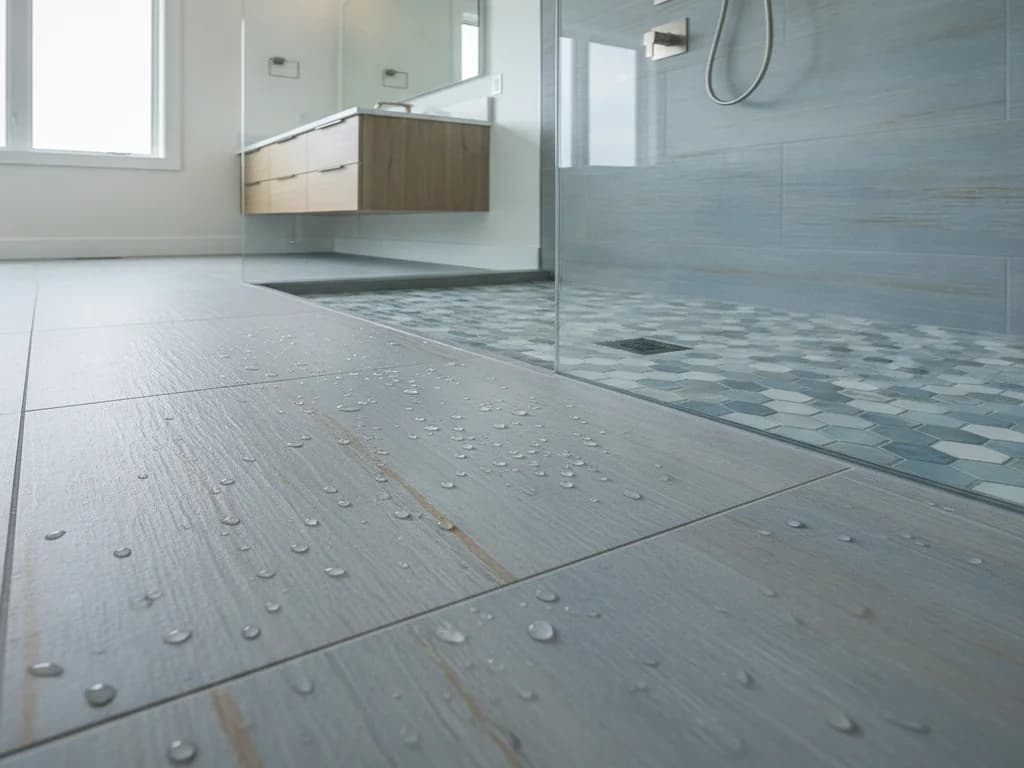
Surface texture is the first. A tile with genuine relief — a structured or textured face — gives water somewhere to go and provides mechanical grip that a smooth surface at the same rating does not. This is why textured porcelain performs well in wet areas even though a polished tile can occasionally test acceptably.
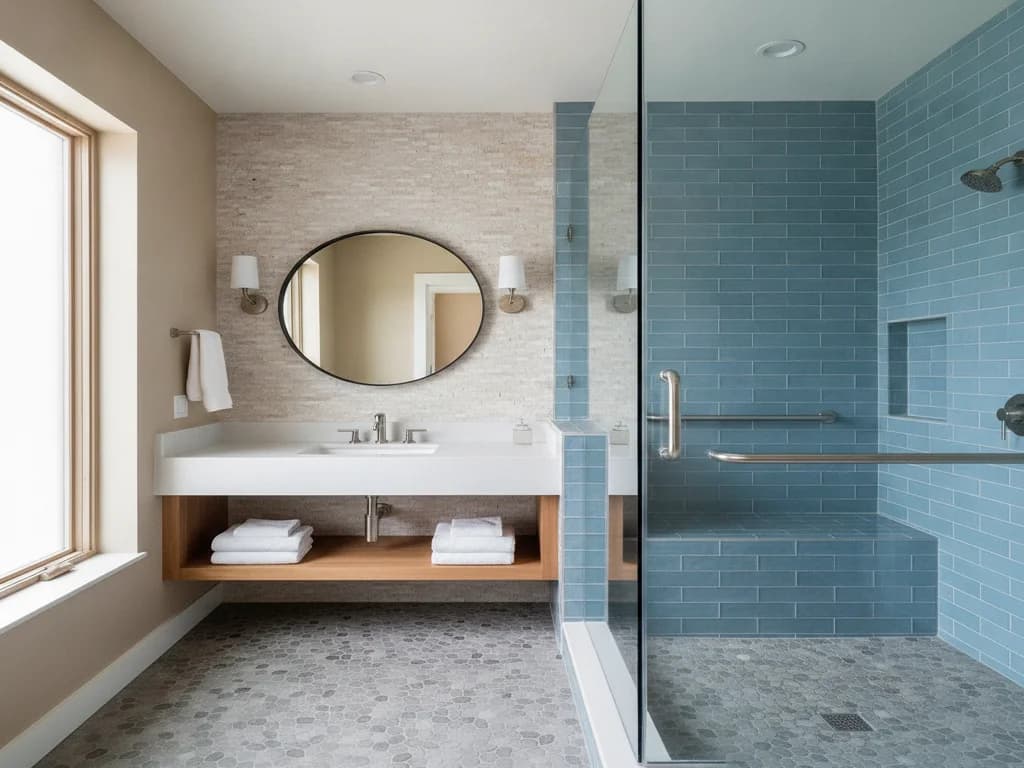
Tile size and grout coverage is the second, and it is the most useful practical lever available. Grout is textured and sits very slightly below the tile face, so every grout line contributes traction. A mosaic floor has many times the grout length per square foot of a large-format tile, which is precisely why small tile is the conventional choice for shower floors. It also handles the slope to the drain better, which is the other reason.
Cleaning regime is the third and the most overlooked. A tile with excellent slip resistance and a film of soap residue on it is a slippery floor. Textured surfaces need proper cleaning to keep working — the texture that provides grip also holds residue.
Why coatings are not the answer
Anti-slip treatments exist and they do something — typically by etching the surface microscopically or leaving a textured film. They are a legitimate remedy for an existing floor that turned out to be too slick, and for that purpose they are worth knowing about.
They are not a substitute for specifying correctly. Coatings wear under foot traffic and cleaning, which means they need periodic reapplication, and the interval is not always obvious. A floor whose slip resistance depends on a treatment applied eighteen months ago is a floor whose current performance nobody actually knows.
Surface texture, by contrast, is a property of the tile. It does not wear off, does not need reapplying, and performs the same in year ten as in year one. In a bathroom being remodeled anyway, choosing the right tile costs nothing extra over choosing the wrong one, which makes the coating conversation avoidable entirely.
Where this matters most
The floor immediately outside a shower or tub is the highest-priority area, because that is where a person steps out wet, often onto a surface with water on it, sometimes while reaching for a towel. It is also where the majority of bathroom slips occur.
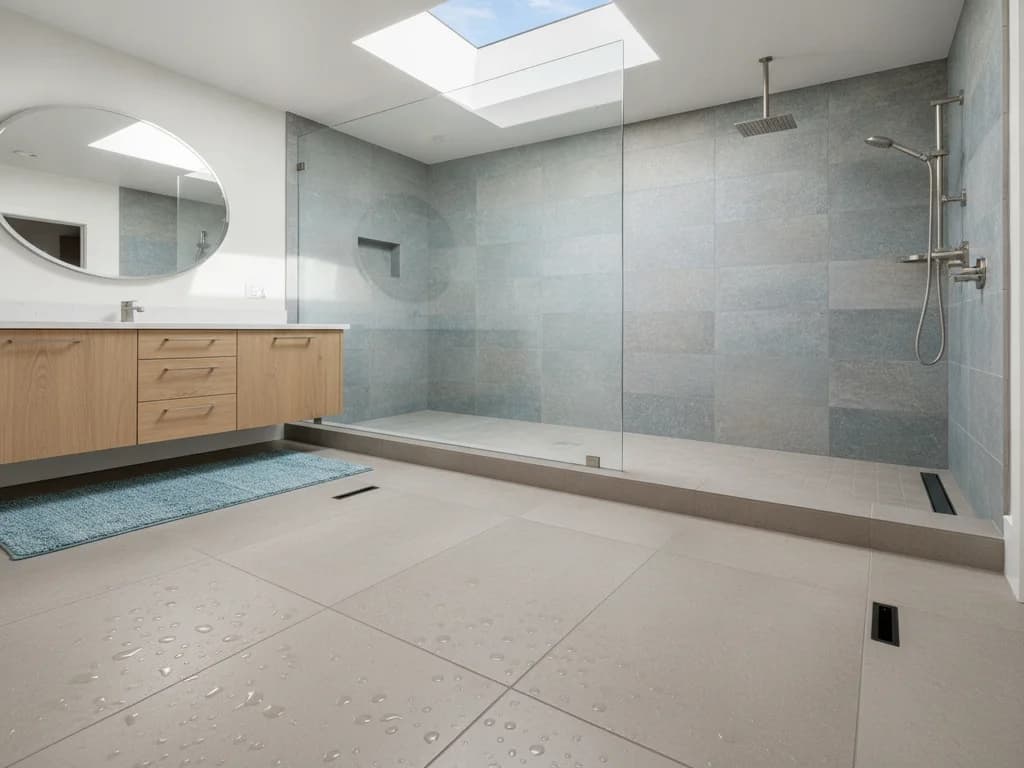
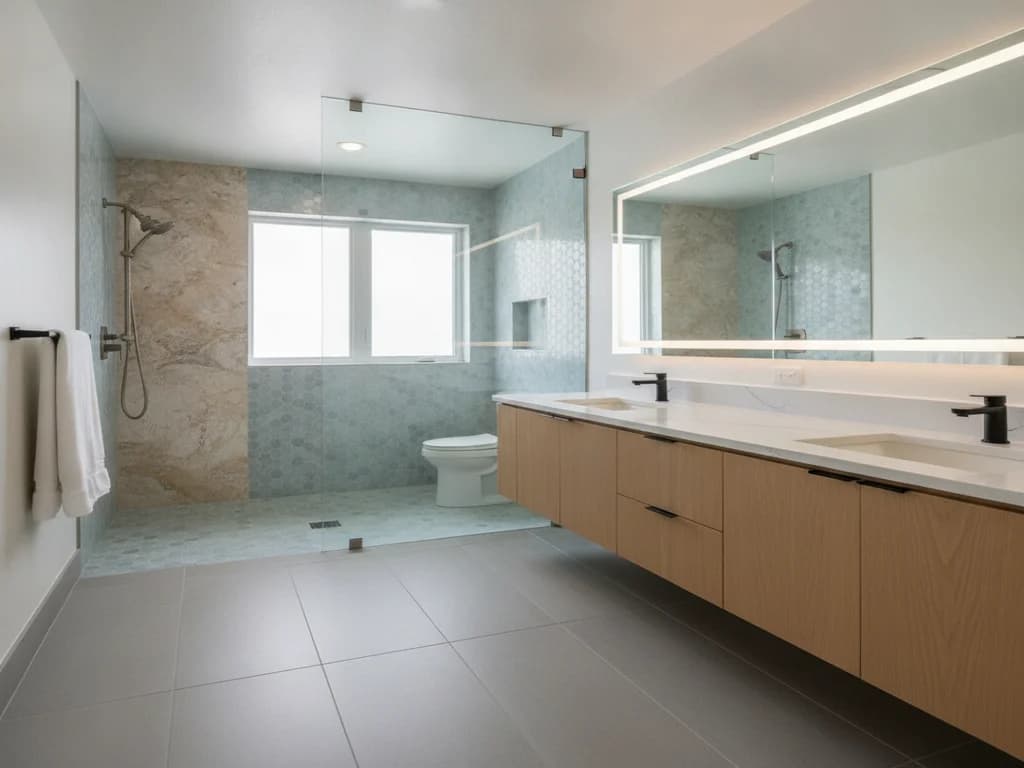
The shower floor itself is next, and is well served by small-format tile for both traction and drainage. Where a curbless shower means the shower floor and the room floor are continuous, the entire wet zone should be specified to the same standard rather than treating the two areas separately.
This is the point at which slip specification stops being a technical footnote and becomes safety design — particularly in a household where anyone is older, unsteady, or bathing seated. Getting the tile right is one of the few safety decisions in a bathroom that costs nothing and lasts as long as the floor does.
Ready to plan your Boise bathroom?
Licensed & insured · 3-year workmanship warranty
Frequently asked questions
- What does DCOF mean on a tile spec sheet?
- Dynamic coefficient of friction — a laboratory measure of how much a wetted tile surface resists a slip that is already in motion. It replaced an older static measure because a slip involves a foot already moving, not one starting from rest. Manufacturers publish the figure, so it is knowable before purchase.
- What DCOF rating do I need for a bathroom floor?
- The ANSI A137.1 standard sets 0.42 or greater for tile in level interior spaces expected to be walked on when wet. Treat that as a minimum to screen out unsuitable tile rather than as a guarantee — the standard itself states that meeting the threshold does not by itself determine suitability for a given installation.
- Does smaller tile make a shower floor safer?
- Generally yes, and it is the most useful practical lever available. Grout is textured and sits slightly below the tile face, so it contributes traction, and a mosaic floor has many times more grout length per square foot than large-format tile. Small tile also conforms better to the slope toward the drain.
- Can I make an existing slippery tile floor safer?
- Anti-slip treatments can help and are a legitimate remedy for a floor already installed. But they wear under traffic and cleaning and need reapplication at intervals that are not always obvious, so performance drifts. Surface texture built into the tile does not wear off and performs the same in year ten.
- Is polished tile ever appropriate in a bathroom?
- On walls, readily. On a floor in a wet area, it is a poor choice regardless of how it tests, because polished surfaces offer little mechanical grip once soap film is present. Matte and textured finishes give water somewhere to go, and they also reduce glare — which helps anyone with reduced vision.
Sources
- Tile Council of North America (TCNA)
- National Tile Contractors Association
- Daltile
- Marazzi USA
- CDC — Older Adult Fall Prevention
Claims and figures are drawn from the sources above and provided for general guidance; your project may vary. Photography is illustrative of design concepts. For a fixed price on your specific bathroom, request a free estimate.